

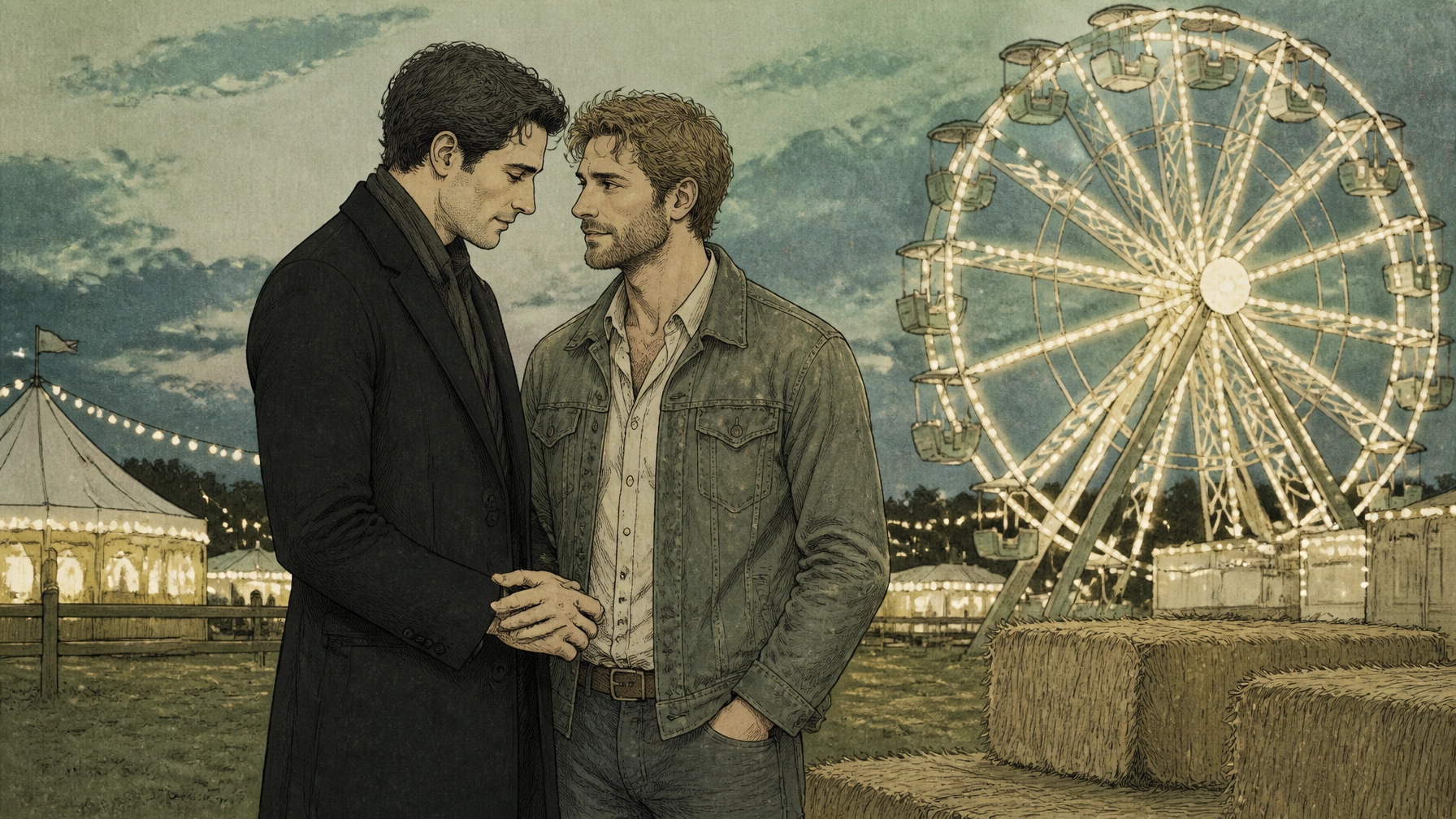
There were places Daniel understood immediately.
The city was one of them. He knew how to move through a crowd without touching anyone, how to read a restaurant by its lighting, how to recognise the difference between loneliness and privacy. He understood the language of train platforms, late-night pharmacies, apartment walls thin enough to carry a stranger’s argument from one room to another.
He did not understand the county fair.
Not at first.
The fair arrived in the small town like a temporary country of its own. For one week, the fields beyond the football ground filled with livestock barns, food stalls, hand-painted signs, rides assembled from shining metal, and strings of bulbs that looked almost fragile in the late summer dark. People came from farms, villages, and the nearest city, carrying children, paper plates, folding chairs, old arguments, and the stubborn pride of having made something worth showing.
Daniel came because Eli asked him to.
That was the first difficulty.
Eli had asked so casually that Daniel nearly missed the importance of it.
“Come on Saturday,” he had said, leaning against the counter of the hardware shop where he worked. “The lights are better after sunset.”
The lights.
Not I want you there. Not I’ve been thinking about you. Not even You should see where I come from.
Just the lights.
Daniel had learned, in the six months since meeting Eli, that rural men could hide an invitation inside a practical sentence. Eli could tell him the weather was turning and mean that he was worried. He could ask whether Daniel had eaten and mean that he had missed him. He could stand on the porch after midnight, hands in his jacket pockets, and say nothing at all while making it clear he did not want Daniel to leave.
So Daniel drove two hours inland on Saturday evening, wearing a shirt that seemed too expensive for the dust and shoes that would prove, within minutes, to be a mistake.
The city man at the edge of the midway
The first thing he noticed was the hay.
It lay everywhere: beneath the boots of farmers, caught in the seams of wooden fencing, gathered in pale drifts at the entrance to the livestock barn. It softened the hard ground and released a dry, sweet scent beneath the sharper smells of diesel, fried dough, animal warmth, and summer rain trapped inside the earth.
In the city, Daniel’s clothes carried the smell of coffee and underground stations.
Here, the evening clung to him differently.
Eli found him beside the ticket booth. He wore faded jeans and a green work shirt with the sleeves rolled to his elbows. His hair was still damp from a shower, but there was dust along one forearm. Daniel wanted, absurdly, to brush it away.
Instead, he said, “You didn’t tell me there would be this many people.”
Eli looked over the fairground. “It’s the biggest night.”
The town had gathered beneath the lights. Teenagers moved in bright groups. Older couples sat on benches with lemonade between them. A boy in a paper crown carried a stuffed animal almost as large as his body. Somewhere behind the grandstand, a loudspeaker announced the next livestock class, and a brass band attempted a song that dissolved into the mechanical roar of a ride.
Daniel felt conspicuous.
He had spent years learning how to be invisible in public. The city had given him that skill. It had taught him how to love in side streets, in locked rooms, and in the temporary privacy of someone else’s apartment. It had taught him to be alert to every stare and every pause.
But here, beneath the Ferris wheel, invisibility seemed impossible.
Eli’s hand found the small of his back.
The touch was brief. Almost careful.
Daniel looked at him.
“Stay close,” Eli said.
It was not a command. It was not a confession.
It was enough.
Where pride is pinned to a blue ribbon
They walked first through the exhibition hall, where the town had arranged its private achievements beneath fluorescent lights.
Jars of peaches and beans stood in neat rows. Quilts hung from temporary frames. There were photographs of barns in winter, paintings of horses, cakes decorated with flowers, and vegetables so perfect they seemed to have been invented for display. Each one had a ribbon attached: blue, red, white, and sometimes purple.
Daniel had never thought much about the word pride.
In the city, pride had often been something declared. It was painted on banners, printed on posters, worn across a chest in bright lettering. It was necessary, hard-won, public.
Here it was quieter.
It was in the woman who stood behind a table of preserves, explaining the difference between two kinds of jam. It was in the teenager who kept glancing towards a prize-winning goat as though willing it to perform better. It was in the old man who had polished the frame of his photograph until the glass shone.
Eli stopped beside a quilt made of small green squares.
“My grandmother made that,” he said.
Daniel turned to him. “She entered it?”
“She entered everything.”
There was laughter in his voice, but also a tenderness that made Daniel pause.
“Did she win?”
Eli looked at the quilt. “Not that year.”
The answer carried a whole history with it: the kitchen table, the careful stitching, the disappointment hidden beneath politeness, the decision to keep making things anyway.
Daniel understood that kind of courage. He had simply never seen it displayed under a ribbon.
The barn, the dark, and the things they did not say
The livestock barn was cooler than the midway. Its walls held the evening in shadow. Metal gates formed narrow pathways between cattle, sheep, and goats. Young people in clean boots moved with the focused exhaustion of those who had been awake since dawn.
Daniel tried not to look nervous.
Eli noticed anyway.
“You can hold my hand,” he said.
“I am holding your hand.”
“You’re holding two of my fingers.”
“That is strategic.”
Eli smiled, and the expression changed his entire face.
Daniel took the rest of his hand.
They moved slowly through the barn. Around them, animals shifted in their stalls. Hooves struck the floor. A fan turned somewhere overhead, pushing warm air from one corner to another. The sounds were intimate, bodily, impossible to separate from the place.
Daniel had always been afraid of being seen wanting something.
Not wanting Eli. That had happened too quickly and too completely to deny.
He was afraid of wanting a life that could not be edited down to a series of visits. Afraid of the questions that would follow. Afraid that Eli’s town would tolerate him only as a guest, an interesting interruption from elsewhere, never as someone who belonged.
Eli squeezed his hand.
“What?” Daniel asked.
“Nothing.”
“You’re looking at me.”
“I like looking at you.”
The words were simple. They landed with the force of something much larger.
Outside, the midway lights turned in the darkness. Inside, beneath the smell of hay and the low breathing of animals, Daniel allowed himself to believe that love did not always arrive as a dramatic rescue. Sometimes it was a hand offered in a crowded place. Sometimes it was an invitation disguised as a comment about better lighting.
Sometimes it was someone making room.
Glitter against the hay
They ate at a picnic table near the food stalls.
Daniel chose a paper tray of fried dough dusted with sugar. Eli stole the corner of it and pretended not to notice when Daniel laughed. The fair moved around them in waves: music, shouting, the clatter of rides, the deep mechanical groan of the Ferris wheel lifting strangers above the rooftops.
The city had taught Daniel that pleasure should be efficient. A good meal between appointments. A drink before the last train. A beautiful view photographed before it disappeared.
The fair offered no efficiency.
It was too loud, too sweet, too bright. It demanded patience. It asked people to stand in queues, lose at games, wait for rides, and keep walking when the dust settled on their shoes. It made room for embarrassment and delight in equal measure.
Eli watched him watch the crowd.
“You hate it,” he said.
“I’m considering it.”
“That’s not an answer.”
Daniel looked at him. “I don’t hate it.”
“High praise.”
“I don’t know what to do here.”
Eli’s expression softened. “You don’t have to do anything.”
The sentence opened something in Daniel.
For years, he had treated every unfamiliar place as a test. He had believed that belonging required performance: the right clothes, the right knowledge, the right ease. He had mistaken competence for safety.
But Eli did not ask him to understand the fair.
He only asked him to remain.
Later, they rode the Ferris wheel. Their carriage swung gently as it rose. Below them, the fairground became a constellation of small human things: the white roofs of stalls, the green shadows of the barns, the moving dots of people beneath the lamps. Beyond the fence, the town rested in darkness. Beyond that, open fields stretched towards the horizon.
Daniel could see both worlds from there.
The bright, crowded world he had come from.
The dark, patient world Eli had never left.
Neither looked complete on its own.
After the lights go out
The fair closed at eleven, but the night did not end immediately.
Vendors packed away their signs. The last rides slowed. A few bulbs flickered above the emptying midway. The air smelled of grass, sugar, petrol, and the faint smoke of a grill being extinguished.
Eli led Daniel to the edge of the field, where his pickup stood beneath a row of trees.
For a while, neither man spoke.
Daniel sat on the tailgate. Eli stood between his knees, close enough that their shadows joined on the dusty ground.
“I thought you’d hate it,” Eli said.
“I thought I would too.”
“That’s different.”
Daniel looked back towards the fair. In daylight, it would probably seem smaller. Less enchanted. The rides would be painted metal again. The barns would smell of work rather than mystery. The ribbons would return to being paper.
But tonight, for a few hours, the town had shown him what it valued.
Not perfection.
Participation.
The courage to bring what you had made and place it beneath a stranger’s judgement. The courage to return the following year. The courage to love a place that could not promise to understand everything about you.
Daniel reached for Eli’s hand.
“I’m coming back,” he said.
Eli studied him. “For the fair?”
Daniel shook his head.
The answer did not need decoration.
At the county fair, beneath the glitter and hay, Daniel had not discovered that the rural world was simpler than the city. It was not. It carried its own silences, its own histories, its own exclusions and wounds.
What he discovered was more difficult and more valuable: that a place could be unfamiliar without being unreachable. That love could cross the distance between polished pavement and trampled grass. That a man could arrive as an outsider and still be invited to stay.
For readers drawn to emotionally immersive MM romance, heartfelt gay fiction, and queer fiction shaped by urban and rural contrast, this is where the Evening Edition lives: in the charged space between what a character fears and what he finally permits himself to hope.
Explore more LGBTQ+ ebooks, gay novels, MM novels, and emotional gay love stories from Dick Ferguson through Read with Pride, or visit the Dick Ferguson collection for literary MM romance and LGBTQ+ fiction that gives complicated feelings room to breathe.
Follow us on social media
Follow Dick Ferguson and Read with Pride for new gay releases, LGBTQ+ reading recommendations, emotionally charged MM romance books, and stories for readers who believe love is worth examining in all its complexity.
#EveningEdition #ReadWithPride #MMRomance #GayRomance #QueerFiction #GayFiction #MMNovels #LGBTQFiction #GayLiterature #GayLoveStories #EmotionalMMBooks #HeartfeltGayFiction #GayRomanceBooks #MMRomanceBooks #LGBTQReading #GayAuthors #QueerAuthors #ReadingWithPride
Three possible next Evening Edition stories
- The Last Train Home: How a guarded city commuter meets a small-town conductor who remembers every passenger’s name.
- The Winter Market: Two men, one unfinished apology, and the quiet intimacy of choosing gifts for people they are afraid to love.
- The Lighthouse Keeper’s Son: A coastal homecoming, an old friendship, and the difficult distance between being known and being forgiven.


Leave a Reply
You must be logged in to post a comment.