

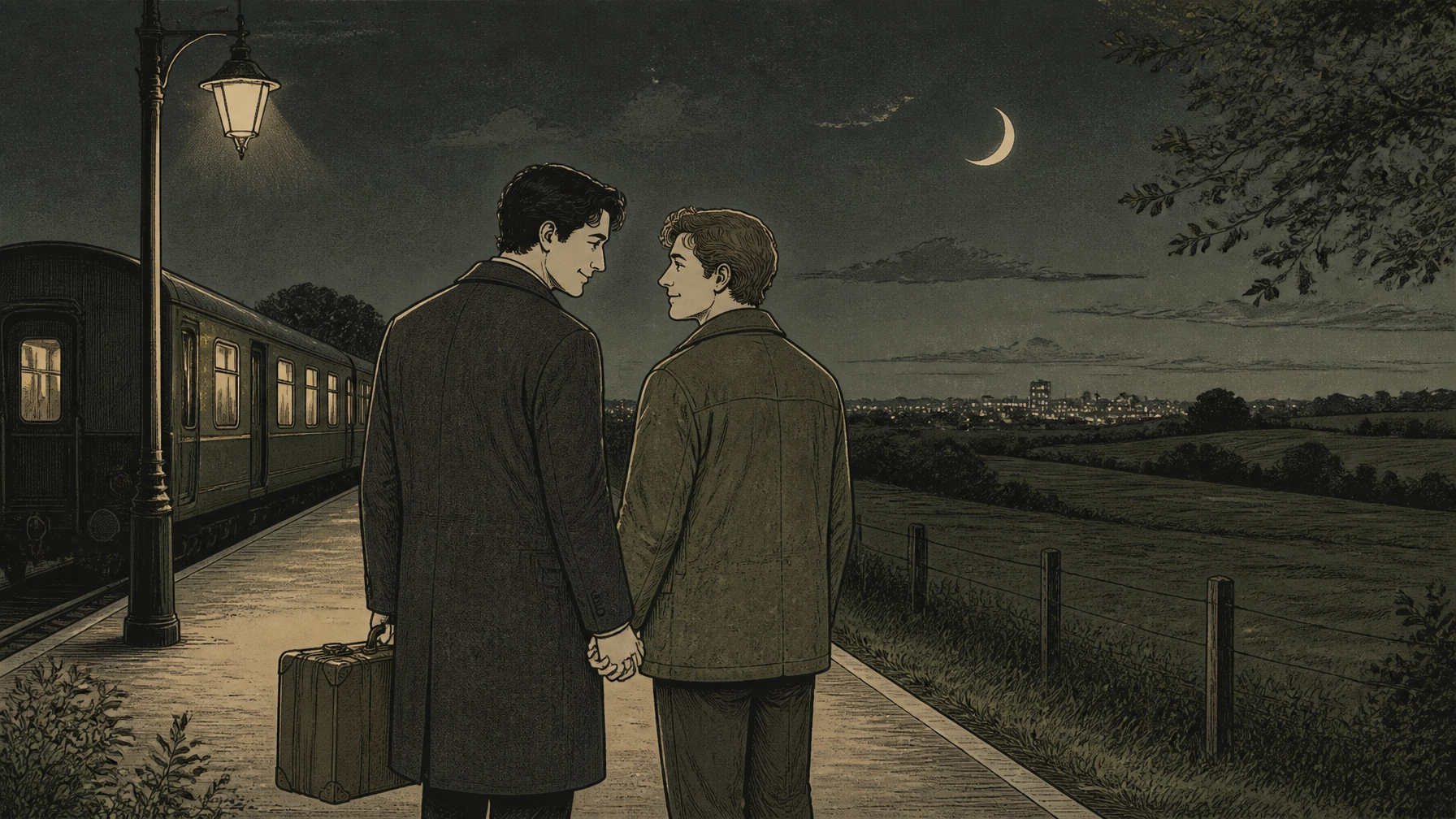
There is a particular kind of silence that belongs to railway stations after midnight.
The loudest trains have passed. The platform has emptied. The last announcements dissolve into the rafters, leaving only the hum of electric lights, the distant shudder of machinery and the soft movement of people carrying their lives from one place to another.
In The Midnight Station, that silence becomes more than atmosphere. It becomes a test.
For two men standing at the edge of a city, the journey into the countryside is not simply a change of address. It is a negotiation between two versions of the self: the man each of them has learned to be in the city and the man each hopes he might become somewhere quieter. Their transition from urban life to rural life asks a deceptively difficult question:
Can devotion survive when the distractions fall away?
A city can hide a person in plain sight
The city offers movement, noise and anonymity. It allows a person to pass through crowded streets without explaining himself. It offers familiar freedoms: late-night cafés, chosen communities, private rooms, busy pavements and the comfort of knowing that a personal history can be left several neighbourhoods away.
For one of the men, the city has become a form of armour.
He knows how to disappear into its rhythm. He understands which streets feel safe, which friendships require no explanation and which parts of himself can remain carefully separated. His life may be crowded, but it is also controlled. Every train arrives on a schedule. Every decision can be postponed by another appointment, another drink, another evening spent beneath the hard glow of office windows.
The countryside threatens that control.
There, the horizon is wider but privacy is narrower. People recognise one another. A familiar face at the shop can carry an entire family history. A couple walking side by side may become part of the local landscape before they are ready to decide what that means.
This is one of the most affecting tensions in an emotionally immersive MM romance: the difference between being unseen and being known.
The city may provide protection through invisibility. The country may offer belonging, but only after the risk of exposure.
The countryside changes the meaning of time
Urban romance often moves at the speed of interruption. Messages arrive while characters are crossing roads. Plans are made and abandoned between shifts, trains and obligations. Emotional revelations are frequently interrupted by the demands of modern life.
In the countryside, time behaves differently.
The darkness is deeper. Morning arrives gradually. Weather decides whether a journey is possible. A task that seemed small can fill an entire afternoon. The relationship is no longer measured only by dates or declarations, but by the accumulation of ordinary acts: making tea, carrying boxes, repairing a gate, remembering how the other man takes his coffee.
This slower rhythm is not automatically peaceful. In fact, it can make conflict more difficult to avoid.
When there is nowhere urgent to go, an unanswered question remains in the room. When the nearest train is hours away, leaving becomes a decision rather than an impulse. When two men share a house surrounded by fields, they must learn the difference between comfortable silence and emotional withdrawal.
That distinction sits at the heart of The Midnight Station. Quiet devotion is not the absence of conflict. It is the choice to remain present through it.
The midnight train as a relationship milestone
The train journey marks a threshold between lives.
Before it, the men can still imagine that their relationship exists in separate compartments. The city man can tell himself he is only visiting. The country man can pretend that the old patterns of waiting, retreating and protecting himself will continue to work.
But once the train leaves the station, those stories become harder to maintain.
A city-to-country transition creates powerful relationship milestones because it makes the future physical. Moving in together is no longer an abstract promise. It means deciding who brings which belongings, where the books will go, who will speak to the landlord, and whether both men are truly prepared to be visible in the same place.
It also brings more complicated questions:
- Who is giving something up?
- Who is being asked to start again?
- Is the move an act of mutual choice or a sacrifice made by one man for the other?
- What happens when the place that feels like home to one partner feels like exile to the other?
These questions give high-angst MM romance its emotional weight. The tension is not simply whether the men love each other. It is whether love can become practical without becoming possessive, and whether compromise can exist without quietly turning into resentment.
When the familiar world no longer speaks for you
One of the most moving aspects of an urban/rural romance is the way each setting challenges the couple differently.
In the city, the relationship may have been protected by speed. They could meet between obligations, find privacy in the crowd and avoid confronting the expectations attached to family or community.
In the countryside, their relationship becomes part of daily life.
A shared glance at the market. A hand placed briefly against a shoulder. Two mugs left beside the sink. A name spoken with affection in a place where both men once expected to be judged.
These details matter because public acknowledgement is not always a grand declaration. Sometimes it is the quiet refusal to behave as though love must be hidden. Sometimes it is introducing a partner without hesitation. Sometimes it is standing beside him when a conversation becomes uncomfortable, not with theatrical bravery but with the steady message: You will not face this alone.
For queer readers, these moments can carry particular emotional force. Stories about gay men and male/male relationships do not need to present acceptance as simple or universal in order to be affirming. They can acknowledge fear, hesitation and old wounds while still allowing tenderness to be real.
That balance is essential to sensitive queer fiction. The men are not symbols of an issue. They are people with habits, contradictions, private griefs and very different ideas about what it means to be safe.
Quiet devotion is built through repetition
Passion can be immediate. Devotion is repetitive.
It appears in the second question after “Are you all right?” It is the coat placed over a chair before the rain begins. It is remembering which memories should not be pressed. It is learning when to offer advice and when simply to stay.
In The Midnight Station, the countryside gives these small gestures room to become visible.
The men cannot rely on the city’s momentum to carry them forward. They have to create momentum together. Their relationship grows through shared labour and through the difficult tenderness of being witnessed in unguarded moments.
One man may be more comfortable with words. The other may speak through action. One may long for a clean break from the past; the other may understand that leaving a place does not mean leaving its influence behind.
Their devotion is tested when these differences stop being romantic contrasts and become real pressures. A future cannot be built from chemistry alone. It requires negotiation, patience and the willingness to hear an uncomfortable truth without treating it as betrayal.
That is where the relationship becomes more than a fantasy of escape. The countryside does not magically heal either man. The move does not erase the city, family history or fear. Instead, it gives them a new setting in which to practise honesty.
Home is not a landscape
The emotional destination of a city-to-country romance is rarely a particular house, village or field.
It is the realisation that home is not defined by silence, noise, architecture or distance. Home is the place where a person does not have to divide himself into acceptable portions.
For these two men, that realisation arrives gradually. It is present in the station before either of them can name it. It is there in the shared luggage, the uncertain future and the decision to board the same train.
The deepest promise is not that everything will become easy.
It is that when the city feels too loud, the countryside feels too exposed or the past returns without warning, neither man will mistake difficulty for failure. They will keep choosing the conversation. They will keep making room. They will keep returning to one another, not because love has solved every problem, but because devotion has become an action they are willing to repeat.
That is what makes The Midnight Station such a resonant Evening Edition story. Beneath the railway lamps and the fading city skyline, it understands that a relationship milestone is rarely one dramatic moment.
Sometimes it is simply two men stepping off a train together, uncertain of what waits beyond the platform, but certain that they want to face it side by side.
For readers drawn to emotionally intense MM romance, character-driven gay fiction, quiet devotion and high-angst relationship journeys, discover more stories through Read with Pride, including the Dick Ferguson e-book collection.
Three possible next Evening Edition posts
- The Last Light in the Village: When a Gay Romance Turns Returning Home into an Act of Courage
- Two Keys, One Door: The Emotional Milestones of Moving In Together in MM Romance
- Rain on the Conservatory Glass: Why Weather Can Reveal What Characters Refuse to Say
Follow us on social media
Follow Dick Ferguson and Read with Pride for more reflections on MM romance, gay love stories, LGBTQ+ fiction and emotionally immersive reading:
#MMRomance #GayRomance #QueerFiction #GayFiction #MMNovels #LGBTQFiction #GayLiterature #GayLoveStories #EmotionalMMBooks #CharacterDrivenRomance #HighAngstRomance #ReadingWithPride


Leave a Reply
You must be logged in to post a comment.