

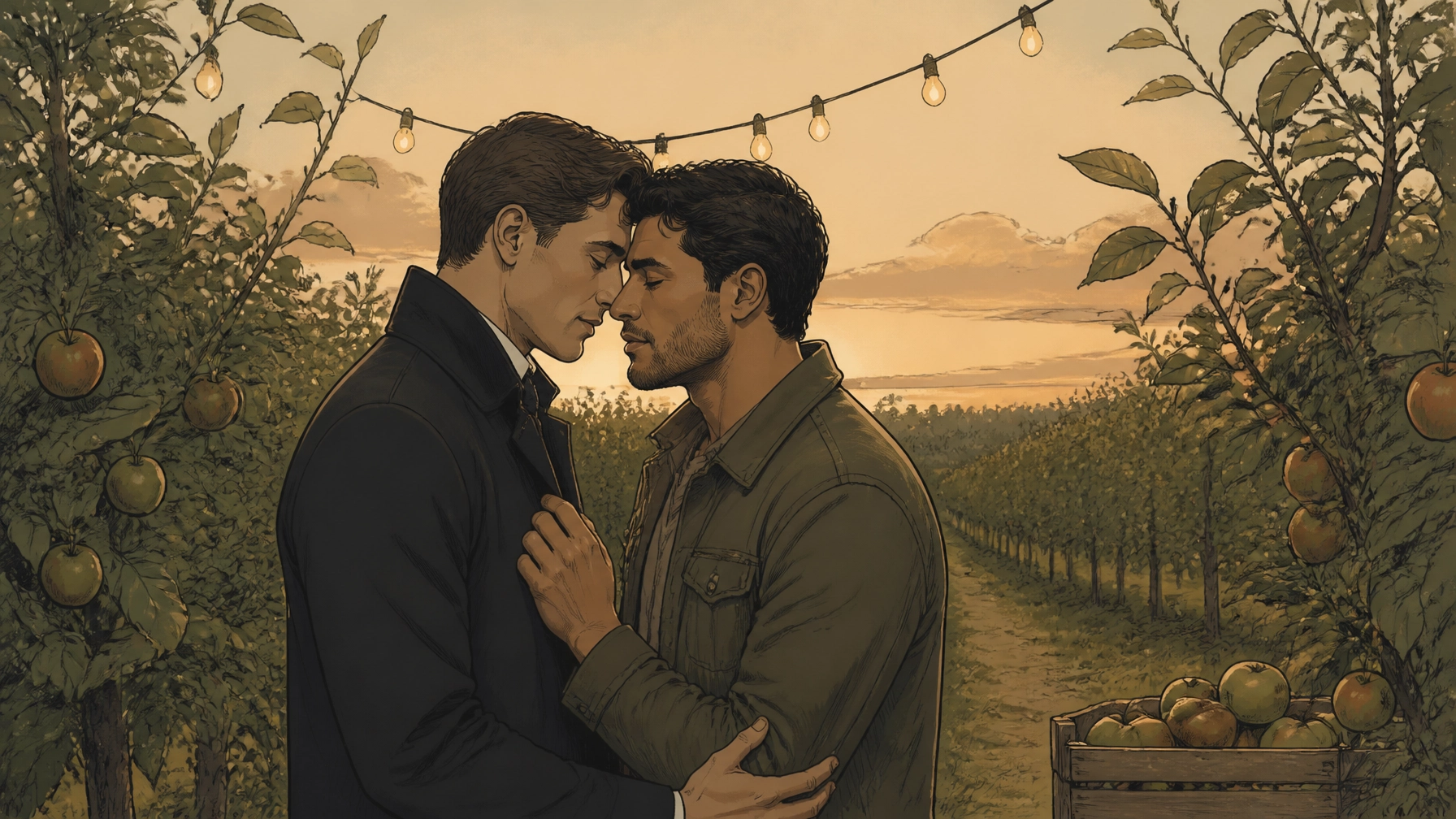
Henry arrived at the orchard with three plans, a tailored coat, and the quiet conviction that he had been invited because he might be useful.
The plans were folded inside his phone: a proposed investment for the pressing shed, a list of repairs he had noticed on the drive in, and the name of a supplier who could probably reduce the cost of replacing the festival’s old lighting system. He had not been asked for any of it.
Still, Henry had spent most of his life believing that love was something a person earned by anticipating needs before they were spoken.
Joaquin met him at the gravel entrance beneath a hand-painted sign welcoming visitors to the autumn harvest festival. He wore a faded work jacket, boots dusted with orchard soil, and an expression that made Henry feel both expected and entirely unprepared.
“You came,” Joaquin said.
“I said I would.”
Joaquin’s smile was small but warm. “That isn’t always the same thing.”
Beyond them, the orchard opened in long, orderly rows. Apples hung among the leaves like small lanterns. Hay bales marked the path toward the festival grounds, where string lights looped between wooden posts and the first notes of fiddle music rose above the murmur of the crowd.
Henry tightened his grip on his overnight bag.
He had come for a weekend in the country. He had not understood that the country would ask him to put everything down.
A City Man Measures the Orchard
In London, Henry’s days were divided into figures, forecasts, and decisions that had to justify themselves. He worked as a financial analyst, which meant he had become fluent in the language of risk. He could look at a balance sheet and tell where the strain had begun. He could find inefficiency hidden inside a column of numbers. He could make a difficult truth appear manageable if he arranged it correctly.
The orchard resisted arrangement.
It had its own timetable. Apples ripened when they were ready. Cider pressed when there was enough fruit. The festival began when the fiddler arrived and ended when the light thinned, not when a projected schedule said it should.
Joaquin led him between stalls displaying apple pies, jars of preserves, wreaths of dried leaves, and baskets overflowing with russet and crimson fruit. The air smelled of cider, woodsmoke, hay, and cold soil. Children ran between the hay bales. Neighbours called greetings across the path. Someone laughed near the cider press.
Henry noticed the warped plank beneath a stall table.
“I could have someone replace that,” he said.
Joaquin glanced at the plank. “You could.”
“It’s a safety issue.”
“It has been a safety issue for nine years.”
“That doesn’t make it less of one.”
“No,” Joaquin said. “But it does make it part of the table.”
Henry wasn’t sure what that meant. He made a note in his phone.
At the cider stall, he watched Joaquin lift a heavy crate of apples from the ground. Henry stepped forward immediately.
“I’ll take that.”
Joaquin held on. “I have it.”
“It’s heavy.”
“It is.”
“Then let me help.”
Joaquin looked at him, not irritated, not amused, simply attentive. “Henry, I know what heavy feels like.”
The words settled between them.
Henry released the crate, though every instinct in him told him not to.
The Offers He Could Not Stop Making
By midday, Henry had offered to replace the festival’s ageing card reader, hire a better accountant for the orchard, arrange a delivery contract, and look into a grant that might help modernise the pressing shed.
Each time, Joaquin thanked him.
Each time, Joaquin said no.
The refusals were gentle enough to make Henry feel foolish for being hurt by them.
“You don’t have to do everything the hard way,” Henry said eventually.
Joaquin was sitting on the low stone wall outside the cider barn, holding a paper cup between both hands. Steam rose into the cool air.
“What makes you think I’m doing it the hard way?”
“Because you’re carrying too much. Because half the equipment here is older than I am. Because you’re trying to run a festival and an orchard with systems that belong in another decade.”
Joaquin took a sip of cider. “The orchard belonged to my grandfather. Then my father. Now it belongs to me.”
“That doesn’t mean you can’t improve it.”
“I can improve it.”
Henry waited.
“I just don’t need to become someone else to do that.”
The fiddle music shifted into a slower tune. Somewhere behind them, apples tumbled into a wooden bin with a soft, uneven thud.
Henry looked across the festival grounds. He saw opportunities everywhere: gaps, waste, unnecessary labour, problems waiting for the right person to solve them.
He had not realised that he was looking at Joaquin in the same way.
What Joaquin Wanted Instead
They walked toward the far side of the orchard in the afternoon, away from the loudest part of the festival. Joaquin showed Henry the oldest trees, their branches bent and silvered with age. He pointed out where frost had damaged the blossom in spring and where the wind had broken a limb in July.
Henry asked questions. At first, they were practical ones.
How many acres?
What was the annual yield?
How much did the pressing equipment cost?
Joaquin answered patiently, then began telling him other things.
Which tree had been planted the year he was born.
Where his father used to sit during harvest season.
How the orchard sounded before dawn, when the leaves moved but the birds had not yet begun.
Henry listened.
The wind passed through the rows with a dry, whispering sound. It moved over them without asking anything. A few apples dropped somewhere out of sight.
“You’re quiet,” Joaquin said.
“I’m trying not to make a spreadsheet.”
“That must be exhausting.”
“It is.”
Joaquin laughed, and Henry felt the sound move through him more deeply than any praise he had received in a boardroom.
At the edge of the trees, Joaquin stopped.
“I don’t mind that you want to help,” he said.
Henry looked at him.
“I mind when helping becomes the only way you know how to stand beside me.”
The words were not an accusation. That made them harder to defend against.
Henry looked down at his hands. They were clean. Too clean for the orchard.
“I’m not trying to control you.”
“I know.”
“I’m trying to make things easier.”
“I know that too.”
“Then what’s the problem?”
Joaquin’s expression softened. “Sometimes you make things easier for yourself by making them belong to you.”
Henry had no answer.
After the Crowd Goes Home
By dusk, the festival had emptied.
The last visitors carried bags of apples toward their cars. The fiddle music faded into silence. Smoke from the fire pit drifted low across the grass, carrying the scent of charred wood and late autumn. String lights remained glowing above the paths, small and steady against the deepening blue.
Joaquin was stacking empty crates near the barn when Henry approached.
“I can do that,” Henry said.
Joaquin turned.
Henry stopped himself.
The pause was almost painful.
“I can stay with you while you do that,” he corrected.
Joaquin nodded. “All right.”
So Henry stayed.
He did not lift the crates. He did not suggest a more efficient arrangement. He did not take out his phone. He stood beside Joaquin in the cool evening air and watched the day gather itself into darkness.
After a while, Joaquin carried the final basket inside. When he returned, Henry was standing at the edge of the orchard, looking down the long rows.
“You all right?” Joaquin asked.
Henry nodded, though the answer was not simple.
“I think I’ve been doing something wrong for a very long time.”
Joaquin came to stand beside him. Their shoulders almost touched.
“What?”
Henry watched the wind move through the trees. The leaves turned over in the fading light, green-grey and silver.
“I’ve been treating love like a transaction.”
Joaquin said nothing.
Henry drew a breath.
“If I was useful, people would keep me. If I paid for dinner, fixed the problem, remembered the details, made the plan, then I had a reason to be wanted. I could point to what I’d done and say, There. That is why you should stay.”
The confession sounded smaller aloud than it had inside him.
“I thought if I gave enough, nobody could call me a burden.”
Joaquin turned toward him.
“Henry.”
There was no pity in his voice. Only recognition.
“I know you can give,” Joaquin said. “I know you can fix things. I know you can walk into a room and make people feel safer because you’ve already considered every possible failure.”
Henry’s throat tightened.
“But I don’t want to be managed into loving you.”
The truth of it moved through Henry like cold water.
Joaquin reached for his hand, slowly enough that Henry could have stepped away.
“I want you here,” he said. “Not your money. Not your solutions. Not the version of you that arrives with an answer before I’ve finished speaking.”
Henry looked at their hands.
“What if I have nothing to offer?”
“Then offer me the truth.”
“And if the truth is that I’m afraid?”
“Then be afraid beside me.”
The First Time He Simply Stayed
Joaquin’s hand was warm. Henry felt the roughness of his palm, the small cuts and calluses left by years of work. It was not a polished hand. It had not been made for presentations or signatures or approving figures on a screen.
It was a hand that knew the weight of a bushel basket.
Earlier, Henry had wanted to take that weight away. He had thought love meant lifting what Joaquin carried until there was nothing left for him to bear.
Now he understood that sometimes love meant trusting another man to tell you what he needed.
The orchard darkened around them. The smell of apples lingered in the grass. From the barn came the faint creak of wood settling into the night.
Henry closed his fingers around Joaquin’s.
He did not offer to buy the orchard.
He did not promise to redesign the festival.
He did not ask what he could do to deserve this moment.
He simply stayed.
Joaquin leaned his shoulder against Henry’s. The contact was quiet, almost ordinary. That was what made it precious.
In the city, Henry had believed love announced itself through certainty: the signed agreement, the completed plan, the problem resolved before it could become a crisis.
In the orchard, beneath the last glow of the harvest festival, love was less dramatic and more demanding.
It asked him to remain present when he could not improve anything.
It asked him to be known without presenting evidence.
It asked him to believe that his worth did not begin at the point where his usefulness became visible.
The wind moved through the rows.
Henry listened.
For once, he did not try to make it stop.
Read with Pride: Stories Where Love Is Earned by Being Seen
The most moving MM romance stories are not always about grand declarations. Sometimes they are about the quiet dismantling of the beliefs that kept two men apart.
Henry and Joaquin’s evening in the orchard is a reminder that emotional MM books can explore more than attraction. They can ask what happens when a man who has survived by being indispensable finally allows himself to be wanted as he is.
For readers drawn to heartfelt gay fiction, character-driven MM romance, emotionally immersive gay love stories, and queer fiction with high-angst emotional journeys, discover more stories through Read with Pride. You can also explore Dick Ferguson’s work in the Dick Ferguson e-book store.
Because sometimes the most courageous romantic gesture is not giving more.
It is staying.
Three Possible Next Evening Edition Topics
- The Lighthouse Keeper’s Spare Room : How Two Men Learned That Trust Can Begin with a Door Left Unlocked
- The Last Table at the Winter Bookshop : When a Perfectly Planned Goodbye Became a Reason to Stay
- The River Road in November : How a Broken-Down Car Gave Two Men Time to Tell the Truth
Follow us on social media
Follow Dick Ferguson for more lyrical MM romance, gay novels, LGBTQ+ fiction, emotional love stories, and updates from the world of Read with Pride:
#MMRomance #GayRomance #MMBooks #QueerFiction #GayFiction #GayNovels #GayLoveStories #MMNovels #LGBTQFiction #GayLiterature #MMFiction #EmotionalMMBooks #HeartfeltGayFiction #GayRomanceBooks #MMRomanceBooks #LGBTQRomance #GayBookRecommendations #LGBTQReading #ReadingWithPride #ReadWithPride


Leave a Reply
You must be logged in to post a comment.