

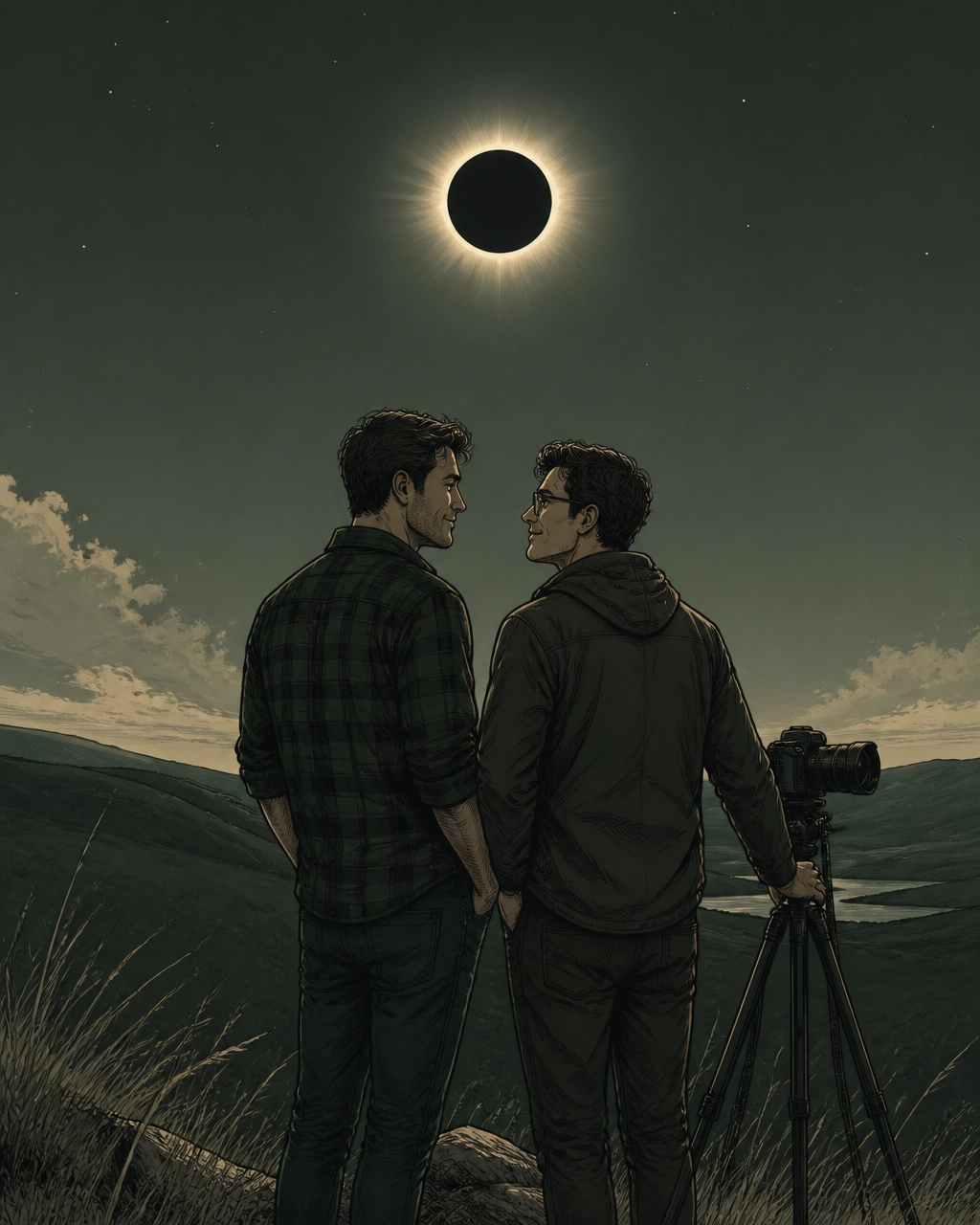
There were already hundreds of people on the hill when Elias arrived, but he felt alone among them.
Cars had lined the narrow road below. Blankets covered the grass. Children chased one another between folding chairs while adults checked watches, cameras and weather apps. Everyone had come to see the same rare event: the Moon passing exactly between Earth and the Sun, turning afternoon into twilight.
Elias had told his mother he was going because the eclipse would not happen again in their town for decades.
That was true.
It was not the whole truth.
The whole truth was that he had spent most of his life waiting for a moment when the world might become dark enough for him to stop pretending.
He carried his eclipse glasses in the pocket of his jacket. His hands were already damp. The morning had begun warm, but a cool wind was moving across the hill, lifting the grass in silver-green waves. He stood near the edge of the crowd and watched the town spread below him: the church steeple, the petrol station, the row of houses where everyone knew everyone else’s business.
Especially his.
Or so he had always feared.
At thirty-four, Elias had mastered the art of being unremarkable. He knew how to answer questions about women without offering too much detail. He knew how to laugh when someone made a careless joke. He knew how to keep his phone face down and his heart further down still.
He also knew that fear could become a kind of furniture. You lived around it long enough, and eventually you stopped noticing how much space it took up.
“Are you here for the eclipse,” a voice asked, “or are you planning to escape through that hedgerow?”
Elias turned.
The man standing behind him was tall, dark-haired and carrying a camera bag over one shoulder. A tripod rested against his leg. He had the weathered, slightly distracted appearance of someone who spent more time looking at the sky than at clocks.
“Is it that obvious?” Elias asked.
“You’ve been staring at the hedge for three minutes.”
“I was admiring it.”
“It’s a very good hedge.”
The man smiled. It was not the bright, effortless smile Elias distrusted in other people. It was smaller than that. Careful. As though it had been earned.
“I’m Jonah,” he said.
“Elias.”
Jonah glanced at the eclipse glasses in Elias’s hand. “First one?”
“First total eclipse.”
“Mine too.”
“You’re carrying a professional-looking amount of equipment for a first.”
“I’m an astronomer.”
Elias looked at the camera. “So you’re here to take a picture.”
“I’m here to try,” Jonah said. “There’s a difference.”
That answer stayed with Elias.
The crowd shifted as the first partial phase began. Sunlight weakened by degrees, though the afternoon remained bright. Through the glasses, the Sun looked like a small golden coin with a bite taken from its edge.
Jonah explained the stages without sounding as though he was giving a lecture. The Moon would continue its slow passage. Shadows might sharpen. The temperature would fall. Near totality, the light would become strange, not simply dimmer, but altered.
“People think an eclipse is about the darkness,” Jonah said. “It isn’t exactly.”
“What is it about?”
“Alignment, mostly.”
Elias laughed softly. “That sounds like an astronomer’s way of avoiding a sentimental answer.”
“I’m an astronomer and a photographer. I’m allowed one sentimental answer per eclipse.”
“And what’s the answer?”
Jonah adjusted the focus on his camera. “The light has to be blocked before you can see what was there all along.”
The words landed too close to home.
Elias looked back towards the town. From the hill, it seemed peaceful. Small enough to hold in one hand. He could name the houses where he had grown up, the streets where he had learned to ride a bicycle, the pub where he had once kissed a boy and then spent six years avoiding him.
That kiss had not been dramatic. There had been no music, no rain, no sudden revelation. Just the taste of cheap cider and the trembling certainty that Elias had been waiting for something he did not yet have language for.
Afterward, he had treated the memory like evidence from a crime scene.
“Are you from around here?” Jonah asked.
“Born here.”
“Then you must know the best places to watch the sky.”
“I know the best places to watch people.”
Jonah looked at him.
Elias felt the familiar urge to take the sentence back, to turn it into a joke. Instead, he let it stand.
“People are easier,” he said. “They don’t move as far away.”
Something changed in Jonah’s face. Recognition, perhaps. Not pity. Elias could bear almost anything better than pity.
The eclipse deepened.
Across the hill, conversations became quieter. Birds moved through the hedges and disappeared. A coolness touched Elias’s arms. The air smelled of dry grass, warm earth and the faint mineral scent that comes before rain.
Everyone began looking up.
For once, Elias was not the only person afraid of being seen.
The last minutes before totality arrived with astonishing speed. The world seemed to draw in on itself. The edges of shadows became unnaturally crisp. A long, dark band moved across the distant fields, racing towards them.
Jonah lifted his camera.
“You’ll want to take off the glasses only when the Sun is completely covered,” he said. “And put them back on the instant totality ends.”
Elias nodded, though his attention was no longer on the equipment.
Jonah’s hands were shaking.
“You’re nervous,” Elias said.
“Terrified.”
“Of missing the photograph?”
Jonah lowered the camera. Around them, the hill had fallen almost silent.
“Of being here,” he said. “I’ve photographed eclipses from observatories, rooftops, deserts. Places where I could hide behind my work. This is the first time I’ve brought someone.”
“Someone important?”
Jonah looked at him then, fully.
“My brother,” he said. “He died last year. He was the one who taught me to look up.”
Elias’s chest tightened.
Jonah continued, “I kept thinking that if I took the perfect picture, I’d prove I was coping. That I could turn grief into something beautiful and controlled.”
“And can you?”
“No.”
The answer was so plain that Elias felt his own defences loosen.
The light collapsed.
For a breath, the Sun became a diamond ring. Then the last bright bead vanished, and the day turned inside out.
The crowd gasped, not as one sound, but as hundreds of separate astonishments joining together. The sky was a deep, bruised blue. Around the black Moon burned the corona, delicate and white, streaming into space like light caught in motion.
Stars appeared.
Not the whole night sky. Only the brightest ones, suddenly visible where daylight had hidden them. A planet shone above the western horizon. Around the hill, the world ended in a ring of sunset: orange at one edge, violet at another, gold everywhere else.
Elias took off his glasses.
For the first time in years, he looked directly at something he had been taught to fear.
Beside him, Jonah had lowered his camera.
“You’re not photographing it,” Elias whispered.
“I am.”
“You’re not looking through the camera.”
Jonah’s hand found his.
The contact was light, almost uncertain. Elias could have moved away. Jonah would have let him. That was the unbearable kindness of it.
Instead, Elias closed his fingers around Jonah’s.
“I’ve spent my whole life thinking that if people saw me properly, I’d lose everything,” he said.
The eclipse made the words possible. The darkness held them without judgement.
Jonah’s thumb moved once across his knuckles. “Maybe being seen isn’t the same as being exposed.”
Elias looked at him.
Jonah’s face was illuminated by the strange silver light. Without the usual distractions, the crowds, the cameras, the busy brightness of the day, there was nowhere for either of them to hide.
“I’m bisexual,” Elias said.
The sentence did not echo. Nothing in the world broke open. The hill remained beneath his feet. The town remained below. Somewhere, a child laughed in the darkness.
But Jonah did not look away.
“I know,” he said.
Elias’s breath caught.
“Not because you told me,” Jonah added. “Because you look at men like you’re apologising for wanting to.”
The honesty should have frightened him. Instead, it felt like a door opening.
Jonah turned towards him. “I’m gay,” he said. “And I’ve spent years making myself invisible in a different way.”
“How?”
“By becoming useful. By knowing the names of stars. By standing behind cameras. By convincing myself that observation was safer than participation.”
The Moon covered the Sun. The stars showed themselves.
Elias thought about all the things the daylight hid, not because they were weak, but because brightness could be overwhelming. Some truths needed shadow. Some people needed the world to stop demanding an explanation long enough to understand what they already knew.
The total eclipse lasted only a few minutes.
It was enough.
When the first bead of sunlight returned, the crowd cried out again. Jonah slipped the eclipse glasses into Elias’s hand.
“Now,” he said.
Elias put them on. Jonah did the same.
The world brightened quickly, but it did not return to how it had been. The grass was still grass. The road was still the road. The town was still full of people who might misunderstand him.
Yet something had shifted.
Elias had been looked at and had survived it.
More than survived. He had been recognised.
Jonah packed away the camera without checking the photograph. They walked down the hill together, their shoulders brushing. At the bottom, the road divided: one direction towards the town, the other towards the station.
“Can I see you again?” Jonah asked.
Elias watched the late sunlight move over his face.
“Yes,” he said. Then, because courage was not a single grand act but a series of smaller choices, he added, “Somewhere people can see us.”
Jonah smiled.
The photograph, when it developed later, was not perfect. The corona blurred at the edges. One of the stars was almost lost. The horizon was uneven.
Jonah kept it anyway.
Not because it captured the eclipse exactly, but because it captured the moment two men stopped treating visibility as a threat.
A total solar eclipse is a rare experience. For a few minutes, the Moon covers the Sun, daylight dims, the corona emerges and bright stars become visible in the middle of the day. Before and after totality, proper eclipse glasses are essential; during totality, when the bright solar disk is completely covered, observers may look directly at the eclipse.
But for Elias and Jonah, the science was only the beginning.
The darkness did not erase the world. It revealed what ordinary daylight had made difficult to see.
Sometimes love begins there: not in certainty, and not in perfect light, but in the brave decision to let another man look at you without turning away.
Read with Pride: LGBTQ+ Stories with Emotional Depth
For readers seeking heartfelt gay fiction, emotionally charged MM romance books and queer fiction that explores identity with sensitivity, Dick Ferguson’s work offers immersive gay love stories shaped by vulnerability, longing and resilience.
Explore Dick Ferguson’s books at Read with Pride and discover character-driven LGBTQ+ ebooks, gay novels and emotional MM books for readers who want more than a simple love story.
You can also visit Read with Pride for LGBTQ+ fiction, gay literature, M/M books, queer authors and new gay releases.
Follow us on social media
Follow us on social media for new stories, literary reflections and updates from Dick Ferguson:
#MorningEdition #MMRomance #GayRomance #QueerFiction #GayFiction #GayLoveStories #MMNovels #LGBTQFiction #GayLiterature #MMFiction #EmotionalMMBooks #HeartfeltGayFiction #LGBTQRomance #ReadingWithPride #ReadWithPride #GayAuthors #QueerAuthors
Three possible next Morning Edition stories
-
Morning Edition: The Last Train Home : Two men meet on an almost-empty railway platform after midnight, each carrying a secret they are finally ready to leave behind.
-
Morning Edition: The Lighthouse Keeper’s Winter : A guarded historian and a lighthouse keeper discover that isolation can protect the heart, but it cannot teach it how to love.
-
Morning Edition: The Photograph in the Attic : Two men searching through an old family house uncover a forgotten image that changes what one of them believes about his past: and his future.
Images


Leave a Reply
You must be logged in to post a comment.