

Evening Edition: The First “We” : When Two Men Discover That the Smallest Word Can Hold a Whole Love
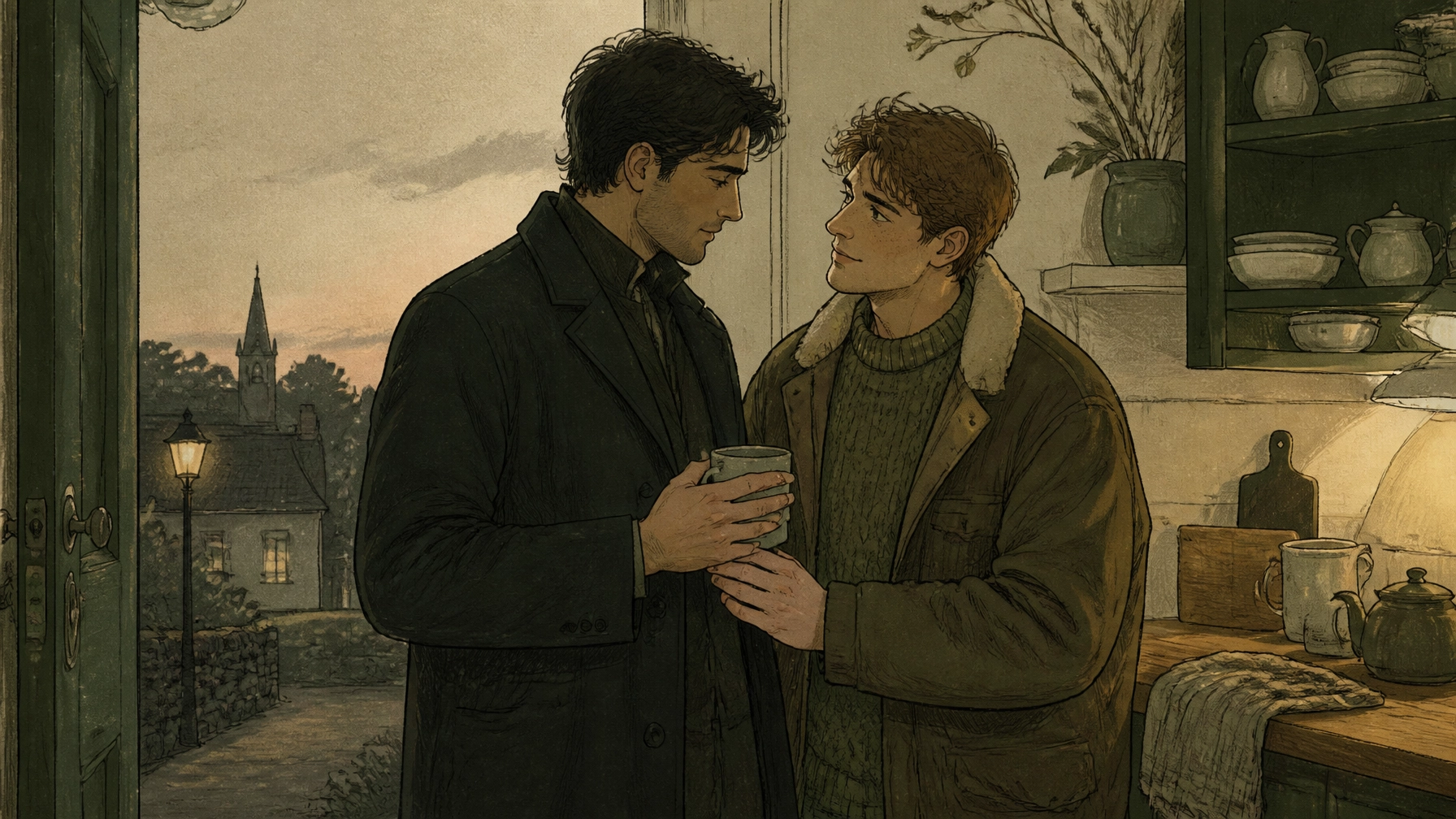
The first “we” rarely arrives with ceremony.
There is no music beneath it. No table covered in candles. No carefully chosen moment in which one man takes the other’s hand and says, This is what we are now.
Often, it slips out while one of them is tired.
It appears in the middle of a conversation about groceries, a journey, a difficult relative, or the weather. It may be spoken to a friend over the telephone, offered to a stranger at a counter, or murmured in the dark while two men are deciding whether to leave the light on.
“We could go tomorrow.”
“We don’t have to explain ourselves.”
“We’ve already been there.”
The word arrives quietly. Then both men hear it.
For a second, the room changes.
Before “we,” there is only “I”
Consider two men who have learned to live in different kinds of solitude.
Daniel comes from the city. He knows the language of movement: trains arriving beneath enormous clocks, taxis sliding through wet streets, the constant negotiation of crowded pavements. He has made a life out of self-containment. He is good at leaving before anyone can ask him to stay. His independence looks impressive from the outside, but inside it is built from old fears: the fear of needing too much, of being known too clearly, of discovering that love can become another name for loss.
Thomas is rooted in a small town where people remember what you were like at seventeen. He knows which road floods after heavy rain and which shopkeeper keeps the good bread behind the counter. His history is not hidden so much as woven into the landscape. Every corner contains a story, and every story has a witness.
He has learned a different kind of caution. In a small town, belonging can feel like shelter. It can also feel like scrutiny.
When Daniel and Thomas meet, neither man is looking for a shared life.
Daniel tells himself he is only visiting. Thomas insists he is only showing him around. Their first walks are full of almost-confessions and harmless questions. They talk about books, work, the city, the town, and all the ways each place has failed to become home.
They do not say what they want.
They say, “I’m fine.”
They say, “I’m not staying long.”
They say, “It’s complicated.”
The early stages of love are often built from such phrases. Each man protects the outline of his former life. Each man keeps the door open behind him.
“I” is safe. “I” asks nothing of anyone else.
The word that gives them away
The first “we” might happen in the least romantic place imaginable.
Perhaps Daniel and Thomas are standing in the narrow aisle of a village shop. Thomas is comparing two jars of coffee. Daniel is holding a basket and pretending not to be charmed by the seriousness with which Thomas approaches this decision.
A neighbour sees them.
“Are you two staying for the weekend?”
Daniel opens his mouth to answer. He is about to say, “I’m leaving Sunday.”
Instead, he hears himself say, “We might stay another night.”
There it is.
Not I. Not he and I. Not the careful, explanatory language of men who are still trying to define the edges of their connection.
We.
The neighbour nods, accepting the word without question. She turns back to the shelves.
But Daniel cannot.
He feels the syllable settle somewhere beneath his ribs. It is so small that it should not be able to frighten him. Yet it carries the weight of the spare key in his coat pocket, the toothbrush Thomas has left beside his own, the photographs they have not yet taken, and the possibility of a future neither man has dared to name.
Thomas notices the change in Daniel’s face.
“What?” he asks.
“Nothing.”
But it is not nothing.
It is the first time Daniel has placed their relationship inside a sentence without needing to defend it. It is the first time Thomas has heard him make room for tomorrow.
“We” is not the end of individuality
The beauty of “we” is not that it erases “I.”
A healthy shared life does not require two men to become indistinguishable. Daniel remains a man who loves crowded museums, late trains, and the restless energy of the city. Thomas remains a man who prefers the quiet before sunrise, familiar roads, and the comfort of knowing exactly where the spare batteries are kept.
Their differences do not disappear when they fall in love. They become part of the conversation.
“We” is not a locked room.
It is a doorway.
It means Daniel can say, “I need the city this week,” without fearing that he has abandoned Thomas. It means Thomas can say, “I want to stay here,” without making Daniel feel trapped. The word becomes meaningful because both men are still present inside it.
This matters particularly in queer relationships, where love may have had to survive years of uncertainty before it could be spoken plainly. For some men, especially those who have spent a long time separating private truth from public language, saying “we” can feel more exposed than saying “I love you.”
“I love you” describes an emotion.
“We” suggests a life.
It implies shared decisions, shared consequences, and the terrifying possibility that another person’s happiness has become inseparable from your own.
The ordinary things become evidence
After the first “we,” the word begins to appear everywhere.
Not dramatically. Not all at once.
It appears when Thomas texts Daniel to ask whether we need milk. It appears when Daniel tells a colleague that we are thinking about moving some of his books into the spare room. It appears when they argue about paint colours, travel plans, family expectations, and whether a broken boiler is making that sound on purpose.
The smallest domestic details become evidence of emotional transformation.
Two mugs drying beside the sink.
A coat left on the back of a chair.
A favourite meal remembered without asking.
A calendar with both men’s appointments written in the same square.
This is where character-driven gay fiction often finds its deepest emotional truth: not in grand declarations, but in the quiet accumulation of choices. A gay love story becomes convincing when affection has consequences in the everyday world. When a man who has always made plans alone begins to check the train times for two. When a man who has always belonged to one place begins to imagine another place as home because someone he loves is there.
The relationship does not become less passionate because it becomes ordinary.
It becomes more vulnerable.
Why the first “we” can feel terrifying
The word can also awaken old grief.
Daniel may remember every time he trusted someone and was left to rebuild himself. Thomas may remember how often his desires were treated as temporary, embarrassing, or impossible. Both men know that language can promise more than people are able to give.
So when “we” enters the room, it brings hope with it. It also brings risk.
What happens if one of them changes his mind?
What happens if the city calls Daniel back?
What happens if the town never fully accepts Thomas’s happiness?
What happens if love is not enough to resolve every difference between them?
These questions do not make the relationship weaker. They make it human.
The first “we” is not a guarantee. It is an act of courage performed without certainty. It says: I know I am still myself, but I am willing to let my life touch yours. I am willing to make plans that include the possibility of you.
For two men who have spent years protecting themselves, this can be the most intimate promise of all.
A shared life announces itself softly
Perhaps, months later, Daniel and Thomas are walking home through the small town at dusk.
The streets are damp. A bakery has closed for the night, leaving the air faintly scented with sugar and yeast. Somewhere behind a fence, a dog barks once and then settles. Thomas reaches for Daniel’s hand, not because anyone is watching, but because he has stopped measuring the world before offering affection.
Daniel looks towards the darkened shopfronts.
“I used to think I’d never live somewhere this quiet,” he says.
Thomas smiles. “You still complain about it.”
“I do.”
“You complain beautifully.”
Daniel laughs. Then he looks at the house waiting for them at the end of the road. The house is not perfect. The roof needs attention. The hallway is too narrow. Thomas’s books have taken over one room, while Daniel’s city maps are still rolled beneath the stairs.
It is not a finished life.
It is a life being made.
“We’ll sort it out,” Daniel says.
Thomas hears the word. This time, neither of them flinches.
They keep walking.
That is the secret of the first “we”: it does not announce that two men have become one person. It announces that two separate lives have begun to move in the same direction, carrying their histories, fears, habits, and hopes with them.
A single word can hold a whole love because love is not only found in the moments that overwhelm us.
Sometimes it is found in the language we use when we have stopped imagining the future alone.
For readers who love emotional MM fiction
If you are drawn to heartfelt gay fiction, emotionally complex MM romance, and queer novels where love is shaped by history as much as desire, the first “we” is a milestone worth lingering over.
It is the moment a relationship becomes audible.
For more LGBTQ+ fiction, gay literature, gay romance books, and character-driven stories about men finding connection in difficult, beautiful circumstances, explore Read with Pride and discover Dick Ferguson’s e-books.
If this reflection spoke to your own experience of love, belonging, or shared identity, follow us on social media:
#MMRomance #GayRomance #QueerFiction #LGBTQFiction #GayNovels #MMFiction #GayLoveStories #EmotionalMMBooks #HeartfeltGayFiction #CharacterDrivenFiction #GayLiterature #ReadingWithPride #ReadWithPride #GayAuthors #QueerAuthors


Three possible next blog post options
- The First Time He Stays Until Morning: Why Remaining Can Be More Intimate Than Saying “I Love You”
- The Spare Key: When Trust Becomes Something You Can Carry in Your Pocket
- The Family Introduction: Two Men, One Name, and the Courage to Be Seen Together

Leave a Reply
You must be logged in to post a comment.