

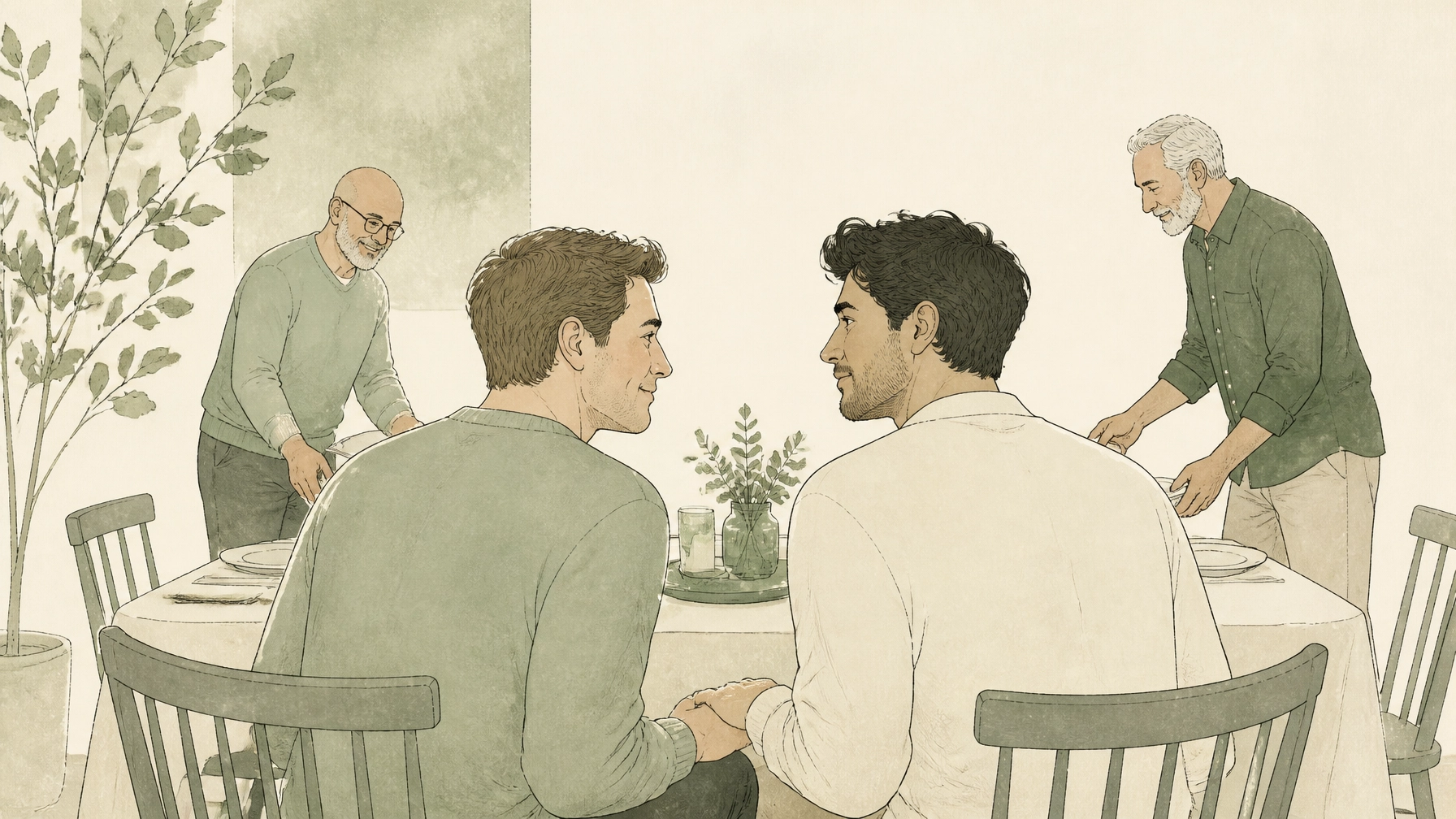
There are introductions, and then there is the introduction.
“This is my boyfriend.”
You may have said the words before. You may even have said them proudly, casually, in a café or to a friend who already knew. But saying them while your parents are standing in the doorway, or reaching for their coats, or asking whether anyone wants tea? That can make a perfectly ordinary sentence feel like it is carrying your entire life.
This is the next instalment in our Queer Life and Identity 2 PM series, following “The First Time I Said ‘My Boyfriend’ Out Loud : Small Words, Huge Courage.” That first declaration may have happened in a single breath. Meeting your parents is what happens when the breath has to continue.
It is hope and fear tangled together. It is wanting the man you love to be welcomed, while wondering whether your family has learned how to welcome all of you.
The nerves begin long before the doorbell
The first time your boyfriend meets your parents, the anxiety rarely begins when he arrives. It may start days earlier.
You think about where everyone will sit. You imagine the questions your parents might ask. You try to predict whether your father will be warm, awkward, or suddenly fascinated by the weather. You wonder if your mother will hug him. You wonder if either of them will say “partner” or avoid naming the relationship at all.
Your boyfriend may have his own private fears. Will they like him? Will they understand what he means to you? Will he accidentally say the wrong thing? Will he be expected to represent every gay man your parents have ever seen on television?
And then there is your fear: the fear that the people who raised you will look at the person who makes you feel most like yourself and see a problem instead of a future.
That is why this moment matters so much in a gay love story emotional journey. It is not simply a social visit. It is the collision of different parts of a person’s life: childhood and adulthood, family history and chosen future, the self you once protected and the self you are finally allowing to be seen.

Making room at the table means more than adding a chair
Sometimes acceptance arrives dramatically. A parent says, “We love you,” and reaches for your hand. Someone apologises. A door opens, and the family crosses through it together.
More often, acceptance appears in smaller forms.
A parent asks what your boyfriend would like to eat. Someone remembers that he takes sugar in his tea. An extra chair is brought in without anyone making a performance of it. Your father asks him about his work, not as an interrogation, but as an invitation.
There is a particular tenderness in a parent making room at the table.
The chair is literal, of course. But it is also symbolic. It says: You are not being kept at the edge of this family. There is space for you here.
For queer people, especially those who have spent years editing themselves for other people’s comfort, that space can feel enormous. It may be the first time your relationship is not merely tolerated in private but acknowledged in the ordinary rhythm of family life.
Not every family makes room immediately. Some need time. Some respond with clumsy questions or a silence that feels louder than shouting. Some parents grow slowly, learning new language and new habits one awkward conversation at a time.
The important question is not whether the first meeting is perfect. It is whether the family is willing to grow.
The awkward moments become family lore
The first meeting may include a long silence. Someone may ask a wildly personal question. Your boyfriend may knock over a glass. Your father may tell the same story twice. You may introduce your boyfriend by an ex-partner’s name, then briefly consider moving to another country.
These moments can feel catastrophic when they happen. Later, they may become family lore.
“That was the night you spilled gravy across the table.”
“Remember when Dad thought your boyfriend was called Daniel for six months?”
“Remember how nobody knew what to say, so we all discussed the neighbour’s new fence?”
There is something quietly powerful about these stories becoming part of the family’s shared history. The awkwardness no longer marks the relationship as unusual. It becomes one of the details of how everyone learned each other.
For emotionally invested MM readers, these are the scenes that often stay with us. Not because they are polished, but because they feel true. A meaningful relationship is not built entirely from perfect speeches. It is built through embarrassing moments, second attempts, small acts of patience, and the decision to come back to the table.
That is the heart of character-driven queer fiction. The emotional stakes live inside the details.
When bisexuality is part of the conversation
For a bisexual man introducing his boyfriend to his parents, the moment can carry another layer of uncertainty.
Perhaps he has already come out as bisexual. Perhaps he has not. Perhaps his family knows but does not quite believe him. There may be an unspoken assumption that being with a man means he is now gay, or that being with a man is proof that his bisexuality was only a phase.
Those assumptions can hurt deeply.
A relationship does not erase an identity. Being in love with a man does not make a bisexual man’s past attraction disappear, and it does not dictate what label he must use in the future. His boyfriend is not evidence in an argument. He is a person he loves.
Sometimes the fear is not only, Will my parents accept my boyfriend? It is also, Will they accept the whole truth of me?
That truth may be complicated. It may not fit neatly into the categories other people find convenient. A parent who makes room at the table is not required to understand everything in one evening, but they are asked to listen without reducing their son to a phase, a confusion, or a relationship status.
The same tenderness applies within the couple. A loving boyfriend does not demand a simplified identity in exchange for security. He understands that being chosen does not mean every other part of a person has vanished.
Biological family, chosen family, and the people who stay
Not everyone can bring a boyfriend home safely. Not everyone has parents who are ready to meet them with kindness. Some people have lost biological family members through rejection, distance, or years of being made to feel conditional.
That is where chosen family becomes essential.
Chosen family can be the friends who help you rehearse what you want to say. It can be the couple who lets you spend holidays with them. It can be the queer colleague who sends a message before the meeting and waits for your update afterwards. It can be the boyfriend who sits beside you in the car and reminds you that you do not have to earn the right to be loved.
Biological family and chosen family do not have to compete. Sometimes they overlap beautifully. Sometimes chosen family offers the first safe table, and biological family learns: slowly, imperfectly: how to join it.
The first meeting with parents is not a test your boyfriend must pass. It is a test of the whole family’s willingness to recognise that you have grown into a life they did not design for you.
The question is not, “Is he good enough for our son?”
It is also, “Are we willing to know our son as he truly is?”
Why this milestone belongs in emotional MM romance
In emotional MM romance literary stories, meeting the parents works because it turns private love into visible consequence.
Two men may have survived secrecy, distance, grief, jealousy, or the fear of being known. They may have found each other in MM romance unexpected places: a train station, a hospital corridor, a remote holiday, a dangerous investigation, or a kitchen where one of them finally stops pretending he is fine.
But the family table asks a different question: what happens when love enters the everyday?
This is where a relationship encounters history. Old wounds surface. One man may become defensive. The other may mistake awkwardness for rejection. A parent may surprise everyone by trying. Someone may fail, then apologise.
That complexity is precisely why the scene resonates with emotionally invested MM readers. We are not only watching two men fall in love. We are watching them negotiate belonging, identity, memory, and the possibility of a shared future.
A chair pulled out at the table can hold an entire world.
If you love heartfelt gay fiction, gay novels shaped by internal struggle, and emotionally rich MM romance books, explore the Read with Pride community and discover Dick Ferguson’s LGBTQ+ ebooks and gay romance books.
Follow us on social media
Follow Dick Ferguson and Read with Pride for more queer life reflections, LGBTQ+ fiction, gay love stories, and emotional MM romance:
#QueerLifeAndIdentity #MMRomance #GayRomance #Bisexuality #QueerFiction #GayFiction #LGBTQBooks #CharacterDrivenFiction #EmotionalMMRomance #ChosenFamily #ReadingWithPride #ReadWithPride
Three suggested next topics in the series
- Queer Life and Identity: The First Family Photograph : Being Seen, Remembered, and No Longer Edited Out
- Queer Life and Identity: When Your Boyfriend Becomes Your Emergency Contact : Trust, Fear, and the Language of Commitment
- Queer Life and Identity: The Holiday Visit : Navigating Tradition, Chosen Family, and Love Under One Roof
Supporting images


Leave a Reply
You must be logged in to post a comment.