

A short opening
The city had taught Daniel to keep moving.
There was always another train to catch, another message to answer, another bright window reflected in another bright window. Even his loneliness arrived with notifications. It vibrated in his palm, glowed across the dark of his bedroom, and disguised itself as urgency.
Then a work assignment sent him beyond the last reliable road, to a remote farmhouse where the signal disappeared somewhere between the village and the fields.
That was where Daniel met Owen.
And that was where quiet began asking questions.
The city that never let him hear himself
Daniel had become very good at being available.
At work, he answered emails before anyone had time to wonder whether he would. He accepted invitations he did not want, stayed late in offices washed with artificial light, and carried his phone from room to room as if it were a second pulse.
His friends called him spontaneous. His colleagues called him dependable. Men he dated called him difficult to read.
Daniel accepted all three descriptions because none of them required him to explain the truth.
The truth was that he was frightened of being known too closely.
Not because he was ashamed of being bisexual. He had spent years learning that his queerness was not a flaw to solve or a confession to make in the dark. It was part of him: complicated, ordinary, tender, sometimes joyful, sometimes difficult to name in a world that still preferred its categories neat.
What frightened him was intimacy itself.
He feared the moment another man might look past the polished surface: the quick wit, the expensive trainers, the effortless confidence: and find someone uncertain beneath it. Someone who wanted to be loved without having to perform for it.
So Daniel kept moving.
Motion was easier than honesty. Noise was easier than memory.
The farmhouse at the edge of the map
The assignment was meant to last four days.
Daniel’s company was preparing a report on rural housing and agricultural infrastructure. He had expected uncomfortable travel, weak coffee, and a few hours of interviews with people who would politely tolerate his city questions.
He had not expected Owen.
Owen ran the farm with his older brother, though the brother was away for the week. He was broad-shouldered without being imposing, weathered without looking old, and moved with the deliberate economy of someone who had learned not to waste energy.
When Daniel arrived, rain was coming sideways across the yard.
“You’re early,” Owen said.
“I’m seven minutes late.”
Owen looked at the muddy track behind him.
“Then you’re early for tomorrow.”
It was the first thing anyone had said to Daniel in weeks that did not ask him to hurry.
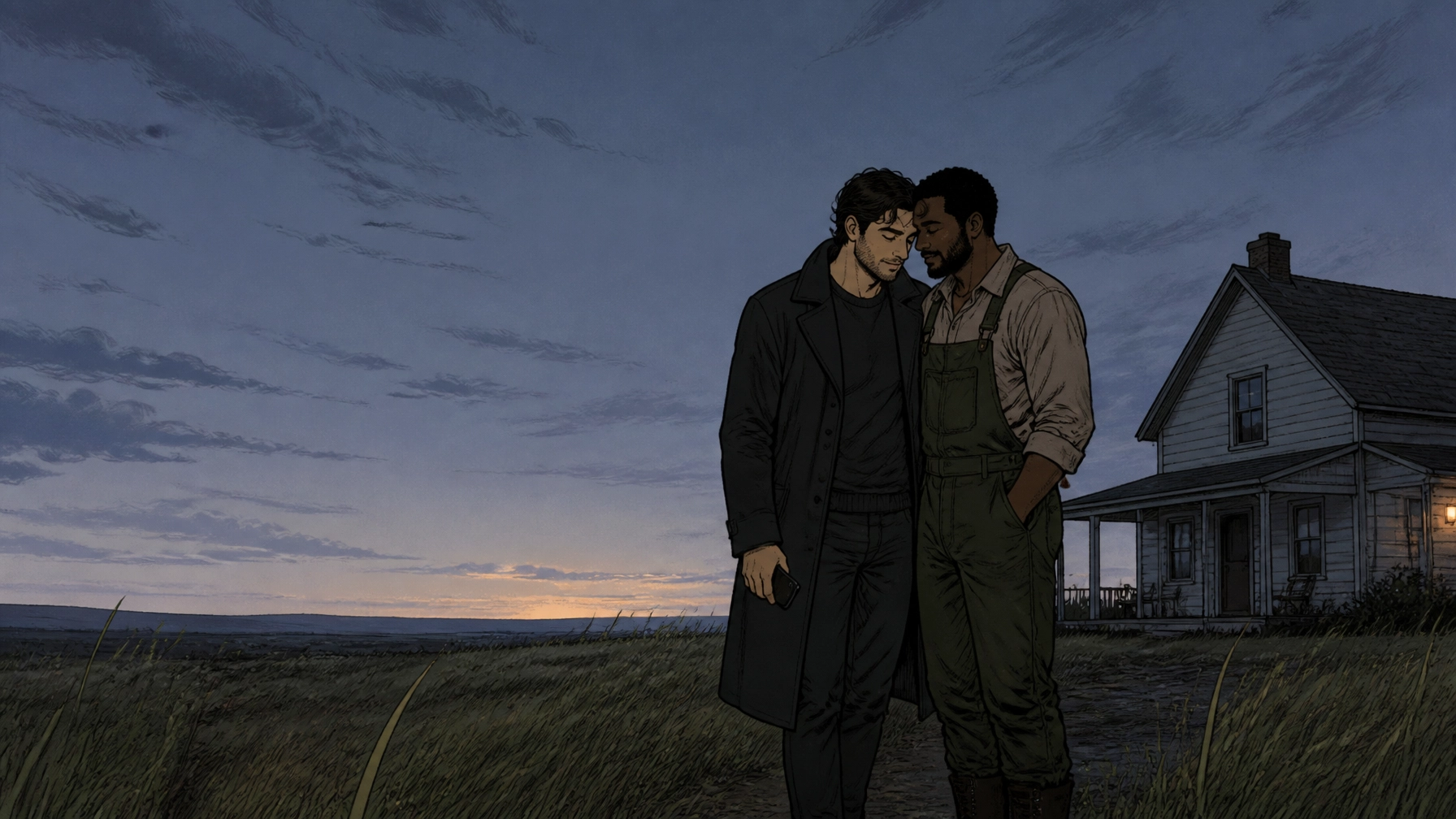
The farmhouse stood among fields that seemed to continue long after the road had ended. Its walls were pale stone. Its windows held the soft yellow of lamplight. Somewhere behind the buildings, sheep called to one another in the wet dusk.
Daniel lifted his phone.
One bar appeared, trembled, and vanished.
Owen noticed.
“It comes back sometimes,” he said.
“When?”
“When it feels like it.”
Daniel stared at him.
Owen smiled, not unkindly. “The signal. Not me.”
When the signal went
By six o’clock, Daniel had checked his phone twenty-three times.
By seven, he had walked to the top of a nearby hill and held it above his head while rain soaked through his coat.
By eight, he had stopped pretending the problem was professional.
He sat at the kitchen table, staring at the blank screen. Without messages, the phone became only an object: black glass, smooth edges, a small machine with nothing to offer him.
Owen placed a mug of tea beside his hand.
“Your report can wait until morning.”
“It’s not the report.”
“I know.”
Daniel looked up. “Do you?”
Owen leaned against the counter. Outside, rain ticked steadily against the window. It was not dramatic rain. It did not lash the glass like something from a film. It simply continued, patient and complete.
“I know what it looks like when someone keeps checking a door after they’ve already locked it,” Owen said.
Daniel gave a short laugh. “That sounds like a farm saying.”
“No. It sounds like something I did.”
The quiet shifted.
That was the first thing Daniel noticed about Owen’s silence: it was not blank. It had shape. It made room. It carried what had already been said instead of rushing to cover it.
Daniel wrapped both hands around the mug.
“I don’t like not knowing what’s happening,” he said.
“Most people don’t.”
“I mean, I need to know where I stand.”
Owen’s gaze stayed on him. “With me?”
The question was gentle. That made it worse.
Daniel looked towards the window, towards the dark fields and the faint reflection of his own face.
“I don’t know,” he said.
It was the most truthful answer he had given anyone in a long time.
What quiet asked of him
The next morning, Owen showed Daniel how to mend a section of fencing damaged by the storm.
Daniel was useless at it.
He held the wire too loosely, caught his sleeve on a post, and nearly lost a boot in the mud. Owen did not laugh. He only reached over, placed his hand over Daniel’s, and adjusted the angle of the tool.
“Slow down,” he said.
“I am going slowly.”
“You’re moving slowly. That’s different.”
Daniel wanted to resent him for being right.
Instead, he felt the warmth of Owen’s hand remain against his for one second longer than necessary.
The fields were enormous under the clearing sky. In the city, distance was measured by buildings, junctions, and the time between stations. Here, distance was weather. It was the darkening line of rain across the horizon. It was the walk from the farmhouse to the barn, taken without a reason to hurry.
At lunch, Daniel told Owen about the first man he had loved.
Not dated. Not slept with. Loved.
His name had been Marcus, and he had been kind in a way Daniel had not known how to receive. Marcus had asked questions and waited for answers. He had wanted a relationship that existed in daylight, not only in the private hours Daniel could control.
Daniel had loved him. Then he had panicked.
“I kept telling myself I was confused,” Daniel said. “About what I wanted. About whether I could be with a man and still be all the other things I was.”
Owen sat opposite him, forearms resting on the table.
“And were you confused?”
“Sometimes.” Daniel considered this. “But not in the way I said. I was afraid that if I let someone know me properly, they could leave properly too.”
Owen did not offer a solution.
He did not say Marcus had been wrong, or that Daniel should have tried harder, or that fear was an excuse.
He simply listened.
That listening became its own kind of answer.
The first evening
On Daniel’s last night, the rain stopped.
The fields steamed faintly in the fading light. Water clung to the grass in silver beads, and the air smelled of wet soil, woodsmoke, and the cold green breath of growing things.
Owen sat on the farmhouse steps.
Daniel stood beside the door with his phone in his hand. The screen had finally found a signal. Messages filled it at once: work reminders, missed calls, a string of questions from a colleague who had apparently survived four hours without him.
The city was reaching for him again.
He could feel the old reflex rising. The urge to answer everything. To become useful. To put distance between himself and the strange, tender ache that had formed in this place.
Owen looked up.
“You can go inside if you need to.”
Daniel stepped outside instead.
He sat beside him. Their shoulders touched through their coats.
For a while, neither man spoke.
The silence was not empty. It held the ticking of the cooling tractor, the scrape of branches against the roof, the distant movement of animals settling for the night. It held Daniel’s fear, but it did not magnify it. It held Owen’s patience, but did not make a demand of it.
Daniel turned his phone face down on the step.
“I don’t know how to do this,” he said.
“Do what?”
“Stay still when I’m frightened.”
Owen looked across the fields. “You’re doing it now.”
Daniel swallowed. His eyes burned, though he had not expected tears.
“I like you.”
“I know.”
“I’m not saying that because I’m stranded here.”
“I know that too.”
Daniel laughed softly, helplessly. Then he leaned his head against Owen’s shoulder.
It was not a grand declaration. There was no music, no sudden light, no promise that fear would never return.
There was only the weight of one man allowing himself to rest against another.
Owen lifted his hand and placed it over Daniel’s.
For the first time, Daniel did not perform being fine.
He did not make a joke or reach for his phone or turn the moment into something easier to survive. He let Owen see the uncertainty, the longing, the old grief, and the fragile hope beneath them.
Owen stayed.
And in that staying, Daniel understood something the city had never taught him:
Stillness was not the absence of life.
Quiet was not the same as empty.
Why this contrast matters in emotional MM romance
The city and the countryside are more than settings in a character-driven queer fiction story. They can become emotional languages.
The city speaks in interruptions: traffic, deadlines, crowds, screens, and constant movement. It offers opportunity and connection, but it can also give a frightened man endless ways to avoid himself.
The rural landscape speaks differently. It does not automatically heal him, and it should not be treated as a perfect refuge. Rural life can include isolation, hard work, limited privacy, and its own pressures. But the open fields create a different kind of confrontation. There is less to hide behind. Weather cannot be hurried. A fence cannot be repaired by refreshing a screen.
For readers who love an emotionally layered MM romance, this is where unexpected places become powerful. A farmhouse, a remote road, or a darkening field can hold the same intensity as a crowded city nightclub or a high-stakes thriller. The setting matters because it presses against the character’s defences.
Daniel’s journey is not about becoming a different man. It is about becoming less divided. His bisexuality is not the obstacle to love. His fear of being fully seen is. Owen does not rescue him from that fear; he offers the steadiness in which Daniel can face it himself.
That is the heart of many memorable gay love stories: not perfection, but recognition. Not the disappearance of uncertainty, but the courage to remain present while uncertainty speaks.
For more LGBTQ+ ebooks, gay fiction, emotional MM books, and queer novels shaped by complex relationships, explore the wider Read with Pride collection. You can also discover Dick Ferguson’s MM romance collection for stories of vulnerability, desire, identity, and the difficult beauty of being known.
Three possible next Evening Edition options
- The Last Train Home : A guarded London architect misses the final train and spends one unexpected night with the stationmaster who knows every kind of waiting.
- The Lighthouse Keeper’s Window : A man escaping public heartbreak finds that the keeper across the bay has been watching the storms: and him: with quiet concern.
- Rain on the Boxing Club Roof : Two men with unfinished history meet again in a nearly empty gym, where anger becomes the first honest language they share.
Follow us on social media
Follow Dick Ferguson and Read with Pride for new gay books, MM novels, queer fiction, heartfelt gay fiction, and reading recommendations for emotionally invested readers.
#EveningEdition #ReadWithPride #MMRomance #GayRomance #QueerFiction #GayFiction #MMNovels #LGBTQFiction #GayLoveStories #EmotionalMMBooks #CharacterDrivenMM #LiteraryMMRomance #GayRomanticFiction #HeartfeltGayFiction #QueerAuthors #MMAuthors #LGBTQReading #ReadingWithPride


Leave a Reply
You must be logged in to post a comment.