

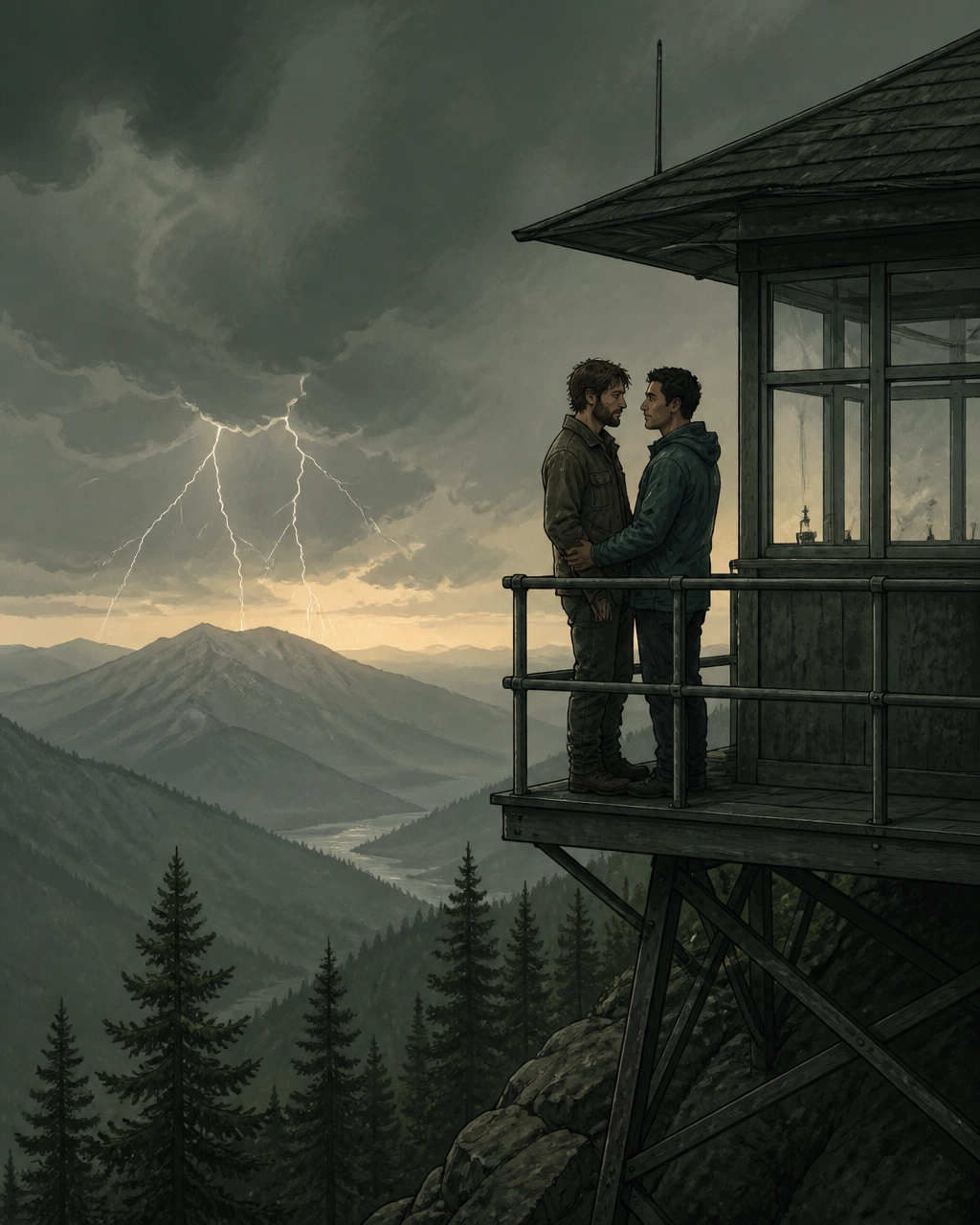
By late afternoon, the mountain had disappeared beneath the storm.
Elias knew the ridge by its shapes: the long shoulder of spruce below the tower, the split boulder beside the eastern trail, the valley opening west like a dark hand. He had watched those landmarks through snow, smoke, rain, and the blue-white stillness before dawn.
Now they were gone.
Cloud pressed against the windows of the lookout cabin, turning the world outside into a grey-green blur. Thunder moved through the floorboards. The tower shivered on its legs, not violently, but with the steady unease of something trying not to show fear.
Elias sat at the observation table with a weather radio murmuring beside him. A map lay open beneath his hands. Red pencil marks tracked old burns across the mountainside. The lines were precise. The handwriting was neat.
For nine summers, he had made a life from watching.
He watched for smoke lifting where it should not. He watched the colour of the forest, the direction of the wind, the way a column rose and widened before becoming dangerous. He watched the lightning strikes that stitched themselves across the horizon, counting seconds between flash and thunder.
He watched the world so he would not have to enter it.
A bright flare opened behind the clouds.
Elias leaned toward the window.
Three seconds.
Two.
One.
The thunder arrived so hard that the radio crackled.
Then someone shouted below.
Elias was already on his feet.
A figure stood at the bottom of the tower stairs, soaked through and gripping the railing. He wore a city-made rain jacket, expensive once perhaps, though the mountain had reduced it to something shapeless. His hair was plastered to his forehead. One hand held a pack. The other was pressed against his ribs as if he had been running from something more dangerous than the storm.
“Are you Elias Vale?” the man called.
“That depends who’s asking.”
“Daniel Mercer.”
The name meant nothing. The fact of him did.
Elias descended three steps, enough to be heard over the rain. “You can’t stay down there. Storm’s moving across the ridge.”
Daniel looked up at the tower. Fear passed briefly over his face. It was not fear of heights. It was the recognition of having reached the place he had been trying to reach, followed by the terror of being expected to explain why.
“I know,” he said.
Elias studied him. “You alone?”
Daniel’s mouth tightened.
It was answer enough.
“Come up.”
The climb seemed to take Daniel everything he had. By the time he reached the cabin, his breathing came in ragged bursts. Elias pulled the door shut behind him, latched it, and handed him a clean towel.
Daniel stood in the middle of the room, dripping onto the floorboards.
The cabin was small but orderly. A narrow bunk occupied one corner. A cast-iron stove sat cold beside stacked firewood. Maps covered one wall. A battered green kettle rested on the table, and beside it, two enamel mugs.
Daniel stared at the second mug.
“You have company?” he asked.
“No.”
“Then why two?”
Elias followed his gaze. “Habit.”
Outside, lightning spread across the clouds without striking the ground. The whole cabin filled with a faint, underwater glow.
Daniel wiped his face. “I thought fire lookouts were supposed to have visitors.”
“Not this one.”
The answer carried more weight than Elias intended. Daniel heard it. He had the look of someone who had become very good at hearing what other people left unsaid.
Elias took the pack from him and placed it by the door. “You’re staying until the storm passes.”
“I can go back down.”
“You can barely stand.”
“I can stand.”
“Then sit.”
Daniel sat.
Elias filled the kettle and set it on the small gas burner. His movements were efficient, practised. He had learned to make every task contain only what was necessary. Heat water. Check radio. Mark strikes. Eat. Sleep. Repeat.
Daniel watched him.
“What?” Elias asked.
“You live up here.”
“That’s generally how lookout towers work.”
“No, I mean, you live here.”
Elias glanced at him. “For the season.”
“And then?”
“Sometimes I come down.”
“That wasn’t what I meant.”
The kettle began to tremble.
Elias turned away before Daniel could see his face change.
He had brought people up here once. Before Tomas died, he had believed solitude was a temporary condition, something a person endured until the right life returned. Tomas had laughed at the tower’s narrow stairs and complained about the lack of a proper shower. He had slept with one hand curled in Elias’s shirt.
After the accident, Elias had climbed higher into himself.
There were losses that asked to be carried. There were others that became architecture.
The kettle whistled. Elias poured coffee into both mugs.
Daniel accepted his with both hands. Steam gathered between them.
“Thank you,” he said.
Elias nodded.
For several minutes, the only sounds were the storm and the low radio chatter. Daniel sat hunched over the coffee as if warming himself from the inside. His clothes smelled of wet stone and city rain, the different rain that fell against pavement, trapped between buildings, never allowed to become part of the earth.
“You hiked up from the south trail?” Elias asked.
“Yes.”
“In that weather?”
“I started before it came in.”
“Why?”
Daniel looked toward the window. “I needed to get somewhere no one knew me.”
Elias almost smiled. “You picked badly.”
“I know who you are. That’s different.”
“Is it?”
“Yes.” Daniel lowered his mug. “You’re a fire lookout. That’s all I know.”
“That’s plenty.”
“It isn’t.”
The words landed between them.
Elias turned to the map, though he could no longer see the marks. “People usually come up here wanting a photograph.”
“I don’t want a photograph.”
“What do you want?”
Daniel’s fingers tightened around the mug.
The storm struck closer. A crack of thunder tore through the cabin, and the glass in the windows rattled. Daniel flinched. Elias saw it and moved instinctively, placing himself between Daniel and the nearest pane.
The gesture was small. Daniel noticed anyway.
“I don’t know,” Daniel said.
It was the first honest thing he had offered.
Elias pulled the chair opposite him from the table and sat. “That’s allowed.”
Daniel looked up.
“Most people come here pretending they know exactly what they’re doing,” Elias continued. “They don’t. They just dislike being caught without an answer.”
“Do you know what you’re doing?”
“Here?”
“In your life.”
The radio hissed. Somewhere beyond the storm, a dispatcher gave coordinates. Elias reached for the pencil but did not write.
“No,” he said.
Daniel breathed out, and the sound was almost a laugh. “Good.”
“Good?”
“I thought you would say yes.”
“I’m a man in a tower during a lightning storm. I’m not a prophet.”
Daniel smiled then. It changed his whole face, though the sadness remained beneath it.
He told Elias about the city without naming it. The apartment with its clean white walls. The job he had once wanted because wanting it had made sense to everyone else. The friends who knew his routines but not the shape of his fear. The relationship he had tried to inhabit as if commitment could make certainty appear.
“There was a version of me,” Daniel said, “who believed that if I chose one thing and stayed loyal to it, the confusion would eventually disappear.”
Elias kept his eyes on him.
“I loved him,” Daniel added. “I did. But I kept feeling as if I had left some locked room inside myself. And I was terrified that opening the door would make everything I had built collapse.”
“You think you’re bisexual,” Elias said.
Daniel’s face went still.
The storm seemed to pause around the tower.
“I know I am,” he said at last. “That’s the problem.”
Elias waited.
“I know I’m bisexual, and I know I’m attracted to men. I know there’s a man I can’t stop thinking about. I know I’m tired of translating myself into something easier for other people to understand.” Daniel swallowed. “But knowing it privately is different from being seen knowing it.”
Elias understood more than he wanted to.
“People are cruel about what they can’t file away,” he said.
“Were they cruel to you?”
“Some.”
“And the rest?”
“The rest were polite.”
Daniel looked down.
Politeness had its own kind of violence. It could make a person disappear without ever raising its voice.
Elias watched the rain crawl down the window. “Tomas was the first person who saw me clearly.”
Daniel did not ask who Tomas was. He waited.
“He died nine years ago,” Elias said. “A vehicle went over the western pass during a fire evacuation. The road gave way. They told me it happened quickly.”
“I’m sorry.”
Elias had heard those words in every room he entered afterward. They had become smooth with use, polished nearly empty.
Daniel said them differently. Not as an ending. As an open hand.
Elias looked at him.
“I kept thinking,” he said, “that if I watched hard enough, I could stop the next disaster. If I saw the smoke early, if I logged every strike, if I learned every path through the forest, then I would never again be surprised by loss.”
“And did it work?”
“No.”
The answer was almost a relief.
The storm began to move east. Thunder rolled away in long, diminishing waves. On the horizon, the clouds opened enough to reveal a narrow seam of bruised gold.
Elias rose to check the instruments.
Daniel followed him to the door.
“You can’t go out,” Elias said.
“I’m not going out.”
They stood together on the threshold, looking through the wet glass. The mountain emerged in fragments: black pines, pale rock, the faint silver of rain falling across the valley.
A thin line of smoke appeared far to the north.
Elias reached for the radio.
Daniel watched as he reported the coordinates, bearing, and estimated distance. His voice remained calm. Professional. The voice of a man trained to name danger before it became catastrophe.
When the message was complete, Daniel said, “You make it sound simple.”
“Most things are simple once they have a name.”
“Are they?”
“No.”
Elias turned toward him.
Daniel’s expression was unguarded now. The storm had taken something from him: the polished distance, perhaps, or the belief that he could remain untouched if he kept moving.
“I came here because I thought being alone would make me honest,” Daniel said. “But I’ve spent the whole climb imagining what I would say if someone asked.”
“What would you say?”
Daniel looked at the space between them.
“I’m afraid.”
Elias nodded.
“And I want something I don’t know how to ask for.”
Another nod.
“And I don’t want to keep watching my life from a safe distance.”
Elias felt the old architecture inside him tremble.
He reached out slowly, giving Daniel time to move away. His hand settled against Daniel’s wrist. Warm skin. A pulse, quick and living.
Daniel looked down at their hands, then back at Elias.
The touch was not a promise. It was not a cure. It did not erase grief or make the future safe.
But it was real.
Outside, somewhere beyond the ridge, lightning had found the forest. A small fire had begun. Crews would come. Reports would be filed. The first dark thread of smoke would rise into the morning and ask to be seen.
Elias held Daniel’s wrist a little more firmly.
“Stay tonight,” he said.
Daniel’s eyes shone. “Is that an invitation?”
“It is.”
“To stay until the storm passes?”
Elias looked toward the fading clouds.
“That too.”
By dawn, the rain had washed the air clean.
The fire to the north remained small, contained beneath a widening sky. The tower stood above the trees, damp and shining, its copper grounding wires beaded with water.
Daniel packed his things slowly.
At the top of the stairs, he paused. “I can walk down alone.”
“I know.”
“But I don’t want to.”
Elias locked the cabin and slipped the key into his pocket.
They began the descent together.
The trail was slick beneath their boots. Mist drifted between the pines. Below them, the valley unfolded in green layers, imperfect and immense.
Daniel did not take Elias’s hand immediately. He walked close enough that their shoulders brushed whenever the path narrowed.
It was not much.
It was everything Elias had forgotten to want.
For years, he had believed his purpose was to stand above the world and warn others about its fires. He had believed distance was the same as safety. He had believed grief was a room with one door, and that once he entered, he had to remain there.
But some fires did not ask to be extinguished.
Some only asked to be named.
And when Daniel’s hand finally found his on the mountain trail, Elias did not look away.
Why Unexpected Places Make Powerful MM Romance Settings
A remote fire lookout tower offers more than a dramatic backdrop. It creates a pressure chamber where two men cannot easily escape the questions they have avoided in ordinary life. That is the emotional power of MM romance in unexpected places: the setting interrupts routine, removes familiar distractions, and gives intimacy room to develop through small, revealing choices.
In a tower above the forest, a character cannot disappear into a crowd. He must decide whether to speak, listen, reach out, or remain behind the emotional walls that once kept him safe. A storm outside can mirror grief, fear, desire, and the uncertainty of coming out, while the physical landscape gives those inner conflicts shape.
For readers seeking a gay love story emotional journey, the most compelling romance is rarely only about attraction. It is about what attraction reveals. It may expose an old wound, challenge a carefully managed identity, or ask whether being loved is worth the risk of being fully known.
That is why character-driven queer fiction often thrives in unusual locations. A lighthouse, mountain cabin, railway platform, or remote research station can make emotional truth impossible to postpone. The characters’ surroundings become part of their transformation.
For emotionally invested MM readers, atmosphere matters because it deepens the relationship rather than decorating it. The best emotional MM romance literary stories use landscape, weather, and silence to illuminate the characters’ inner lives. They make room for gay fiction, gay love stories, MM novels, LGBTQ+ romance, and queer fiction that feel intimate, nuanced, and emotionally honest.
Explore more LGBTQ+ ebooks and gay romance books through Read with Pride, or discover Dick Ferguson’s emotionally immersive work in the Dick Ferguson e-book store.
Three Possible Next Morning Edition Stories
Morning Edition: The Last Ferry : Where Two Men Learned That Leaving Is Not the Same as Letting Go
A grieving deckhand and a passenger fleeing his old identity are stranded together when the final crossing is delayed by heavy fog.
Morning Edition: The Museum Archive : Where Two Men Learned That Some Histories Refuse to Stay Buried
An archivist and a visiting photographer uncover a forgotten love letter that forces them to confront the stories they have concealed about themselves.
Morning Edition: The Winter Greenhouse : Where Two Men Learned That Tender Things Can Survive the Cold
A guarded horticulturist and a burned-out urban planner restore a neglected greenhouse while discovering that vulnerability, like new growth, requires patience and light.
Follow Us on Social Media
Follow Dick Ferguson and Read with Pride for new releases, reflective conversations about queer fiction, gay literature, MM romance, and reading with pride:
#MorningEdition #MMRomance #GayRomance #QueerFiction #GayFiction #MMNovels #LGBTQPlusFiction #GayLoveStories #EmotionalMMRomance #CharacterDrivenFiction #ReadWithPride #ReadingWithPride


Leave a Reply
You must be logged in to post a comment.