

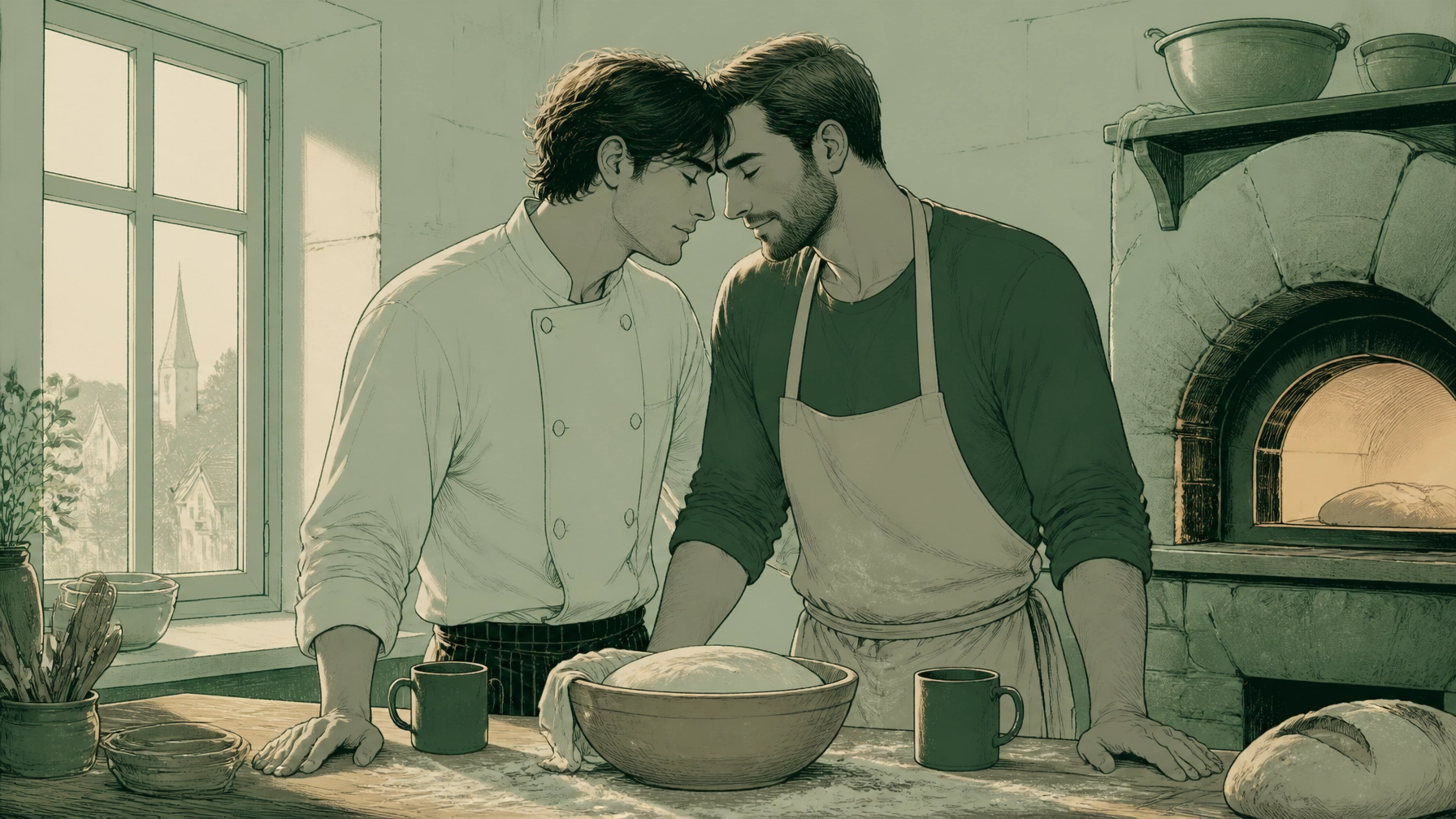
There are people who know how to arrive beautifully.
They know what to wear, what to say, how long to hold someone’s gaze before looking away. They understand the choreography of a room: where to stand, when to smile, how to make desire appear effortless.
Rafael had built an entire life around that kind of precision.
In the city, he was celebrated for it. His restaurant was known for immaculate plates, impossible reservations, and food that seemed to contain more feeling than ingredients. Every dish arrived exactly as intended. Every detail had been considered. Every flaw had been removed before anyone else could see it.
He had become a man who could control almost everything except the question that waited for him in the quietest hours.
What would happen if someone saw him without the performance?
That was why Rafael usually left before dawn.
He had never allowed a lover to see the first light find him. Night was generous. Night softened edges and made courage easier. In darkness, a person could be desired before he was fully known. He could be wanted in fragments: a shoulder beneath a sheet, a laugh in the dark, a mouth still brave from kissing.
Morning was different.
Morning showed the unedited face. The sleep-creased cheek. The uncertainty. The old scars that were easier to hide beneath tailored clothing and professional confidence. Morning asked a person to remain present after the mystery had lifted.
Rafael had spent years believing that the honest light would reveal the truth about him: that beneath all his certainty was someone unworthy of being loved.
He had learned to perform certainty long before he understood why he needed it. The world had questioned his desire for men, asked him to explain the shape of his attraction, treated bisexuality as hesitation or disguise. So Rafael had become fluent in declaration. He chose his words carefully. He made his decisions quickly. He left before anyone could mistake his complexity for weakness.
Then he met Arlo in a village where the mornings began before the sun.
Arlo was a baker, and his work belonged to the dark.
While the town slept behind drawn curtains, he measured flour into steel bowls, crumbled yeast between his fingers, and listened for the quiet changes in dough. He knew that rising could not be hurried. He knew the difference between something that needed more warmth and something that needed more time.
Rafael had come to the village because of a family obligation and expected to stay only long enough to complete it. He was accustomed to temporary places. Hotels. Guest rooms. Restaurants where no one knew him beyond the name printed on the reservation system.
Arlo’s bakery unsettled him from the beginning.
It was too warm. Too honest. The windows fogged when the ovens were working. Flour gathered in the corners no matter how often the floor was swept. There was no polished distance between the work and the person doing it.
Arlo carried the bakery on his skin: flour at his wrist, sugar dusting the front of his shirt, the warm scent of yeast clinging to his hair.
Rafael, who could identify the balance of a sauce with one taste, found himself unable to disguise how much he wanted to stand near him.
Their relationship grew in the spaces between the village and the city Rafael had left behind. Arlo showed him how to shape a loaf without forcing it. Rafael taught Arlo the pleasure of seasoning by instinct. They disagreed about coffee. They laughed over burnt toast. They learned each other’s silences slowly, as if each one were a locked room that might open when approached without pressure.
Still, Rafael kept one boundary intact.
He never stayed until morning.
He had excuses ready. An early call. A train. A delivery. A kitchen problem that could not possibly wait. Each time, Arlo let him go without making Rafael feel ashamed of the leaving.
That patience frightened him more than anger would have.
Anger was familiar. Anger offered something to fight.
Patience asked him to trust what he could not yet prove.
The morning Rafael chooses to stay
The night before their first morning together, rain moved across the village in long, silver sheets. It tapped against Arlo’s windows and darkened the narrow lanes outside. They cooked late, using vegetables from the market and a loaf that had risen too far but tasted wonderful anyway.
There was no grand declaration.
No promise designed to sound permanent.
Only Arlo falling asleep with one hand resting lightly against Rafael’s chest, as if his body had decided that Rafael was safe before his mind could agree.
Rafael woke at 4:47.
For one sharp second, he was already leaving.
His old instincts assembled themselves with professional efficiency. Find his trousers. Locate his phone. Make coffee somewhere else. Turn departure into evidence that the night had been beautiful but contained.
Then Arlo shifted beside him.
The baker’s hair was flattened on one side. His mouth was slightly open. One hand had curled into the sheet between them. In sleep, he looked younger and more vulnerable, not unlike the loaves waiting in the bakery below: unfinished, unguarded, still becoming.
Rafael stayed still.
The room smelled faintly of rain, clean cotton, and the warm bread Arlo had prepared before bed. Beyond the window, the village remained dark. Somewhere beneath them, the ovens were beginning to cool. A clock ticked with small, patient certainty.
Rafael looked at his own hand resting on the blanket.
It was not the hand people praised in the restaurant. It was not steady over a plate or elegant around a wineglass. It trembled.
He had spent years mistaking control for safety. He had believed that if he could leave before dawn, he could leave before judgment. Before questions. Before the moment when another man might see the fear beneath his confidence and decide it was too much trouble to love.
But Arlo had never asked him to be simple.
That was the unbearable kindness of it.
Arlo did not demand a perfect answer about identity, desire, or the future. He did not require Rafael to make his life legible before he could be held inside it. He only made space beside him and allowed Rafael to arrive as he was.
When the first light entered the room, it did not expose a stranger.
It revealed a tired man with rumpled hair, a guarded heart, and a face Arlo already knew how to touch.
“You stayed,” Arlo said when he woke.
His voice was rough with sleep.
Rafael looked toward the window. Dawn had turned the glass pale green. The village rooftops were emerging one by one, wet and shining. In the distance, a chimney released a thin ribbon of smoke.
“I almost didn’t,” Rafael admitted.
Arlo did not reach for reassurance too quickly. He let the truth settle between them.
“Thank you for telling me.”
“I don’t know how to do this.”
“Neither do I,” Arlo said. “But I know how to make coffee.”
It was such an ordinary answer that Rafael laughed. The sound came out cracked and unpolished. He covered his face with one hand.
Arlo gently caught his wrist.
There was flour beneath Arlo’s thumbnail. A small white crescent. Rafael stared at it as if it were a kind of map.
“You don’t have to be impressive here,” Arlo said.
The words went deeper than praise ever had.
Rafael had been impressive for so long that he no longer knew what remained when impressiveness was removed. He had been the successful chef, the certain man, the person who could enter any room and make himself impossible to overlook. He had performed confidence because uncertainty had once been used against him.
Now Arlo was looking at him in the soft, unflattering light of morning, and there was no demand in his expression.
Only recognition.
Rafael turned his hand beneath Arlo’s and held on.
Then they went downstairs.
The bakery was blue with early light. Arlo switched on the oven, and the room filled with a low, familiar warmth. Dough waited beneath a cloth. Coffee began to drip into a chipped ceramic pot. Rafael stood at the workbench in yesterday’s shirt while Arlo pressed flour into his palm.
“Too much,” Rafael said automatically.
“You always say that.”
“I know what I’m doing.”
“You do.” Arlo smiled. “That doesn’t mean you can’t make a mess.”
Rafael looked at the flour between them. Then at Arlo.
Slowly, deliberately, he touched the flour to Arlo’s cheek.
Arlo blinked.
Rafael waited for the old panic to arrive: the urge to turn the moment into a joke, to move away, to make himself untouchable again.
Instead, Arlo smiled.
The sun came up while they stood there.
Not dramatically. Not with music or a sky transformed for their benefit. It came as morning usually comes: gradually, imperfectly, filling the windows until the dark had nowhere left to hide.
Rafael had thought staying meant surrendering control.
He began to understand that it could mean something else.
It could mean choosing to be known in stages. Letting someone witness the quiet face, the uncertain hand, the appetite that did not always have a name. It could mean remaining present long enough for love to become ordinary.
Arlo set two cups of coffee on the table.
Rafael sat down.
For the first time, he did not leave before dawn.
For the first time, dawn did not take anything from him.
Why this milestone matters in emotional MM romance
The first morning is powerful because it transforms intimacy from an event into a choice.
Many stories explore the electric beginning of attraction: the first glance, the first kiss, the moment two men recognise something neither can safely ignore. But the morning after carries a different emotional weight. It asks what remains when performance is no longer useful.
That is why the milestone works so well in emotional MM romance literary fiction. It gives the characters room to reveal the private fears beneath the romantic premise. A man who stays through dawn is not simply extending a date. He is allowing himself to be witnessed without the protection of atmosphere.
For readers drawn to character-driven queer fiction, this kind of scene can hold as much tension as a dramatic confrontation. Rafael’s fear is not only about romance. It is tied to the years he spent defending the legitimacy of his desire for men, and to the pressure of performing certainty when his bisexuality was treated by others as something to question or explain.
Arlo’s patience offers another way to understand queer love: not as a demand for simplicity, but as a practice of making room for the whole person.
This is also where MM romance in unexpected places becomes especially compelling. The contrast between Rafael’s urban restaurant and Arlo’s rural bakery is more than scenery. The city represents speed, polish, reputation, and constant scrutiny. The village bakery represents repetition, patience, warmth, and trust built by hand.
Together, they create a setting for a gay love story emotional journey in which the central conflict is not whether the men are attracted to each other. It is whether Rafael can believe that attraction can survive knowledge.
That question speaks directly to emotionally invested MM readers who seek more than a convenient happy ending. They want MM novels and gay novels where the characters carry history into the room. They want gay romance that respects vulnerability, queer fiction that allows identity to be complex, and LGBTQ+ fiction that portrays love as both refuge and risk.
The first morning also belongs to the tradition of heartfelt gay fiction and emotional MM books because it makes a quiet act feel brave. Coffee, flour, sleep, and sunlight become symbols of trust. In gay contemporary romance, the most important turning points are often domestic rather than spectacular: sharing a kitchen, answering an honest question, staying long enough to be seen.
That is the lasting appeal of this kind of gay love story. It understands that love is not only found in grand gestures. Sometimes it is found in the decision not to reach for the door.
For more LGBTQ+ ebooks, gay literature, gay romance, queer fiction, and emotionally rich stories about men choosing connection, explore Read with Pride. You can also discover Dick Ferguson’s work in the Dick Ferguson e-book store.
Three possible next Evening Edition options
-
The First Shared Silence
Two men shelter from a power cut in an old coastal hotel. One is used to filling every quiet moment with stories; the other has learned to communicate through presence. When the lights return, neither wants to be the first to speak. -
The First Photograph They Keep
A guarded archivist and a travelling bookbinder find an undeveloped photograph in a demolished railway station. As they search for its owner, they confront why neither man has ever allowed himself to be recorded beside someone he loves. -
The First Time He Says “Come Home”
After a difficult week, a city musician arrives at a remote mountain cottage expecting only a place to sleep. The man who opens the door does not ask him to explain his grief. He simply leaves the porch light on and makes room at the table.
Follow us on social media
Follow Dick Ferguson and Read with Pride for lyrical queer fiction, MM romance, gay novels, heartfelt gay love stories, and new LGBTQ+ reading recommendations:
#MMRomance #GayRomance #QueerFiction #GayFiction #MMNovels #LGBTQFiction #GayLoveStories #EmotionalMMBooks #CharacterDrivenMM #LiteraryMMRomance #HeartfeltGayFiction #QueerAuthors #MMAuthors #LGBTQReading #ReadingWithPride #EveningEdition #ReadWithPride


Leave a Reply
You must be logged in to post a comment.