

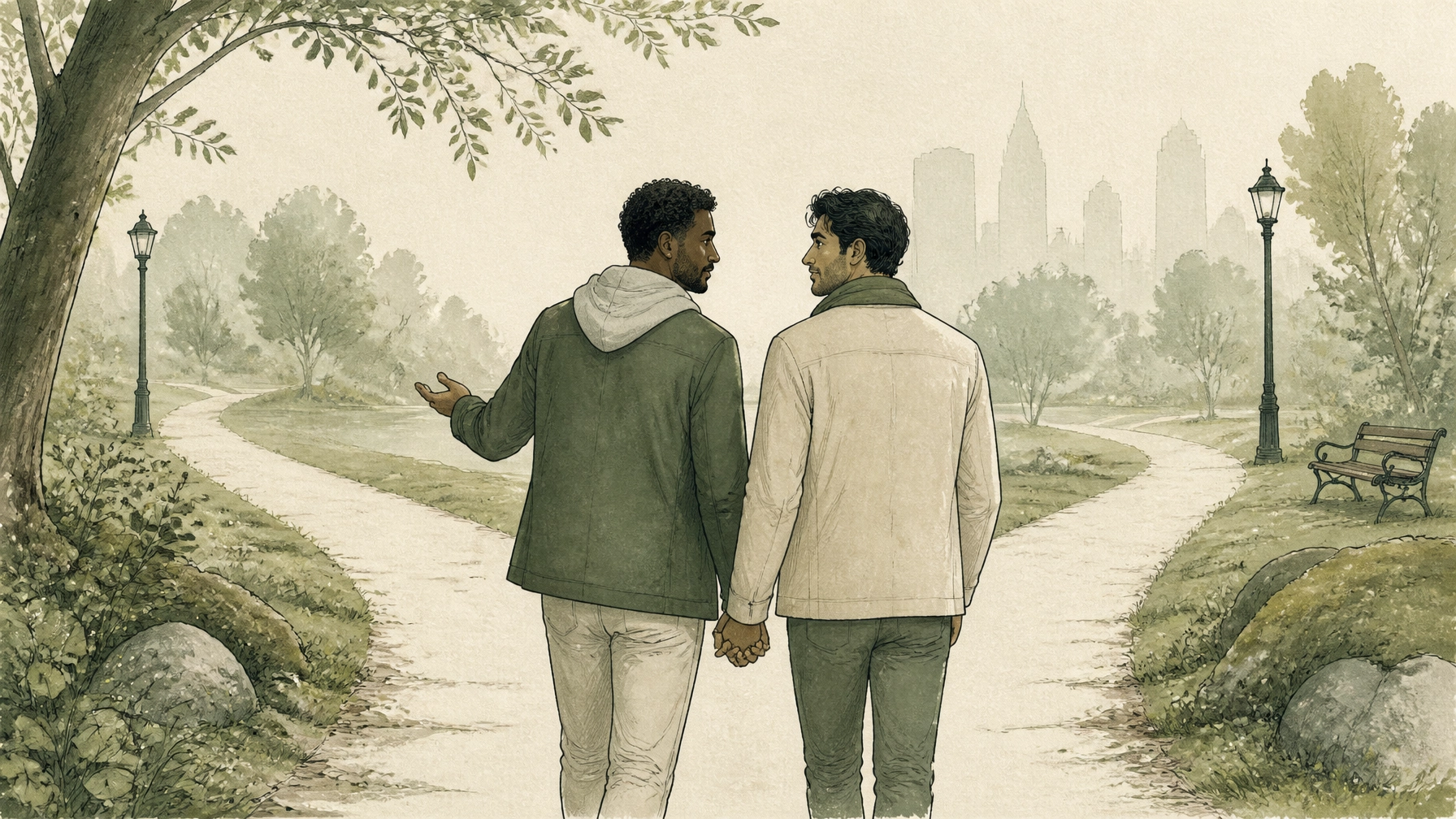
The morning after a difficult evening, Julian does something Elias is not expecting.
He gives him the choice.
Not the choice between staying and leaving. Not the dangerous, loaded question of whether their relationship is still all right. Something smaller, at least on the surface.
“How do you want to get home?”
There are two routes. The direct one is quicker, familiar, and busy enough to make the journey feel practical. The quieter route passes through the park, where the trees are still holding the last of the night’s rain.
Elias knows that route.
Years earlier, before Julian, before he had learned to say what he needed, he used to walk through that park with his shoulders drawn in and his attention fixed on the ground. It was a place where he had taught himself not to be noticed. A place where every laugh from behind him had sounded like a warning, and every pair of approaching footsteps had made him calculate how quickly he could disappear.
Now Julian is asking him to choose the way home.
The question becomes something more than directions.
It becomes a quiet test of trust, not because Julian is testing Elias, but because Elias has to decide whether the past still gets to choose every road for him.
The morning after a difficult evening
Julian wakes before Elias, though he does not move immediately.
The room is grey with early light. A narrow strip of it rests across the floorboards, catching on the leg of a chair and the sleeve of Julian’s shirt, which he left there the night before. Beside him, Elias is awake but still. His breathing has the careful rhythm of someone who has been conscious for a while and is waiting for the world to become easier.
Neither man says good morning.
Not yet.
The previous evening remains between them, not as an argument exactly, but as the residue of one. A sentence spoken too sharply. A silence that lasted too long. Julian trying to help before Elias had asked him to. Elias withdrawing because being cared for had begun to feel too much like being examined.
They have already learned that love does not prevent misunderstanding. It only gives the misunderstanding somewhere to go.
Julian turns his head.
“You all right?”
Elias looks towards the window. “I’m thinking.”
“About last night?”
“About everything.”
Julian accepts this. He has become better at resisting the impulse to solve every silence. Sometimes Elias needs a question. Sometimes he needs room around the question.
After a while, Julian gets up and makes coffee. Elias follows him into the kitchen, still wearing yesterday’s clothes. They move around each other carefully, sharing the small space without quite touching.
The kettle clicks off.
Julian pours two mugs.
Elias wraps both hands around his, letting the warmth settle into his fingers.
“Do you want to go home?” Julian asks.
The question is gentle, but Elias hears the fear beneath it.
“Yes,” he says. “I think I do.”
Julian nods. He does not look wounded. He does not ask whether home means his flat or Julian’s. He only reaches for his jacket.
That, somehow, makes Elias glance up.
Two routes, two kinds of fear
Outside, the city is beginning its ordinary work.
A bus groans at the corner. Someone unlocks the shutters of a bakery. A cyclist moves past them in a blur of dark clothing and silver wheels. The morning is not beautiful in any dramatic sense, but it is clear. The air smells of wet pavement and leaves.
At the end of the street, the route divides.
“Direct way?” Julian asks. “Or through the park?”
Elias stops.
It is such a simple question. He should be able to answer without thinking.
The direct route would take them along the main road, past the pharmacy and the row of cafés that do not open until late morning. It would be quicker. There would be traffic, delivery vans, and people moving with purpose.
The park would take longer.
It would be quieter. More exposed in some ways, because the paths narrowed beneath the trees. Less exposed in others, because the morning walkers tended to keep to themselves.
Julian watches Elias, but he does not steer him.
That is the difference.
In the past, Julian might have chosen for him. He might have said, “Let’s take the direct route,” believing that efficiency was kindness. He might have tried to protect Elias from discomfort without understanding that protection could also become another form of control.
This time, he waits.
“I don’t know,” Elias says.
“You don’t have to know immediately.”
“I used to walk through there.”
Julian looks towards the park entrance. “The park?”
“Before I met you. Before a lot of things.”
There is no need to ask whether the memories are good.
Julian keeps his voice quiet. “Do you want to avoid it?”
Elias studies the trees. Their branches are dark with rain. A few pale leaves have fallen across the path, flattened into the mud.
“I used to come this way when I didn’t want anyone to see me.”
Julian says nothing.
“I knew which paths were busiest. Which benches faced away from the road. Where I could stand if I needed to wait for someone to pass.” Elias gives a small, humourless smile. “I was very good at planning not to be noticed.”
“You were trying to feel safe.”
“I was trying to feel invisible.”
Julian’s hand hangs at his side, close but not reaching.
Elias notices.
That restraint is its own kind of tenderness.
Choosing the quieter route
“The direct way is faster,” Julian says.
“I know.”
“And the park is quieter.”
“I know that too.”
“Which one do you want?”
Elias looks at him. “You really mean that?”
Julian’s expression shifts. “Yes.”
“You’re not asking because you’ve already decided?”
“No.”
“You’re not going to tell me what would be better for me?”
“I have opinions.”
That pulls a reluctant smile from Elias.
“Of course you do.”
“But they’re not instructions.”
The smile fades into something softer.
Elias looks once more at the main road. It is easy to imagine taking it. Easy to keep moving among other people, to let the noise carry them forward, to arrive quickly and avoid the old path altogether.
But avoidance has never been the same as healing.
He turns towards the park.
“Let’s go that way.”
Julian nods.
They walk beneath the trees.
At first, Elias keeps to the edge of the path. His body remembers the route before his mind does. He notices the bench beneath the ash tree. The low wall where he once sat with his hands tucked between his knees. The bend where the path disappears briefly behind a screen of shrubs.
Nothing happens.
A man jogs past them with headphones in. An older couple walks in the opposite direction, speaking softly to each other. A dog pulls at its lead, determined to investigate a patch of wet grass.
The world does not pause to ask Elias who he used to be here.
Julian walks beside him, not too close.
After a minute, Elias says, “I thought you might take my hand.”
“I wanted to.”
“Why didn’t you?”
“You were looking at the path like it was going to accuse you.”
Elias exhales. “That obvious?”
“To me.”
There is affection in the answer, but no triumph. Julian does not sound pleased with himself for noticing. He sounds like a man who has learned that paying attention is only useful if it does not become another way to take control.
Elias slows.
Julian slows too.
“I don’t want you to be careful all the time,” Elias says.
“I know.”
“No, I mean it. I don’t want you to keep guessing what I can manage.”
“I’m not guessing.”
“You are a little.”
“Probably.”
Elias glances at him.
Julian’s mouth lifts. “I’m learning.”
The admission lands more deeply than reassurance would have.
Neither of them is pretending to have mastered love. They are learning how to move through it without turning fear into a map.
Moving slowly is still moving forward
The path curves towards the centre of the park.
Elias remembers walking here alone on winter afternoons, when the branches were bare and the light disappeared early. He remembers keeping his phone in his hand, not because he had anyone to call, but because holding it made him look occupied. He remembers practising neutral expressions in the reflection of dark windows.
He had believed that if he could make himself unreadable, nothing could hurt him.
Julian once told him that privacy and hiding were not the same thing.
Elias is beginning to understand the difference.
Privacy can be chosen.
Hiding is what happens when fear makes the choice for you.
At the next bend, Julian reaches out: not for Elias’s hand, but towards a low branch that hangs across the path. He lifts it out of the way and holds it until Elias has passed.
It is such a small gesture that Elias almost misses its significance.
Julian does not pull him forward. He does not place himself between Elias and the world. He simply makes the way a little easier, then lets Elias continue under his own power.
A few steps later, Elias reaches for him.
Their hands meet without ceremony.
Julian’s fingers close around his.
The contact is warm and steady. Not a declaration. Not proof. Just a choice made in the middle of a path they are taking together.
“You could have asked me to choose the quick route,” Elias says.
“I could have.”
“You might have been home already.”
“I’m not in a hurry.”
Elias looks at their joined hands. “You say that now.”
“I mean it now.”
That is the most honest promise either of them can make.
Not forever without difficulty. Not a life untouched by old memories. Only this: I am here in this moment, and I am not trying to rush you through it.
For readers who love emotionally immersive MM romance, this is where the deepest movement often happens. Not when a character conquers fear in one dramatic scene, but when he notices fear, names it, and takes another step anyway.
The way home
By the time they reach Elias’s building, the morning has brightened.
The walk has taken twenty minutes longer than the direct route.
Neither man mentions this as a failure.
At the entrance, Elias does not immediately let go of Julian’s hand.
“Thank you,” he says.
“For taking the long way?”
“For letting me choose.”
Julian’s thumb moves across his knuckles. “You should always get to choose.”
“I know that in theory.”
“In practice?”
Elias looks towards the park behind them. From here, the trees appear harmless. Almost gentle. They do not look like the place where he learned to vanish.
“In practice, I’m still learning.”
Julian leans closer, giving him time to move away if he wants to. Elias does not move. Their foreheads touch.
“You don’t have to learn it all today,” Julian says.
Elias closes his eyes.
The sentence is not permission to remain stuck. It is permission to continue at a pace that does not turn progress into another demand.
When Julian kisses him, it is slow and unhurried. A morning kiss, soft with coffee and tiredness. The kind of kiss that does not ask the future to prove itself.
Elias feels the old instinct to look around.
He does not.
He keeps his hand in Julian’s and lets the moment be visible: not to strangers, not for a performance, but to himself.
Two men at the entrance to a building.
Two men choosing the longer route.
Two men discovering that moving slowly is not the same as standing still.
Read with Pride: stories about the steps that change us
The most affecting gay love stories often turn on decisions that look small from the outside: asking instead of assuming, waiting instead of directing, reaching for someone’s hand, or choosing the path that once felt impossible.
Julian and Elias’s story belongs to that tradition of warm, character-driven queer fiction. Their relationship is shaped by fear, tenderness, memory, and the patient work of learning how to trust another man without losing themselves.
If you enjoy high-angst MM romance, heartfelt gay fiction, quiet queer experiences, and emotionally complex relationships between men, explore more LGBTQ+ ebooks and queer fiction through Read with Pride.
You can also discover more of Dick Ferguson’s MM romance books and gay novels at Read with Pride, including stories shaped by emotional depth, vivid imagery, difficult choices, and the resilience of love.
Three possible next 6 PM stories
- The Evening Elias Asked Julian to Wait Outside : When two men learned that support does not always mean stepping in.
- The Morning Julian Found Elias Keeping the Door Open : When two men discovered that a small domestic habit could become a promise.
- The Afternoon They Sat on the Same Bench : When two men returned to an old place and allowed a new memory to begin.
Follow us on social media
Follow Dick Ferguson for more gay romance books, emotional MM stories, character-driven queer fiction, and reading recommendations:
#QueerExperiencesAndStories #MMRomance #GayRomance #QueerFiction #GayFiction #MMNovels #LGBTQFiction #GayLoveStories #EmotionalMMBooks #HeartfeltGayFiction #CharacterDrivenRomance #GayRomanceBooks #MMRomanceBooks #ReadingWithPride #ReadWithPride


Leave a Reply
You must be logged in to post a comment.