

Morning Edition: The Ice Hotel : Where Two Men Learned That Some Warmth Arrives in the Coldest Rooms
Rare Experience
By the time Elias arrived, the river had disappeared beneath a white silence.
The road into the village was narrow and dark, bordered by snowbanks that rose higher than the car windows. Beyond them, the forest stood in black ranks beneath the polar night. Every branch carried frost. Every sound seemed softened before it could travel.
Then the ice hotel appeared.
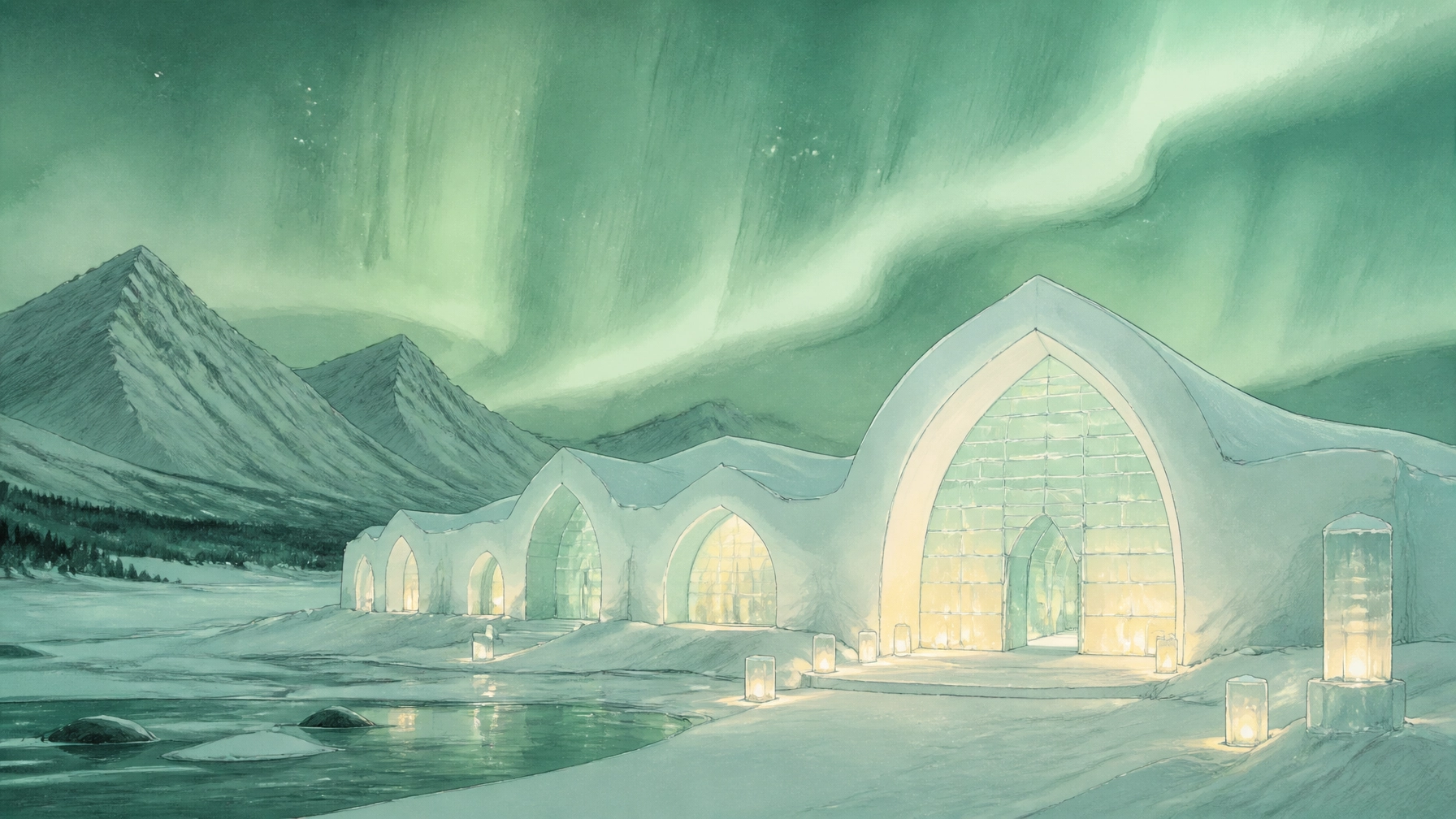
It did not look built so much as grown from the winter itself: a long, low structure of snow and river ice, its walls glowing with a muted green light. Through the translucent surfaces, Elias could see the shadows of carved pillars, sleeping alcoves, frozen arches, and rooms that seemed to belong to a dream someone had forgotten to wake from.
He stopped at the entrance with one hand on the strap of his equipment bag.
For the winter season, he had been commissioned to carve an art suite from blocks cut from the frozen river. The work was prestigious. Difficult. Temporary. By spring, the walls would melt and return to the water.
Elias understood temporary things better than most.
He had spent years making himself provisional in other people’s lives. He had become skilled at offering carefully edited versions of himself: the reliable artist, the quiet friend, the man who dated women because it was easier to explain, the man who never corrected anyone when they assumed they knew the whole story.
He was bisexual. The word had always felt both true and dangerous, like a door he had built but never learned to open.
Inside, he met Soren, the night manager.
Soren had stayed at the hotel through eleven winters, long enough to know which corridors creaked when the temperature dropped and which doors swelled after a heavy snowfall. He knew how to explain the sleeping bags, the reindeer hides, the storage lockers in the warm building, and the importance of not leaving wet clothing near an ice wall.
He also knew how to tell visitors that the cold was not their enemy.
“It is steady in here,” Soren said, leading Elias through the main hall. “Outside, the wind changes everything. Inside, the cold holds its breath.”
Elias looked at him then.
Soren was tall, broad-shouldered, and older by perhaps a decade. His dark hair was threaded with silver at the temples. There was a guardedness in his face, not unfriendly but carefully maintained, as if grief had once entered through an unlocked door and he had spent the years since replacing every hinge.
“What happened to the last artist?” Elias asked.
“He went home in April.”
“That isn’t what I meant.”
A small smile touched Soren’s mouth. “No. It isn’t.”
Their first week passed in fragments.
Elias worked in the sculpture chamber, where the air smelled of packed snow and iron tools. His design was a pair of figures standing back to back, their shoulders connected by a single arch. He had told the commission panel it represented endurance.
He had not told them it was about intimacy.
About the fear of being witnessed from every direction. About how two people could touch without turning toward each other. About the strange safety of being close while remaining unseen.
Soren visited each night after the guests had gone quiet. He brought tea in a metal flask and stood just beyond the reach of Elias’s work light.
“You’re carving around the faces,” he observed.
“Faces are difficult.”
“Hands are more difficult.”
“Hands can lie.”
“So can faces.”
Elias lowered his chisel. The sculpture gave a faint, crystalline groan.
The ice hotel creaked around them.
It was not a threatening sound. The walls shifted as the temperature moved, the structure answering the cold with tiny movements. Still, Elias felt it in his ribs. The building was never entirely still. It was always becoming something else.
Soren understood the sound better than anyone.
“It’s settling,” he said.
“Does it ever collapse?”
“Not if we listen.”
The sentence stayed with Elias longer than it should have.
On the eighth night, he found Soren sitting alone in the chapel. The room was small and blue-white, with a vaulted ceiling and rows of ice benches. There were no candles, only soft lights buried inside the walls.
Soren held a folded photograph.
Elias did not ask what it showed. He sat on the opposite bench, leaving enough space between them for the question not to become an intrusion.
“My brother worked here,” Soren said eventually. “Years ago. Before I became manager.”
Elias waited.
“He died during a winter storm. Not here. On the river.” Soren looked down at the photograph. “People assume time makes grief quieter. Sometimes it only teaches you how to carry it without dropping anything.”
The words were plain, but Elias felt their weight.
“My father still calls me by the name he used when I was a child,” Elias said. “Even though I’ve corrected him.”
Soren glanced across the chapel.
“Because of your sexuality?”
Elias’s throat tightened. He had expected the usual hesitation, the careful phrasing, the attempt to make the subject smaller.
“Because he knows I’m not straight,” Elias said. “But he doesn’t know what that means to me. I dated women. I loved some of them. I’ve loved men too. Somehow, everyone wants one answer that makes the rest disappear.”
Soren folded the photograph once more.
“Do you want one answer?”
“No.”
“Then perhaps you don’t owe anyone one.”
The hotel seemed to breathe through its walls.
After that, the distance between them changed.
Not dramatically. There was no sudden confession beneath the aurora, no perfect moment that solved the past. Instead, Soren began leaving the workshop door open when he made his rounds. Elias began asking questions he would once have swallowed.
They shared late meals in the warm staff room. They stood shoulder to shoulder at the sauna entrance, wrapped in wool and carrying the scent of cedar smoke. Once, when Elias’s fingers had gone numb, Soren took his hands between his own and held them until the feeling returned.
Neither man called it tenderness.
Some things need time before they can bear their names.
One night, the aurora appeared.
Soren found Elias outside the hotel, looking up. The sky had opened above the frozen river, green light moving through it in long, silent curtains. The snow reflected the colour so that the whole world seemed caught between earth and water.
Elias had forgotten his gloves.
“You’ll lose your fingers,” Soren said.
“I’m trying to remember this.”
“You can remember it with gloves.”
Soren held out a spare pair. Elias took them, but their hands met inside the wool.
For a moment, neither moved.
The fear Elias carried had not vanished. It was still there, an old animal alert to every door, every departure, every possible misunderstanding. But beneath it was something less familiar: the possibility that being known did not have to mean being reduced.
Soren looked at him beneath the green sky.
“My brother hated the cold,” he said. “He used to say winter made liars of people. You could see who they were by what they did when no one was watching.”
“And what do you do?”
“Stay.”
The answer moved through Elias with the quiet force of thaw.
He wanted to say that he was afraid. That he had spent years confusing privacy with safety. That he did not know how to begin a life in which every part of him was allowed to remain present.
Instead, he said, “I’m leaving in April.”
“I know.”
“The sculpture will be gone too.”
“I know that.”
Elias turned toward him. “You make everything sound temporary.”
Soren’s eyes were tired, open, and unguarded in a way Elias had not seen before.
“Everything is temporary,” he said. “That doesn’t make it meaningless.”
They stood together until the aurora faded.
In the final week, Elias carved the faces.
He turned the two figures toward each other, not touching, but close enough that the space between them became part of the design. Their expressions were unfinished. Hopeful, perhaps. Or simply honest.
On the morning the sculpture was completed, Soren entered the suite carrying two cups of coffee.
He studied the ice figures for a long time.
“They look like they’re waiting,” he said.
“They are.”
“For what?”
Elias looked at him. “For someone to tell the truth.”
Soren set the coffee down. Then he stepped close enough that their coats brushed.
“I don’t know how to promise you a future,” he said.
“I’m not asking for one.”
“I may not know how to be easy.”
“I don’t need easy.”
Outside, snow began to fall, fine and steady against the translucent walls.
Elias reached for Soren’s hand. The gesture was small. It did not erase grief, fear, family, distance, or the coming thaw. It did not make either man suddenly certain.
Soren held on.
Some warmth arrives as a declaration. Some arrives as a hand that does not let go immediately. Some arrives in the coldest rooms, where two people are still learning whether they can be fully seen and remain loved.
The ice hotel would melt.
The river would carry the walls away.
For now, beneath the green light and the creak of frozen architecture, Elias and Soren walked back toward the warm building together.
They did not know what came next.
They knew they would meet there.
Why Rare Experiences Make Powerful MM Romance Settings
An ice hotel is more than a striking backdrop. It creates a physical world where every emotion becomes sharper. The cold demands attention. Breath becomes visible. Silence gains texture. A glance can feel warmer than a fire.
That makes the setting ideal for MM romance in unexpected places. Readers are not simply watching two men fall in love; they are watching them negotiate vulnerability inside a structure that is temporary, beautiful, and always changing. The environment reflects the emotional journey of the characters without overpowering it.
For an emotionally invested reader, the most compelling gay love story emotional journey is rarely about attraction alone. It is about the risks of honesty. It is about what happens when a guarded man meets someone patient enough to notice what he is not saying. It is about grief, identity, fear, bisexuality, coming out, and the slow discovery that complexity does not make love less real.
This is where character-driven queer fiction can thrive. The ice hotel gives the story natural opportunities for intimacy: two men carving together, sharing a sauna after a long shift, crossing a frozen river beneath the aurora, or speaking quietly while the walls creak around them. Each moment can reveal character.
For emotionally invested MM readers, the setting also offers a powerful contrast between cold and warmth. The ice rooms are quiet and stark, while the staff quarters, sauna, coffee, wool blankets, and shared meals provide spaces where connection can grow. That contrast suits emotional MM romance literary storytelling, where atmosphere and interior life matter as much as plot.
Readers looking for LGBTQ+ ebooks, gay romance books, MM romance books, queer fiction, and gay fiction often want more than familiar scenery. They want gay love stories that take emotional experience seriously. They want LGBTQ+ reading that reflects uncertainty without treating it as failure, and gay book recommendations that lead them toward heartfelt gay fiction and emotional MM books.
A rare setting can make a familiar question feel new: what would you risk if the world around you were already changing?
Read with Pride
Discover more LGBTQ+ ebooks, gay novels, MM novels, LGBTQ+ fiction, and gay literature through Read with Pride.
You can also explore Dick Ferguson’s collection of emotionally immersive gay romance books and MM romance books, created for readers who value lyrical prose, complex characters, and honest queer relationships.
For more gay book recommendations, popular gay books, new gay releases, and reading with pride, visit Read with Pride and find your next character-driven story.
Three Possible Next Morning Edition Stories
-
The Last Working Cable Car : Where Two Men Shared a Mountain Before the Lines Went Silent
A cable-car mechanic and a stranded mountain archivist confront old resentment, altitude, and the kind of confession that cannot be taken back. -
The Underground Salt Library : Where Two Men Found Their Voices Beneath the Earth
A preservationist and a visiting translator work through a sealed collection of letters while the world above disappears beneath a winter storm. -
The Lighthouse Bell Foundry : Where Two Men Learned to Listen Through the Noise
A bell maker protecting his family’s fading craft meets a marine cartographer carrying the aftermath of a lost expedition.
Follow Us on Social Media
Follow Dick Ferguson for literary LGBTQ+ fiction, gay love stories, MM authors, queer authors, and new emotional MM romance:
#MorningEdition #MMRomance #GayRomance #QueerFiction #EmotionalMMRomance #ReadWithPride #GayFiction #MMBooks #LGBTQBooks #GayLoveStories #CharacterDrivenFiction #HeartfeltGayFiction #EmotionalMMBooks #ReadingWithPride #LGBTQReading


Leave a Reply
You must be logged in to post a comment.