

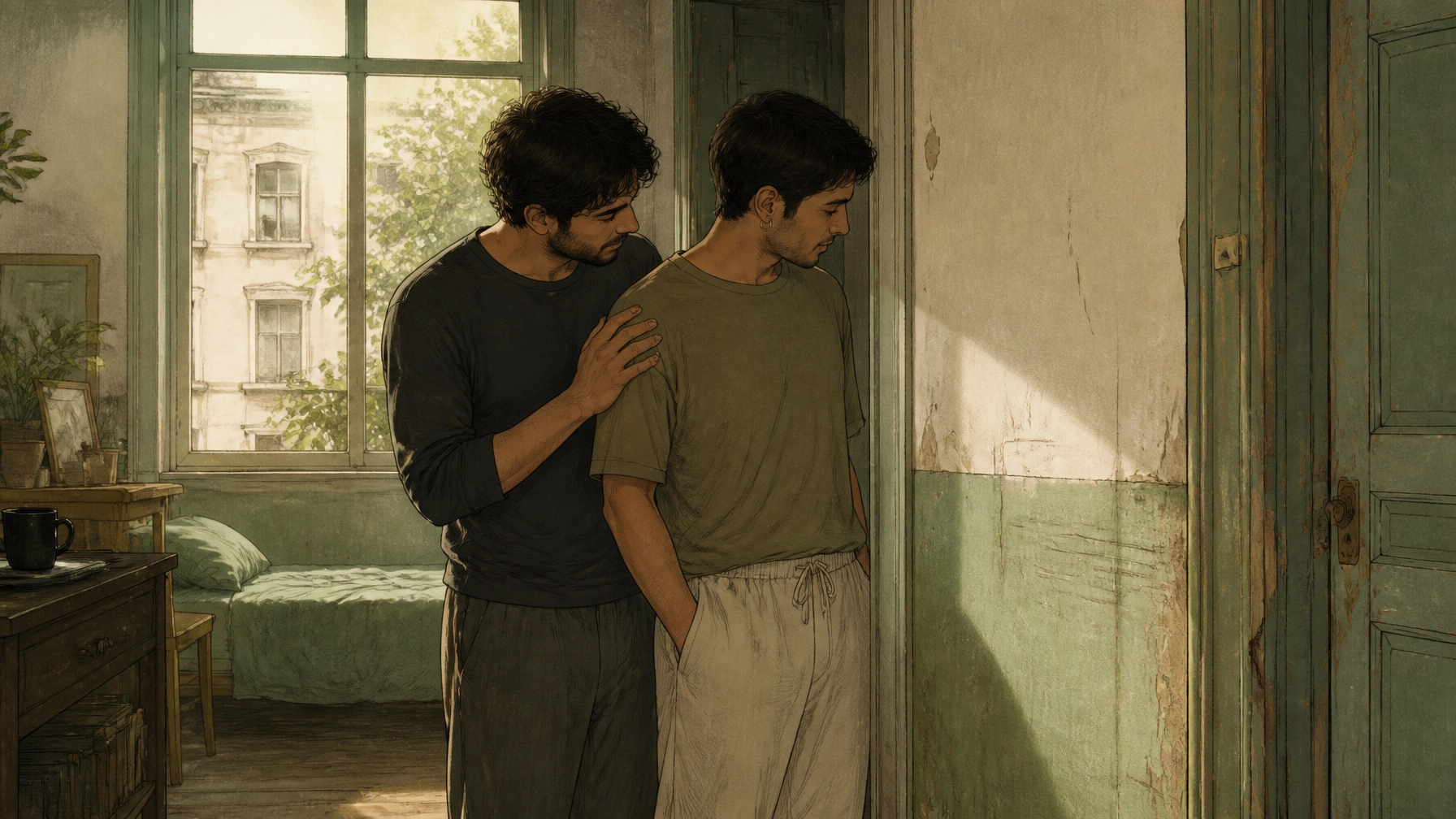
Elias did not sleep much after speaking to Adrian.
He slept beside Julian, technically. His shoulder touched Julian’s whenever either of them moved. Their feet tangled beneath the sheet. Once, sometime after three in the morning, Julian woke to find Elias holding the edge of his T-shirt in one hand.
Not gripping it.
Just holding on.
By seven, the room had turned the pale green of early morning. Elias was already dressed.
Julian opened one eye.
“Are you leaving?”
Elias looked down at him. “No.”
It took him a second to say it. Julian noticed that.
“No,” Elias repeated. “I want to take you somewhere.”
Julian pushed himself up against the pillows. “Somewhere with coffee?”
“Eventually.”
“That sounds ominous.”
“It probably is.”
Elias smiled, but only with one side of his mouth.
Julian reached for him. His fingers found the waistband of Elias’s trousers and rested there, light and familiar.
“Do I need shoes suitable for emotional damage?”
“You always need those.”
They left the flat just after eight.
The neighbourhood was only twenty minutes away by bus, but Elias watched the streets change as if they were travelling between different versions of his life. The bright cafés gave way to tired shopfronts. The pavements narrowed. Buildings leaned into one another, their brick dark with last night’s rain.
Julian sat beside him, close enough that their knees touched whenever the bus turned.
Elias kept looking out of the window.
“I lived there for almost three years,” he said.
“The apartment?”
“Yes.”
“Is that where you met Adrian?”
“No. Earlier.”
Julian waited.
Elias had become good at silence since they had fallen in love. Not the old silence, the one that meant fear or withdrawal or the careful removal of every dangerous thought. This was different. Julian’s silence made room.
After a while, Elias said, “I was twenty-two when I moved in. I thought I was old enough to start over.”
“And were you?”
“No.”
The answer came easily.
That worried Julian more than hesitation would have.
Elias turned his hands over in his lap. His nails were short. A small crescent of paint marked his right thumb from something he had repaired the evening before.
“I thought starting over meant becoming someone nobody could recognise,” he said. “Someone uncomplicated.”
Julian looked at him. “You were never uncomplicated.”
“I know that now.”
The bus stopped outside a row of narrow buildings with stained stone steps and windows crowded by curtains. Elias led Julian through a passageway that smelled of damp plaster and someone’s breakfast.
A man in a navy jumper was replacing a light fitting near the entrance.
He glanced over.
“Elias?”
Elias stopped.
The man studied him for a moment, then nodded. “Elias Mercer.”
Julian felt the shift in Elias’s body. Not a flinch exactly. More like a door closing somewhere behind his ribs.
“Mr Patel,” Elias said.
“Call me Sanjay. You’re not twenty-two anymore.”
“I’m sorry to arrive without warning.”
“You’re not causing trouble.” Sanjay looked at Julian. “Friend?”
Elias glanced at him.
There were still moments when the word seemed to be waiting between them. Not because Julian did not know what they were. Because Elias was learning that the truth could be spoken in ordinary places.
“My partner,” Elias said.
Sanjay’s expression did not change, but his eyes warmed.
“Then you’d better both come in before the rain starts again.”
The old apartment was on the second floor.
Elias climbed the stairs slowly. He remembered where the banister wobbled. He remembered the patch of yellow paint on the wall outside number six. He remembered carrying a mattress up these steps alone, stopping twice because he had been too proud to ask for help.
At the door, he took out his phone.
“It’s empty now,” he said. “Sanjay keeps a spare key for the landlord.”
“Do you want to do this?”
Elias looked at him.
Julian meant it. He would leave if Elias wanted to leave. He would stay if Elias wanted to stay. He would not turn either choice into a test.
“Yes,” Elias said. “I think I do.”
The apartment was smaller than Julian expected.
Elias laughed once when they entered.
“I remember this kitchen being enormous.”
“You were smaller then.”
“I was not.”
“You were emotionally smaller.”
“That is not the same thing.”
“It affects spatial memory.”
Elias gave him a look, but the tension had loosened.
The rooms were almost bare. A narrow sofa stood against one wall. The kitchen cupboards had been painted a clean, bright white. The old carpet was gone, replaced by cheap laminate that clicked beneath their shoes.
Elias walked from room to room.
Here was where he had slept on a mattress beneath the window. There was where he had kept his clothes in plastic boxes. The little pantry still had a shelf that sloped downward, as if the building itself had grown tired.
He pointed out the bathroom door.
“I used to stand there for ten minutes before going out.”
“Why?”
“To decide whether I looked normal.”
Julian leaned against the kitchen counter.
“And?”
“I never reached a conclusion.”
Elias tried to make it funny. Julian could hear the bruise beneath it.
They went into the bedroom.
There was no furniture except an old wardrobe pushed into the corner. The paint behind it was darker, untouched by sunlight.
Elias stood in the middle of the room.
“This was where I learned to disappear,” he said.
Julian did not speak.
“I would hear people in the hallway and stop moving. I’d turn off every light. I’d wait until they passed.” Elias folded his arms. “Sometimes I’d hear men outside laughing, and I’d convince myself they were laughing at me.”
“Were they?”
“Probably not.”
“But you didn’t know that.”
“No.”
Elias walked to the wardrobe and placed his palm against the side.
“I thought if I became quiet enough, nothing could reach me.”
Julian stepped closer. “Did it work?”
Elias looked at him.
“No.”
The word hung there between them.
Then Julian noticed the mark.
It was low on the wall, partly hidden behind the wardrobe. A thin, uneven line showed beneath several layers of paint. At first it looked like a crack. Then he saw the shape of the letters.
“Elias.”
Elias turned.
Julian crouched beside the wall.
There were more words beneath the paint. Faint. Scratched quickly into the plaster with something sharp.
**ELIAS WAS HERE, **
The sentence ended there.
No period. No explanation. Just the dash, trailing into nothing.
Elias stared at it.
For a moment, his face became very young.
Julian could see the twenty-two-year-old version of him: frightened, exhausted, living among borrowed furniture and unopened boxes. A man who had not yet learned how to say what he wanted. A man who believed that being noticed was the first step towards being hurt.
“You wrote that,” Julian said.
“I don’t remember.”
“You wrote your name.”
“I might have been drunk.”
“Were you?”
“No.”
“Then you were brave.”
Elias shook his head. “I was hiding it.”
“Maybe.”
“It was behind the wardrobe.”
“Still counts.”
Elias crouched beside him. Their shoulders touched.
He reached out, then stopped just before touching the writing.
“I must have thought someone would find it.”
“Maybe you wanted someone to.”
“I didn’t know anyone who could.”
Julian looked at the unfinished sentence.
“What were you going to write?”
Elias gave a soft, humourless laugh. “I have no idea.”
“Try.”
Elias considered the wall.
“Elias was here,” he said. “Elias was afraid.”
Julian’s hand found the back of his neck.
“Elias was trying.”
The words landed differently.
Elias swallowed.
“Elias was in love,” he said.
Julian’s thumb moved gently against his skin.
“Maybe you weren’t ready to write that part yet.”
“No.”
“But you left room for it.”
Elias looked at him. His eyes were bright, though he was trying not to let them become wet.
For years, he had thought the mark was evidence of shame. Proof that he had been desperate enough to scratch his name into a wall and cowardly enough to hide it.
Now Julian was looking at it as if it were something else.
A message.
A small refusal.
A frightened young man saying: I was here. I had a life. I felt things. You may not have seen me, but I existed anyway.
Julian touched the wall beside the writing.
“Can I?”
Elias nodded.
Julian placed his palm over the painted-over letters, careful not to cover the visible name.
Elias leaned against him.
They stayed that way for a long time.
Outside, a bus sighed at the kerb. Somewhere downstairs, Sanjay moved a ladder across the hallway. The old building carried on around them, indifferent and familiar.
Elias rested his forehead against Julian’s shoulder.
“I hate that he was so frightened,” he whispered.
“I know.”
“I want to go back and tell him it gets better.”
“You can tell him now.”
Elias closed his eyes.
“You’re not invisible,” Julian said.
Elias’s breath caught.
“You don’t have to make yourself smaller to keep me.”
“I know.”
“You don’t have to earn being loved by being easy.”
“I know.”
Julian turned slightly. “Do you?”
Elias opened his eyes.
“No,” he said. “But I’m learning.”
That was enough.
It had to be enough.
They left the apartment before midday. At the door, Elias looked back once. The room was already becoming unfamiliar again. The wardrobe hid most of the wall. The paint had swallowed nearly everything.
Nearly.
Julian reached for his hand.
Elias took it.
They walked down the stairs together, slowly, without pretending the past had vanished behind them.
At the entrance, Sanjay held the door open.
“Come back if you need anything,” he said.
Elias nodded. “Thank you.”
Outside, the rain had stopped. The pavement shone beneath a thin wash of sunlight.
Julian squeezed his hand.
“What now?”
Elias looked towards the main road.
“Coffee.”
“Emotionally safe coffee?”
“Possibly.”
“And breakfast?”
“Yes.”
“Will you choose?”
Elias looked at him, then smiled.
“I will.”
Julian smiled back.
They walked towards the café side by side, their shoulders brushing, their hands joined between them.
Some marks survived because nobody had managed to erase them completely.
Others survived because, years later, someone loving came along and knew where to look.
Why This Story Matters
This instalment of the Queer Experiences and Stories 6 PM series is about the quiet evidence we leave behind while trying to survive.
For many queer people, the past is not always a clear sequence of declarations and transformations. Sometimes it is a locked door, a hidden note, a name scratched beneath a wardrobe, or the memory of holding your breath until danger passed.
Elias’s mark matters because it does not pretend he was fearless. He was afraid. He hid. He made himself small.
But he also wrote his name.
That contradiction is at the heart of a gay love story emotional journey. Survival is not always dramatic. Sometimes it is the decision to remain present for one more day. Sometimes it is allowing the person who loves you to see the version of yourself you believed was unlovable.
Julian does not rescue Elias from his history. He witnesses it. He helps Elias read the past with greater kindness.
That is one of the most powerful promises of character-driven queer fiction: not that love erases pain, but that love can change the meaning pain carries.
For emotionally invested MM readers, this is where intimacy lives: in a hand held beneath a bus seat, a partner waiting without pressure, and two men standing together in a room where one of them once believed he had to disappear.
Read with Pride
Dick Ferguson’s catalogue is written for readers who want more than a simple romantic premise. Across his gay novels, MM fiction, psychological dramas, thrillers, and emotionally charged gay romance books, his characters wrestle with identity, fear, desire, loyalty, and the difficult work of becoming known.
Readers drawn to this story’s emotional MM romance literary style may find similar themes of vulnerability and transformation in The Transaction of Self. Those looking for intense emotional stakes can explore The Redwood Heart, while readers who enjoy speculative danger alongside a male/male relationship may connect with MINDCAPE: A Gay Mind-Reader Romance.
Explore Dick Ferguson’s LGBTQ+ ebooks and discover more heartfelt gay fiction, gay love stories, and character-led MM romance books through the Dick Ferguson author store on Read with Pride.
You can also visit Read with Pride for more LGBTQ+ fiction, gay literature, queer authors, reading recommendations, and stories created for people who believe every kind of love deserves to be seen.
Three Possible Next 6 PM Stories
-
The Evening Elias Let Julian Read the Unsent Letter : When Elias finally shares the letter he wrote to Adrian years ago, two men discover that honesty sometimes begins with words never delivered.
-
The Morning Julian Forgot Where He Had Parked the Car : A simple mistake sends Julian into panic, and Elias learns that being strong for someone can mean helping them laugh at the fear.
-
The Evening Adrian Asked Julian What He Saw in Elias : A difficult question opens an unexpected conversation about love, loyalty, and the difference between protecting someone and truly knowing them.
Follow Us on Social Media
Follow Dick Ferguson for new stories, updates, character moments, and recommendations:
Hashtags
#QueerExperiencesAndStories #MMRomance #GayRomance #QueerFiction #GayFiction #MMNovels #LGBTQFiction #GayLoveStories #EmotionalMMBooks #HeartfeltGayFiction #CharacterDrivenRomance #GayRomanceBooks #MMRomanceBooks #ReadingWithPride #ReadWithPride
Story Illustrations


Three New Daily Blog Post Options for Dick
-
The Queer Romance of Being Remembered : How small details become emotional anchors in character-driven MM love stories.
-
Why Quiet Coming-Out Stories Matter : Exploring the courage found in ordinary conversations, hesitant words, and being seen by one man who stays.
-
The Emotional Geography of Queer Fiction : How old flats, train stations, cafés, and unfamiliar streets can hold the turning points of a gay love story.

Leave a Reply
You must be logged in to post a comment.