

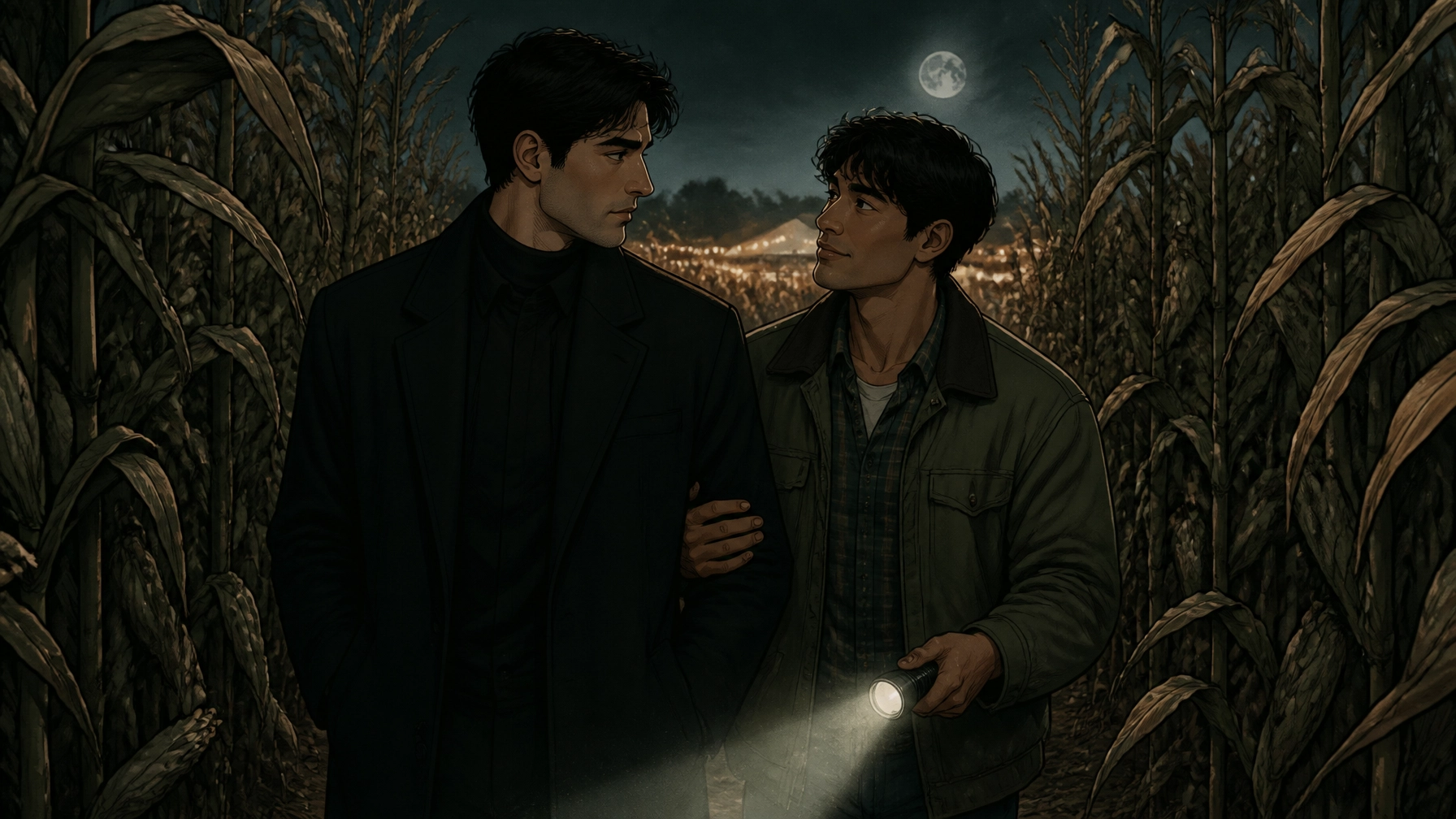
There are men who make a home out of being difficult to reach.
Elliot had perfected the art.
He lived in the city, in a flat high above the traffic, where the windows reflected more than they revealed. His calendar was divided into clean blocks. His clothes were carefully chosen. His answers were polished before anyone had the chance to ask the second question.
He had dated women because it was easier to explain. He had wanted men because wanting them had never been the difficult part.
The difficult part was what wanting them might mean.
He had never said the word bisexual aloud. Not to a friend. Not to a lover. Not even in the privacy of his own bathroom, where the mirror had watched him practise every other kind of honesty. The word existed somewhere inside him, bright and frightening, but he kept it behind his teeth.
Then, one cold Saturday in October, Elliot drove three hours from the city to a rural autumn festival because a colleague had cancelled at the last moment.
He told himself he wanted fresh air.
He told himself he wanted to see something uncomplicated.
He did not tell himself that he was tired of being known only in fragments.
The Festival Beyond the Field
The festival occupied a few acres beside a working farm. There were hay bales arranged beneath hand-painted signs, strings of lights looped between wooden posts, and tables crowded with jars of preserves, knitted scarves, carved pumpkins, and small cakes dusted with sugar.
The air smelled of earth and cider.
Somewhere near the centre of the field, children shrieked with laughter as they chased one another between the stalls. A folk band played beneath a canvas awning. Beyond the music, crickets sang in the long grass with the stubbornness of tiny clocks.
Elliot stood at the edge of it all, holding a paper cup of cider he had forgotten to drink.
He was too sharply dressed for the mud. His boots were city boots, beautiful and impractical. The local families glanced at him without hostility, but with the mild curiosity reserved for someone who had arrived from a place where people did not know one another’s grandparents.
That was when he met Rowan.
Rowan was standing beside a wooden board marked NIGHT MAZE , LAST ENTRY 8:30. He wore a faded green jacket, worn boots, and a wool hat pulled low against the cold. His hands were broad and roughened by work. There was a small white scar across one knuckle.
“You planning to go in?” Rowan asked.
Elliot looked towards the cornfield. In daylight, the maze might have seemed playful. In the dark, its walls rose higher than a man’s head, the dry stalks whispering together whenever the wind moved through them.
“I’m considering it.”
“That usually means no.”
“I’m from the city,” Elliot said. “We consider things before doing them.”
Rowan smiled, but not in a way that made Elliot feel mocked. “Then you’d better consider quickly. The lights go out in twenty minutes.”
The maze had been built by Rowan and his father, though Rowan had designed the pattern himself. He explained this while handing Elliot a small paper wristband and a torch.
His mother, Rowan added, had helped every year until the previous autumn.
He said it plainly. There was no dramatic pause, no invitation for pity. But grief moved through his voice like a draft beneath a door.
Elliot noticed because he knew something about hiding pain inside ordinary sentences.
The First Wrong Turn
Inside the maze, the festival disappeared almost at once.
The sounds remained, but they changed. Laughter became distant and strange. Music thinned into a few notes carried over the field. The dry corn stalks scraped against Elliot’s jacket as he walked, leaving a faint dust on the dark fabric.
His torch beam trembled over the path.
The cold was sharper between the walls. It carried the smell of cut earth, crushed leaves, and the sweet smoke of cider heating somewhere beyond the field. Above him, the sky was a narrow strip of black-blue, crowded with stars the city had taught him not to expect.
Rowan walked ahead, not too quickly.
“You built all this?” Elliot asked.
“Most of it.”
“How do you know where you’re going?”
“I don’t always.”
Elliot gave a short laugh. “That’s reassuring.”
“The maze has a map.”
“Do you carry it?”
“No.”
“Why not?”
“Because then it wouldn’t be a maze.”
They reached the first fork. Rowan turned left.
Elliot followed.
The path narrowed. The corn brushed his shoulders on both sides. He felt enclosed, watched by every dry leaf and bent stalk. The torchlight made a pale tunnel in front of him, but the darkness beyond it seemed endless.
At the next crossing, Rowan stopped.
“Which way?” he asked.
Elliot stared at him. “You’re the one who built it.”
“I asked which way you want to go.”
It was such a small question. Elliot felt it enter him like a pin.
He was used to people who chose on his behalf because they assumed they understood him. He was also used to choosing first, before anyone else could. It was safer that way.
“Right,” he said.
They turned right.
Ten minutes later, they reached a dead end.
The corn stood before them in a dense wall. A pale scarecrow watched from the corner, its stitched smile almost invisible in the dark.
Rowan did not say anything.
Elliot looked at him. “You can laugh.”
“I’m not going to laugh.”
“You should. I was very confident.”
“Confidence and direction aren’t the same thing.”
The words landed harder than they should have.
Elliot turned away. Beyond the corn, a strand of festival lights flickered between the stalks. People were still moving out there. They were still warm, visible, connected.
“I’m good at pretending they are,” he said.
Rowan’s voice softened. “Pretending what are?”
“That the wrong path is progress.”
For a moment, there was only the sound of crickets and the faint creak of corn bending in the wind.
Then Rowan lifted his torch and pointed back the way they had come.
“We can go back,” he said.
Elliot felt the familiar instinct to make a joke, to turn the moment into something lighter and less dangerous.
Instead, he said, “I hate going back.”
“I know.”
“You don’t know me.”
“No,” Rowan said. “But I know the look of someone who would rather stay lost than admit he needs a different direction.”
What the Darkness Makes Possible
They retraced their steps.
This time, Rowan walked beside him.
He did not touch Elliot. He did not reach for his arm or place a guiding hand against his back. He simply kept the torch low, illuminating the ground between them so Elliot could see the roots, the stones, the places where the mud had begun to freeze.
It was an unfamiliar kind of care: offered without possession.
“My mother loved this night,” Rowan said after a while. “She said the maze made people honest.”
“Did it?”
“Not always.”
“What happened to her?”
Rowan’s silence was not evasive. It was the silence of someone deciding how much truth he could carry without dropping it.
“She died last winter.”
Elliot looked at him.
“Cancer,” Rowan continued. “Quick at the end. Slow everywhere else.”
“I’m sorry.”
“Thank you.”
Rowan’s face was partly hidden by shadow. He looked younger than Elliot had first thought, but the grief had altered the shape of him. It had made him careful, too. Perhaps not in the same way Elliot was careful, but with a similar fear of discovering that the people he loved could vanish without warning.
“I keep thinking everyone is leaving,” Rowan said. “Even when they’re just going home.”
Elliot understood that more than he wanted to.
“People leave,” he said.
“They do.”
“So you’re right to be afraid.”
Rowan glanced at him. “That’s a bleak thing to say.”
“It’s an honest thing.”
“Honesty isn’t always the same as truth.”
Elliot nearly stopped walking.
There it was again: the feeling of being seen without being exposed. Rowan did not know about the women Elliot had dated, or the men he had loved in rooms where the curtains stayed closed. He did not know how many times Elliot had reached for a word and swallowed it.
But perhaps he understood the shape of silence.
At another fork, Rowan held out the torch.
“Your turn.”
Elliot took it.
The light shifted between them. His hand brushed Rowan’s. The contact was brief, almost accidental, but neither man pretended not to notice.
“Straight ahead,” Elliot said.
Rowan followed.
The Word Between Them
They walked for several minutes before Elliot spoke again.
“I’ve never said it.”
Rowan waited.
“The word.”
“What word?”
Elliot tightened his grip on the torch. “Bisexual.”
The corn whispered around them.
He had expected the word to feel like a confession. Instead, once spoken, it seemed almost ordinary. A sound. Seven letters. Something that had been true before he had found the courage to name it.
Rowan did not celebrate. He did not tell Elliot that it explained everything. He did not say he had known.
He only said, “Thank you for telling me.”
Elliot looked at him. “That’s all?”
“That’s not all.”
“What else is there?”
“You said something true in a place where you couldn’t see the whole way out.”
The tenderness of it frightened Elliot more than judgement would have.
“I don’t know what I’m supposed to do now,” he said.
“You don’t have to do everything now.”
“I’ve waited too long.”
“Maybe. But waiting isn’t the same as failing.”
They reached another dead end.
This time Elliot laughed. It came out unexpectedly, rough and quiet. Rowan laughed too, and the sound loosened something in the darkness.
“Your maze is badly designed,” Elliot said.
“It’s emotionally accurate.”
“That’s worse.”
Rowan turned towards him. Their shoulders nearly touched.
“I’m not going to ask you to promise you’ll stay,” he said.
Elliot’s breath caught.
“Good,” he said.
“But I might ask you not to disappear without saying goodbye.”
Elliot looked down at the ground. The torch beam lit a scatter of yellow leaves.
“I can try.”
Rowan nodded. “Trying is a beginning.”
Out Into the Light
The exit appeared so gradually that Elliot did not recognise it at first.
The walls of corn thinned. The ground widened. Beyond the final row, the festival lights glowed in soft loops of amber and green.
The music had stopped. Families were gathering their coats. Someone was stacking empty cider cups beside the stall. The ordinary world waited exactly where they had left it.
Rowan lowered the torch.
Elliot did not feel transformed. He was still afraid. He still had a life in the city built from locked doors and carefully managed distances. He still did not know who he would tell, or when, or what might change once the truth was no longer contained inside him.
But Rowan had walked beside him through every wrong turn without making his fear into a weakness.
At the cider stall, Rowan poured them both another cup.
Elliot held the warm drink between his hands. Steam rose into the cold air.
“Will you be here next weekend?” Rowan asked.
It was not a declaration. It was not a promise. It was simply a question offered a little too carefully.
Elliot could have protected himself with uncertainty.
Instead, he said, “Yes.”
Rowan’s smile was small, but it reached his eyes.
Elliot looked back at the maze. In daylight, it would be only corn again: harvested stalks, trampled paths, a structure destined to disappear when the field was cleared.
But tonight it had given him something he had not known how to ask for.
Not rescue.
Not certainty.
A man with a flashlight. A patient voice. One turn at a time.
For readers drawn to MM romance in unexpected places, a gay love story emotional journey, and character-driven queer fiction, this is where the heart of the story lives: not in instant love, but in the first brave decision to remain present.
That is the kind of emotional MM romance literary readers remember. The kind that understands vulnerability is not a single grand gesture. Sometimes it is a word spoken in the dark. Sometimes it is choosing a direction when every path looks uncertain. Sometimes it is allowing another man to walk beside you without demanding that he lead you forever.
Explore more LGBTQ+ ebooks, gay novels, queer fiction, and emotionally immersive MM romance through Read with Pride, or discover Dick Ferguson’s collection of heartfelt gay fiction and gay love stories in the Dick Ferguson e-book store.
Three Possible Next Evening Edition Stories
- The Last Ferry Across the Estuary: A guarded museum curator misses the final boat and must spend the night with the fisherman’s son who has been quietly waiting for him to come back.
- The Lantern Walk Through the Forest: Two men carrying separate griefs lose sight of the community procession and discover that the darkest path can lead to the most honest conversation.
- The Winter Greenhouse: A city architect arrives to close a failing rural nursery and finds himself challenged by the gay horticulturist determined to keep his family’s fragile legacy alive.
Follow us on social media
Follow Dick Ferguson and Read with Pride for more gay romance books, LGBTQ+ fiction, MM novels, reading recommendations, and new emotionally charged stories:
#EveningEdition #ReadWithPride #MMRomance #GayRomance #QueerFiction #GayFiction #MMNovels #LGBTQFiction #GayLoveStories #EmotionalMMRomance #CharacterDrivenQueerFiction #BisexualRepresentation #LGBTQReading #GayBookRecommendations #ReadingWithPride


Leave a Reply
You must be logged in to post a comment.