

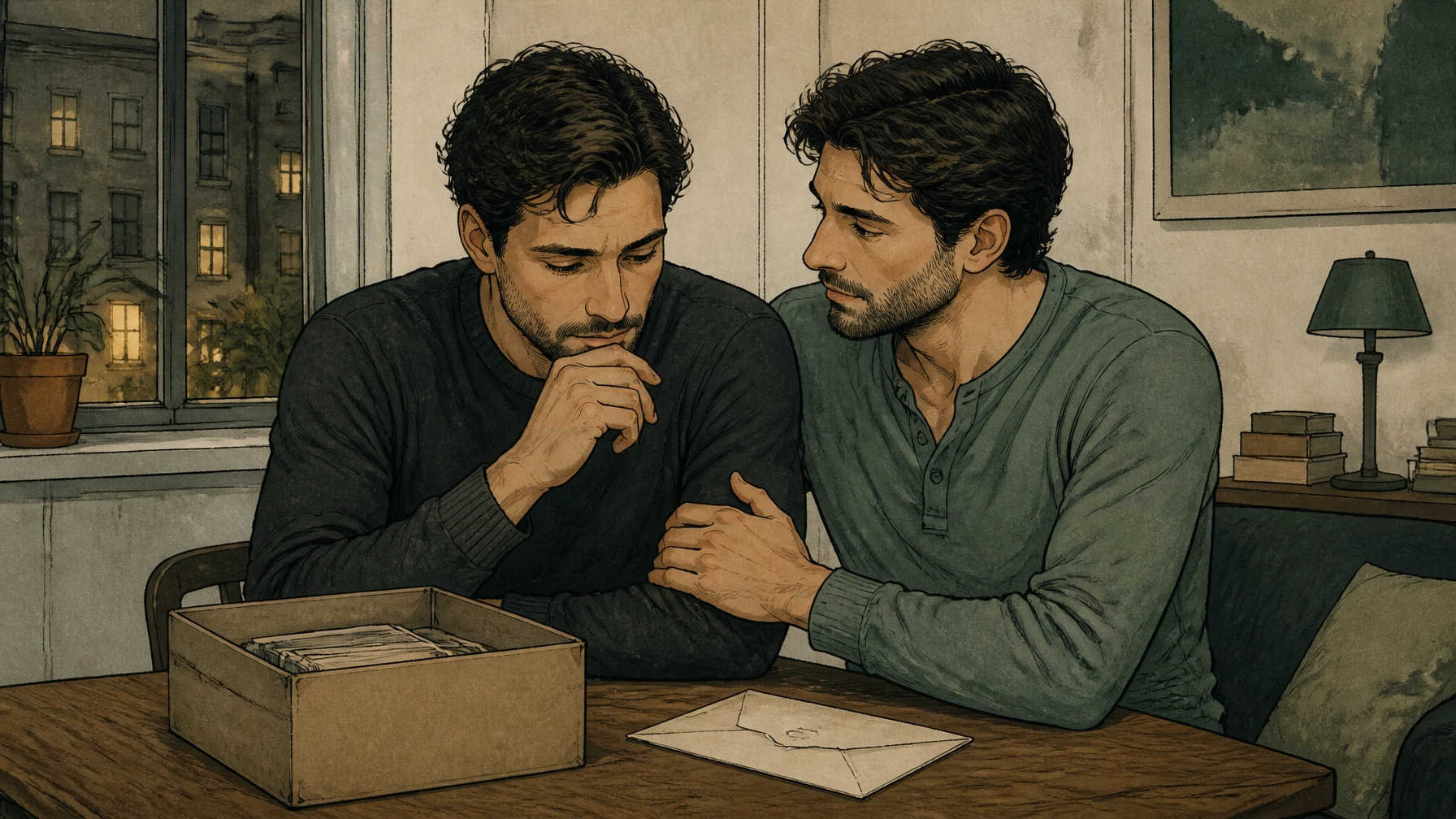
Part of the Queer Experiences and Stories 6 PM daily series , the Julian and Elias arc.
The morning after Julian found Elias’s name still written on the old apartment wall, neither of them mentioned the dust on their coats.
They had walked home through streets silvered by rain, carrying the strange quiet that follows a confrontation. Elias had finally stood in front of Adrian, his ex, his unfinished sentence, the person whose name had lived for years in the locked rooms of Elias’s memory.
He had expected anger to feel louder.
Instead, it had felt like setting down a weight and discovering the floor beneath him was still there.
Now, that evening, Elias sat at the edge of Julian’s sofa with a small cardboard box between his shoes.
Julian did not ask what was inside.
That was one of the things Elias loved about him. Julian knew how to leave a door open without standing in it.
The flat smelled of tea and rain-damp wool. Somewhere outside, a bus sighed at the kerb. The old radiator clicked and settled, clicked and settled, as though trying to find the right words.
Elias rested both hands on the box.
“I wrote something to Adrian,” he said.
Julian looked over from the kitchen doorway. “Recently?”
“No.”
The answer carried more weight than the box.
Elias was in his thirties now. He had learned how to make a life, how to pay bills, how to answer difficult questions with a joke sharp enough to turn people away. He had learned how to walk into a room and become part of its wallpaper.
When he was younger, invisibility had been a form of survival.
He had made himself smaller at school. Quieter in crowded rooms. Careful around anyone who seemed capable of noticing too much. He had mastered the art of swallowing his own reactions before they reached his face.
Even with Adrian, he had hidden.
Especially with Adrian.
“I wrote it when we were still together,” Elias continued. “Or when I thought we were still together. I don’t know. We had already started disappearing from each other.”
Julian came closer and sat beside him, leaving only a few inches between them.
“You never sent it?”
Elias shook his head.
He lifted the lid from the box.
Inside were old receipts, a train ticket, two photographs turned face down, and a letter folded into quarters. The paper had softened along the creases. Its edges were yellowed, and one corner had been repaired with a strip of clear tape.
Julian stared at it, but did not reach for it.
Elias appreciated that.
“I kept it because I thought one day I’d become the sort of person who could read it,” he said.
“And are you?”
Elias gave a tired smile. “I don’t know.”
Julian’s hand moved across the sofa cushion until his little finger touched Elias’s. It was barely contact. It was enough.
For a moment, Elias considered putting the letter away again. He could close the box, slide it beneath the sofa, and tell Julian that it no longer mattered.
But that would be another kind of lie.
“I want you to read it,” Elias said.
Julian’s expression changed, not with surprise, exactly, but with care. “Are you sure?”
“No.”
The honesty of it made Julian smile.
“Then we can stop.”
“I know.”
Elias picked up the letter. His fingers trembled once before becoming still.
He handed it over.

Julian unfolded the first crease slowly. He did not smooth the paper flat. He seemed to understand that some things should be allowed to keep their scars.
The handwriting was Elias’s, but not quite. The letters leaned too far forward, as if they were always trying to escape. Some words had been crossed out so hard the paper had nearly torn.
Julian read silently.
Elias watched his face.
That was the worst part, not the letter, not Adrian’s name, not the old humiliation rising like heat beneath his skin.
It was being witnessed.
The younger Elias had been desperate. He had written about waiting by the phone. About pretending not to care when Adrian cancelled. About wanting to be chosen without ever having the courage to ask.
He had written: I keep telling myself I’m patient, but I think I’m afraid.
He had written: If you leave, I don’t know who I’m allowed to be.
He had written: I hate that I need you to say I’m real.
Elias remembered writing those words late at night, sitting on the floor of a room that no longer existed. He remembered the blue light from the window. He remembered hearing Adrian move around in the next room and deciding, once again, that silence was safer.
Julian reached the final page.
Elias looked away.
The room blurred around him. The radiator clicked. A car passed outside. Julian breathed beside him.
“I was pathetic,” Elias said.
Julian folded the letter along its old creases.
“You were young.”
“I was pathetic and young.”
“You were frightened.”
“That doesn’t make it better.”
“No,” Julian said. “It makes it true.”
Elias swallowed. “I wanted him to save me.”
“Maybe you wanted him to see you.”
The words entered Elias with such gentleness that they hurt.
He had spent years believing the letter was evidence against him. Proof that he had been needy, weak, embarrassing. Proof that the younger version of himself had mistaken longing for love.
But Julian had not read it like a confession at trial.
He had read it like a map.
A map of all the places Elias had once been afraid to stand.
“I never showed him,” Elias said. “I thought if he read it, he’d know how much power he had.”
“He already had the power.”
“I know.”
“And you thought hiding the letter would take it back.”
Elias nodded.
Julian placed the pages on his knee. “Did it?”
“No.”
The answer was almost a laugh, but it broke before it became one.
Julian turned towards him. “Elias, you don’t have to be proud of every version of yourself to forgive him.”
“Forgive who?”
“The man who wrote this. The man who stayed. The man who kept waiting. All of them.”
Elias stared at the letter.
There it was: the thing he had never understood about tenderness. It was not admiration. It was not pretending someone had never been lost.
Tenderness was looking directly at the worst parts and refusing to use them as weapons.
“Would you have stayed?” Elias asked.
“With Adrian?”
“With me. Back then.”
Julian’s eyes softened. “I didn’t know you back then.”
“That isn’t what I asked.”
“No.” Julian took Elias’s hand. “But I know you now.”
The sentence was simple. It did not promise to rewrite the past. It did not turn pain into something beautiful just because it had ended.
It offered something better: presence.
Elias leaned forward, elbows on his knees. Julian’s thumb moved over his knuckles.
“I thought being loved meant being easy to keep,” Elias said. “No demands. No difficult truths. No needs that might make someone look at me and decide I was too much trouble.”
“And what do you think now?”
Elias considered the question.
The answer did not arrive all at once. It came in pieces: Julian waiting by the doorway, Julian reading every damaged page, Julian not flinching from the boy Elias had been.
“I think being loved means someone knows where it hurts,” he said, “and doesn’t press there.”
Julian’s mouth trembled.
Then he lifted Elias’s hand and kissed his fingers.
It was not dramatic. No music swelled. No old ghosts vanished. Adrian remained part of the story, as did the apartment wall and the years Elias had spent hiding in plain sight.
But the letter was no longer sealed inside him.
Julian placed it back in the box, then paused.
“Do you want to keep it?”
Elias looked at the pages.
For years, he had treated the letter like a locked room. Now it seemed smaller. Still painful, but no longer endless.
“Yes,” he said. “But not hidden.”
Julian nodded.
Together, they found an envelope. Elias wrote the date on the front. Not Adrian’s name. Not an explanation.
Just the date.
Then he placed the letter inside and set it on the bookshelf, between two books they had both read.
A secret, brought into the light.
Later, they sat on the floor with their backs against the sofa. Elias rested his head on Julian’s shoulder. The box remained open beside them.
“What happens now?” Julian asked.
Elias closed his eyes.
“Now,” he said, “you know.”
Julian turned and kissed his temple.
“I know.”
For Elias, that was the beginning: not of becoming fearless, but of no longer mistaking fear for a command.
The letter had never reached Adrian.
It had reached Julian.
And, at last, it had reached him too.
Why This Story Matters
Queer experiences are often shaped by the things people learn not to say. For many men, especially those who grew up believing that visibility was dangerous, silence can become a habit long after the danger has passed.
This story is about the emotional journey of allowing another man to witness the self you once tried to erase. It explores how a gay love story emotional journey can hold grief, shame, tenderness, and hope at the same time. Julian does not rescue Elias from his past. He meets him there: with patience, respect, and the steady understanding that healing is rarely a straight line.
For readers searching for MM romance unexpected places, this story finds intimacy not in a grand declaration but in an old box, a damaged letter, and the decision to remain present. That quiet scale is central to character-driven queer fiction, where the most important turning points may happen in a living room rather than on a stage.
It is also written for emotionally invested MM readers who want flawed men, honest conversations, and relationships built through trust. This is emotional MM romance literary in spirit: a story where the interior life matters as much as the plot, and where love is shown through attention.
Elias’s letter is not a perfect confession. It is messy, frightened, and sometimes unfair. That is precisely why Julian’s response matters. Queer fiction can make room for the younger selves we have outgrown without asking us to despise them.
Read with Pride
If you enjoy heartfelt gay fiction, emotional MM books, gay love stories, and character-driven romance, discover more LGBTQ+ ebooks through Read with Pride.
You can also explore Dick Ferguson’s stories in the Read with Pride e-book store, where readers can find gay novels, MM fiction, queer fiction, and emotionally immersive LGBTQ+ romance.
For readers looking for gay book recommendations, MM romance books, gay romantic fiction, or new gay releases in 2026, Read with Pride offers a welcoming place to continue reading with curiosity and connection.
Three Possible Next 6 PM Stories
1. The Night Julian Asked What Elias Had Left Out
After reading the letter, Julian notices one page is missing. Elias insists it was never written, but the empty space between the folded sheets tells another story. As the evening deepens, Julian asks the question Elias has been avoiding: what happened in the final week with Adrian?
2. The Saturday Elias Took Julian Back to the Railway Platform
Elias returns to the station where he once waited for Adrian and never boarded the train. Julian comes with him: not to recreate the past, but to help Elias see the younger man who stood there differently. A missed departure becomes the setting for a new promise.
3. The Afternoon Julian Found the Photograph Face Down
While helping sort the old box, Julian discovers a photograph Elias has kept turned away for years. The image reveals a version of Elias who once believed happiness had to be borrowed from someone else. Together, they decide whether some memories should be preserved, rewritten, or finally released.
Follow Us on Social Media
Follow Dick Ferguson for more queer experiences and stories, emotionally driven MM romance, gay fiction, and reading recommendations:
#QueerExperiencesAndStories #MMRomance #GayRomance #QueerFiction #GayFiction #MMNovels #LGBTQFiction #GayLoveStories #EmotionalMMBooks #HeartfeltGayFiction #CharacterDrivenRomance #GayRomanceBooks #MMRomanceBooks #ReadingWithPride #ReadWithPride


Leave a Reply
You must be logged in to post a comment.