

The Fair at St Aldwyn’s Hall
By four o’clock, the rain had polished the small town until every roof and pavement shone.
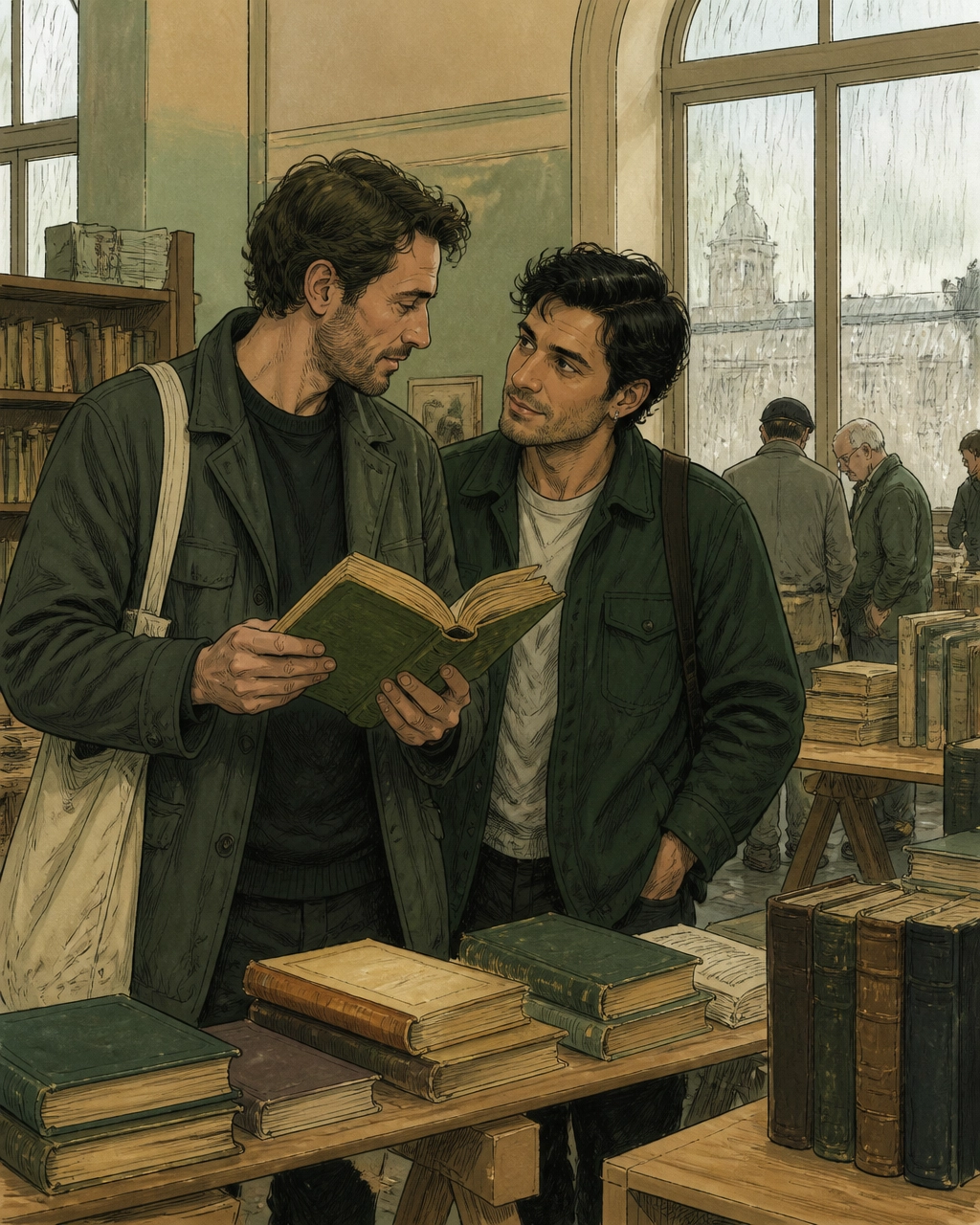
St Aldwyn’s Hall stood at the edge of the market square, a square-shouldered building of honey-coloured stone with tall windows and a clock that had been five minutes slow since 1987. For three days each autumn, it became a rare book fair. Dealers arrived in vans loaded with cardboard boxes, leather-bound volumes, maps, old theatre programmes, signed first editions, and the private remnants of lives that had once believed themselves permanent.
Caleb Vale had come for a particular book.
He had told himself that on the train. He had repeated it while walking from the station beneath a borrowed umbrella. He had believed it as he paid the entrance fee and accepted a paper catalogue from the volunteer at the door.
A particular book. Nothing more.
The book was a first edition of a novel by a writer Caleb had loved since he was nineteen, when he had discovered the author in a second-hand shop and read the final fifty pages standing beside a radiator. The story had been about a man who left home without knowing whether he was running from shame or towards himself.
Caleb had never decided which.
Inside the hall, the air smelled of dust, wet wool, coffee, and old paper. Conversations rose and fell between the trestle tables. A dealer lifted a fragile volume from a glass case. Someone laughed softly near the maps. Rain tapped the windows with the patient insistence of a person waiting to be admitted.
Caleb moved through the stalls slowly, keeping his hands in his coat pockets.
Then he saw the book.
It rested beneath a lamp on a table near the back wall, its green cloth cover faded almost to grey. The dealer had placed it beside a handwritten description of its history: found in a village library, rebound once, carried through a flood, preserved by someone who could not bear to throw it away.
Caleb reached for it at the same moment as another hand.
“Sorry,” the man said.
His voice was low and unhurried. He withdrew his hand, though his fingers remained close to the book.
Caleb looked up.
The man was perhaps a few years older than him, with dark hair touched by silver at the temples and a rain-darkened coat. He wore no wedding ring. Caleb noticed this, then hated himself for noticing.
“No,” Caleb said. “I’m sorry.”
They both smiled, uncertainly.
The dealer watched them with the calm amusement of someone who had spent decades observing people fall in love with objects, places, and occasionally one another.
“You may share it,” he said. “It’s not going anywhere.”
Caleb opened the book. The pages were cream-coloured and faintly uneven. A pressed leaf lay between the title page and the dedication, brittle as a thought that had survived too long.
“I’ve been looking for this edition for years,” Caleb said.
“So have I.”
The stranger leaned closer. His shoulder brushed Caleb’s. It was a small contact, entirely accidental, and yet Caleb felt it travel through him like a struck match.
“You’re Adrian?” Caleb asked, reading the name on the dealer’s receipt tucked beneath the volume.
“Adrian Mercer.”
“Caleb.”
“Just Caleb?”
“For now.”
Adrian looked at him then, not prying, simply listening to the shape of the answer.
They took turns reading the notes in the dealer’s description. The book had belonged to three people before reaching the fair. The first had written their name in blue ink. The second had underlined a sentence in pencil. The third had left no mark at all.
“No one leaves nothing behind,” Adrian said.
Caleb glanced at him. “You think so?”
“I think even silence has a history.”
It was the sort of sentence Caleb usually distrusted. Too polished. Too ready to be remembered. But Adrian said it without performance, his eyes still on the page.
They walked together after that.
The fair was large enough to offer the illusion of escape. They passed shelves of poetry, boxes of postcards, military histories, illustrated children’s books, and slim pamphlets advertising places that no longer existed. Adrian knew what he was looking for: travel journals, especially those written by men who had gone abroad and returned changed.
Caleb knew what he was avoiding.
At a table of modern first editions, Adrian picked up a signed collection of essays and turned it over in his hands.
“My sister gave me this author’s work when I was twenty-four,” he said. “She said it might help me understand myself.”
“Did it?”
“No. But it helped me understand that I wasn’t the only person failing to.”
Caleb smiled, but Adrian did not.
The crowded hall seemed to narrow around them.
“I was with a woman then,” Adrian continued. “Everyone thought that explained me. I thought it explained me. It was easier to say I was confused than to admit I wanted men. Easier still to let people call me bisexual as if the word were an apology.”
Caleb’s hand tightened around the catalogue.
“Are you bisexual?” he asked.
“Yes.”
The answer held no hesitation. It carried the weight of something long examined, not something newly discovered.
Caleb stared at the rows of books. The labels blurred: MEMOIR, POETRY, QUEER FICTION, LOCAL HISTORY.
“I am too,” he said.
Adrian turned towards him.
Caleb had told people before. He had told one friend in a university kitchen, his voice shaking over a mug of cold tea. He had told his brother by text because he could not bear to watch the first reaction arrive. He had told a man he once loved, who had responded by asking whether Caleb was simply afraid of commitment.
But he had never said it like this, in the middle of a rare book fair, with rain pressing against the windows and Adrian standing close enough to touch.
“I’m bisexual,” Caleb repeated. “I’ve known for years. I just haven’t known what to do with the knowing.”
Adrian nodded. He did not offer reassurance. He did not say that everything would be fine. He only remained.
That, Caleb discovered, was its own kind of mercy.
They bought the book together.
The dealer wrapped it in tissue paper and tied it with green cotton ribbon. Caleb paid half. Adrian paid the other half. They agreed, without discussing the practicalities, that neither of them would take it home that night.
Outside, evening had gathered over St Aldwyn’s. The market square lamps glowed in the rain. Across the road, the bakery was closing, and the last warmth of bread drifted into the wet air.
“I’m staying at the Bell,” Adrian said.
“So am I.”
It was a small hotel, the kind with polished brass numbers and carpets patterned to conceal decades of spilled drinks. Caleb had booked a room because the final train home left too early in the morning. Adrian had booked one because, he said, he liked old buildings with unreliable plumbing.
They walked beneath the same umbrella.
At the hotel, they sat in the lounge beside a dead fireplace. The book rested between them on the low table, wrapped and waiting. For a long time, neither man spoke.
Caleb thought about the years he had spent dividing himself into acceptable and unacceptable pieces. The women he had dated because affection was expected to travel in one direction. The men he had desired in secret, then dismissed as evidence of some personal failure. The loneliness of being known only in fragments.
“I’m frightened,” he said.
Adrian looked at him. “Of what?”
“Being known properly.”
The words seemed too bare once spoken.
Adrian reached across the table. His hand stopped a few inches from Caleb’s, asking a question without making him answer aloud.
Caleb closed the distance.
Their fingers met.
There was no thunder. No music. The hotel radiator clicked and settled. Someone moved dishes behind the bar. Outside, a bus passed through the square, its windows bright with other people’s lives.
Adrian’s thumb brushed once over Caleb’s knuckles.
“I’m frightened too,” he said.
Caleb turned his hand and held on.
Later, they opened the book beneath the lounge lamp. The old pages released a faint scent of cedar and rain. The underlined sentence waited exactly where the previous owner had left it:
We become real when someone is willing to remember us accurately.
Caleb read it aloud.
Adrian listened.
Then Adrian leaned towards him, slowly enough to be refused, and kissed him.
It was not a perfect kiss. Caleb’s mouth trembled. Adrian breathed in sharply. They both laughed afterwards, quietly, with the astonishment of men who had spent too long imagining the moment and not enough time living inside it.
In the morning, they would return to the fair. They would decide who kept the book first. They would exchange numbers, perhaps. They would discover the difficult, ordinary details that came after recognition.
But for that evening, in a small hotel beside a rain-bright square, they sat together with the pages open between them.
The book had survived a flood.
Their lives had survived silence.
And now, at last, both men had found someone willing to stay for the next chapter.
Why This Story Speaks to Emotionally Invested Readers
This rare book fair setting explores MM romance unexpected places, where intimacy begins not in a familiar romantic landscape but among fragile pages, handwritten histories, and the quiet pressure of a small town. At its heart, this is a gay love story emotional journey about bisexuality, coming out, loneliness, and the courage to be seen without explanation or apology.
Readers drawn to character-driven queer fiction will recognise Caleb and Adrian’s struggle to reconcile public identity with private truth. Their connection is not instant certainty. It is built through listening, patience, shared vulnerability, and the rare comfort of being believed.
For emotionally invested MM readers, the story offers an emotionally immersive relationship between two men who understand that love cannot erase fear. It can, however, make fear survivable. This is emotional MM romance literary in spirit: a tender, high-angst gay romance about identity, memory, and the stories we preserve because they preserve us in return.
Discover more emotionally rich LGBTQ+ ebooks, gay books, MM romance, queer fiction, gay novels, gay love stories, MM novels, LGBTQ+ fiction, gay literature, and heartfelt gay fiction through Dick Ferguson’s Read with Pride eBook store.
Read with Pride
Read with Pride celebrates LGBTQ+ reading, from gay romantic fiction and MM romance books to queer authors, gay authors, LGBTQ+ romance, emotional MM books, and new gay releases. Find your next character-driven story at Read with Pride, a welcoming destination for readers looking for meaningful representation and unforgettable connection.
Three Possible Next Evening Edition Stories
1. The Last Ferry to Blackwater Island
Two men meet aboard the final ferry of the season, carrying separate reasons for leaving the mainland. When the engine fails in the dark, they must face the truths they intended to outrun.
2. The Photograph Booth at the Winter Market
A guarded photographer and a recently out antique dealer are brought together by a lost photograph. One image forces them to question what can be hidden, what must be remembered, and whether love can begin after years of self-erasure.
3. The Night Train Book Club
A travelling book club gathers in a restored railway carriage, but one member never arrives. As two strangers search the station for him, an old letter reveals that their families’ histories have been connected all along.
Follow Us on Social Media
Follow Dick Ferguson for more emotionally charged MM romance, LGBTQ+ fiction, gay romance books, literary queer stories, and updates from the world of Read with Pride:
#ReadWithPride #ReadingWithPride #MMRomance #GayRomance #QueerFiction #GayFiction #LGBTQBooks #MMFiction #GayLoveStories #BisexualRepresentation #ComingOutStories #CharacterDrivenFiction #EmotionalMMRomance #GayAuthors #QueerAuthors #GayBookRecommendations #LGBTQReading #GayLiterature #EmotionalBooks


Leave a Reply
You must be logged in to post a comment.