

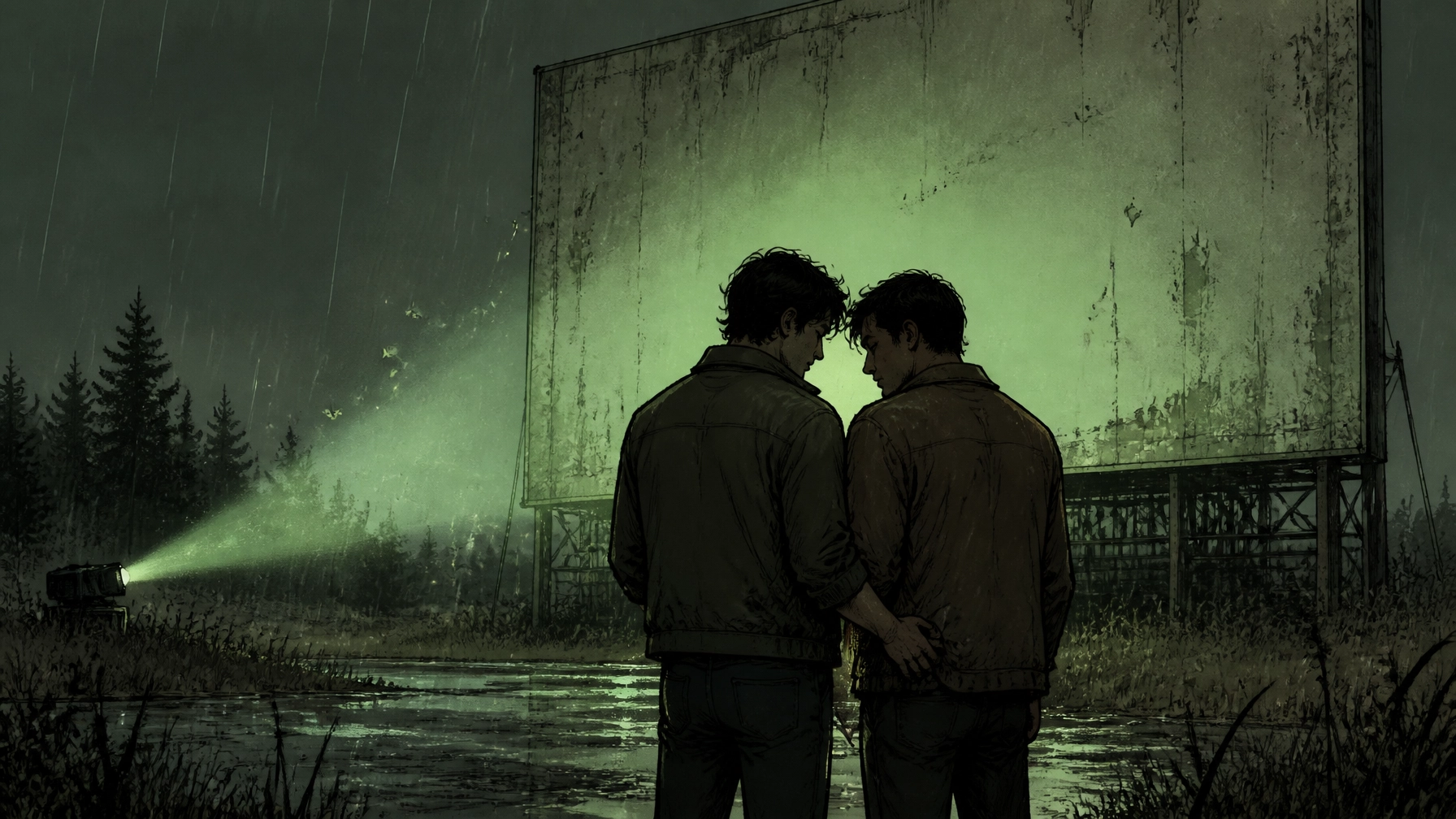
The Last Drive-In
By the time Julian Marsh reached the entrance, the rain had turned the old gravel road into a ribbon of black mud.
The sign above the ticket booth had lost most of its letters. Only THE LAST DRIVE-IN remained clear, though the final word hung crookedly from one rusted bracket. Behind it, the grounds stretched towards the tree line in waist-high grass. The screen stood at the far end of the lot, enormous and pale, its surface stained by weather and time.
Julian switched off the engine.
For a moment, he sat with both hands on the steering wheel.
He had come to sell the land.
That was the simple version. His father’s solicitor had used the words estate settlement, but Julian knew what they meant. Empty the house. Sign the papers. Find a buyer for the drive-in. Leave town before the place could pull him back into the life he had spent twenty years escaping.
The booth was still there, a low concrete building beside the concession stand. His father had spent forty years inside it, feeding reels through the projector while the town gathered beneath the stars.
Julian had spent forty years believing that his father had loved the projector more easily than he had loved his son.
He stepped out into the rain.
The smell reached him first: damp earth, rust, and the faint greasy sweetness of old popcorn oil. He remembered it from childhood. Summer evenings. Car windows open. His father’s hand on his shoulder as they watched the screen flare to life.
Then, from somewhere behind the concession stand, came the unmistakable hiss and mechanical rhythm of a film projector.
Julian froze.
The projector ran again.
He followed the sound through the weeds and found a man standing beneath the narrow awning outside the booth. He was perhaps thirty, with dark hair damp from the rain and a green jacket patched at both elbows. In one hand he held a metal film can. In the other, a flashlight.
“Can I help you?” the man asked.
“This is private property.”
“So is trespassing.”
Julian stared at him. “You’re the one trespassing.”
The man glanced towards the booth. “I’m looking after it.”
“You’re living here.”
It was not a question.
The man’s mouth tightened. “Sometimes.”
Julian recognised the reaction. He had spent enough of his life protecting difficult truths to recognise someone else’s defences.
“I’m Julian Marsh,” he said.
The man’s expression changed. “Your father’s son.”
“My father’s dead.”
“I know.”
The rain drummed on the metal awning between them.
“What’s your name?”
“Ezra Boone.”
“Ezra, you need to leave.”
Ezra looked past him to the screen. A pale rectangle of light trembled across its surface. The picture was almost impossible to see through the rain, but Julian caught the outline of a man walking along a railway platform.
“The projector still works,” Ezra said.
“That doesn’t give you the right to use it.”
“No. But it gives the place a reason to stay.”
Julian laughed once, without humour. “The place is falling apart.”
“Most things are, if you only look at the roof.”
Ezra led him into the booth.
Inside, the air smelled of old film, dust, and machine oil. The projector sat on its metal table, green paint dulled by decades of use. Reels turned slowly. The mechanism clicked and sighed, pulling the image through the lens and out into the night.
On the wall, Julian saw his father’s handwriting. Film titles. Dates. Notes about focus and sound. A list of repairs. Near the bottom, written in blue pencil, was a sentence Julian had never seen before:
Some pictures only come into focus after the projector goes dark.
“What does that mean?” he asked.
“Your father wrote it.”
“I know.”
Ezra shrugged. “Maybe you should ask him.”
The words landed harder than they should have.
Julian turned away.
For the next two days, they argued.
Julian measured the boundary lines and spoke to the solicitor. Ezra repaired a section of the screen’s frame and cleared weeds from the old speaker posts. Julian said no buyer would want a collapsing cinema in a field. Ezra said the town had lost enough places where people could gather without having to buy something.
“You’re preserving a memory,” Julian said.
“I’m preserving a possibility.”
“For whom?”
Ezra looked at him then. “People who haven’t arrived yet.”
The storm came on the third night.
Wind tore through the trees, lifting sheets of rain against the screen. The old structure groaned. Julian had just reached the driveway when lightning struck somewhere beyond the lot, and the sky opened with a crack that made him duck.
Ezra grabbed his arm.
“Booth,” he said. “Now.”
They ran together.
Inside, they stood dripping beneath the buzzing fluorescent light. Rain streamed from Ezra’s hair onto his face. Julian was aware of the warmth of his hand, still wrapped around Julian’s arm.
Neither of them moved.
Then the projector stuttered.
Ezra swore and crossed the room. “The reel’s slipping.”
Julian followed him to the machine. “Can it be fixed?”
“It can if you know what you’re doing.”
“My father taught me.”
Ezra glanced at him. “Did he?”
“When I was twelve.”
“And after that?”
Julian looked at the projector. “After that, I left.”
The film had come loose from the path. Ezra opened the gate and carefully lifted the reel. Julian remembered his father’s hands: steady, patient, never hurried. He remembered standing on a wooden crate beside him, learning how to guide the strip through the sprockets.
“Here,” Julian said. “The loop goes above the sound head.”
Ezra stepped close. Their shoulders touched.
The booth filled with the dry whisper of film between their fingers. Outside, rain hammered the screen. The projector’s lamp cast a green-white glow over Ezra’s cheekbones and the fine scar beneath his eye.
“Your father’s favourite,” Ezra said, nodding at the film can.
Julian read the handwritten label.
The Long Way Home.
“He watched it every year,” Julian said.
“Why?”
“I don’t know.”
Ezra’s voice softened. “You could find out.”
Julian threaded the film into place. “He was a quiet man.”
“So are you.”
“I’m not.”
“You’ve been here three days and said almost nothing that wasn’t about selling.”
Julian gave him a tired smile. “That’s because selling is easier.”
The projector began to run smoothly again.
For a while, they watched the image through the booth window. On the screen, a man stood at the edge of a sea, facing a town he had once abandoned. The picture shook whenever the wind struck the old screen.
“My father knew,” Julian said.
Ezra did not ask what he meant.
“Knew what?”
“That I was gay.”
The word seemed too large for the small booth. It crossed the room and settled between them.
Julian kept his eyes on the screen.
“I tried to tell him when I was nineteen. I had rehearsed it for weeks. I thought he might shout. Or ask questions. Instead, he told me the focus was wrong and handed me a screwdriver.” Julian swallowed. “I never tried again.”
“Maybe he understood.”
“Maybe. That was the problem. He never made me say it.”
Ezra leaned against the projector table.
Julian continued, because the storm had closed the world around them and there was nowhere left to run.
“I loved him for not making me ashamed. I hated him for making it so easy to stay silent. Then he died, and I realised I had built my whole life around a conversation that never finished.”
Ezra’s eyes were bright in the projector light.
“My mother used to bring me here,” he said. “After she died, I came back because I didn’t know where else to go. I started repairing things. First the booth. Then the projector. Then the screen.” He looked down at his hands. “I told myself I was preserving the place. Really, I was waiting for someone to notice it was still alive.”
Julian reached for him.
It was a small movement. Ezra could have stepped away.
He didn’t.
Their hands met beside the projector, warm and uncertain. The machine hissed on. Moths circled in the light beam, appearing and vanishing like fragments of a forgotten film.
“You could have told me,” Julian said.
“I thought you wanted to erase everything.”
“I thought you wanted to be left alone.”
“Maybe I wanted both.”
Julian smiled. “That sounds familiar.”
Ezra turned his hand and laced their fingers together.
The storm lasted until morning.
When they finally stepped outside, the rain had softened to a mist. Water shone on the screen. The grass bowed beneath its weight. Beyond the trees, the eastern sky was beginning to pale.
Julian stood beside Ezra in the middle of the empty lot.
“I’m not selling,” he said.
Ezra looked at him carefully. “You don’t have to rescue the place.”
“I know.”
“And it will cost money.”
“I know.”
“And the first season may be a disaster.”
Julian looked towards the booth. Through its small window, the projector was still glowing faintly.
“Then we’ll learn how to focus it.”
Ezra laughed, and the sound seemed to wake the whole abandoned theatre.
Julian put an arm around his waist. Ezra leaned into him. They stood beneath the enormous blank screen, two men surrounded by wet grass, broken speaker posts, and the remains of a life neither of them had expected to inherit.
By summer, the drive-in would show films again.
Not every night. Not to hundreds of cars.
But one season.
Together.
And sometimes, after the last picture ended and the projector went dark, Julian and Ezra would remain in the booth, listening to the quiet. In that darkness, without the machinery or the screen to speak for them, they would keep learning how to tell the truth.
Why Unexpected Places Make Powerful MM Romance Settings
An abandoned drive-in theatre is more than a striking backdrop for an MM romance. It gives the relationship a physical language.
The decaying screen reflects the characters’ emotional lives: both Julian and Ezra are standing inside stories that have been left unfinished. Julian has built an identity around leaving, while Ezra has built one around preserving what has already gone. Their conflict works because the setting makes those opposing instincts visible.
Unexpected places also create emotional pressure. A projection booth is cramped, private, and surrounded by darkness. When the storm forces Julian and Ezra inside, they cannot keep performing the roles they have chosen for themselves. There is no easy escape, only the hiss of the projector, the sound of rain, and the other man standing close enough to hear the truth.
For readers who seek emotionally immersive MM romance, settings like this deepen the story beyond attraction. They allow the landscape to carry themes of memory, grief, coming out, loneliness, and renewal. A forgotten drive-in becomes a place where two men can imagine a future: not by denying the past, but by choosing what deserves to be restored.
That is one reason atmospheric gay fiction, heartfelt gay love stories, and character-driven MM novels can stay with us long after the final page. The setting becomes part of the emotional journey.
Read with Pride
Discover more emotionally rich MM romance, LGBTQ+ fiction, gay novels, and moving gay love stories through Read with Pride.
You can find Dick Ferguson’s books, including literary gay fiction shaped by complex characters, intense emotion, and authentic male/male relationships, in the Dick Ferguson e-book store at Read with Pride.
Whether you are looking for emotional MM books, gay romance books, queer fiction, or new LGBTQ+ releases in 2026, Read with Pride is a welcoming place to continue reading with pride.
Three Possible Next Morning Edition Stories
1. The Night Train Bookshop
Two estranged men inherit a travelling bookshop built inside a retired railway carriage. One wants to sell the carriage for scrap; the other has spent years carrying queer literature between towns that have no LGBTQ+ bookshop. When the train is stranded overnight in a snowstorm, they must decide whether a home is defined by where it stops: or who is waiting inside.
2. The Lighthouse Repair Crew
A marine electrician returns to a remote lighthouse to dismantle its failing light. There he meets the solitary caretaker, a man who believes the tower still saves lives even though the modern coastguard no longer needs it. As the two repair the lantern together, old resentment gives way to a gay love story about visibility, fear, and being willing to shine.
3. The Museum of Unsent Letters
A quiet archivist discovers that the small-town museum’s collection contains hundreds of letters never delivered. A visiting conservator arrives to close the museum, but the two men begin tracing the stories behind the envelopes. Their search leads them towards a truth about their own lives: sometimes the most important message is the one we finally choose to send.
Follow Us on Social Media
Follow Dick Ferguson for new releases, writing updates, literary reflections, and more LGBTQ+ reading recommendations:
#ReadWithPride #ReadingWithPride #MMRomance #GayRomance #MMBooks #QueerFiction #GayFiction #GayNovels #GayLoveStories #MMNovels #LGBTQFiction #GayLiterature #MMFiction #GayRomanceBooks #MMRomanceBooks #LGBTQRomance #GayAuthors #QueerAuthors #MMAuthor #GayBookRecommendations #LGBTQReading #EmotionalMMBooks #HeartfeltGayFiction #CharacterDrivenMM #AngstyRomance
Images


Leave a Reply
You must be logged in to post a comment.