

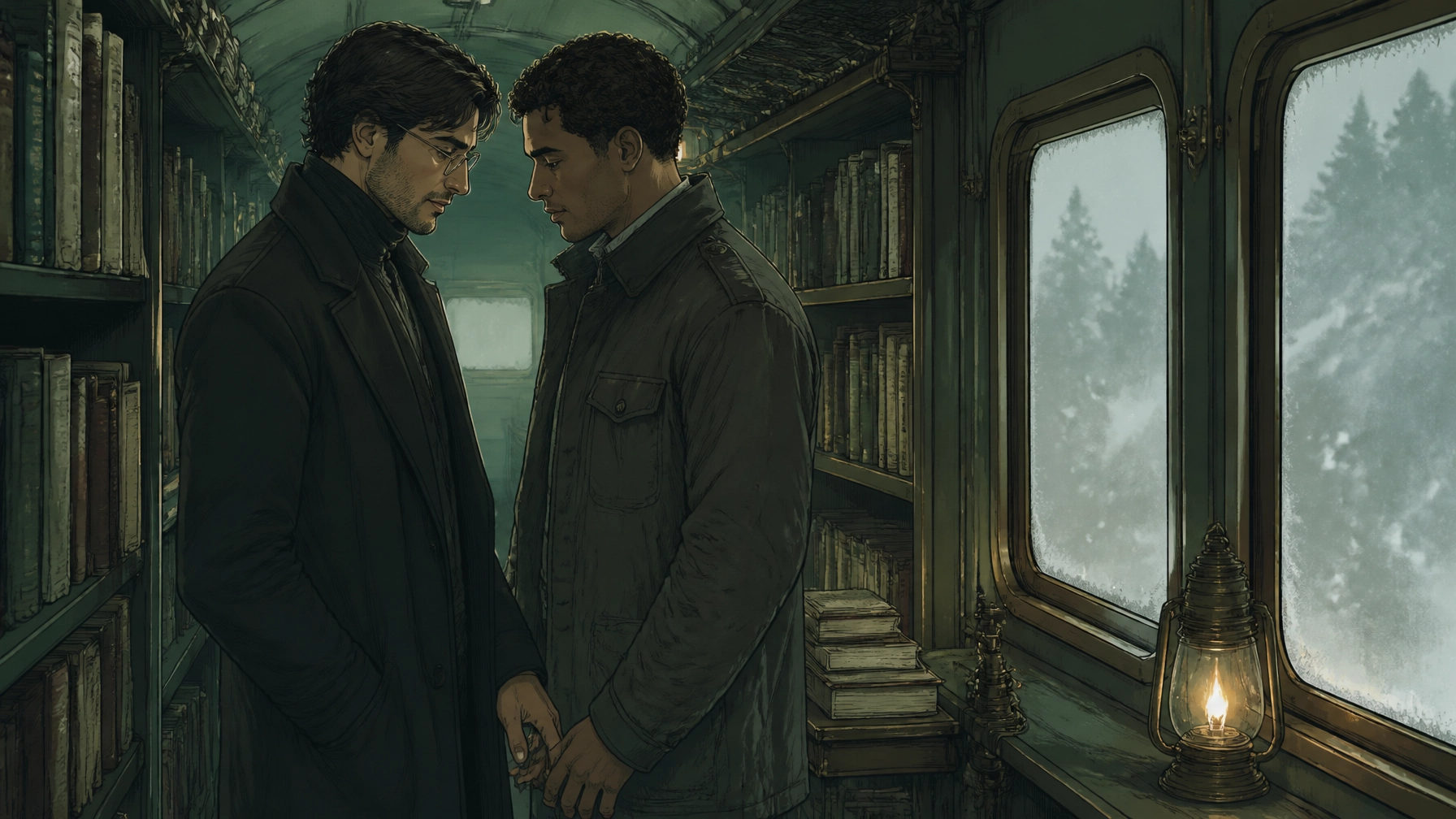
Cormac Vale arrived in Brackenford with one suitcase, a black wool coat, and a list of things that needed to be finished.
The list had been written in the city, where every task could be arranged into a column and every difficult feeling postponed until after lunch. Notify the solicitor. Empty the house. Photograph the contents. Settle the debts. Sell the railway carriage.
He had not written: stand in the doorway of the place his uncle had loved most and admit that the past still knew his name.
The station had been closed to passengers for eleven years. Its platform lay under a thin skin of snow, the signal box dark and leaning, the tracks shining like two lines drawn towards nowhere. Beyond the station, the hills folded into one another beneath a white sky.
And there, on a siding beside the old goods shed, stood the Night Train Bookshop.
It was a retired railway carriage painted a deep, weather-softened green. Brass lamps glowed behind the windows. Hand-painted lettering curved along its side. Inside, shelves had been fitted beneath the luggage racks and along the walls, packed with novels whose spines had been worn soft by hundreds of hands.
Cormac stopped at the carriage door.
He had expected dust. He had expected neglect. He had not expected the smell of old paper, paraffin, damp wool, and something warm cooking on a small stove.
“Doors are usually locked when the shop is closed,” said a man inside.
Cormac looked up.
The man stood between two shelves, tall and quiet, with dark hair touched by premature silver. He wore a railway keeper’s jacket over a thick jumper. His hands were ink-stained. His expression suggested that he had been expecting someone else, or perhaps no one at all.
“I’m Cormac Vale,” Cormac said. “My uncle was Declan Vale.”
“I know.”
“You’re Finley?”
“Finley Shaw.”
Cormac stepped inside. The carriage shifted slightly beneath him, as though it remembered the movement of a train.
Finley watched him take in the shelves.
There were gay novels, queer mysteries, MM romance, memoirs, poetry collections, and books about coming out. Some were new. Many were second-hand. A few had handwritten notes tucked between their pages.
Cormac lifted a paperback from a shelf and examined its cracked spine.
“You’ve been running this without proper inventory records.”
“I know what’s here.”
“That isn’t the same thing.”
“No,” Finley said. “It isn’t.”
Cormac placed the book back exactly where he had found it.
The carriage belonged to him now, apparently. Along with the contents of his uncle’s house, the unpaid repair bills, the outstanding fuel account, and a debt to the railway authority that made the solicitor’s voice go careful and flat.
He had inherited a moving bookshop with no reliable income and a roof that needed replacing.
“I’m going to sell it,” he said.
Finley’s face did not change, but something in the carriage seemed to go still.
“You’ve been here three minutes.”
“I’ve been looking at the figures for three days.”
“The figures don’t tell you what it is.”
“They tell me what it costs.”
“It costs less than losing it.”
Cormac turned towards him. “That’s not a business argument.”
“No,” Finley said. “It’s a human one.”
They spent the afternoon disagreeing.
Cormac found water damage beneath the rear window, a failing brake line, and receipts folded into the pages of old novels. Finley showed him the route map: Brackenford to Lowmarsh, Lowmarsh to St Anne’s Crossing, then north through three villages where the libraries opened twice a week, if the heating worked.
At every stop, people came looking for books they could not find anywhere else.
A young man who wanted a novel about another young man falling in love without dying at the end.
A married bisexual man who stood for twenty minutes in front of the fiction shelves before asking whether there were stories about people who loved more than one gender and still built something steady.
An older man who bought a book of queer poetry and held it against his chest as though it were warm.
“They come because they need to see that their lives have language,” Finley said.
Cormac looked through the carriage window at the snow beginning to fall again.
“They could order online.”
“They could,” Finley said. “But sometimes a person needs to walk into a room and discover that the book they were afraid to ask for is already waiting.”
The storm arrived just after dusk.
Snow swept across the siding in hard white waves. The railway operator sent word that the line was blocked beyond Lowmarsh. The carriage could not be moved until morning. The power failed soon afterwards, leaving only the paraffin lamps, whose flames hissed and trembled behind their glass.
Cormac stood with his phone raised towards the ceiling, searching for a signal.
“There’s no point,” Finley said.
“There has to be.”
“There isn’t.”
“No one knows I’m here.”
Finley gave a tired laugh. “Your uncle knew.”
The words struck harder than they should have.
Cormac lowered the phone.
His uncle had known many things. He had known Cormac hated early mornings, preferred black coffee, and could repair a torn dust jacket with the patience of a surgeon. He had known Cormac was leaving for university and would not be coming back often.
But he had not known the whole truth.
At eighteen, Cormac had left Brackenford because he was afraid of being seen. Afraid someone would understand why he looked too long at certain boys in the sixth-form common room. Afraid his careful, ordinary life would split open if he said the words aloud.
Later, in the city, he found language for himself. Bisexual. Queer. Complicated. Free, sometimes.
He found men, too. He loved some of them. He disappointed others. He kept one part of himself always prepared to leave before anyone could decide he was too much trouble to keep.
And through every relationship, he carried the unfinished conversation with his uncle.
“I was going to tell him,” Cormac said.
Finley sat on the edge of the narrow bench beside the stove. “Were you?”
“Yes.”
“When?”
Cormac looked at the frost feathering the windows. “The next time I came home. Then the next. Then after he got ill.”
Finley said nothing.
The old carriage gave a low, familiar shudder as the wind struck its side. Snow began to pile along the roof. The lamps hissed. Around them, the books leaned close in their shelves, their softened spines bearing the evidence of every reader who had needed them.
“My whole life,” Finley said, “I’ve been moving.”
Cormac glanced at him.
“Town to town. Line to line. If I left first, no one could leave me. That was the theory.”
“Did it work?”
“No.”
The honesty of it seemed to alter the air between them.
Finley told him that the Night Train had been the only home that ever wanted him. Not because it was easy. It was draughty, underfunded, and forever threatening to lose a wheel or a roof tile. But it had carried him through years when staying anywhere felt dangerous.
“I kept thinking,” Finley said, “that if I stopped, everything I’d outrun would catch up.”
“And did it?”
Finley looked at him then. “You did.”
For a moment, neither man moved.
Outside, the storm erased the tracks. Inside, Cormac could hear the soft ticking of cooling metal, the hiss of the lamp, and Finley’s breathing.
He had spent years preserving books because restoration was a form of control. A torn page could be mended. A cracked binding could be strengthened. Damage could be stabilised, documented, made almost invisible.
People were different.
People remembered where they had been broken.
Cormac reached across the small space between them and took Finley’s hand.
It was not a grand gesture. There was no audience, no perfect speech, no certainty that either of them knew what they were doing.
Finley’s fingers closed around his.
The carriage shuddered once more beneath the snow.
Neither man let go.
By morning, the storm had softened to a pale, steady fall. The railway crew cleared the line, but Cormac did not leave with the first maintenance vehicle. He stood on the platform while Finley unlocked the carriage, watching dawn gather in the frosted glass.
The debts remained. So did the leaking roof, the broken brake line, and the impossible accounts.
Cormac still intended to sell the house.
But he did not intend to sell the Night Train.
“One season,” he said. “I’ll help you run it for one season. We’ll make a proper plan. Apply for grants. Talk to the towns. Work out what it needs.”
Finley leaned against the open door. “And after one season?”
Cormac looked down the tracks.
“I don’t know yet.”
It was the first answer he had given all week that did not feel like a lie.
Finley nodded. “I want to stop.”
Cormac turned back to him.
“Not the bookshop,” Finley said. “The running.”
Cormac stepped closer.
Finley’s smile was uncertain, almost frightened. “I don’t know how to stay.”
“Neither do I.”
“That’s not very reassuring.”
“No,” Cormac said. “But it’s honest.”
They began with the shelves.
Cormac repaired what could be repaired. Finley kept the route. Together, they made room for more books about bisexual lives, more gay novels, more MM romance, more stories in which queer men were allowed to survive, desire, grow old, argue, return, and be loved without apology.
The Night Train continued between the small towns.
Some readers came for the books. Some came for the warmth. Some came because they had nowhere else to stand beneath a lamp and say, quietly, “I was looking for this.”
And when the carriage finally stopped at the end of the line each evening, Cormac began to understand that home was not necessarily the place you had escaped.
Sometimes it was the place that waited, patiently and imperfectly, for you to become brave enough to stay.
Why Unexpected Places Make Powerful MM Romance Settings
A railway carriage is an ideal setting for MM romance in unexpected places because it gives the love story motion and limitation at the same time. Cormac and Finley are always travelling, yet the winter storm forces them to become still. That tension creates space for the emotional work that a convincing romance requires.
The strongest gay love story emotional journey is rarely only about attraction. It is also about what the characters believe they must hide, what they are prepared to lose, and whether they can imagine being chosen without having to perform a different version of themselves.
The Night Train Bookshop also offers a natural home for character-driven queer fiction. Its shelves carry the private hopes of readers in communities without queer spaces of their own. The carriage becomes more than a setting: it becomes a moving refuge, a place where gay men and bisexual readers can encounter language for lives that may have felt isolated or invisible.
That emotional focus matters to emotionally invested MM readers. They want more than a convenient meeting and an uncomplicated happy ending. They want guarded men, difficult histories, coming-out journeys, bisexual visibility, fear, tenderness, and the slow, believable courage of learning to stay.
For readers who love emotional MM romance literary fiction, unexpected settings can make familiar themes feel newly alive. A bookshop on rails turns coming home into a physical journey. A blocked railway line becomes a chance to stop running. Worn book spines become evidence that stories can pass from hand to hand until someone finally recognises themselves.
Read with Pride
Read with Pride is a welcoming destination for LGBTQ+ ebooks, gay books, queer fiction, gay fiction, gay novels, MM novels, and heartfelt gay love stories.
To explore Dick Ferguson’s collection of emotional MM books, gay romance books, LGBTQ+ romance, gay psychological thrillers, gay contemporary romance, and other character-driven stories, visit the Dick Ferguson writer store on Read with Pride.
Read with pride. Find the story that has been waiting for you.
Three Possible Next Morning Edition Stories
-
The Last Lighthouse Cinema : Two men restoring a remote coastal cinema discover that the final film on its programme holds the secret to a love one of them thought he had lost forever.
-
The Museum of Unsent Letters : A guarded archivist and a touring poet meet in a museum where visitors leave letters they are too afraid to deliver.
-
The Mountain Weather Station : When a communications engineer is stranded at an isolated weather station, he must rely on its solitary keeper: and confront the future he has spent years refusing to forecast.
Follow Us on Social Media
Follow Dick Ferguson and Read with Pride for new LGBTQ+ fiction, gay romance recommendations, MM books, queer authors, reading inspiration, and emotionally immersive stories.
#ReadWithPride #ReadingWithPride #MMRomance #GayRomance #MMBooks #QueerFiction #GayFiction #GayNovels #GayLoveStories #MMNovels #LGBTQFiction #GayLiterature #MMFiction #GayRomanceBooks #LGBTQRomance #GayAuthors #QueerAuthors #MMAuthors #CharacterDrivenMM #EmotionalMMBooks #HeartfeltGayFiction #LGBTQReading #BisexualRepresentation #EmotionalRomance #QueerLiterature #GayBookRecommendations #LGBTQKindleBooks #GayRomanticFiction #PopularGayBooks #BestMMRomance


Leave a Reply
You must be logged in to post a comment.