

The Road Back
By the time Adrian saw the first flowers, the desert had already begun to forgive itself.
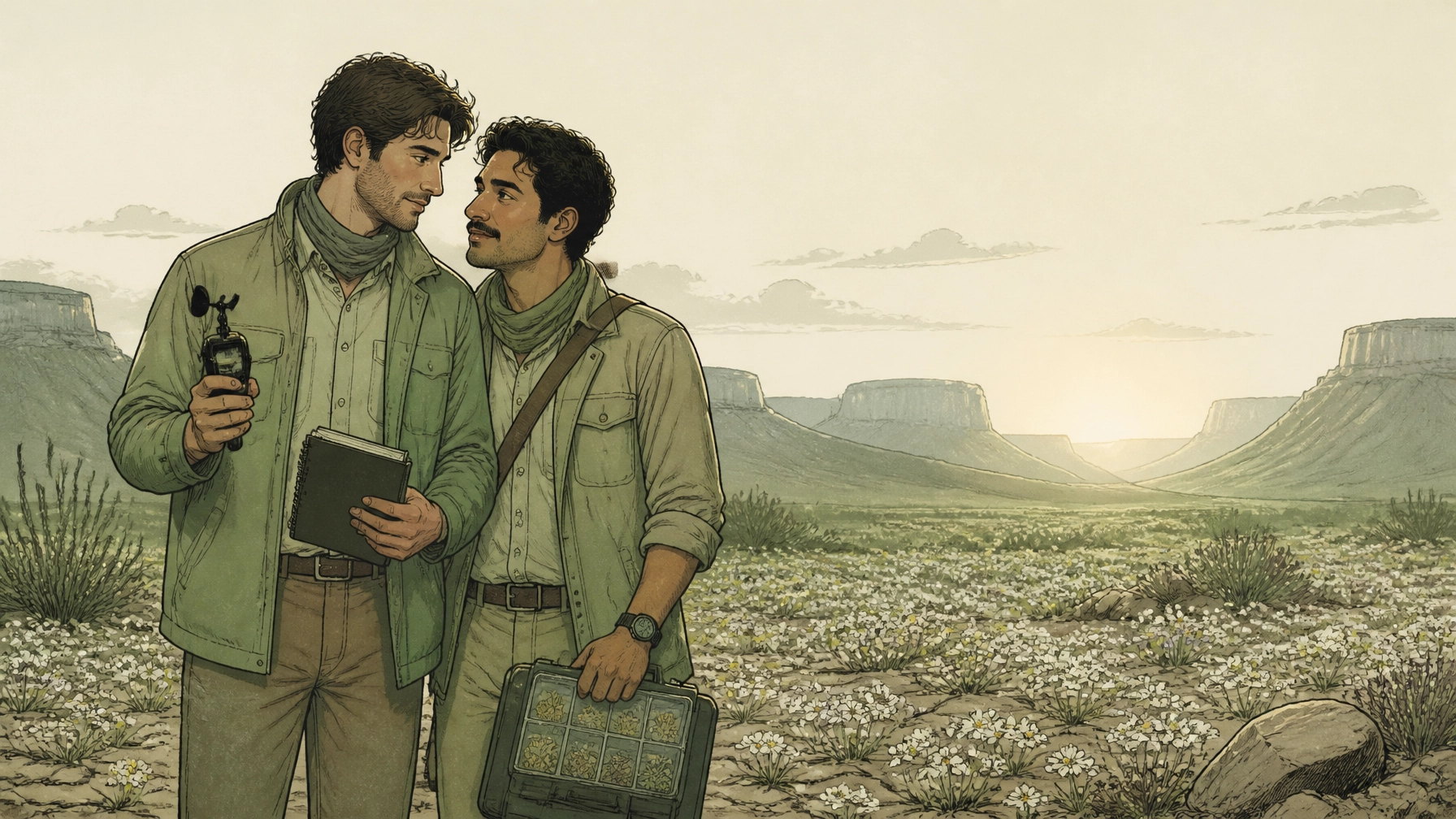
They appeared in scattered handfuls beside the highway: pale yellow cups, purple stars, small white faces turned towards the morning. Beyond them, the land stretched towards the mesas in long bands of rust and ash, still carrying the severity of all the years that had gone without enough rain.
Adrian drove slowly.
He had returned to the town with two cameras, a climate sensor, three notebooks, and the professional certainty that observation was safer than participation. His report would record rainfall, soil moisture, germination rates, wind patterns, and the timing of the bloom. It would explain how a buried seed bank could remain dormant through years of drought, then awaken when a rare sequence of storms softened the ground.
It would not explain why his hands had begun to shake when the town appeared.
He had left twelve years earlier, just as something between him and Tomás had started to become impossible to name as friendship. Adrian had been twenty-nine, frightened of staying, frightened of wanting a life that might ask him to be known. He had told himself that leaving was temporary.
The desert had understood otherwise.
He parked outside the botanical station, where the paint had faded from the doors and a line of flowering plants had pushed through the gravel. Tomás stood beneath the awning with a clipboard pressed against his chest.
He had aged in ways Adrian recognised and ways he didn’t. His hair was threaded with silver at the temples. His face had grown more deliberate, as if every expression had been considered before being permitted into the world.
“Adrian,” he said.
The name landed between them with the weight of a stone dropped into still water.
“Tomás.”
Neither man moved to embrace the other.
The flowers kept opening.
The Seed Bank
The seed bank occupied the oldest building on the station grounds. Its walls were thick enough to hold back the summer heat, and its interior smelled of paper, dust, metal shelving, and the faint green promise of things not yet alive.
Tomás had stayed behind to protect the collection. He had catalogued seeds gathered by generations of botanists, stored in envelopes and glass jars, each one carrying a future that might outlast the people who had placed it there.
He had also stayed to guard the memory of what he and Adrian had almost been.
Adrian understood that only after Tomás led him past the shelves.
“Some of these haven’t germinated in twenty years,” Tomás said. “They were waiting for the right conditions.”
“Or avoiding the wrong ones.”
Tomás glanced at him. “You always did prefer the explanation that made everything sound less personal.”
The words were not sharp. That made them worse.
Adrian set down his equipment. “I’m here to document the bloom.”
“I know.”
“I thought you might want the data.”
“I thought you might want to see what happened while you were away.”
The room seemed to narrow around them.
Outside, the desert had received more rain than it had seen in years. The first storm had soaked the hard upper soil. Then came the gentler rains, the ones that kept the ground damp long enough for roots to form. The seeds had not been dead. They had been conserving themselves.
Adrian placed his palm on the edge of the nearest shelf.
“I kept thinking I left just before things became real,” he said.
Tomás looked down at the clipboard. “You left when they were becoming real.”
What the Drought Kept
They worked together for three days.
Adrian measured the soil in the mornings while Tomás marked flowering sites and checked the protected plots. Their old rhythm returned in fragments. Tomás knew when Adrian would forget to eat. Adrian knew that Tomás became silent when he was tired rather than admitting he needed help.
They did not speak about the night Adrian left.
They spoke about rainfall instead.
The desert superbloom was not simply a miracle of water. It was an agreement between timing, temperature, buried seed, and patience. A single violent storm could wash the soil away. A few light showers could awaken the seeds without giving them enough moisture to survive. The bloom required rain that arrived deeply, then returned gently.
Adrian wrote this down.
In the margin, he wrote: Not every beginning can survive its first hope.
Tomás saw it.
“You still write things no one else can read?”
“Only when I’m trying not to say them.”
“And is it working?”
“No.”
They stood among the flowering plots, surrounded by colour so improbable that Adrian felt almost accused by it. The blooms had risen from years of restraint. They had not demanded an apology from the drought. They had simply taken the rain when it came.
For readers drawn to an MM romance unexpected places, the desert offered no easy metaphor. It was not a soft landscape. It did not make tenderness convenient. It gave them heat, distance, dust, and the hard evidence of survival.
Tomás had loved him patiently once.
Then patience had curdled into protective distance.
He had built a life that did not require Adrian’s return. He had learned to speak of him as weather: something that had passed through, altered the air, and gone.
The Fear of Blooming
On the fourth morning, Adrian found Tomás beyond the marked trail, kneeling beside a cluster of blue flowers.
The wind moved through the petals in small, uncertain waves.
“I used to think you would come back,” Tomás said without looking up.
Adrian stopped several paces away. “I came back.”
“Now.”
“Yes.”
“After the drought.”
Adrian had no answer that did not sound like an excuse.
He had spent years believing that he always left just as something began to bloom. He had made a private law of it, a story that excused him before anyone else could. Love would become serious; he would become restless. A place would begin to feel like home; he would find a reason to go. Someone would look at him with too much recognition; he would turn away.
It was easier to call himself incapable of staying than to admit that staying meant being witnessed.
“I was afraid,” Adrian said.
Tomás finally raised his head. “You were afraid of me?”
“I was afraid of what I became when you saw me clearly.”
The statement seemed to pass through Tomás rather than reach him.
“I saw you clearly,” he said. “You still left.”
“Yes.”
There were no arguments left to make the past kinder. No hidden circumstance waiting to explain everything. Adrian had left because he had been afraid, and Tomás had been hurt because he had been loved by someone who chose fear.
That was all.
That was enough.
The Work of Being Seen
The bloom spread across the valley in colours that changed with the light. Gold in the morning. Violet by noon. White and rose near dusk.
Visitors arrived from distant towns, carrying water bottles and cameras. They walked carefully between the marked paths while Tomás reminded them not to step on the new growth. Adrian recorded the flowering dates and the soil readings, but he also began to record the people who came simply to stand still.
One afternoon, Tomás found him beside the seed-bank door.
“You’ll put this in your report?” he asked.
“The data?”
“The part where the desert looks alive.”
Adrian considered the question. “I’ll put in what I can support.”
Tomás gave a tired smile. “You always needed evidence.”
“I still do.”
“Then what evidence do you have?”
Adrian looked at him.
Tomás’s expression tightened, ready for disappointment. Ready, perhaps, to protect himself from another answer that arrived too late.
Adrian reached for his hand.
He did not pull Tomás closer. He did not ask to be forgiven. He only offered the contact, palm open, with the same care Tomás had once shown him when they were younger and neither understood how much could be lost by waiting.
For several seconds, Tomás did nothing.
Then he took Adrian’s hand.
The gesture was small enough to be missed by anyone passing the building. It did not repair twelve years. It did not promise that fear would never return. It did not turn the past into something beautiful.
But Tomás stayed.
And Adrian stayed beside him.
After the Rain
The superbloom would not last forever.
The heat would come. The flowers would close. Seeds would form, scatter, and settle into the earth. Some would germinate next year. Others would wait for another season of impossible weather.
Adrian’s work would eventually take him elsewhere. Tomás would continue caring for the seed bank. The town would return to its ordinary colours.
Hope, Adrian discovered, was not the opposite of drought. It was what endured inside it without knowing whether rain would arrive.
At sunset, they walked beyond the last marked trail. The desert was darkening around them, but the flowers still held the final light.
“I can’t promise I won’t be afraid,” Adrian said.
Tomás’s hand brushed against his.
“I wouldn’t believe you if you did.”
“I can promise I’ll tell you when I am.”
Tomás looked towards the flowering ground. “That might be harder.”
“It probably will be.”
They continued walking.
Neither man was rescued. Neither became untouched by what had happened. They carried the old damage with them, not as a sentence, but as part of the truth they had finally allowed each other to see.
Behind them, the seed bank waited in the cooling dark.
Ahead, the flowers opened wherever the rain had reached.
Read with Pride
For readers who seek a gay love story emotional journey, richly drawn relationships, and character-driven queer fiction, Dick Ferguson’s work explores the tenderness, fear, jealousy, resilience, and longing that make love feel lived rather than manufactured.
Discover more gay romance, MM romance, queer fiction, LGBTQ+ ebooks, and literary gay fiction through Read with Pride. You can find Dick Ferguson’s books in the Read with Pride e-book store, alongside stories for emotionally invested MM readers who value complexity, emotional honesty, and beautiful prose.
For readers searching for emotional MM romance literary in tone and deeply rooted in character, the next story may begin in a desert, a city, a lighthouse, or the quiet space between two men who have not yet said what they came back to find.
Three Possible Next Morning Edition Stories
-
The Lighthouse Keeper’s Second Light
Two men reunite on a remote island when a broken lighthouse beacon begins sending a signal no one can explain. One has spent years maintaining the light; the other has returned to investigate the storm that once separated them. -
The Orchard Beneath the Snow
A conservationist returns to his family’s abandoned orchard and discovers that one old tree has survived every winter. The man caring for the land remembers why he left: and what was never spoken beneath the first snowfall. -
The Railway Station at the Edge of the Map
Two strangers meet at a rural station where trains have stopped arriving on schedule. As they wait through a long night, each must decide whether the life they escaped is the same as the life they still want.
Follow Us on Social Media
Follow Dick Ferguson for new stories, literary reflections, and emotionally immersive MM romance:
#MMRomance #GayRomance #QueerFiction #LGBTQPlusFiction #LiteraryGayFiction #EmotionalMMRomance #CharacterDrivenFiction #GayLoveStories #MMNovels #ReadWithPride #ReadingWithPride #GayBooks

Leave a Reply
You must be logged in to post a comment.