

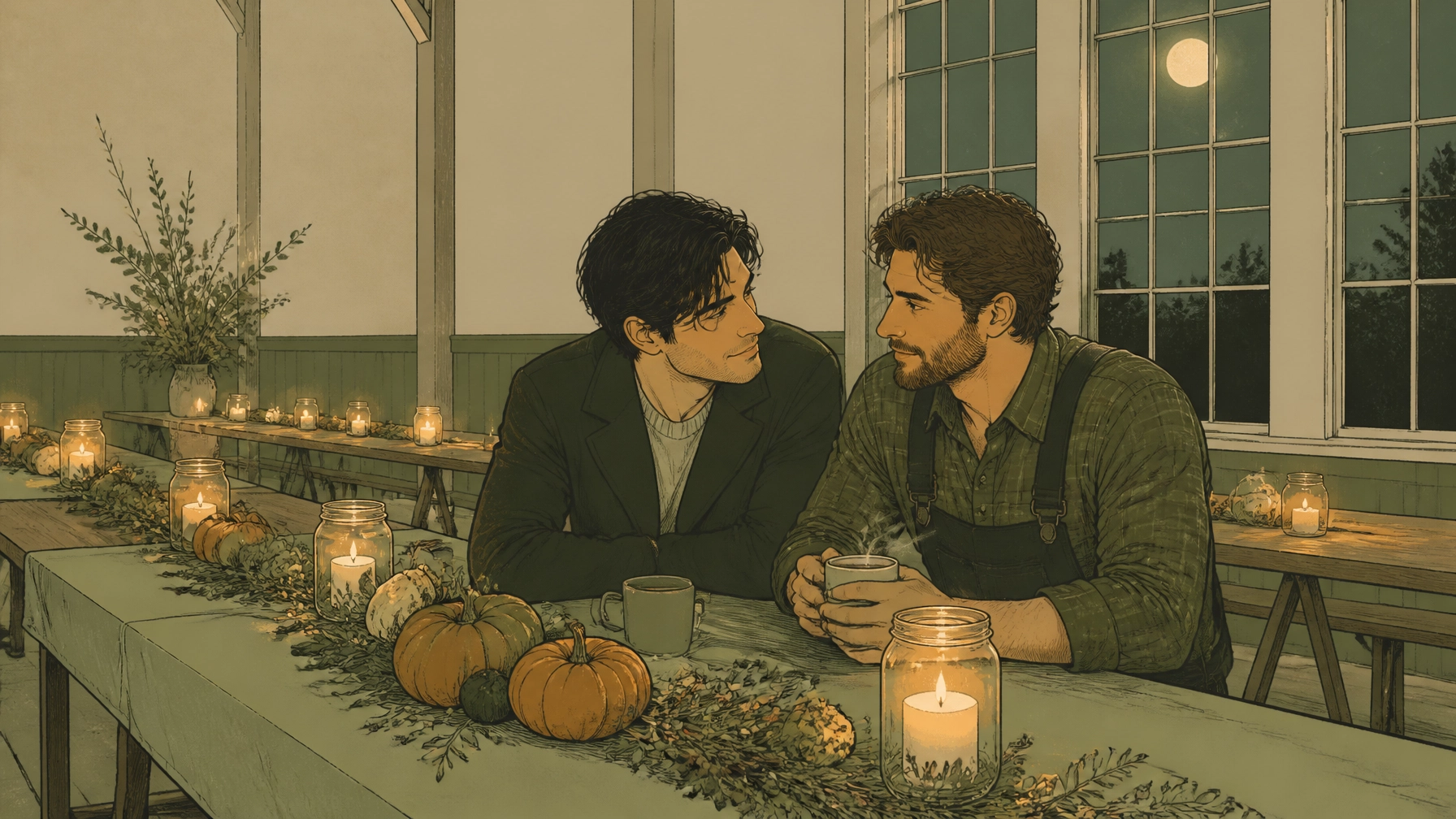
There were things Elias had learned in the city that had no use at the Harvest Moon Dinner.
He knew how to cross a crowded street without breaking stride. He knew which underground stations stayed open late, which cafés tolerated laptops after midnight, and how to make himself invisible in a room full of strangers. He knew the quiet discipline of not looking too closely at anyone, not because he lacked curiosity, but because being seen in return had always felt like a kind of danger.
In the city, he had learned to keep his life edited.
The village had no patience for editing.
By six o’clock, the community hall smelled of baked apples, warm bread, woodsmoke, and cider steeped with cinnamon. Long trestle tables ran from one end of the room to the other, covered in linen cloths that did not quite match. Candles burned in old glass jars. Baskets of onions, squash, pears, and late tomatoes formed bright, uneven centres along the tables.
Everything had been brought by somebody.
The bread belonged to a family whose farm sat beyond the eastern ridge. The jars had been collected over years. The candles had been poured by hand. Even the chairs seemed to carry histories: a scrape along one leg, a faded name beneath a seat, a repaired backrest polished smooth by generations of use.
Elias stood just inside the doorway, holding a dish he had bought from a supermarket in the nearest town.
He had removed the label. He had transferred the food to a ceramic bowl. He had told himself that made it less obvious.
“You’re early,” Rowan said.
Elias turned.
Rowan had come in from the fields. His boots were clean but still marked with dark soil around the seams. His sleeves were rolled to the elbow, showing forearms browned by weather and work. His hands were broad, calloused, and red at the knuckles from the cold.
The sight of them did something unsettling to Elias. Not because they were beautiful, though they were. Because they looked capable of belonging anywhere.
Rowan took the dish from him.
“You didn’t have to bring anything.”
“I know.”
“You brought something anyway.”
“I didn’t want to arrive empty-handed.”
Rowan glanced at the bowl, then back at him. “You didn’t.”
It was a simple thing to say. Elias felt it move through him like warmth.
That was the trouble with Rowan. He never seemed to speak only about the thing in front of him.
They had met three months earlier at the village post office, when Elias had been trying to send a parcel and had misunderstood the opening hours. Rowan had been behind him in the queue, patient enough to explain the difference between local collection and registered delivery.
Later, he had helped Elias carry a broken bookcase from the rented cottage. Then he had shown him the footpath beside the river. Then, one cool evening in September, he had stood outside Elias’s kitchen door with two paper cups of coffee and asked if he would come to the Harvest Moon Dinner.
“Everyone goes,” Rowan had said.
Elias had heard the unspoken question beneath it.
Would you come with me?
Now, as Rowan placed their dish among the others, Elias watched the room fill. People greeted one another without ceremony. They called across tables. They exchanged news about sheep, weather, repairs, grandchildren, and the lane that had flooded after the last rain.
No one seemed to wonder whether they had earned the right to be there.
Elias wondered constantly.
He had spent years believing belonging was something other people could grant or withdraw. An invitation. A glance. A hand held in public. A name spoken with affection instead of hesitation.
He had come to the village because the city had become too loud. He had stayed because Rowan made silence feel less like absence.
But the village knew things.
It knew whose chimney smoked late. It knew who was ill, who had left, who was struggling, who had planted winter garlic too soon. It knew when a person was lonely.
The city let him disappear. The village might ask him to remain.
At the table, Rowan sat beside him. Their shoulders touched once, briefly, as someone passed behind them with a steaming jug of cider.
The scent rose between them: apple, spice, and something faintly sharp beneath the sweetness.
“Do you want to leave?” Rowan asked quietly.
Elias looked at him. “Already?”
“I asked if you want to leave. I didn’t say we had to.”
Across the hall, candles trembled in their jars. Outside, the first pale edge of the moon was lifting above the fields.
Elias lowered his voice. “What if I don’t know how to do this?”
“Eat dinner?”
“Be here.”
Rowan did not pretend not to understand.
That was one of the things Elias loved most about him, though he had not yet said the word aloud. Rowan did not rush to fill a silence simply because it made him uncomfortable. He let difficult truths take their proper shape.
“You don’t have to know how,” Rowan said. “You only have to stay for as long as you want to stay.”
The food began to pass around the table. Root vegetables glazed with honey. Thick slices of bread. Savoury pies. Bowls of soup that sent steam curling into the candlelight.
Elias accepted a plate from Rowan. Their fingers touched.
The contact was ordinary. It was also not.
In the city, Elias had trained himself to treat tenderness like contraband. He had kept his voice measured. He had learned which kinds of affection could be explained away and which might invite questions. Even now, with Rowan’s knee resting lightly against his beneath the table, some old instinct told him to move away.
Instead, he stayed.
The dinner’s organiser stood at the far end of the hall and invited everyone to name one thing they were grateful for.
There were answers about rain, health, harvests, new roofs, old friends, and second chances.
When it reached Rowan, he looked down the table.
“I’m grateful for people who arrive,” he said. “Even when they’re not sure they’re allowed to stay.”
Elias felt the room narrow around those words.
He did not look at Rowan. He could not. His eyes had begun to sting, and he was afraid that if he moved too quickly, everyone would see.
But perhaps that was the lie he had lived inside for too long: the belief that being seen was the same as being exposed.
There was a difference.
Exposure was being looked at without care.
Being known was something else.
Being known was Rowan placing a hand beside his on the table, palm upward, offering rather than asking.
After a moment, Elias turned his hand over and took it.
Rowan’s fingers closed around his. The calluses pressed into Elias’s skin. They were rough in places, warm in others. A working hand. A real hand. A hand that had carried timber, repaired fences, lifted feed sacks, and now held him with unmistakable gentleness.
No announcement followed. No one stopped eating. Someone at the far end of the table laughed at a story Elias did not hear.
The world did not break open.
It made room.
Later, they stepped outside while the others cleared the plates. The hall glowed behind them, its windows bright with candlelight. The fields stretched into darkness, their edges silvered by the rising moon.
Elias drew his coat closer.
“I thought everyone would know I didn’t belong,” he said.
Rowan stood beside him, close enough that their sleeves touched.
“Everyone knew you were new.”
“That’s not the same thing.”
“No,” Rowan said. “It isn’t.”
Above them, the Harvest Moon climbed higher, large and pale over the fields. It illuminated the paths between the buildings, the hedgerows, the low stone wall that led toward Rowan’s farm.
Elias looked back at the hall.
“I brought a supermarket dish.”
“You brought food.”
“I was afraid it wouldn’t be enough.”
Rowan turned toward him. “You keep thinking belonging is something you have to prove.”
Elias swallowed.
“And it isn’t?”
“Not here.”
The answer was not grand. It did not erase the years Elias had spent guarding himself. It did not promise that fear would never return. But it offered something stronger than reassurance: a place to put the fear down.
Some tables are set long before the guests arrive.
They are prepared in the unseen hours, through years of shared work and quiet generosity. They are built from borrowed chairs, repaired doors, remembered names, and the certainty that someone will notice when another place is empty.
Elias had believed he was entering the hall as a stranger.
Perhaps he had been wrong.
Perhaps Rowan had been setting a place for him all along: not because he knew exactly who Elias would become, but because he understood that love sometimes begins by making room before anyone knows how to accept it.
For readers drawn to emotional MM romance literary fiction, this is where the deepest stories often begin: not with grand declarations, but with the fragile decision to remain. A gay love story emotional journey can unfold in a glance across a crowded room, in a hand offered beneath a table, or in the quiet relief of discovering that vulnerability is not a weakness.
It is an entrance.
It is the first step into character-driven queer fiction, where two men meet not in perfect circumstances but in the difficult, beautiful middle of ordinary life. It is the heart of MM romance in unexpected places: the recognition that tenderness can find us in a village hall, beneath harvest candles, while cider steams and the moon rises over fields we once believed we could never call home.
And for emotionally invested MM readers, perhaps that is the most enduring promise of all:
You do not have to arrive already certain.
You only have to come to the table.
Read more emotionally immersive MM romance, gay love stories, and LGBTQ+ fiction through Read with Pride, or explore Dick Ferguson’s books at Read with Pride.
Follow us on social media
Follow Dick Ferguson and Read with Pride for literary queer fiction, emotional MM romance, gay novels, and new reading recommendations:
#MMRomance #GayRomance #QueerFiction #LGBTQFiction #GayLiterature #MMNovels #CharacterDrivenFiction #EmotionalRomance #GayLoveStory #LiteraryRomance #ReadWithPride #EmotionallyInvestedReaders


Leave a Reply
You must be logged in to post a comment.