

There are days when hope feels easy to talk about.
Then there are days when grief sits beside you at breakfast, follows you onto the bus, and takes up the whole sofa in the evening. On those days, “look on the bright side” can feel less like comfort and more like a door being gently closed in your face.
Queer healing asks for something more honest.
It allows us to acknowledge what hurts while still making room for what might become possible. It reminds us that LGBTQ+ resilience is not about being endlessly strong, cheerful, or untouched by loss. It is about finding ways to remain connected to ourselves and one another, even when the road ahead is difficult to see.
Grief is part of queer history , and queer life
LGBTQ+ people carry many kinds of grief.
Sometimes it is the loss of a person we loved. Sometimes it is the loss of family support, a relationship, a home, a sense of safety, or years spent hiding parts of ourselves. There is grief in coming out stories that ended with rejection, and grief in the coming out stories that never felt safe enough to begin.
There is also collective grief: the people and possibilities taken from our communities by discrimination, violence, illness, poverty, shame, and silence. Some losses are publicly recognised. Others are not. A queer relationship may be dismissed by relatives. A chosen family member may be left out of funeral arrangements. A trans person’s life may be spoken about without the name or pronouns that honoured them.
When grief is repeatedly minimised, healing becomes harder. We need language that says: That mattered. They mattered. Your love mattered. Your life matters.
This does not mean staying trapped in pain. It means refusing to erase the truth in order to make other people comfortable.
Queer healing is not a straight line
Healing is often described as a journey, but even that image can feel too tidy. A journey suggests a route, a destination, perhaps a cheerful little sign saying “You’re nearly there!”
Real healing is more like a queer dance floor: circular, surprising, sometimes joyful, sometimes chaotic, and occasionally involving an unexpected encounter with a chair.
You may feel steady for weeks and then be surprised by a song, a date, a photograph, or a familiar smell. You may laugh one afternoon and cry the next morning. Neither response cancels the other out.
Grief and joy can share the same day. You can miss someone and still fall in love again. You can be angry about what happened and still imagine a beautiful future. You can need help and still be resilient.
In fact, asking for help is one of the clearest expressions of LGBTQ+ resilience. So is resting. So is setting a boundary. So is saying, “I cannot carry this alone today.”

Community care gives grief somewhere to go
Queer communities have always created forms of care in places where formal systems failed us. We have built chosen families, mutual-aid networks, support groups, online spaces, dance floors, community kitchens, and living rooms where someone can finally exhale.
This kind of care does not need to be grand to matter.
It might look like a friend bringing soup without asking you to explain everything. It might be a neighbour walking you home. It might be a queer book club where people gather every month and discover that a fictional character’s heartbreak has somehow unlocked a two-hour conversation about their own lives.
It might be sharing LGBTQ+ novels with someone who is questioning their identity. It might be sending a message that says, “No pressure to reply. I’m thinking of you.” It might be sitting quietly beside someone who has run out of words.
Community care does not remove grief. It helps make grief less lonely.
That distinction matters. We are not expected to heal in isolation, and we should not have to prove our strength by pretending we do not need anyone.
Stories can help us carry what feels too heavy
Reading cannot solve every problem. A book is not a substitute for therapy, medical care, financial support, or a safe place to live. But stories can offer companionship when we are struggling to find the right words.
Queer fiction gives shape to feelings that may otherwise stay tangled. A gay love story can remind us that tenderness is possible. A lesbian romance can offer a vision of connection that feels expansive rather than restrictive. A novel about family, identity, or survival can reassure us that someone else has wrestled with a question we thought belonged only to us.
At Read with Pride, our collection of LGBTQ+ ebooks includes stories about love, loss, identity, family, desire, courage, and becoming. Some are soft. Some are steamy. Some are gloriously complicated, because queer lives are gloriously complicated.
For readers looking for emotional MM romance books, The Unspoken Chapter: A Second Chance MM Romance explores forgiveness, old wounds, and the courage to begin again. For a sweeping futuristic story about love, power, memory, and building a family after oppression, The Majority Rule: Love in 2150 offers an especially powerful vision of queer futurity.
And for readers interested in the many ways families survive and flourish, Raising Rainbow Kids brings together fifteen stories of LGBTQ+ families, resilience, challenges, and unconditional love.
These are not stories that demand we forget the past. They show us how the past can become part of a larger story.
Future visions begin with small details
When people talk about a better queer future, the phrase can sound enormous. We might imagine legal protection, healthcare access, safety, representation, and freedom from discrimination , and we should.
But future visions can also begin much closer to home.
A future vision might be:
- A bedroom where you can display the flag you were once afraid to own.
- A partner who knows when to sit beside you and when to make tea.
- A family gathering where nobody asks you to explain your existence.
- A queer book club that becomes a lifeline.
- A school where every child sees LGBTQ+ families treated with dignity.
- A care home where older queer people do not have to return to the closet.
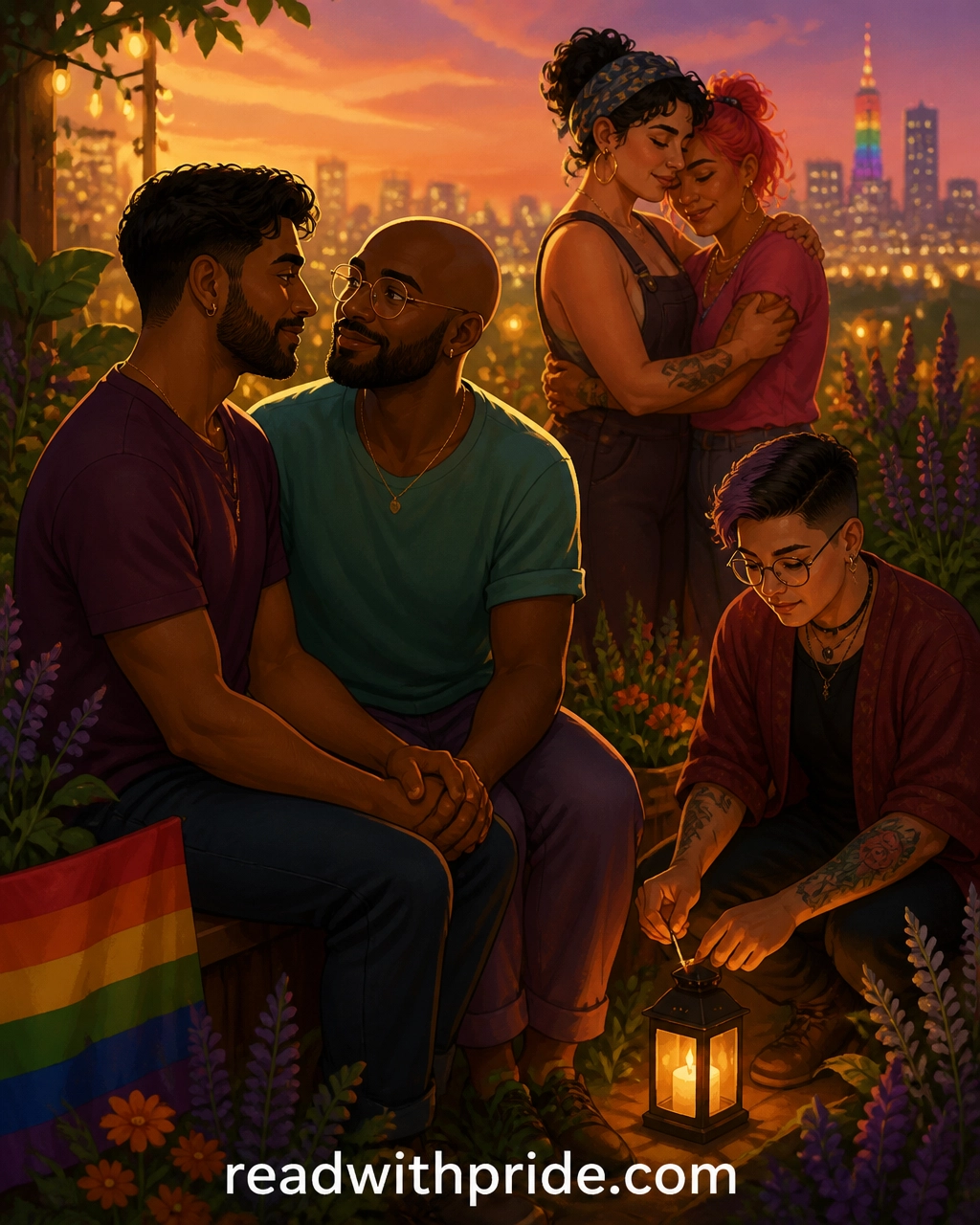
- A community garden where elders, teenagers, parents, lovers, and friends all have a place.
- A morning when you wake up without immediately bracing for bad news.
These details may sound small, but they are not. A future is built from ordinary moments that become possible because people cared enough to imagine them.

Hope is not denial
There is a difference between hope and pretending.
Pretending says everything is fine. Hope says things are not fine, and we can still work toward something better.
Hope does not ask us to be grateful for suffering. It does not turn trauma into a motivational slogan. It does not insist that every painful experience made us stronger.
Sometimes terrible things happen and we simply deserve support. Sometimes the bravest thing we do is survive the day without making meaning from it.
Over time, though, hope can become a practice. We can practise it by protecting our joy. We can practise it by learning our history, supporting queer creators, checking in with friends, voting and organising where we can, and choosing stories that make space for complex LGBTQ+ lives.
We can practise it by imagining a future where queer people are not merely surviving the news cycle but growing old, making art, raising families, falling in love, changing their minds, and being gloriously ordinary.
That is queer futurity at its warmest: not perfection, but possibility.
A gentle reflection for today
If you are carrying grief right now, you do not need to solve everything before bedtime. Try asking yourself three gentle questions:
-
What am I grieving?
Name it without judging the size or shape of the loss. -
What helps me carry it?
This might be a person, a ritual, a memory, music, movement, therapy, community, or a story. -
What future detail would I like to make room for?
Keep it small if you need to. A safer conversation. A good meal. A new book. A message to someone you trust.
If grief feels overwhelming, persistent, or connected to immediate concerns about your safety, please reach out to a trusted person or an LGBTQ+-affirming professional or crisis service in your area. You deserve care that respects every part of who you are.

Carrying grief into hope
We do not have to choose between remembering and imagining. We can carry our losses with care while still reaching toward joy.
The people we have lost can remain part of the futures we build. The rejection we survived can deepen our commitment to welcome. The years we spent hiding can make us fiercely protective of someone else’s freedom to be seen.
That is not a neat ending. It is an ongoing practice.
Read a story that helps you feel understood. Share a queer love story with a friend. Start a queer book club. Make a home where people can be honest. Rest when you need to. Dream beyond survival when you can.
Explore the full Read with Pride collection of queer fiction, gay fiction, lesbian romance, MM romance books, and LGBTQ+ ebooks. Discover stories for grief, desire, courage, coming out, chosen family, and the futures we are still building together.
Follow Read with Pride on Facebook and Instagram for more LGBTQ+ reading recommendations, reflections, and new releases.
Read with pride. Carry what matters. Make room for what comes next.
#ReadWithPride #QueerHealing #FutureVisions #LGBTQResilience #MMRomanceBooks #GayRomanceNovels #ComingOutStories #QueerBookClub #LGBTQFiction2026 #CSection2026 #GayFiction #LGBTQNovels #QueerLoveStories

Leave a Reply
You must be logged in to post a comment.