

The line he always left blank
Adrian had become very good at leaving things blank.
Forms. Invitations. Voicemails that asked him to call back. The space beside next of kin. The small white box marked emergency contact.
He left it empty with the quiet precision he brought to everything else.
At forty-six, he was a senior project manager in a city that rewarded speed, discretion, and the ability to appear untroubled. He knew which trains ran late. He knew how to end a meeting without inviting another one. He kept painkillers in a labelled drawer and spare shirts folded in his office in case the day required a different version of him.
He had come out late, after years of mistaking self-containment for safety. There had been no single dramatic revelation, only the slow exhaustion of living as though desire were an administrative error. By the time Adrian met Sam, he had learned how to build a life with no loose edges.
Then Sam arrived with his unhurried voice, his weathered hands, and the rural habit of looking directly at people when they spoke.
Sam came from a small town where everyone knew whose tractor had broken down, who was sitting with an ageing parent, who needed a lift to the pharmacy. In Sam’s childhood, being someone’s emergency contact was not a line on a form. It was a fact of belonging.
“You put down the person who’ll come,” Sam had once said.
Adrian had pretended not to hear the tenderness in that.
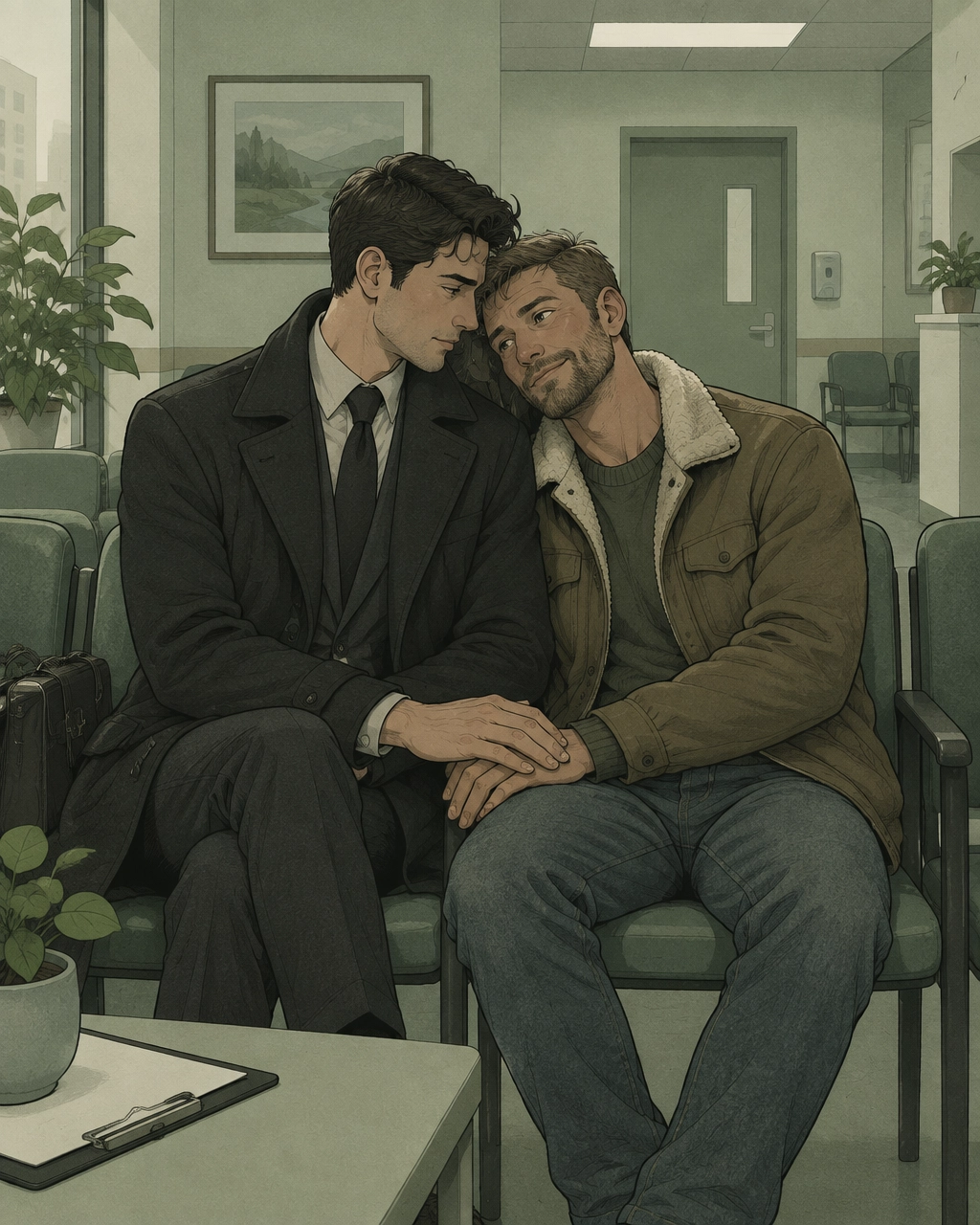
Now they sat together in a city clinic beneath fluorescent lights that made everyone look slightly unfinished. The air smelled of disinfectant and paper towels. Somewhere behind a closed door, a machine gave a soft, repeating beep.
Sam’s appointment was routine. Nothing urgent. Nothing frightening. Adrian had accompanied him because Sam had asked, and because Adrian was still learning that love did not need a crisis to justify its presence.
The waiting-room chairs were moulded plastic, joined in a row. Adrian sat with his knees angled neatly forward, his coat buttoned, his hands folded over a leather notebook. Sam sat beside him, broad and calm, one boot tapping lightly against the floor.
On the reception desk, a clipboard waited.
The receptionist called Sam’s name and handed him a form.
“Just the usual details,” she said. “Address, telephone number, emergency contact.”
Sam thanked her and returned to his seat.
Adrian looked away.
The form rested on Sam’s knee. The paper was cheap and faintly grey, its corners softened by use. A pen lay across it, heavier than it needed to be.
Sam filled in his address. His phone number. His date of birth.
Then he reached the empty line.
Adrian felt the old instinct rise in him: the desire to become invisible without moving. He had spent his adult life treating that space as a locked door. Leaving it blank meant no one could be summoned. No one would have to see him frightened, confused, feverish, helpless. No one would receive a call in the middle of the night and hear bad news arrive in their own voice.
Needing someone, Adrian had always believed, was the first stage of becoming a burden.
Sam noticed him watching.
“You all right?” he asked.
“Yes.”
It was the answer Adrian used when he meant: Please don’t look too closely.
Sam did not reach for the form. He did not tell Adrian what the line meant. He did not say, You can put me down.
Instead, he rested his hand on the chair between them, palm open.
That was Sam’s particular gift. He never chased Adrian into honesty. He simply made room for it.
Being the person others call
Sam had always been the dependable one.
His sister called when the boiler failed. His old school friend called when his father went into hospital. A neighbour called when a roof tile came loose in a storm. Sam answered, drove, carried, waited, and returned home with other people’s emergencies folded carefully inside him.
But there was a wound beneath his steadiness.
People called Sam when something went wrong. They did not always call him when something went right.
He was the man trusted with the difficult news, the spare key, the late-night lift. He was less often the first person someone rang to say, I saw something beautiful today.
Adrian knew this. He knew it because Sam had told him one evening while they were washing dishes, his sleeves pushed to the elbow and rain ticking against the kitchen window.
“I don’t mind being useful,” Sam had said. “I just sometimes wonder if anyone thinks of me when they don’t need fixing.”
The words had stayed with Adrian.
Now Sam looked down at the form. His thumb moved along the edge of the paper.
“You don’t have to fill it in,” Adrian said.
“I know.”
“You could put your brother.”
“I could.”
The city pressed against the windows: traffic, sirens, glass towers catching the last pale light. Outside, people moved quickly beneath umbrellas, each carrying their own private list of obligations.
Sam glanced at him.
“Who would you want them to call?”
The question was gentle. That made it worse.
Adrian imagined the possibilities. A colleague who would send an efficient email. A distant relative who would be shocked to hear from a clinic. No one. The blank line had always seemed honest.
But honesty, he was beginning to understand, was not the same as isolation.
His coming out had taught him that identity could be spoken into existence one sentence at a time. First to himself. Then to another man. Then, eventually, in the ordinary places where life insisted on being recorded.
This was another sentence.
Adrian took the pen.
The plastic barrel pressed into his fingers. It was warm from Sam’s hand. He looked at the line marked emergency contact name and felt an unreasonable terror move through him.
To write Sam’s name was to admit that Sam belonged in the place where everything could go wrong.
It was to say: If I cannot speak, let it be him.
It was to say: I trust him with the least polished version of me.
It was to say: I am no longer building a life designed to survive without witnesses.
Adrian wrote carefully.
Sam Mercer.
The letters looked strangely permanent.
Beside the name, he wrote Sam’s number. Then, under relationship, he paused.
The word partner waited among the printed possibilities, plain and unadorned.
Adrian’s throat tightened.
He had spent years fearing that being known would make him smaller. Yet the word did not diminish him. It gathered something around him. It placed him beside another person without erasing the space between them.
He wrote it down.
Sam did not smile immediately. He looked at the form, then at Adrian.
Something passed between them that was too quiet to call triumph.
“Thank you,” Sam said.
Adrian capped the pen. “It’s only a form.”
“No,” Sam said. “It’s a choice.”
The warmth of somewhere to return to
By the time they left the clinic, evening had settled over the city.
The pavements shone with rain. The wind travelled between buildings with a clean, metallic cold. Adrian walked beside Sam, aware of the folded form in Sam’s coat pocket. The paper seemed to have weight beyond its size.
Sam had grown up where a person could knock on three doors before finding the one they needed. Adrian had learned to live among thousands of strangers without allowing any of them to knock.
They walked past a takeaway glowing amber through steamed-up windows. Sam stopped to buy two coffees. He handed Adrian one without asking how he took it.
“Too much milk,” Adrian said.
“You’ll survive.”
“That’s not the point.”
“It usually is with you.”
Adrian laughed, quietly. The sound surprised him.
At home, the flat was warm. Sam turned on the lamp beside the sofa, and the room softened into honey-coloured light. Outside, the city continued its restless movement, but the windows held it at a distance.
They sat close together. No television. No music. Only the low hum of the heating and the occasional rush of tyres through wet streets.
Sam took the folded form from his pocket and placed it on the coffee table.
Adrian looked at it.
There it was: his name, Sam’s name, a number, a relationship written in ink. Nothing dramatic. No audience. No announcement.
Still, something in the shape of their life had changed.
Being someone’s emergency contact was not promising to prevent every disaster. It was not agreeing to be perfect, endlessly available, or strong enough for two people.
It was simpler and more frightening than that.
It was agreeing to be the person who came.
Adrian leaned against Sam’s shoulder.
“If they call you,” he said, “you’ll come?”
Sam turned his head. “You know I will.”
“I do.”
“And if they call me for something good?”
Adrian took Sam’s hand.
“Then call me first.”
Sam’s fingers closed around his.
For a while, they sat without speaking. The folded form remained on the table, quiet as a promise. In the city’s cold, among all its distances and locked doors, Adrian understood what Sam’s small town had always known:
Home was not only the place where someone waited for you.
Sometimes, home was the name you finally allowed someone else to write down.
For more character-driven queer fiction, emotional MM romance literary stories, and a gay love story emotional journey that begins in unexpected places, explore the latest work from Dick Ferguson through Read with Pride.
Three fresh Evening Edition story options
- The Last Train to Platform Nine : Two men who have spent years avoiding the same commuter train discover that missing it together may be the first honest thing they have ever done.
- The Key Beneath the Flowerpot : After a late-life coming out, a widower gives his neighbour a spare key and learns that trust can begin with something almost embarrassingly practical.
- The Photograph in the Rain : A guarded archivist finds an old photograph of his partner’s rural childhood and begins to understand the family history his lover has never known how to tell.
Follow us on social media
Follow Dick Ferguson and Read with Pride for new releases, reflective LGBTQ+ reading, gay books, MM romance, queer fiction, and emotionally immersive stories:
#EveningEdition #MMRomance #GayRomance #QueerFiction #GayFiction #MMNovels #LGBTQPlusFiction #CharacterDrivenQueerFiction #EmotionalMMRomance #GayLoveStory #EmotionallyInvestedReaders #GayLiterature #ReadingWithPride #ReadWithPride


Leave a Reply
You must be logged in to post a comment.