

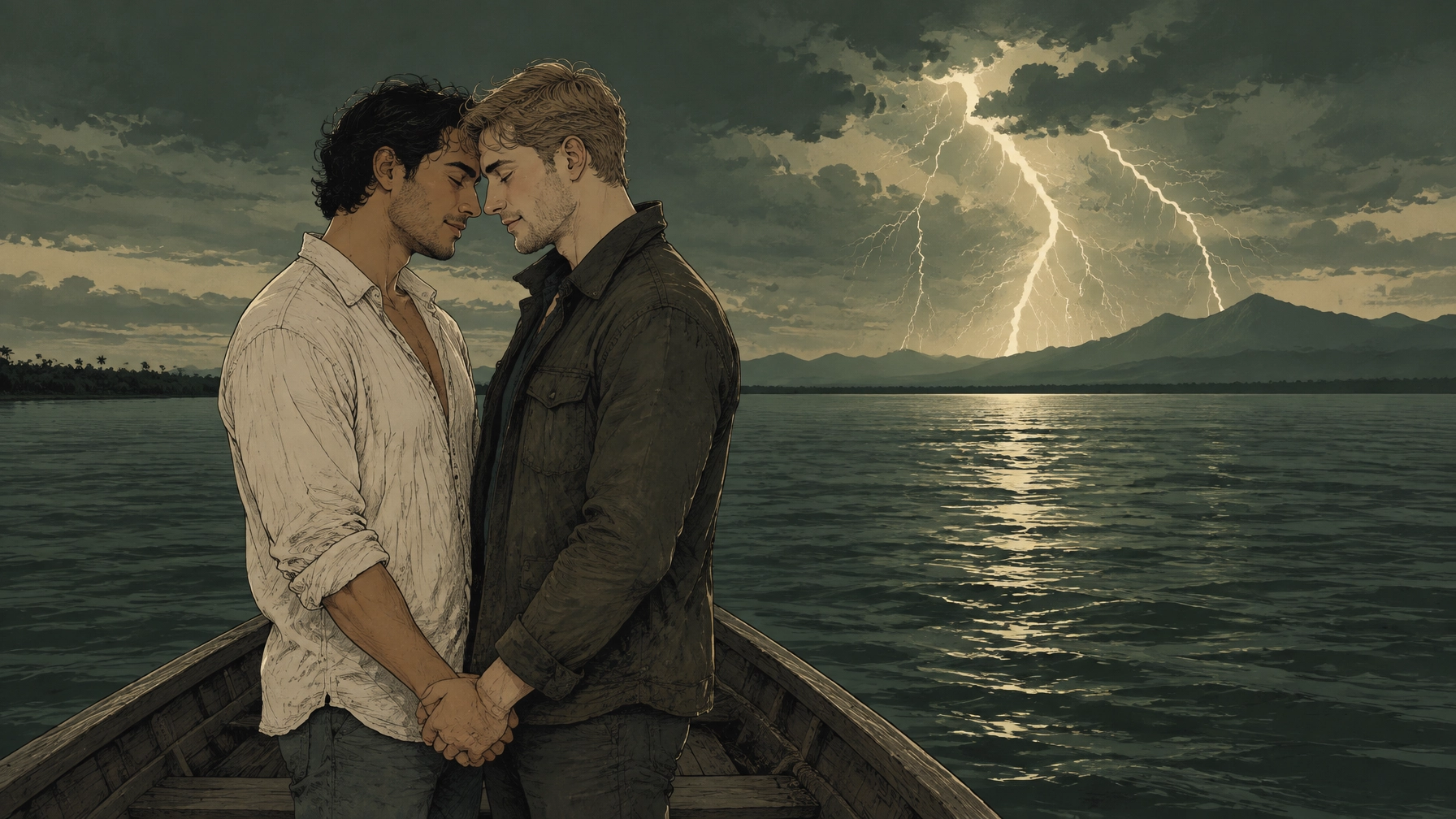
The sky that refused to go dark
By the time the first lightning appeared, Tomás had stopped pretending he was not afraid.
He stood at the stern of the narrow boat with one hand wrapped around the damp wooden rail and the other pressed flat against his chest. Across the water, the Catatumbo River opened into Lake Maracaibo, and beyond it the mountains gathered like a dark wall beneath the clouds.
Then the sky flashed.
Not once. Not with the clean, startling violence of an ordinary storm. The light returned almost immediately, branching across the horizon in pale green-white veins. It illuminated the lake, the low houses on stilts, the wet ropes coiled near the boat’s bow. For a heartbeat, every detail became visible. Then darkness folded back over everything.
Elias watched him rather than the storm.
“You can tell me to turn around,” he said.
Tomás gave a quiet laugh. “You think I’m frightened of the lightning?”
“I think you’re frightened of many things.”
The answer should have angered him. Instead, it settled between them with the weight of something recognised.
The Catatumbo Lightning is one of the world’s most extraordinary natural phenomena. Where the Catatumbo River meets Lake Maracaibo in north-western Venezuela, thunderstorms can gather with remarkable persistence. The region is often said to experience lightning on nearly 300 nights a year, with active bursts reaching as many as 280 flashes an hour.
The exact figures vary according to season, measurement and location. The wonder does not.
For centuries, the lightning has served as a natural lighthouse, its repeated flashes guiding sailors across the dark waters of the lake. It is a beacon born from turbulence: a light created not by calm, but by collision.
Tomás understood that better than he wanted to.
Warm water, cold air, and the making of a storm
During the day, the tropical sun warms Lake Maracaibo. Water rises into the air as vapour, carrying heat and moisture above the lake and surrounding wetlands. At night, winds move through the basin, bringing humid air towards the mountains.
There, warm air meets colder air.
The geography gives the storm nowhere easy to escape. Mountain ranges surround much of the lake, shaping and trapping the atmospheric movement. Moisture is forced upward. Towering clouds form. Inside them, water droplets and ice crystals collide, separating electrical charges until the cloud can no longer contain what it has made.
Then the lightning comes.
Tomás had once read that the storm’s consistency depended on a precise meeting of conditions: warm lake water, humid air, cooler upper layers, mountain ridges and nocturnal winds. Remove one element, and the pattern might weaken.
He thought love could be like that.
Not simple. Not effortless. A meeting of things that did not appear designed for one another.
Elias was all sharp edges and quiet observation. He had arrived in the region to work with a small environmental research team documenting local weather patterns and community safety practices. He carried notebooks in waterproof bags and spoke about cloud formation with the patient intensity of a man who trusted facts more easily than people.
Tomás was warmer, quicker to laugh and quicker to retreat. He repaired boat engines, knew the moods of the lake, and could tell from the wind whether the night would be gentle or dangerous. He also knew how to leave a room before anyone could ask him to explain himself.
Especially when the room contained Elias.
The fear of being too much
Tomás had come out as bisexual in pieces.
There had been no single speech, no cinematic moment of standing beneath an open sky and becoming entirely free. There had only been the slow exhaustion of correcting assumptions, the careful decisions about what to say and when, the private knowledge that his capacity for love had never fitted the narrow shape other people expected.
He loved men. He had loved women. He had spent years believing that this made him confusing, unreliable or permanently unfinished.
When he met Elias, the old fear changed its clothes.
Now Tomás worried that he was too intense. Too watchful. Too easily wounded. He noticed every pause in Elias’s messages, every glance held half a second too long on another man, every moment when Elias became absorbed in his work and forgot the world around him.
Jealousy came to him disguised as common sense.
“You like him,” Tomás said one evening, after Elias had returned from a meeting with a visiting researcher.
Elias looked up from the maps spread across the table. “Who?”
“The man with the red notebook.”
“I spoke to him for ten minutes.”
“You smiled.”
“I smile at you.”
“Not like that.”
Elias leaned back. Outside, thunder rolled over the lake. “You don’t know what I smiled like.”
Tomás hated the accusation in his own voice. He hated the panic beneath it more.
He was not asking, Do you love someone else?
He was asking, Am I safe here? If I give you everything I am, will you decide that it is too heavy to carry?
Those were different questions. He had not yet learned how to ask the second one.
When connection becomes a kind of weather
Elias had his own history with fear.
He had spent much of his life treating desire as a problem to be managed. Coming out had not erased that instinct. It had only taught him new ways to hide. He could speak fluently about atmospheric pressure while avoiding the pressure inside his own body. He could describe lightning’s path through a cloud while refusing to say what happened to him when Tomás touched his wrist.
He had mistaken restraint for kindness.
If he wanted less, he thought, he would be easier to love. If he remained measured, he could not frighten anyone. If he never asked for reassurance, he would never become dependent on it.
But Tomás did not need a man who was impossible to disturb. He needed a man willing to stay present when the storm moved through him.
“I’m not interested in the man with the red notebook,” Elias said.
Tomás looked away. “You don’t have to explain.”
“I do.”
The room seemed to narrow around them.
“I’m interested in you,” Elias continued. “But sometimes I don’t know how to prove that without sounding like I’m promising something I might fail to become.”
Tomás’s face tightened. “What are you afraid you’ll become?”
“Someone who needs you.”
The honesty hurt more than an argument would have done.
Tomás crossed the room slowly. “That isn’t the same as failing.”
“No?”
“No. It’s just the part where you stop pretending you’re alone.”
For a moment, neither man touched the other.
Then Elias reached for him.
Outside, the lightning kept flashing. Warm water rose into the air. Cold mountain wind moved through the basin. The storm gathered itself from opposing forces and became, impossibly, something continuous.
A natural lighthouse for difficult truths
The Catatumbo Lightning is sometimes described as a natural lighthouse because its glow can be seen from far across the lake and Caribbean waters. It does not guide anyone by offering a clear, permanent path. It flashes, disappears, then flashes again.
That felt more honest to Tomás than the idea of a light that never went out.
Love was not always illumination. Sometimes it was a signal.
I am here.
I am still here.
The storm over Lake Maracaibo did not promise safety. Lightning remained dangerous. The fishermen and communities living near the river understood that wonder and risk could occupy the same landscape. Admiration did not make the weather harmless. It made people pay attention.
Tomás began to understand that his jealousy also needed attention, not shame. He could not demand that Elias remove every possible threat from the world. He could tell him when fear had entered the room. Elias could listen without treating the fear as an accusation.
Elias began to understand that being loved did not require him to become smaller. Tomás’s intensity was not an emergency. His bisexuality was not a contradiction. His need for reassurance was not evidence of weakness.
They were two men learning the difference between control and care.
Some storms are not punishment
Near midnight, the lightning became almost constant.
The clouds pulsed above them, each flash turning the river silver. The air smelled of rain, mud and warm water. Somewhere in the darkness, insects shrilled from the reeds. Elias sat beside Tomás at the edge of the boat, their shoulders touching.
“Do you think it ever gets tired?” Tomás asked.
“The storm?”
“Of beginning again.”
Elias considered this. “Maybe it doesn’t think of it as beginning.”
Tomás looked at him.
“Maybe it’s a pattern,” Elias said. “Something the place knows how to do.”
Tomás rested his head against Elias’s shoulder. “That sounds exhausting.”
“It can be. It can also be home.”
The words entered Tomás quietly.
For years, he had thought of his strongest feelings as evidence against himself. His jealousy meant he was possessive. His fear meant he was damaged. His longing meant he was asking too much. He had treated every internal storm as a punishment he had somehow earned.
But the Catatumbo sky offered another possibility.
Some storms were not punishments. Some were created by the particular shape of a place, by pressure and warmth, by the meeting of elements that needed one another even when they appeared opposed.
Tomás turned his hand beneath Elias’s and laced their fingers together.
“I’m still afraid,” he said.
“I know.”
“I might be afraid tomorrow.”
“I know.”
“You might be too.”
Elias looked down at their joined hands. “I will be.”
The next flash opened above them, bright enough to make the whole lake visible. For that brief second, Tomás saw Elias clearly: tired, frightened, stubbornly present.
Not perfect. Not safe from every future wound.
There.
The darkness returned, but it no longer felt empty.
Stories that stay lit
The most powerful gay love stories and emotional MM books do not treat intensity as a flaw to be corrected. They ask what happens when two men bring their histories, identities and fears into the same room: and choose honesty instead of disappearance.
That is the heart of Read with Pride’s LGBTQ+ ebooks and queer fiction: stories about gay men, bisexual men, connection, resilience and the complicated work of becoming known. Readers looking for character-driven MM romance, heartfelt gay fiction and emotionally immersive gay love stories can explore Dick Ferguson’s collection of MM novels.
Because sometimes the rarest experience is not witnessing a storm.
It is finding someone who sees the lightning inside you and does not ask you to become dark.
Three Possible Next Morning Edition Stories
-
The Singing Sand Dunes of the Empty Quarter : Two men crossing a desert hear the dunes hum beneath their feet, while one learns that silence does not always mean abandonment.
-
The Glowworm Caves of New Zealand : In a cavern lit by thousands of living lights, a closeted archivist and an adventurous conservationist confront the fear of being seen.
-
The Underwater Forest of Kaindy Lake : Beneath the cold waters of Kazakhstan, the branches of a drowned forest rise like submerged ghosts as two men decide whether love can survive the truths they have buried.
Follow us on social media
Follow us on social media for more emotionally immersive stories, queer fiction recommendations, new gay releases and character-driven MM romance from Dick Ferguson:
#MMRomance #GayRomance #LGBTQBooks #QueerFiction #GayFiction #EmotionalMMBooks #CharacterDrivenFiction #ReadWithPride #GayLoveStories #MMNovels #LGBTQFiction #GayLiterature #GayRomanceBooks #MMRomanceBooks #HeartfeltGayFiction #QueerAuthors #MMAuthors #GayBookRecommendations #LGBTQReading #ReadingWithPride


Leave a Reply
You must be logged in to post a comment.