

Rare Experiences
The first thing Gabriel noticed was not the mountain.
It was the air.
At roughly 5,200 metres above sea level, the Andes seemed to have taken most of it away. Every breath arrived thin and unfinished. Every step required negotiation: with the lungs, with the heart, with the old instinct to keep moving even when the body had begun to ask for mercy.
Tomás walked a few paces ahead, his dark hair lifting in the cold wind. He turned often, pretending to admire the trail when he was really checking on Gabriel.
Gabriel noticed every time.
He had spent most of his life performing confidence so convincingly that people mistook it for truth. He had come out young, before he had learned how much of himself the world might ask him to soften, explain or defend. He became quick with a joke. He learned how to enter a room as though he belonged there. He learned to say, “I’m fine,” in a voice that discouraged further questions.
No one believed he was afraid.
That was the point.
Tomás had a different kind of fear. As a bisexual man, he was tired of being asked to translate himself into something simpler. People wanted him to pick a side, as though loving men and women made his heart a courtroom where only one verdict could stand. Some called him indecisive. Others called him greedy. A few had treated his bisexuality as a phase he would eventually outgrow.
Even Gabriel, who loved him, had once looked at an old photograph of Tomás with a woman and gone very quiet.
The silence had lasted less than a minute.
It had still managed to bruise them both.
The climb that asks for honesty
The trail to Vinicunca is not long only because of its distance. It is long because altitude changes the meaning of effort.
A path that might have been ordinary closer to sea level became something else entirely. The red dust clung to their boots. The cold wind pressed through their jackets. The sunlight was bright enough to make them squint, yet the air carried a sharp chill that found every gap in their clothing.
Gabriel felt a hard ache beneath his ribs.
He slowed.
Tomás slowed too.
“You don’t have to match my pace,” Gabriel said.
“I’m not.”
“You are.”
Tomás looked at him. “Then perhaps I want to.”
The answer should have comforted him. Instead, Gabriel felt shame rise hot behind his face. He had secretly imagined this climb ending with Tomás reaching the viewpoint first, turning back, and finding Gabriel somewhere below, bent over, breathless, exposed as the weaker man.
He was terrified of being the one who slowed them down.
He was also terrified that Tomás would see how much he needed help.
For years, Gabriel had treated dependence as a kind of confession. If he admitted his fear, someone might decide he was less impressive than they had believed. If he stumbled, someone might discover that the confidence was only scaffolding.
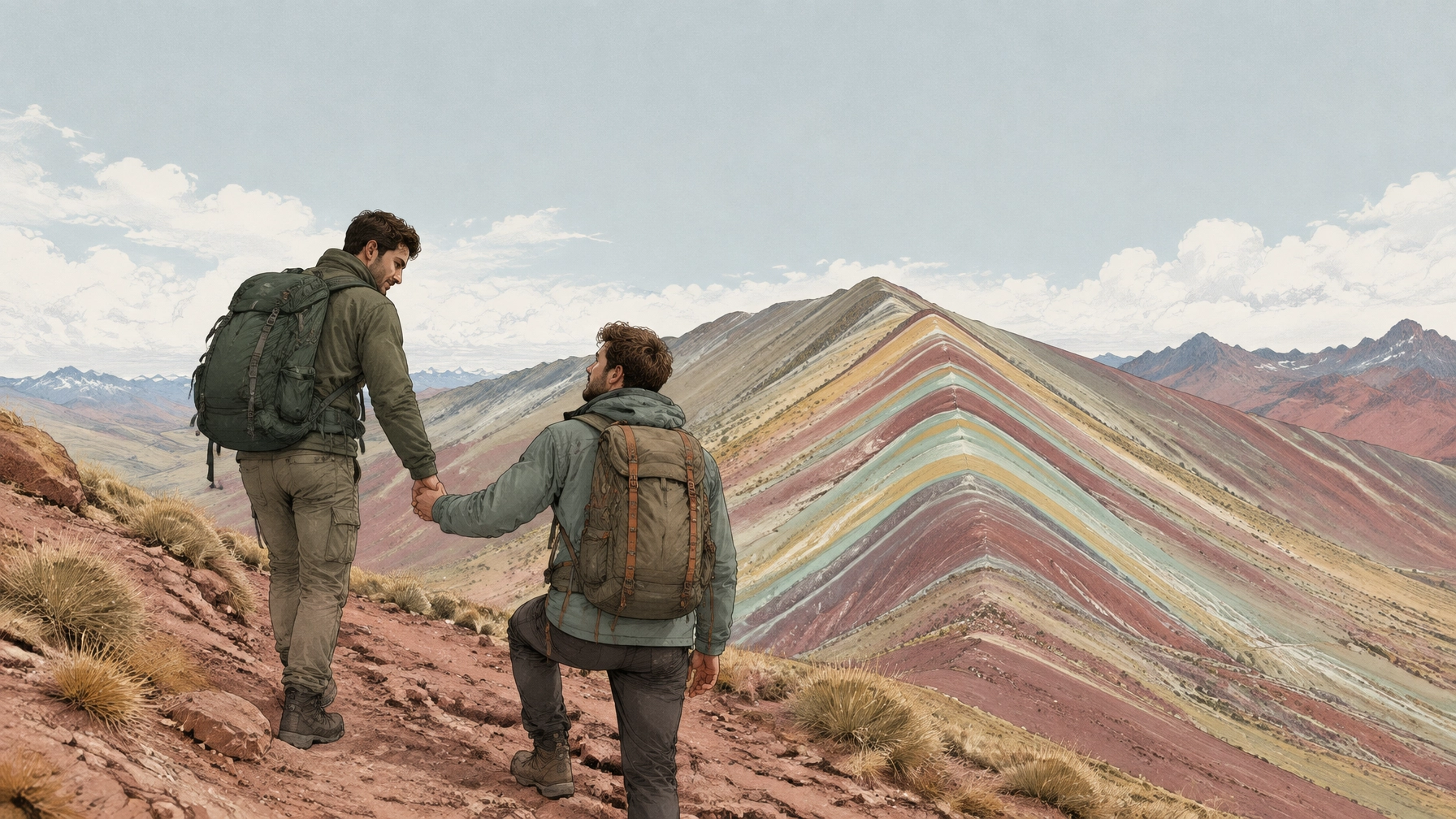
Tomás reached for his hand.
Gabriel let him take it, though his first instinct was to pull away.
Their gloves touched. Then their fingers found one another properly.
The gesture was small, almost hidden beneath the wide sky. It still felt more intimate than anything Gabriel had performed for the world.
What the mountain kept beneath the ice
Vinicunca is known as the Rainbow Mountain, or the Mountain of Seven Colors, but its beauty is not painted onto the earth. Its stripes come from mineral-rich layers formed over immense stretches of geological time.
Iron oxide gives some bands their red tones. Sulfur contributes yellow. Copper oxide can bring greenish or turquoise shades. Clay and sandstone create the softer pink, white and earthy layers that run across the slopes like deliberate brushstrokes.
The colors were there long before anyone came to photograph them.
For centuries, ice and snow concealed much of the mountain. Only in recent years, as the ice receded, did the stripes become fully visible. After 2015, travelers began arriving in growing numbers, drawn by images of a landscape that seemed almost too strange to be real.
But the mountain had not suddenly become colorful.
It had only become visible.
Tomás stood with his face turned toward the distant slope. The wind moved between them, carrying the smell of dust, wool and cold stone.
“That’s the part I can’t stop thinking about,” he said.
“What part?”
“It was always there.”
Gabriel knew what he meant. He also knew what Tomás was not yet saying.
The colors beneath the ice were not made more real by being revealed. They did not become more valuable because strangers could finally see them. Visibility changed the mountain’s relationship with the world, but it did not create the mountain.
Tomás had spent years trying to explain this about himself.
His bisexuality was not a temporary road between two destinations. It was not evidence of confusion. It was not an appetite that made him untrustworthy. It was one layer of the truth, present whether or not other people had the patience to understand it.
Gabriel squeezed his hand.
“I’m sorry,” he said.
Tomás looked at him. “For what?”
“For making you feel that you had to prove it.”
The wind sharpened around them.
Tomás’s expression tightened, not with anger exactly, but with the memory of having needed to be angry so many times before.
“I don’t need you to understand every part of me immediately,” he said. “I need you not to punish me for having parts.”
Gabriel lowered his eyes.
There it was: the fear that had followed him up the mountain. Not only the fear of failing physically, but the fear of being the kind of man who loved Tomás and still made him smaller.
The colors after the long climb
The final ascent seemed to tilt the whole world.
Gabriel’s lungs burned. His legs trembled beneath him. He stopped once with his hands on his knees, trying to draw enough air into his body to continue.
Tomás stood beside him but did not reach out at once.
That restraint mattered.
Love, Gabriel had learned, was not always the hand that pulled you forward. Sometimes it was the person who waited without turning your struggle into a spectacle.
“I can’t do this,” Gabriel said.
The sentence came out raw.
Tomás did not tell him he could. He did not offer the bright, careless encouragement Gabriel had learned to distrust.
“Do you want to go back?” Tomás asked.
Gabriel looked up at him.
The question was terrifying because it contained no trap. Tomás would not love him less for stopping. He would not call him weak. He would not use the mountain as evidence in some future argument.
Gabriel swallowed.
“I want to keep going,” he said. “But I don’t want to pretend it isn’t hard.”
“Then don’t pretend.”
They continued slowly.
One step. Then another.
When the mountain finally revealed its full stripes, Gabriel was too tired to speak.
Red, yellow, turquoise, pink and white moved across the earth in broad, irregular bands. They did not look neat. They did not look manufactured. They looked weathered and ancient, shaped by forces too large to care whether anyone understood them.
Tomás began to cry.
The tears froze at the corners of his eyes almost immediately.
Gabriel wanted to ask what was wrong, but the question felt too small. He stood close instead, shoulder against shoulder, their breath leaving them in pale clouds.
Tomás had always feared being fully seen. Not admired in fragments, not desired for the easy colours, but witnessed in everything: his uncertainty, his jealousy, his tenderness, his need to be believed.
Gabriel had feared seeing too much and discovering that love demanded more than reassurance.
At the viewpoint, neither fear disappeared.
That was not what happened.
Instead, Gabriel looked at Tomás and did not flinch.
“I love all of it,” he said.
Tomás shook his head. “You don’t know all of it.”
“No,” Gabriel replied. “But I want to.”
It was not a promise of perfection. It was not a declaration that jealousy would never return, or that Gabriel would never again feel threatened by the parts of Tomás he could not control. It was an agreement to tell the truth sooner. To question the story before believing it. To stop treating fear as proof.
Tomás leaned into him.
For a while, they watched the mountain in silence.
What remains visible
The descent would still hurt. The altitude would not become kinder because they had reached the viewpoint. Their relationship would not emerge polished and uncomplicated, as though the climb had burned away every difficult thing.
There would be other conversations.
There would be moments when Gabriel’s fear of failure returned wearing a familiar face. There would be times when Tomás felt the old pressure to choose, define or defend himself. Love would not erase the layers they had been taught to bury.
But perhaps love could become a place where those layers were allowed to exist.
The mountain did not become colorful when the ice receded. It became visible.
Perhaps coming out is sometimes like that. Perhaps bisexuality, too, is not a new colour added to a life but a truth that has been present beneath the surface, waiting for the conditions in which it can be seen without apology.
And perhaps an emotional MM romance is most honest when it does not promise that two men will never hurt one another. It promises that they may learn to look again. To stay curious. To choose tenderness after fear has made its argument.
Gabriel and Tomás began the descent hand in hand.
Below them, the red earth stretched toward the valleys. Above them, the cold sky opened without end.
They were still breathless.
They were still afraid.
They were still there.
A note from Read with Pride
For readers who seek an emotional MM romance literary experience, a character-driven queer fiction story or a gay love story shaped by an authentic emotional journey, Read with Pride offers a welcoming home for LGBTQ+ ebooks, gay novels, MM fiction and heartfelt queer literature.
You can explore Dick Ferguson’s work through the Dick Ferguson store at Read with Pride or visit the Read with Pride home page for more LGBTQ+ reading, gay book recommendations and new queer fiction.
Three possible next Morning Edition stories
-
Morning Edition: Blood Falls of Antarctica : Where Two Men Learned That Even the Coldest Places Can Keep a Heart Beating
-
Morning Edition: The Door to Hell in Turkmenistan : Where Two Men Learned That Some Fires Burn Because the Earth Refuses to Forget
-
Morning Edition: Socotra’s Dragon Blood Trees : Where Two Men Learned That Strange Roots Can Still Make a Place Feel Like Home


Follow us on social media
Follow Dick Ferguson and Read with Pride for more emotionally immersive MM romance, LGBTQ+ fiction, gay love stories and character-driven queer literature:
#MMRomance #GayRomance #LGBTQFiction #CharacterDrivenQueerFiction #BisexualityRep #EmotionalMMRomance #ReadWithPride

Leave a Reply
You must be logged in to post a comment.