

The Road Out of the City
By the time Leo reached the village hall, the afternoon had already begun to fold itself into evening.
The road was narrow, flanked by hedges stripped almost bare by winter. Rain clung to the windscreen in fine silver threads. Beyond the glass, fields lay dark and quiet beneath the low sky, their furrows holding the last pale traces of frost.
Leo disliked roads that did not offer alternatives.
In the city, there were always options. A different street. A faster train. A shop open late. A person to call who would answer because they had agreed to be available.
Here, the land seemed to make its own decisions.
Kai had sent him the address with no further explanation. Just the name of the village hall, the starting time, and a message that read:
Bring a warm coat. You’ll like the seeds.
Leo had stared at that last sentence for nearly a minute.
He was not sure he liked anything that could be held between two fingertips and carried away in a paper envelope.
He was even less sure why Kai wanted him there.
A Table Full of Small Futures
The village hall smelled of wet wool, old wood, and tea.
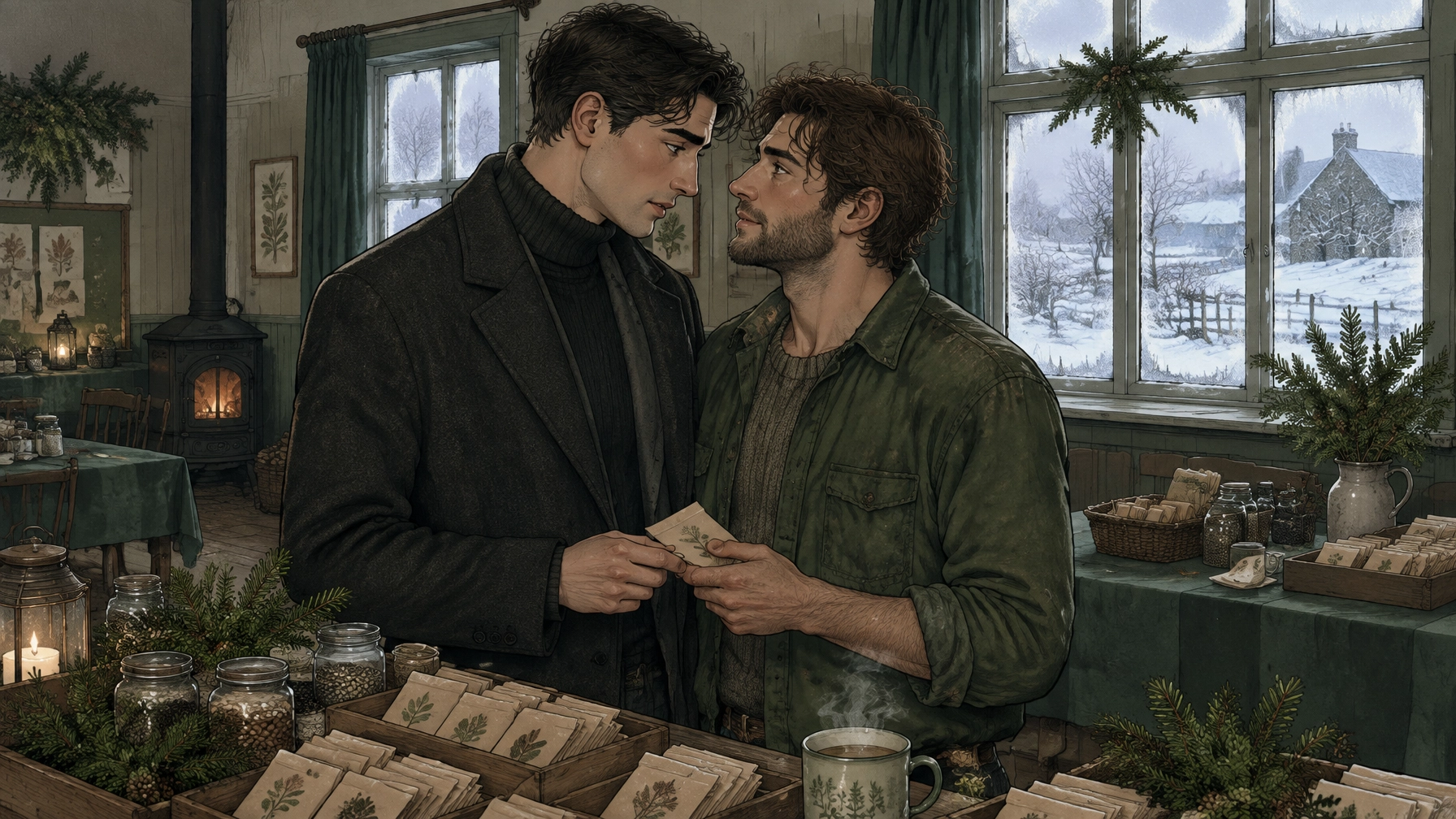
Long tables had been arranged beneath the windows. On them rested small paper packets, folded by hand and marked with neat writing: runner beans, winter lettuce, purple sprouting broccoli, marigolds, onions, peas. Some envelopes had dates. Others carried notes about the people who had grown them.
Good in poor soil.
Saved from my father’s garden.
Strong against wind.
Late flowering but worth waiting for.
The seeds were small enough to seem insignificant. A few dark specks in a crease of paper. Pale grains. Dry curls. Things that could disappear beneath a fingernail.
Yet the people around the tables handled them with careful attention.
Old hands sorted packets into rows. A man with flour-white hair explained the difference between two varieties of bean. Someone poured tea into thick ceramic mugs. Coats steamed gently as they dried. Laughter rose and fell beneath the hall’s wooden rafters, warm and familiar.
Kai stood at the far end of the room with soil beneath one thumbnail and a green scarf looped loosely around his neck.
He was speaking to an elderly woman about tomatoes, listening with the patient concentration he gave to everything living. His dark hair had been touched by rain. His sleeves were rolled to the elbows, exposing forearms marked by the practical abrasions of farm work and making.
Leo watched him for longer than he intended.
Kai looked up.
His expression changed, not dramatically, but enough. The guardedness left his mouth. Something softer moved behind his eyes.
“You came,” he said.
“I said I would.”
“You say a lot of things.”
Leo removed his gloves one finger at a time. “You could have asked me to bring something useful.”
“I did.”
“You asked me to bring a coat.”
“That was useful.”
Kai smiled, and Leo felt the old irritation rise in him: the frustration of being answered without being managed. Kai never rushed to fill silence. He never tried to make Leo comfortable by agreeing with him.
He simply remained himself.
Leo had spent much of his life believing that love meant anticipating every need before it was spoken. He called it attentiveness when he was being generous. Protection when he was honest. Control when Kai was angry.
The Fear Beneath the Instructions
At the seed table, Kai handed him a small envelope.
“Carrots,” he said. “A local variety. They do well in heavy soil.”
Leo looked at the writing. The ink had bled slightly where the paper had once been damp.
“What am I supposed to do with them?”
“Plant them.”
“I don’t have a garden.”
“You have a balcony.”
“It’s shaded.”
“Then find a sunnier pot.”
The answer was so simple that Leo almost laughed.
Instead, he placed the envelope on the table.
Kai studied him. “What?”
“Nothing.”
“That’s rarely true.”
Around them, the seed swap continued. A cup was set down. Chairs scraped. Someone called across the hall for more labels. Outside, a gust of cold pressed against the windows.
Leo kept his eyes on the envelope.
“I don’t understand why you wanted me here,” he said.
Kai’s expression became still.
It was not accusation Leo saw in it. That would have been easier. Anger gave him something to push against. Silence left him with only himself.
“You wanted to come,” Kai said.
“I wanted to see you.”
“That’s not the same thing?”
“No.”
The word came out too sharply.
Kai waited.
Leo had never been good at waiting. He wanted conversations to move towards resolution, towards a clear arrangement that could be named and maintained. He wanted to know where he stood, what was expected, what could be done to prevent loss.
But the hall was full of people who seemed comfortable with uncertainty. They planted things without guarantees. They saved seed from a season that might fail. They trusted that something buried in darkness could still know what to do.
Leo looked at the little envelope again.
“I’m afraid,” he said.
Kai did not move.
“I’m afraid that if I stop trying to be useful, you won’t need me.”
The confession seemed to alter the air between them.
Leo felt the familiar urge to soften it, explain it, turn it into something more acceptable. He could have said he was tired. He could have blamed the city, the distance, the difficulty of loving someone who belonged so completely to a place that had no room for his rules.
Instead, he said, “I know I make decisions for you. I know I tell myself it’s because I’m helping. But sometimes I think I’m just trying to become impossible to leave.”
Kai’s gaze lowered to their hands.
“That sounds exhausting,” he said.
“It is.”
“For both of us.”
Leo nodded.
The truth did not strike like a door slamming. It arrived quietly, almost tenderly. That was what made it difficult to resist.
What the Old Hands Knew
An older man approached with a shallow wooden tray.
He had the broad, weathered hands of someone who had spent decades working outdoors. He placed several envelopes on the table and began explaining which seeds had come from his allotment and which had been given to him by his sister.
“This one nearly disappeared,” he said, tapping a packet of beans. “Too many people stopped saving it. Thought they could always buy more.”
He shrugged, but his eyes remained on the envelope.
“Some things don’t come back once you lose them.”
Leo glanced at Kai.
Kai was listening. His hand rested close to Leo’s, not touching, but near enough to make the possibility of touch feel deliberate.
The older man moved on.
Leo reached for the carrot seeds.
“How many do I take?” he asked.
“Enough to try,” Kai said.
“That’s not a measurement.”
“No. It’s an invitation.”
Leo gave him a look, but there was no force behind it now.
Kai took one of the envelopes and folded the top edge down. His fingers were rough, his movements exact. He wrote a few words on the front, then passed it back.
Leo read the label.
For the balcony.
Beneath it, Kai had drawn a tiny, uneven line that might have been a horizon.
“You made this?” Leo asked.
“I did.”
“You’re an artist. I assumed you’d produce something more impressive.”
“I’m conserving my genius.”
Leo’s smile arrived before he could prevent it.
Kai saw it. He always saw too much.
The Warmth We Cannot Control
They drank tea near the hall’s entrance while the last visitors gathered their coats.
Leo held the mug between both hands. Steam blurred the air before his face. Kai sat beside him, one knee angled towards his, their shoulders touching through layers of winter clothing.
The contact was ordinary.
That was its power.
Nothing dramatic happened. No promise was made that could protect them from future arguments or old habits. Kai did not surrender his independence. Leo did not become a different man simply because he had confessed what frightened him.
But he stopped trying to direct the moment.
He let Kai decide when to speak.
He let the silence remain.
When they rose to leave, Kai placed the carrot envelope in Leo’s palm and closed Leo’s fingers around it.
“You don’t have to grow them,” he said.
Leo looked at him. “You’ll be disappointed.”
“I’ll survive.”
“That isn’t what I meant.”
“I know.”
Kai’s thumb brushed once across Leo’s knuckles. The gesture was small, almost hidden by the darkening hall, but Leo felt it all the way through him.
He had wanted to be needed so badly that he had mistaken dependence for devotion.
Now, standing beside the seed table with cold air waiting beyond the doors, he understood something more frightening and more generous: love was not proved by making yourself essential. Sometimes it was proved by allowing another person to remain free.
What We Carry Forward
Outside, the village had become blue with evening.
Kai walked beside him towards the car. Their footsteps disturbed the thin frost along the path. In Leo’s pocket, the paper envelope made the faintest sound as it moved.
A seed was not a promise of certainty.
It might fail. The soil might be wrong. The balcony might be too shaded. The first shoots might never appear.
Still, someone had saved it.
Someone had labelled it, carried it through winter, and placed it in another person’s hands with the quiet expectation that the future was worth attempting.
Leo looked at Kai, who was watching the dark fields beyond the hall.
“What happens if nothing grows?” Leo asked.
Kai slipped his hand into Leo’s.
“Then we try again.”
The answer was not a guarantee.
It was better than one.
It left room for weather, error, patience, and choice. It made tenderness something they could practise rather than possess.
In the city, Leo had believed the smallest things were the easiest to control.
That evening, with Kai’s hand warm in his and a few dark seeds resting close to his heart, he learned that the smallest things could also carry the future.
Continue Reading with Pride
Discover emotionally immersive LGBTQ+ ebooks, MM romance, queer fiction, gay novels, and heartfelt gay love stories through Read with Pride. For readers drawn to character-driven MM romance, emotional MM books, gay romantic fiction, and literary LGBTQ+ fiction, explore Dick Ferguson’s work at the Dick Ferguson store on Read with Pride.
Follow Us on Social Media
Follow Dick Ferguson for new reflections, reading recommendations, queer fiction, gay literature, MM novels, and future Evening Edition stories:
#ReadWithPride #ReadingWithPride #MMRomance #GayRomance #LGBTQBooks #QueerFiction #GayFiction #MMFiction #GayLoveStories #EmotionalMMBooks #CharacterDrivenMM #GayAuthors #QueerAuthors #LGBTQReading #VillageLife #SeedSwap #RuralFiction #UrbanRuralContrast


Leave a Reply
You must be logged in to post a comment.