

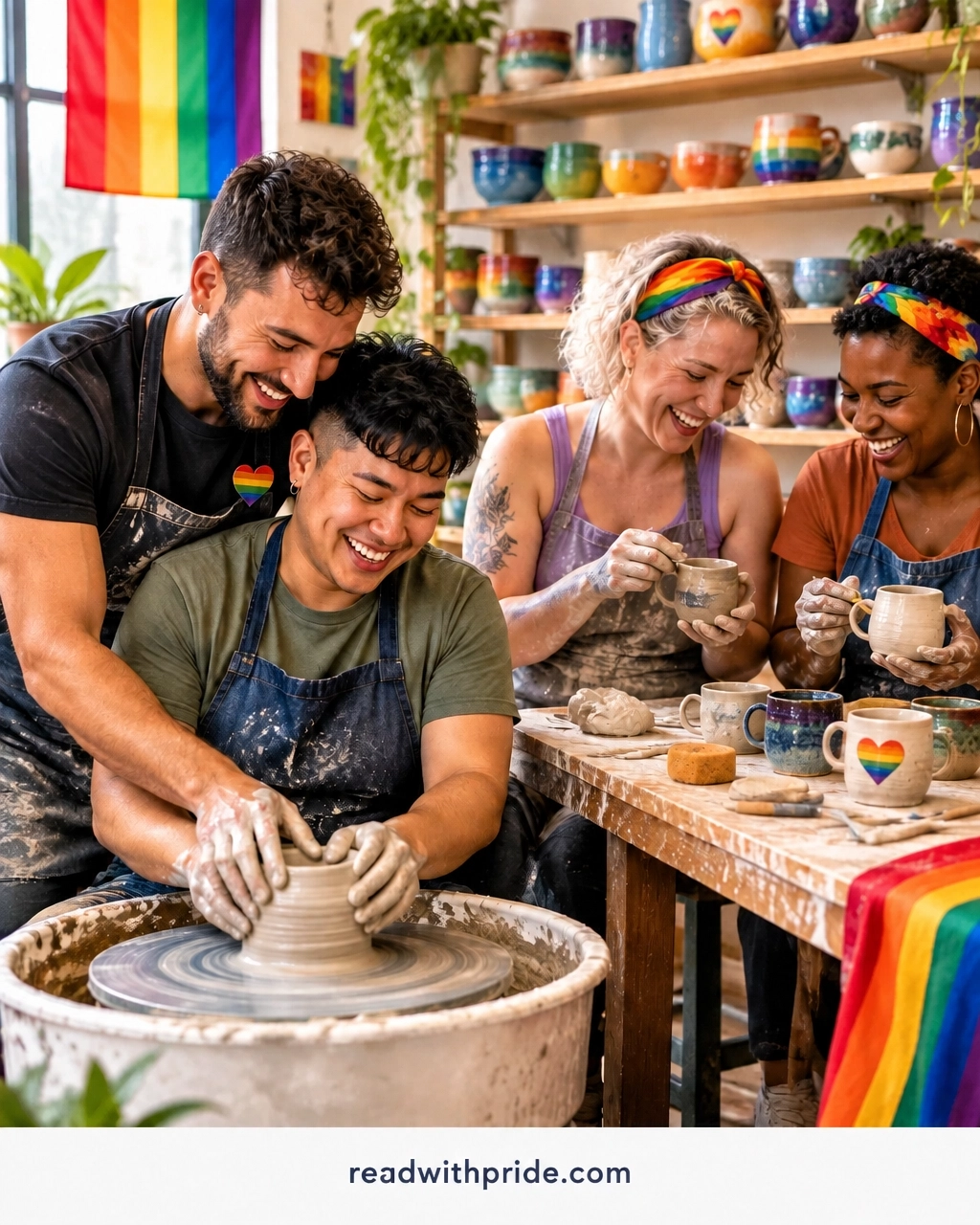
There’s something wonderfully humbling about pottery. You sit down expecting to make a chic little vase, and five minutes later, you’re holding a clay pancake with the structural integrity of a wet sock.
Good news: that is completely normal.
Pottery and ceramics are brilliant queer hobbies because they give people something to do with their hands while making space for conversation, curiosity, and connection. You don’t have to arrive as an artist. You only need to be willing to get a bit messy: and possibly laugh at your first bowl.
Why clay is such a powerful community-building hobby
Ceramics naturally slow you down. At the wheel, you’re focused on pressure, balance, and keeping the clay centred. At a hand-building table, you’re sharing tools, ideas, glazes, and the occasional “does this look like a mug or a haunted mushroom?” moment.
That low-pressure atmosphere makes it easier to meet people without forcing instant vulnerability. You can chat while wedging clay, compare techniques while waiting for the kiln, or bond over the universal experience of accidentally making something lopsided.
This is community building in its most practical form: showing up regularly, learning together, and becoming familiar faces in one another’s lives.
For LGBTQ+ people, an explicitly queer or LGBTQ+-friendly studio can offer an extra layer of comfort. A dedicated queer clay night, a beginner workshop, or a community studio membership can turn a one-off activity into a place where friendships grow naturally.
Choose your clay adventure
Wheel throwing: embrace the chaos
Wheel throwing is dramatic in the best way. The wheel spins, the clay wobbles, and suddenly everyone in the room is emotionally invested in your cylinder.
Beginner classes usually teach the basics of centring, pulling, shaping, trimming, and glazing. You’ll learn plenty, but you’ll also discover that clay has its own opinions. It is a wonderfully literal exercise in patience.
There are even some excellent MM romance tropes hiding at the wheel:
- Grumpy/sunshine at the pottery wheel
- Forced proximity at the shared sink
- Rivals-to-friends over whose bowl survives the kiln
- Found family in the studio
Honestly, if two people keep reaching for the same sponge, a romance novelist would already be taking notes.
Hand building: accessible, social, and gloriously tactile
Hand building uses techniques such as pinching, coiling, and slab construction. It’s often a great starting point if the wheel feels intimidating: or if you prefer making sculptural pieces, tiles, dishes, and wonderfully wonky candle holders.
Because hand building usually happens around shared tables, it can be especially social. You can join a queer workshop with a friend, attend solo, or bring the energy of a casual queer book club into the studio by discussing your latest read between clay-related emergencies.
There’s no single “right” way to make something. Your finished piece can be polished, playful, practical, abstract, or shaped like a tiny emotional support potato.

Community kilns make creativity more accessible
Not everyone has space for a kiln: or wants to explain to their landlord why the flat is suddenly operating as a ceramics factory. That’s where community studios and shared kiln services come in.
Many studios offer memberships, open-studio sessions, firing services, shared tools, and access to glazes. Some run regular queer-focused events, while others provide welcoming spaces where LGBTQ+ members can create their own groups.
When you’re looking for a studio, check whether it offers:
- Beginner wheel throwing and hand-building classes
- Open studio or membership access
- Clear kiln-firing fees and turnaround times
- Accessible pricing or low-income spaces
- LGBTQ+ community nights or inclusive policies
- A friendly approach to pronouns, names, and different learning needs
Queer-centered spaces such as Clay Wild and Reclaim Clay Collective show how ceramics can combine creative practice with genuine community care. If there isn’t a queer studio near you, ask a local arts centre whether it would host a queer clay night. Someone has to make the first slightly wonky mug.
Clay, creativity, and queer joy
There’s a quiet kind of joy in making an object that didn’t exist before. You take a lump of earth, give it time and attention, and end up with something that carries the marks of your hands.
That can feel especially meaningful for people whose identities have been questioned, hidden, or treated as something to be corrected. Ceramics offers the opposite message: you are allowed to take up space, experiment, change shape, and make something beautiful without needing permission.
It also pairs perfectly with reading. Bring an audiobook for the journey home, swap gay fiction recommendations while glazing, or plan a studio social around MM romance books, gay romance novels, and other LGBTQ+ novels. Read with Pride celebrates everything from tender coming out stories and heartfelt queer love stories to steamy romance, lesbian romance, and adventurous LGBTQ+ fiction 2026.
And if your search history has somehow wandered from ceramics to “C Section 2026,” welcome. The internet is a strange and beautiful filing cabinet.
Ready to get your hands in the clay?
Try a one-off pottery class, look for a queer ceramics meetup, or join a community studio with shared kiln access. Go alone, bring a friend, or arrive knowing absolutely nothing. The goal isn’t to make perfect pottery. It’s to make time for yourself: and maybe find your people along the way.
After class, explore the Read with Pride homepage and browse the Read with Pride LGBTQ+ blog for more queer hobbies, culture, and reading inspiration.
Follow Readwithpride on Facebook and Read with Pride on Instagram for more queer joy, bookish recommendations, gay romance books, lesbian romance, and stories worth making space for.
#QueerHobbies #CommunityBuilding #QueerJoy #LGBTQBooks #MMRomanceBooks #GayRomanceNovels #QueerFiction #CeramicsCommunity #QueerArtists #PotteryClass #ReadWithPride

Leave a Reply
You must be logged in to post a comment.