

The Road to the Village Green
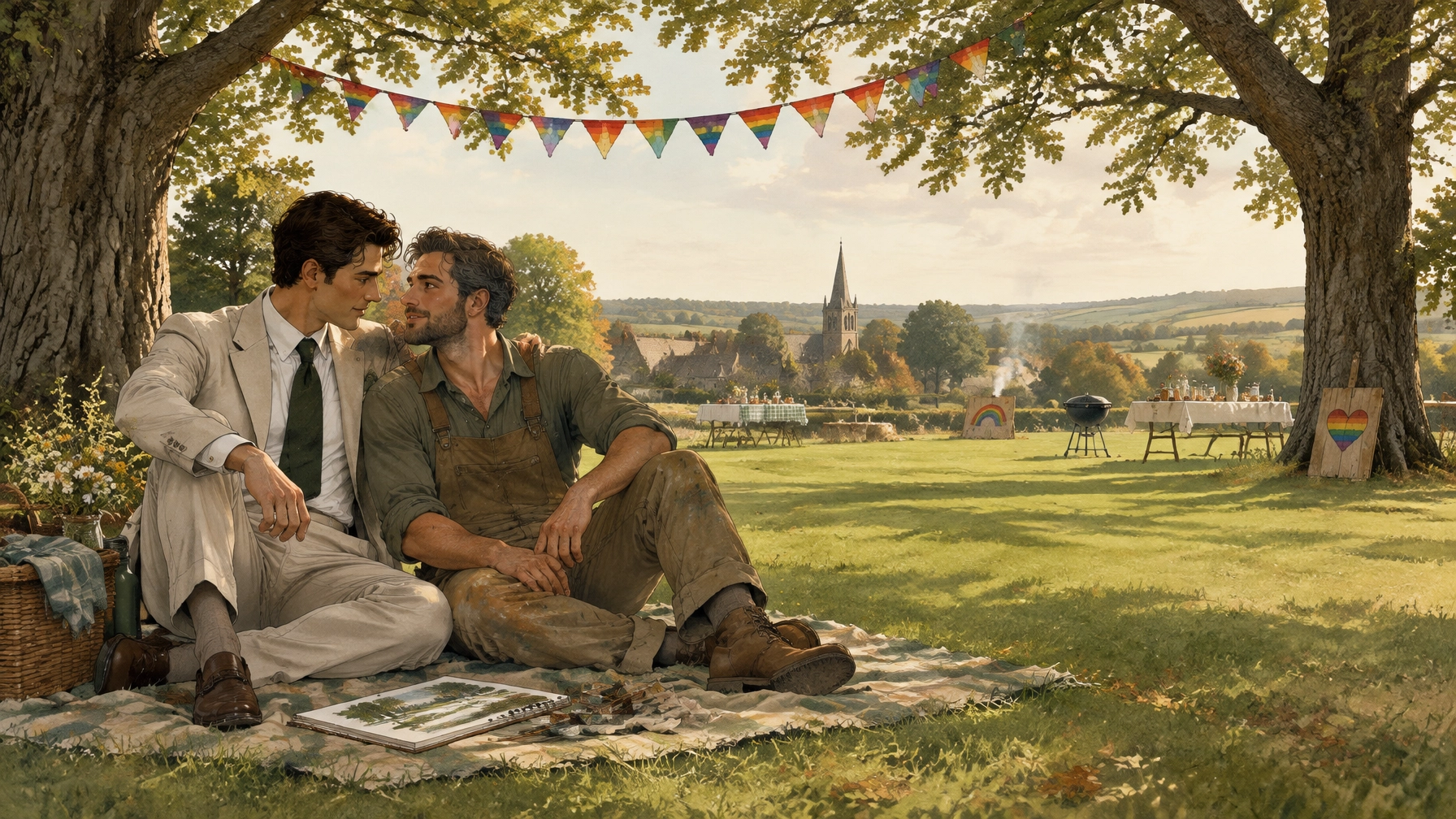
By four o’clock, the village green had begun to look almost brave.
Not grand. Not polished. Brave.
There were folding tables with paper plates stacked beside bowls of homemade salad. A charcoal grill breathed a thin ribbon of smoke into the cool September air. Someone had brought a cake iced in uneven stripes of colour. Someone else had carried two thermoses of coffee from the village hall.
Between two old oaks, rainbow bunting moved gently in the wind.
The flags were not professionally printed. The colours did not quite match. One length had been painted by hand, and the red stripe had bled into the orange. Kai had said that was the point.
“Nothing here needs to pretend it came from somewhere else,” he told Leo.
Kai Torres stood beneath the branches with a roll of twine in his hands, his fingers marked with green and ochre paint. He had spent the morning at the farm, then the afternoon arranging tables, carrying crates and repainting a sign that had been damaged by rain.
Leo Vance had spent the morning trying to make the event safer.
He had called a security firm. He had asked about hiring a larger venue. He had offered to pay for proper banners, lighting, a covered stage and a portable sound system. When the organiser mentioned that the budget was small, Leo had reached automatically for his phone.
The instinct was as familiar as breathing.
Find the weakness. Cover the cost. Control the conditions. Make certain nothing could go wrong.
Kai had watched him for a long moment.
“You’re trying to build a wall around a picnic,” he said.
Leo had wanted to argue. Instead, he had looked through the window at the village green, where three people were carrying folding chairs across the grass.
“I’m trying to help,” he said.
“I know.”
That was the difficult part. Kai always knew.
A Small Event with a Large Shadow
The town’s first Pride picnic had been discussed for months in cautious voices.
Some people had wanted a parade. Others had wanted a private gathering in the village hall. A few had suggested waiting until the following year, when there would be more support, more certainty and fewer opportunities for trouble.
Kai had argued for the green.
Not because it was perfectly safe. It wasn’t.
The village green was visible from the high street. Anyone could pass by and see the bunting. Anyone could stop at the edge and watch. There was no locked door, no guest list and no way to make the afternoon feel entirely separate from the life of the town.
That visibility mattered.
It also carried a cost.
In a city, Leo had once been able to move through a crowd without being remembered. He could attend a restaurant, leave a party or hold a man’s hand on a pavement without wondering who might report it back to his employer, his neighbours or his family.
The country had taught him that smallness could be both intimate and exposed.
Here, everyone knew whose van belonged to which farm. Everyone noticed a new haircut, a different car or a light left on in an upstairs window. A man could be welcomed at the pub and still be discussed before he reached home.
Being seen was not the same as being safe.
Kai understood that without needing to explain it.
He had grown up in places where independence was not simply a personality trait. It was protection. He knew how to make a life with limited approval. He knew when to speak, when to leave and when to let silence pass without mistaking it for agreement.
Still, he had chosen to stand beneath the oaks.
The People Who Came
At first, there were only a handful of people.
A young man from the next village arrived alone and kept his coat on despite the mild weather. Two local men came together but sat at separate tables until someone offered them tea. A painter Kai knew from the market brought a basket of apples and stayed close to the edge of the gathering.
Then came an elderly couple.
They moved slowly, side by side, in matching woollen jumpers. One carried a small picnic basket. The other held a paper bag containing two slices of cake.
They had been together for forty years.
They had shared a house, cared for one another through illness, raised a dog, survived family arguments and learned how to sleep through each other’s snoring. They had built a life so complete that it seemed impossible anyone could call it anything other than love.
Yet they had never said so in public.
Not here.
Not in this town.
When Kai welcomed them, one of the men glanced at the other before answering. The gesture was almost invisible, but Leo saw it. The question was not whether they belonged. It was whether they were allowed to say that they did.
Kai did not press them.
He simply moved two chairs closer together.
Later, when the sun had lowered behind the church roof, the older man reached across the space between them and took his partner’s hand.
No announcement followed. No applause.
The world did not change in any visible way.
But the hand remained there.
The Boy at the Edge of the Green
A teenager stood beyond the line of bunting for most of the afternoon.
He wore a dark sweatshirt and kept his hands in his pockets. Every few minutes, he looked towards the tables, then towards the road, as if checking whether anyone had noticed him.
Leo noticed him.
Of course he did.
He noticed the boy’s distance, his uncertainty and the way he flinched when a car slowed near the green. Leo wanted to walk over. He wanted to offer him a plate of food, ask whether he had somewhere safe to go and tell him that everything would be all right.
Kai caught his wrist.
“Don’t make him choose,” he said quietly.
Leo looked at him.
“Choose what?”
“Whether to be brave for you.”
The words landed harder than any criticism could have.
Kai nodded towards the teenager. “He’s already here. That might be all he can do today.”
So Leo stayed where he was.
The teenager did not join the picnic. But he did not leave either. Before the light began to fade, Kai placed a paper cup of lemonade on the grass near the edge of the green and walked away without looking back.
A few minutes later, the cup disappeared.
The Cheque in Leo’s Pocket
Leo had brought a cheque with him.
He had written it before leaving the house, intending to give it to the small organising group. It would cover security, better signage, a larger venue and the cost of making next year’s event more visible.
He had imagined Kai’s relief.
Instead, as the afternoon continued, the cheque grew heavier in his pocket.
The picnic did not need to become a statement designed for newspapers. It did not need to prove anything to the people who had stayed away. It did not need to become larger before it was allowed to matter.
It needed to belong to the people who had made it.
Kai had painted the signs. The older couple had brought cake. The nervous young man had stayed for another cup of coffee. The teenager had accepted a drink without being asked to explain himself.
Leo had arrived believing that love meant preventing every possible wound.
But sometimes protection became another form of control. Sometimes a person could be so determined to make the world safe that he forgot to leave room for someone else’s courage.
As the evening cooled, Leo sat down on the blanket beside Kai.
He did not offer money.
He did not suggest improvements.
He did not ask whether Kai had enjoyed himself or whether the turnout had been enough.
He simply sat there, shoulder to shoulder with the man he loved, beneath the uneven bunting and the old oak branches.
For once, Leo was not in charge of the outcome.
He was visible.
What Kai Taught Him
Kai leaned back on his hands and looked across the green.
“Are you all right?” he asked.
Leo almost laughed. The question sounded too simple for the answer it required.
“I don’t know,” he said.
Kai accepted that.
There was no demand for certainty between them. That was one of the things Leo loved most: Kai did not confuse confidence with truth. He understood that courage could look like a shaking hand, an unfinished sentence or a man sitting quietly where everyone could see him.
“I wanted to fix it,” Leo admitted.
“I know.”
“I thought if I paid for enough things, nobody could hurt you.”
Kai turned to him. “You can’t purchase the world into kindness.”
“No.”
“But you can stay.”
The words moved through Leo slowly.
To stay was not passive. It was not the same as surrender. It meant choosing presence without guarantees. It meant allowing Kai to decide what he wanted, even when Leo’s fear insisted that he knew better.
So Leo stayed.
He stayed when two men walking past glanced towards the green. He stayed when someone at the table asked whether he and Kai were together. He stayed when Kai answered, “Yes,” without looking at him for permission.
And when Kai reached for his hand, Leo let him choose the moment.
Love in the Open
By sunset, the picnic had become quieter.
The tables were half-empty. The charcoal had gone grey. The hand-painted signs leaned against the legs of the folding chairs, their colours softened by the fading light.
The elderly couple were still holding hands.
The teenager had gone, but the paper cup was gone with him.
Kai rested his head briefly against Leo’s shoulder.
It was not a dramatic gesture. No one applauded. No one took a photograph. It was only the small, ordinary weight of one man trusting another man enough to be seen beside him.
That was the milestone.
Not the bunting. Not the first event. Not the promise that next year would be easier.
The milestone was Leo understanding that love could not guarantee safety. It could not remove every risk or control every response. But love could refuse to turn fear into ownership.
It could stand beside someone without standing over him.
The town’s first Pride picnic ended with two men sitting on a blanket beneath old oaks, sharing the last slice of cake.
For Leo, that was enough.
For Kai, it was a beginning.
Read with Pride
Stories about gay men, emotional MM relationships and the complicated work of being known can hold space for these quiet victories. The most powerful gay love stories are not always about grand declarations. Sometimes they are about the first time two men sit together in public and refuse to make themselves smaller.
For readers drawn to character-driven MM romance, heartfelt gay fiction, queer novels and emotionally immersive stories about love, fear and resilience, explore more LGBTQ+ ebooks through Read with Pride.
You can find Dick Ferguson’s emotionally charged MM romance and gay fiction collection at Read with Pride.
Three possible next Evening Edition stories
- The First Frost: How Leo and Kai learn that sharing a home does not mean sharing every decision.
- The Village Photograph: When one picture makes a private relationship public, two men must decide what they are willing to claim.
- The Empty Chair: A winter gathering forces Kai to confront the person who never came to see the life he built.
Follow Us on Social Media
Follow Dick Ferguson for more lyrical MM romance, gay novels, queer fiction and emotionally immersive gay love stories:
#ReadWithPride #MMRomance #GayRomance #QueerFiction #GayFiction #GayNovels #GayLoveStories #MMNovels #LGBTQFiction #GayLiterature #MMFiction #EmotionalMMBooks #HeartfeltGayFiction #GayRomanceBooks #MMRomanceBooks #LGBTQRomance #GayAuthors #QueerAuthors #MMAuthor #LGBTQReading #ReadingWithPride #2026GayBooks


Leave a Reply
You must be logged in to post a comment.