

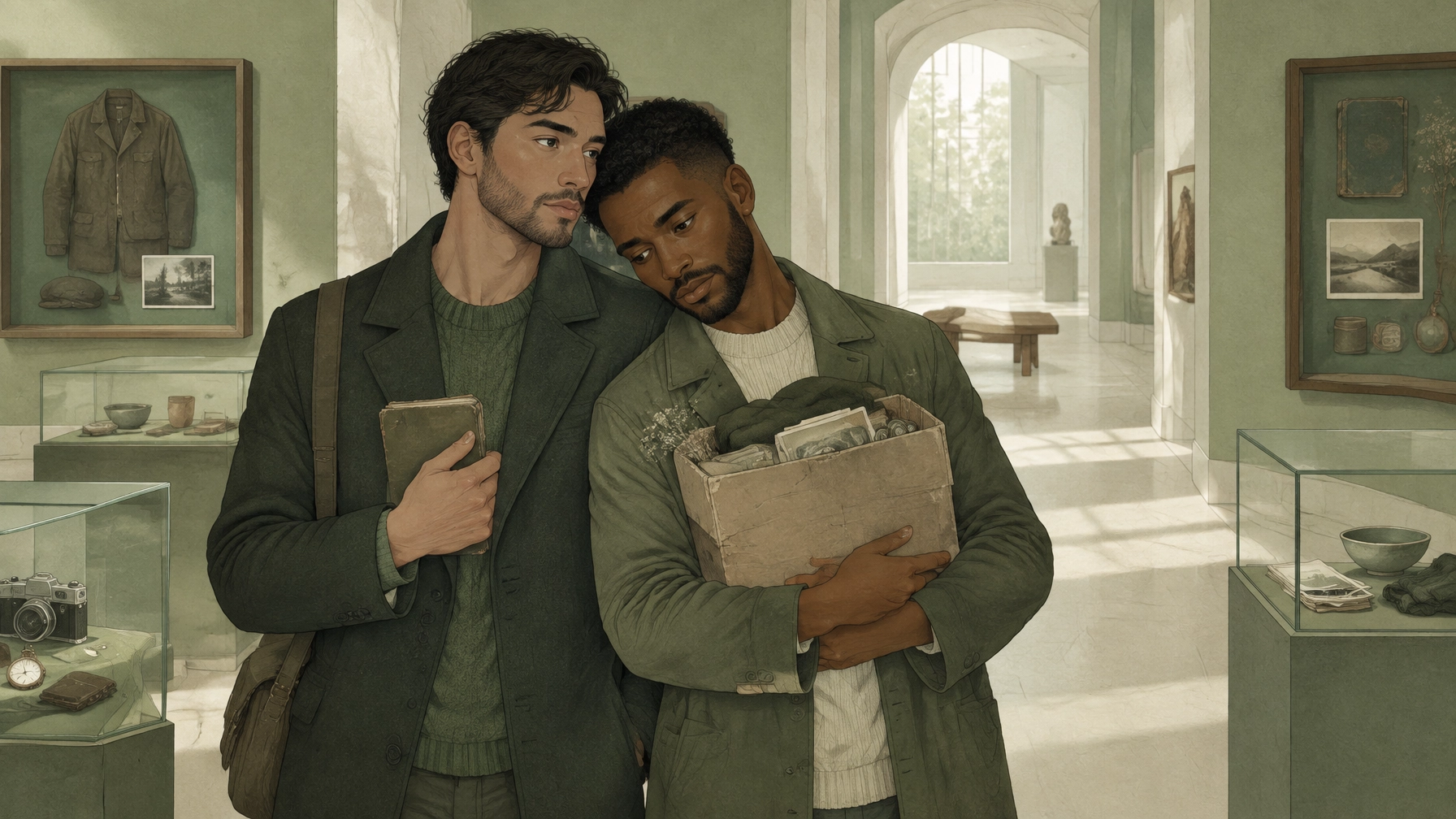
There are places built to celebrate what humanity has made: paintings, engines, crowns, weapons, the preserved bones of creatures that disappeared before we learned how to mourn them.
And then there is the Museum of Broken Relationships in Zagreb.
It is a real museum, housed in the city’s historic Upper Town, where people from around the world donate objects left behind by relationships that ended. A shoe. A key. A dress. A toy. A letter. A kitchen appliance. Something ordinary, made unbearable by memory.
Each object is displayed with a short anonymous story.
The stories are the true exhibits. The objects are only their handles.
For readers drawn to emotionally immersive MM romance, queer fiction, and gay love stories that take grief seriously, the museum offers an unexpected setting for a question that is both simple and devastating:
What do we keep when love is over, and what does keeping it say about us?
The museum of what remains
Elias Varga had always trusted objects more than people.
Objects did not change their version of events. They did not say they were fine when they were furious. They did not leave a room and return with a different face. A watch was a watch. A paperweight was a paperweight. A torn photograph could be examined beneath proper light.
For twelve years, Elias had worked as an archivist. He knew how to catalogue damage without touching it. He understood the discipline of gloves, acid-free folders, controlled temperatures, the careful separation of one fragment from another.
He believed preservation was a form of mercy.
He did not believe it was the same thing as forgiveness.
Jonah met him outside the museum on a pale morning when Zagreb seemed washed in rain. The stones of the Upper Town shone beneath their feet. Somewhere beyond the rooftops, a church bell struck the hour with the weary authority of something that had been repeating itself for centuries.
Jonah was carrying a small cardboard box.
Elias noticed it immediately.
“You brought something,” he said.
Jonah looked down at the box. “I nearly left it at the hotel.”
“But you didn’t.”
“No.”
Elias did not ask what was inside. He had learned that some questions were simply another way of demanding access.
They entered.
The Museum of Broken Relationships began with a breakup of its own and grew into a public archive of private loss. Its collection is made from donated objects and anonymous accounts, each contribution offering a piece of evidence from a relationship that could not continue in its original form.
The museum does not ask visitors to decide who was right.
It does not reward the innocent or punish the faithless.
It places a broken thing under glass and allows it to remain complicated.
What an object remembers
The first room was quiet except for the softened movement of other visitors.
Jonah read every story. Elias read the objects.
He noticed the scratches on a wooden surface. The faded colour of fabric. The small distortions made by years of being held, carried, hidden, or nearly thrown away.
Jonah read a note beside an ordinary household object and stood very still.
“What?” Elias asked.
“Nothing.”
“That isn’t true.”
Jonah gave him a tired smile. “You’re an archivist. You think everything is evidence.”
“Everything is evidence.”
Jonah touched the cardboard box beneath his arm. “Then this is evidence too.”
He had been carrying the box for nearly three years. It had travelled from one rented room to another, from the bottom of a wardrobe to the back seat of a car, from a city where he had been loved to a city where he was trying to become someone who had not been.
Inside was a blue wool scarf.
It had belonged to Daniel.
Daniel had been the first man Jonah had loved without being able to pretend the feeling was anything else. Before him, Jonah had spent years treating bisexuality as a private weather system: something real, shifting, and no one else’s business. He had dated around the truth. He had made himself smaller in conversations. He had accepted the word “confused” because it was easier than explaining that attraction did not become less honest simply because it had more than one direction.
Coming out had not been one brave door opening.
It had been a series of smaller doors, each with its own lock.
Daniel had stood beside him through some of them. Through others, he had been tired, frightened, or angry. Love did not make either man perfect. It only made the consequences more intimate.
When they ended, Daniel had said, “You keep asking me to believe in a version of you that you won’t defend.”
Jonah had heard accusation.
Years later, he understood the fear beneath it.
Jealousy and possession
They found a room containing objects that seemed almost comic until the stories made them human.
A broken ornament. A single glove. A damaged piece of furniture. A collection of photographs with the faces removed.
Jonah stopped in front of a small glass case.
“Daniel used to be jealous of your work,” Elias said.
It was not a question.
Jonah turned to him. “You looked at my phone?”
“I saw his name.”
“You saw his name and invented the rest.”
Elias felt the old, sharp movement inside himself: the urge to possess what he loved by understanding it completely. Jealousy was often described as fear of losing someone. That was too generous. Sometimes jealousy was the belief that another person’s history was an intrusion. Sometimes it was the wish to be the only witness to someone’s tenderness.
Elias had been jealous of Daniel before he ever met him.
Not because Daniel was still present, but because he had left a mark Elias could not remove.
He had wanted Jonah without remnants. He had wanted a clean beginning, an unshared language, a man whose body and memory contained no rooms where Elias had never been invited.
It was an impossible demand.
Everyone arrives carrying evidence.
“I thought you were still in love with him,” Elias said.
Jonah looked at the display case. “I was.”
The words landed without drama. That was what made them hurt.
“Are you now?”
“I don’t know.” Jonah’s voice tightened. “Maybe love doesn’t disappear when the relationship does. Maybe it changes shape. Maybe sometimes it becomes regret. Or gratitude. Or the part of you that still flinches when someone asks you to stay.”
Elias wanted to ask whether there was room for him in that unfinished answer.
Instead, he said, “You brought the scarf here.”
“I brought it because I couldn’t throw it away.”
“That isn’t the same as wanting him back.”
“No,” Jonah said. “But it isn’t the same as being free.”
The fear of being unworthy
They sat on a bench beneath the muted light of the gallery.
For a while, neither man spoke.
The museum had a strange effect on silence. It made silence feel inhabited. Around them were hundreds of absent people, each represented by the thing they had surrendered and the few sentences they had been willing to leave behind.
Elias opened his notebook.
He had brought it out of habit. He wrote down accession numbers, dates, fragments of descriptions. He made order wherever he could.
Jonah watched him.
“What would you donate?” he asked.
“Nothing.”
“That means you have too many things.”
Elias closed the notebook.
He thought of the envelope in his desk drawer at home. Inside it was a photograph of his father’s hands resting on a hospital blanket. He thought of the unsent letter to his mother, written after he had come out and discovered that acceptance could be polite without being warm. He thought of every relationship he had ended before the other person could decide he was difficult to love.
His guardedness had once felt like dignity.
Now it looked more like an empty room he kept polished for inspection.
“I would donate the key,” he said.
“What key?”
“The one to my old flat.”
Jonah waited.
“I kept it after I moved out. I told myself it was practical. It wasn’t. I kept it because I wanted the door to remain possible.”
“Possible for whom?”
Elias looked at him.
That was the question he had avoided for years. Not whether he was worthy of love, but whether he could tolerate love being real without immediately preparing for its disappearance.
“I thought if I never needed anyone,” he said, “no one could prove I was too much trouble to keep.”
Jonah’s expression softened, but he did not reach for him.
That mattered.
Tenderness was not the same as rescue.
What we keep after the end
At the end of the exhibition, Jonah opened the box.
The scarf was softer than Elias expected. Blue wool. Frayed at one edge. It carried no visible trace of Daniel, yet Jonah held it as if memory had weight.
“I thought keeping this meant I was betraying you,” Jonah said.
“It doesn’t.”
“I thought throwing it away would prove I had chosen you.”
“You don’t have to destroy your past to love me.”
Jonah looked at him. “What if I’m still afraid?”
“Then be afraid.”
It was not a grand promise. It did not erase Daniel, the arguments, the years of silence, the shame Jonah had been taught to attach to his own complexity, or Elias’s instinct to retreat whenever love became difficult.
But it was honest.
Jonah folded the scarf and placed it back in the box.
Not as a shrine.
Not as a secret.
As evidence.
Evidence that something had happened. Evidence that two men had once mattered to each other. Evidence that endings could be painful without making the love false.
Outside, the rain had stopped.
They walked down the stone street with the empty box between them, no longer carrying it as a verdict. The city was beginning its morning properly now: shutters opening, footsteps gathering, coffee machines hissing behind café doors.
Elias reached for Jonah’s hand.
This time, Jonah took it.
The Museum of Broken Relationships does not promise that every loss can be repaired. Its power lies elsewhere. It reminds us that a broken relationship is not necessarily a meaningless one, and that memory can be held without becoming a prison.
Sometimes the object we keep is not proof that we are trapped in the past.
Sometimes it is proof that we survived having a past at all.
For readers looking for emotionally complex gay novels, heartfelt gay fiction, LGBTQ+ fiction, and character-driven MM novels shaped by grief, jealousy, resilience, and hard-won hope, this is the kind of unexpected place that stays with you.
Not because it tells us how to let go.
Because it asks us to look carefully at what remains, and to decide what it means now.
Follow us on social media
Follow Dick Ferguson and Read with Pride for more literary MM romance, gay romance books, queer fiction, emotional LGBTQ+ reading, and new gay releases:
Three possible Morning Edition topics for tomorrow
- The Last Bookshop at the End of the Road, Where Two Men Found a Love Story Written in the Margins
- The Night Train to Somewhere Else: An MM Romance About Coming Out, Second Chances, and the Courage to Stay
- The Lighthouse Archive, Where Two Men Learned That Some Warnings Are Really Invitations to Be Saved
#MMRomance #GayRomance #QueerFiction #GayFiction #LGBTQFiction #MMNovels #GayLoveStories #EmotionalMMBooks #HeartfeltGayFiction #GayRomanceBooks #QueerAuthors #MMAuthors #LGBTQReading #ReadingWithPride #ReadWithPride


Leave a Reply
You must be logged in to post a comment.