

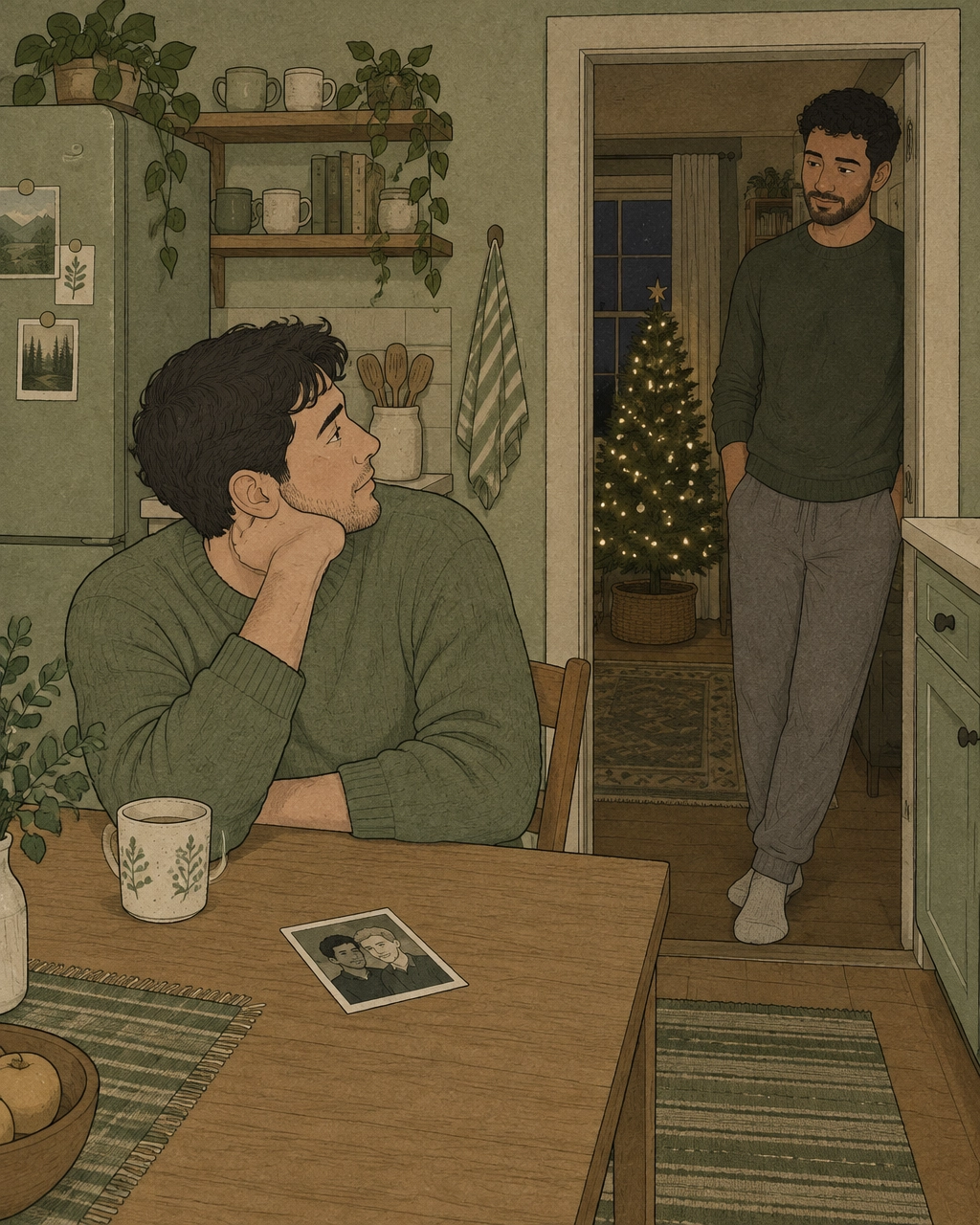
The receipt that could not be found
The lights had been on the tree for less than a day, and already Julian had a plan for returning them.
“The shop sold me a faulty string,” he said, laying the original box on the kitchen table. “Half blink, half hesitate. I’ll explain the fault, show them the packaging and ask for an exchange.”
Elias looked at the lights. One section flashed with confidence; the other appeared to be considering it.
“They may not want the considered explanation.”
“They should. It’s a good explanation.”
The tree stood in the corner, lopsided and nine inches shorter than the ceiling. They’d bought it from the corner shop on 25 November, the flat’s first Christmas tree. The extra space at the top was for a star and, Julian had said, optimism. Theo’s decoration box had gone up first. The star was cut from the cardboard box, Theo’s name written on its hidden side. Half the lights blinked; half lagged behind. Julian had said he’d inspect them tomorrow.
Now tomorrow had arrived with a missing receipt.
He opened the kitchen drawer where the receipts lived. There were receipts for old bulbs, a manual for an appliance neither of them could immediately name, and the Luigi’s Corner takeaway menu with Julian’s deliberate fold. The fold was not decorative. It was useful.
Underneath those lay the brown envelope.
Just one letter on it: J.
Julian shut the drawer a beat too quickly.
Elias noticed. He said nothing.
The ugly duck mug, its blue knitted hat pulled over its head, sat nearby holding Elias’s spare key. Julian’s flat had systems for most things. The one clean knife had its place. So did the mug, the menu, and the sightings notebook for Here, the grey-and-white stray cat who went out late and came back the next evening. Even structural weakness had a place in Julian’s thinking.
“Everything’s a project if you’re thorough,” he said, lightly, as he reached for the light box.
He’d said it as a joke before. Elias smiled, but Julian didn’t look at him.
The shelf with one photograph on it
Later, Elias sat on the floor beside the tree, untangling a length of tinsel with the solemn concentration of a man negotiating a small treaty.
Maurice, the dramatic one-leaf plant on the bookshelf, wore a strand of tinsel and was insufferable about it. Beside him sat the framed photograph of Elias and Theo, a small wooden ornament, and a candle. The photograph had been there long enough to feel like part of the room.
Julian stood near the bookshelf, assessing whether the tree was leaning more than it had been ten minutes earlier.
“Do you have photographs from before?” Elias asked.
The question was gentle. It still landed like a form slid across a table.
Julian answered like a man at an interview. There had been a rented flat. He’d had a job. The boiler had been unreliable. There were dates he could probably look up. He gave Elias facts neatly arranged, with no people in them.
Elias rested the tinsel in his lap.
“That isn’t what I asked.”
“It’s what I can answer.”
Gerald, the creaky floorboard in the hall, made a small complaint as the radiator ticked. The flat had opinions, most of them structural.
Elias didn’t press. He didn’t tell Julian that the question had been harmless, as if intention could tidy away what it had stirred. He only looked back at the tree.
Tuesday evening had its standing place in their week; neither man needed to make a grand announcement of it. They were good at showing up. They were still learning what showing up could ask of the other.
Julian adjusted one branch. “The star’s straight.”
“It’s a piece of cardboard.”
“It can be both.”
Elias smiled. Julian smiled too, briefly, and felt the question remain where it had landed.
What was in the envelope
A few days passed. The flat turned cold, and the radiator knocked as if it had a grievance it was prepared to document.
Julian sat at the kitchen table late one evening, a cold mug at his elbow and the brown envelope open beside it. This time, when Elias came in, Julian didn’t hide it.
Inside was a photograph of Julian at twenty-three, sitting at a table in a shirt too big for him. At the edge of the frame, someone’s arm was cut off at the elbow.
On the back, in handwriting that wasn’t Julian’s, were the words: J, stop doing that with your hands.
“The man was called Owen,” Julian said.
Elias stayed by the doorway, leaving the space around the table clear.
“Owen laughed at my lists. Fondly, at first.” Julian looked at the handwriting. “He said, ‘You make everything into a project so nobody can see inside the project.’”
He put the photograph down.
The relationship was over. Julian didn’t offer a history of how or why, and Elias didn’t ask him to. What he offered instead was the part that still hurt.
“I’ve been trying to disprove that sentence ever since,” he said. “When you joke about projects, I know you mean it fondly. But some part of me hears him underneath it.”
He looked at the mug, then at the photograph.
“Being known feels like being audited. Like somebody will check every detail and decide I’m too much.”
The admission sat between them without becoming a demand. Julian wasn’t asking Elias to repair Owen’s words or take responsibility for the way they’d stayed.
“I see,” Elias said.
Julian let out a breath that was almost a laugh. “That’s a dangerously sensible response.”
“I can make it worse, if you’d prefer.”
“Not tonight.”
“Understood.”
The one-word answer settled between them. On a bad day, either of them could say sideways and the other would know to make room. Tonight wasn’t exactly that. It was close enough to need care.
A question, not a form
Elias came to the table and put the photograph back down flat. He didn’t pick it up to inspect it or lean in to read the back again.
“I’m not collecting evidence,” he said. “There isn’t a form. I’d rather hear it slowly than not at all.”
Julian’s fingers curled around the cold mug.
“Everything’s an audit if someone is asking.”
Elias nodded. “I can understand that.”
He didn’t argue the feeling away. He stayed.
Then, without being asked, he offered one small true thing of his own.
“Sometimes I still hear Theo laugh from another room,” he said. “For half a second, I turn.”
He didn’t compare the men. He didn’t make the photograph on the table compete with the one on the bookshelf. Theo belonged in the flat: in the handwriting on the decoration box lid, in the cardboard star, in Elias’s memory. His laugh had once carried from another room. He’d stolen chips as a moral position. He’d said Elias’s name like it was worth saying twice.
Julian listened. Elias had shared a memory, not opened a door Julian was obliged to walk through.
After a while, Julian looked down at the photograph again.
“Owen used to move my keys,” he said. “Then deny it.”
Elias’s mouth turned up. “Was he good at hiding them?”
“No. But he was very confident.”
It wasn’t a revelation that changed everything. It was a small, unimpressive memory, offered because Julian wanted to offer it.
The envelope stayed on the table overnight. Putting it away would have made it a secret again.
Two photographs on a shelf
The next morning, Julian took the light string back to the corner shop.
The shop would not exchange it without a receipt. Julian gave his considered explanation anyway. The shopkeeper listened, nodded, and maintained the position. Julian accepted this with the air of a man filing the outcome under predictable, but regrettable.
The shop also had a photo-printing machine.
On Elias’s phone was one picture of Julian in the kitchen, taken from behind: tape measure in hand, checking something that had not strictly needed checking. It was badly framed and slightly blurry. It was also the only photograph of them that existed. The only one either of them could call theirs.
Julian stood beside the machine while it printed. Elias held his phone. Neither of them made a speech about what the photograph meant.
They bought a cheap frame. Back at the flat, Julian considered the wall, then the bookshelf. He measured twice.
The photograph of Elias and Theo stayed where it was. Julian set the new one beside it, leaving room between the frames. Not a replacement. Not a contest. Just another life, given a place on the shelf.
Here returned the next evening and settled on Elias’s coat on the kitchen chair, as if the arrangement had been made for him. Maurice rustled his one leaf beneath the tinsel, pleased with the general standard of attention.
The shelf now held two photographs, one more than the flat had ever expected. Julian had answered a question with a frame instead of a file.
For the Emotionally Invested Reader
This instalment of Elias and Julian’s serial is for readers drawn to character-driven queer fiction, where the smallest gestures can carry a history and a question can hold more than one meaning. Its emotional MM romance lives in the careful space between asking and listening: two men learning that tenderness is not the same as certainty, and that trust can grow without demanding a full account all at once.
For emotionally invested MM readers, Julian and Elias’s gay love story emotional journey is built from the ordinary things that become precious: a key in a ridiculous mug, a photograph on a shelf, a familiar joke heard differently, and the choice to stay. If you enjoy queer fiction, thoughtful MM books, heartfelt MM romance books and LGBTQ+ ebooks centred on intimate character work, explore the Dick Ferguson collection on Read with Pride.
Follow us on social media: Instagram · X · Facebook · Read with Pride
#QueerExperiencesAndStories #MMRomance #QueerFiction #GayRomance #LGBTQFiction #CharacterDrivenRomance #ReadWithPride #EmotionalMMRomance
Possible next instalments
- Maurice Gets a Second Leaf, When Two Men Learned That Recovery Can Look Unimpressive and Still Count
- New Year's Eve in a Flat with One Working Radiator, When Two Men Learned That the End of a Year Is Not a Verdict on It
- The Corner Shop Runs Out of Mince Pies, When Two Men Learned That a Small Disappointment Can Be Practised On


Leave a Reply
You must be logged in to post a comment.