

Category: Queer Life and Identity
Seven Days of Tuesday
A week before, Elias’s father sent a short message: Tuesday. Morrow’s. Seven?
Elias read it once, then spent the next seven days preparing for it in the way he prepared for everything. He booked nothing. There was nothing to book. He chose the time, worked out the route, checked Morrow’s opening hours twice, and checked the weather even though the weather had no bearing on whether a chip shop would be open.
Jonah watched this happen from the kitchen table. In his early thirties, working in accounts, he had a reasonable respect for a plan and a deep suspicion of one that kept acquiring new details. Elias made the plan anyway: which road to take, where to park, how long the walk would be, whether they ought to leave ten minutes early.
On Tuesday, he announced they were leaving twelve minutes early.
“Traffic,” he said, though there was no traffic report to support the claim.
Jonah got his coat. He did not point out that they were going to a chip shop, not an airport. Elias had learned young to manage rooms before anyone had asked him to. Jonah knew the habit wasn’t about him alone. Knowing that did not always make it easier to watch.
There is a particular kind of quiet before a family meeting: all the small preparations that promise nothing can go wrong. You may recognise the care in them, and the worry tucked underneath.
A Table Already Paid For
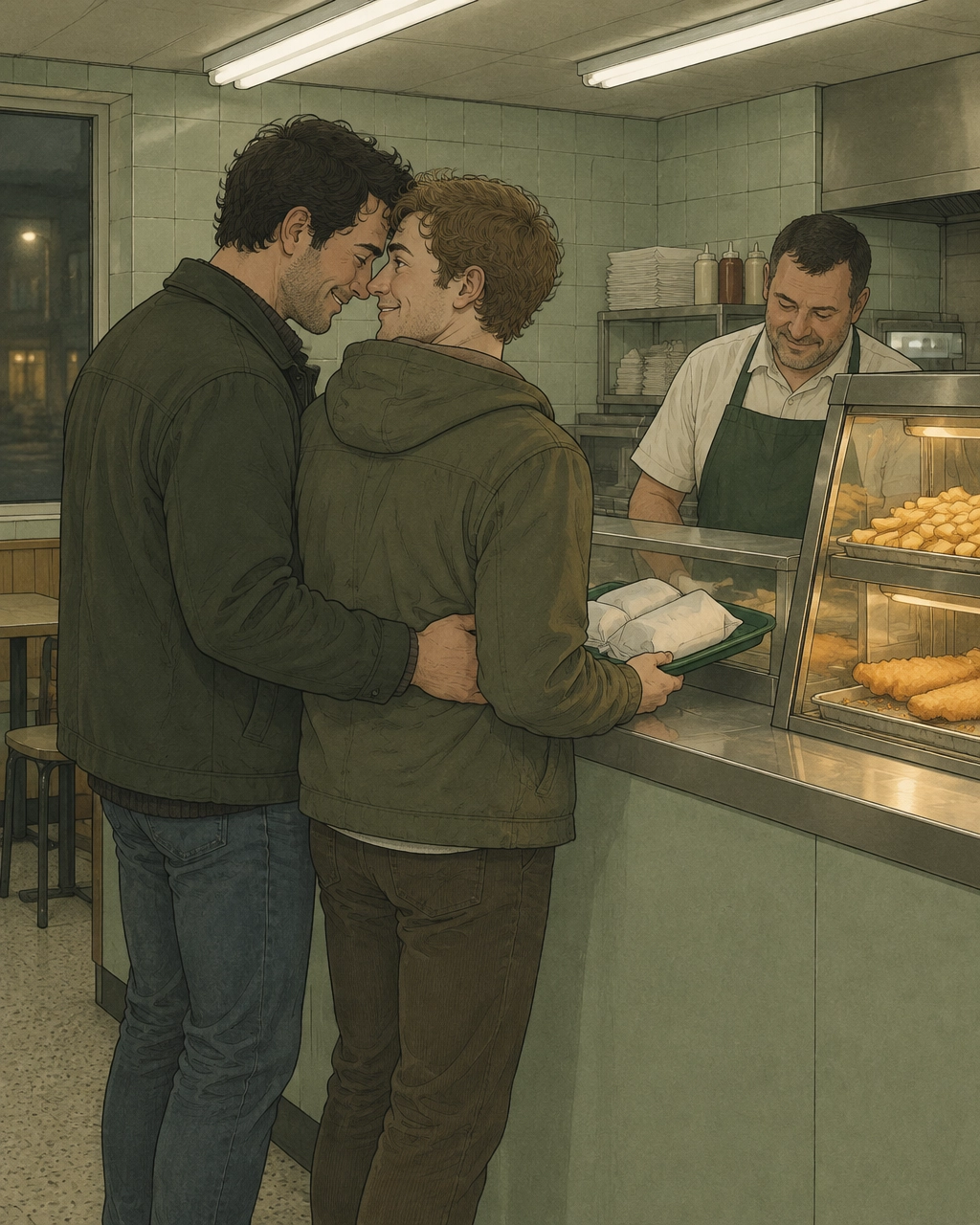
Morrow’s sat on the corner of the road Elias’s father had worked on for nineteen years. The chip shop was plain and bright, its fluorescent lights making the glass hot case shine. A queue hugged the door. Wooden forks stood in a tub by the counter; a bin waited beside them, and a laminated menu offered more choices than anyone needed on a Tuesday.
The father was already inside, seated at a formica table. Three portions, still wrapped in paper, were set out in front of him. His coat hung over the back of his chair. He had already ordered. He had already paid.
Elias stopped at the table with his wallet in his hand.
“One without batter,” his father said. “You said he doesn’t like batter.”
Elias’s hand went towards his wallet, then stayed there. There was nothing to pay for and no useful task to do with the wallet. For a moment, he simply held it.
Jonah looked at the three portions. His first thought was that his partner’s father had remembered something small about him. His second was that Elias had not been given a chance to arrange it first.
Elias sat down. His hands went to the salt shaker, which he straightened. He turned the vinegar bottle a quarter turn, lined up the wooden forks, then folded the corner of a napkin. None of it needed doing. He did it anyway, with the careful concentration of a man trying to leave a moment undisturbed by touching every part of it.
For readers seeking MM romance unexpected places, the surprise here was not the setting so much as the care already waiting at the table. The gesture was simple; noticing what it cost Elias to receive it was less simple.
The Corner He Knew
Morrow’s belonged to Elias’s father in a way that no restaurant ever could. It was not his in any official sense. He did not own the place, and he had not brought them there often. But he knew where to sit, where the queue would bend, and which of the men behind the counter would reach for the paper before the order was finished.
Jonah knew the road because of the work Elias’s father had done there. He knew the man’s clipped manner, too, and the way a pause could last long enough to make a person wonder if the conversation had ended. But he had never seen him here, among the cans of pop and the greasy warmth and the ordinary clatter of forks.
The three men unwrapped their food. Jonah’s portion had no batter, as promised. Elias’s father had guessed correctly, and Elias had arrived with a wallet and no job to perform. He was trying to sit still. His fingers kept finding little corrections around him.
Jonah recognised the effort without needing to name it. He had grown up in a family that took time to arrive at acceptance. His own father had needed about a year, then got there. Jonah understood the value of a person getting there in his own time. He also knew that waiting could make every ordinary gesture feel unusually loud.
What a Tuesday Looked Like
The father looked from one of them to the other. “What do you two do on a normal Tuesday?”
It was the sort of question people often skipped over. They asked about work, plans, the weather, anything that could be answered without opening a window onto the actual shape of a life.
“Nothing much,” Jonah said. “Elias cooks. I wash up. Then we watch something bad on the telly, and one of us falls asleep on the sofa.”
Elias’s father looked at him. “That’s it?”
“That’s it.”
“I thought there’d be more to it.”
“There isn’t. That’s the good bit.”
Elias’s fingers moved before he could stop them. He turned the vinegar bottle a quarter turn, then left his hand resting on it, as if holding a bottle could stand in for holding his tongue.
Jonah let the silence stay. He did not fill it with a joke or add details to make their Tuesday sound more interesting. There was nothing to defend. They did the dishes. They watched bad television. Sometimes one of them woke up with the sofa seam printed across his cheek.
Nobody congratulated anybody. Nobody announced what the answer meant. The father picked up a chip. Elias kept his hand on the vinegar bottle.
A gay love story emotional journey can rest on a question as ordinary as this one. Not every meaningful answer is a revelation; sometimes the truth is a shared sofa and the freedom to call that enough.
A Regular at the Next Table
The man at the next table was loud, cheerful and a bit drunk. He laughed at his own story, then told the ending again as if the first version might not have carried far enough. His voice bounced off the hard surfaces and over the queue by the door.
Elias’s whole body seemed to get ready to handle the room. He shifted his chair, just enough to angle towards the noise. His eyes moved to Jonah, then to the man, measuring how much attention the situation might require.
Before Elias could make a decision on anyone’s behalf, his father said, without looking up, “Leave it. He’s all right. He’s in here every Tuesday.”
The father kept eating. He knew this room, and Elias did not. It was a small distinction, but Jonah saw it land. Elias was a visitor in his own father’s small kingdom, where the loud man was a familiar part of the furniture and the best response was to carry on with the chips.
It stung less than Jonah expected. Elias’s chair settled back into place. Jonah noticed the relief in that, too, not a grand easing, just his partner letting the room belong to somebody else for once.
This is the kind of detail that gives character-driven queer fiction its texture: not a speech about who is allowed to manage a room, but the quiet surprise of discovering the room has already been managed.
The Chips Were Pale
The batter was heavier than it should have been. The chips were pale. The mushy peas had the uncertain look of something that had been waiting under a lid for a while. Nobody complained.
Elias’s father looked down at his food. “It’s not good. It never was. I’ve been coming here nineteen years.”
Jonah glanced at him. The line was delivered without irony, though the dry humour in it arrived a beat late. The father ate another chip, as if the matter had been settled and did not need further discussion.
There was something reassuring in the admission. He did not pretend Morrow’s was excellent. He did not dress up habit as taste or insist that nineteen years had made every meal worthwhile. He simply kept coming.
Jonah thought of his own family, and the slow distance between not knowing what to do with him and learning to make room. The distance had not vanished in one beautiful scene. It had narrowed through imperfect visits, awkward questions and the occasional unremarkable meal. Love, sometimes, looked less like getting everything right than returning when the food was still bad.
Emotionally invested MM readers know that devotion doesn’t need a polished backdrop. It can be stubborn, ordinary and a little disappointing, and still matter because someone keeps showing up.
The Thing He Meant
By the time the plates were cleared, the queue had thinned. The man at the next table had gone. Jonah folded his napkin once, then again, following the crease with his thumb.
Elias’s father had said very little since the chips. He sat with his hands on the table, looking towards the counter rather than directly at either of them. Jonah had learned not to mistake a pause for an empty space. Sometimes the father’s words arrived after the moment when they would have been easy.
“I don’t want to be the man who needed a year and then got one dinner out of it,” he said.
The sentence sat between them. There was no apology attached to it, no explanation of what the year had felt like from his side. Jonah heard the truth of it without needing the man to soften it. One dinner was not enough. The father knew that, and so did Elias.
“Come again,” the father said. “Same time. Same bad food.”
Elias answered, “All right.”
That was all. No promise made for Jonah. No quick agreement on his behalf. Elias’s voice was calm, but Jonah could hear what the short answer cost him: the urge to fill the silence, to make a plan, to smooth the edge of an invitation by managing it.
The emotional MM romance literary tradition has room for truths that arrive late, after the plates are cleared and the easy moment has passed. This one asks for no grand response. It asks only to be heard.
On the Corner
They walked out to the corner. Elias’s father did not come with them to the car. He turned back towards Morrow’s and went inside again, as if the evening had not required a formal ending.
Through the window, Jonah watched him at the counter. The man behind it handed him something. Elias’s father laughed at whatever he said, his shoulders loosening in the warm square of light. He looked at home there, in a room he had never mentioned.
Jonah watched for a moment longer, then looked at Elias.
Elias said nothing at all.
He kept saying nothing as they walked towards the car. Jonah noticed the silence first as an absence: the missing question about the route, the missing offer to drive, the missing little summary that might turn the evening into something manageable. Then he noticed that Elias’s mouth was set but not tight, and his hands were still.
It was not the silence of sulking. It was not a punishment, or a refusal to speak to Jonah. It was simply quiet, with no task attached to it.
At the car, Elias got the keys out and still had not spoken. Jonah watched him unlock the door and understood that nothing had been swallowed either, and nothing was being saved up for later. The quiet was simply where Elias had put the evening.
A note from Read with Pride
Read with Pride hosts LGBTQ+ ebooks including gay fiction, gay romance books, M/M books, MM novels and queer fiction. You can explore the Read with Pride collection for stories about love, identity and the lives people build together.
Follow us on social media
Instagram · X · Facebook · Read with Pride
#QueerLifeAndIdentity #MMRomance #GayRomance #BisexualRepresentation #QueerFiction #GayFiction #MMFiction #LGBTQBooks #EmotionalMMRomance #CharacterDrivenFiction #ReadWithPride #ReadingWithPride
Three stories we could tell next
1) The Third Tuesday — When Elias’s Father Meets Marcus, and Two Kinds of Care Sit at One Table
Marcus joins Jonah and Elias for the next Tuesday meal, bringing his own way of noticing what people need. At the same table, Elias’s father discovers that care can look different without being any less real.
2) What Marcus Kept in the Flat Before Theo — A Box, a Photograph, and the Years He Does Not Describe
A box tucked away in Marcus’s flat holds a photograph and a story he has never quite told. Jonah notices how even a quiet object can change the way the present feels.
3) The Mate Who Asks Again — A Second Invitation, and What It Costs to Say Yes
A friend makes an invitation twice, gently enough that declining remains possible. Saying yes turns out to mean more than choosing an evening out.


Leave a Reply
You must be logged in to post a comment.