

1. The Reed in the Cold
The harmonium smelled of dust, mouse, glue, brass polish and old varnish. When I lifted the lid, the bellows breathed out a warm, animal smell into the cold church.
“Wilf’s gone over on the ice,” Alec said. “Broken his hip. Can you look at it?”
He stood by the door with snowmelt darkening his boots. Tall, wide-faced, badly shorn at the back, he took off his coat and hung it on the same hook beside the porch. Then he checked the door, the place where the stove had stood until 1974, and the bell rope, in that order. Only after that did he come and stand beside me.
Two night storage heaters had replaced the stove, both of them silent since before I moved to Hobb’s End.
I leaned over the instrument. It was a two-manual Victorian harmonium on a threadbare Turkey rug, unplayed since the summer. One reed was dead. The bellows leaked at a corner, the leather split like dry earth.
I tested the reed with my mouth. Brass left a faint taste on my tongue.
“Can you get it through Sunday?” Alec asked.
“Probably. If I keep the pressure up.”
“Could you play as well?”
I touched the little brass tuning fork in my breast pocket, then the felt scrap worn to the shape of my thumb in the other. I could repair the instrument. I could play it. My hands knew the work, and nobody listened to my mouth when there were keys beneath it.
“All right,” I said.
Alec dabbed the corner of his left eye with the knuckle of his right hand. “Cold,” he said.
Wilf had played here since before I was born. The thought arrived before I could stop it: he would not be playing again. It was a hard little thought, clean as a cut. I felt the shame of it before I had put the lid down.
2. Three Things He Checks
For two weeks, I went in to practise when the church was empty. I learned which flagstone shifted beneath my heel and how the building smelled from the doorway: damp stone, old wax, cold ash.
The first time Alec came in, he hung his coat on the hook, checked the door, the place where the stove had stood and the bell rope. Then he set a flask on the pew and poured tea into two enamel cups without asking.
I took mine. The tea smelled of milk and strong leaves. I held the cup between my hands and did not drink until he had gone back to the door to test the latch.
“Gutter’s holding,” he said. “Frost coming back tonight.”
“Then the leather will stiffen.”
“Will the reed hold?”
“If I keep the pressure steady.”
He nodded. We drank our tea. The enamel clicked softly against my teeth.
Two days later he came again. Same coat, same hook, same three stops along the wall. He poured tea for both of us, and this time I drank while it was hot. He sat on the pew opposite, elbows on his knees, his left eye already watering.
“Cold,” he said, dabbing at it.
“Of course.”
He looked towards the harmonium. “Churches do without plenty. Doesn’t mean they do better for it.”
Then he asked if I had enough felt for the bellows.
At home, the front room was my workshop. I had a piano I owned and never played, and a bed that still looked made when I came in at night. On the wall, a chalk mark showed where I had measured the same door twice.
3. Nineteen Years of Being the Ear
For nineteen years I had worked in a piano showroom and workshop in Bristol. I tuned school pianos and church instruments across the West Country, carrying my hammers and wedges in a canvas roll. A note was never wrong. It was sharp, or flat, or fighting the one beside it.
A piano does not hear itself. That was the whole of my job, to be the ear it did not have.
The showroom was sold to a chain that kept the name over the door and sent the work by phone from a call centre. I packed my tools and my tuning fork. I left without making a speech.
Once, I tuned a piano in a concert hall for a man I never met. I was gone before the doors opened. The instrument had been settled and ready, every note in its place. I had stood in the empty auditorium and listened to the room return my test notes to me.
I had not sung aloud in front of another person since I was eleven. At school, we were halfway through a hymn when the teacher stopped us. Someone in the back row, he said, was spoiling it.
I had known, with the certainty of a note struck too hard, that it was me.
After that I mouthed the words. Later I stopped going to places where mouths were needed. I had been to four weddings and sung at none of them. I had been in St Anne’s eleven times and made no sound.
On a Tuesday afternoon, alone in the church, I tried. The hymn book lay open beside the keys. I took a breath and got as far as the first line. My voice broke against the stone, and I shut my mouth.
4. What Wilf Left
I went to see Wilf the day before the service. He sat in his front room with one leg propped on cushions. A signal box diagram hung in a frame above him, the lines and junctions marked in red and black.
“The old thing’s got a leak,” I said.
“It always had a leak.” He shifted his blanket. “Needs the room to lean on, that one. Never built to carry a tune on its own.”
He asked whether the bellows would hold. I said they might, if I worked the pedals.
“Then work them,” he said.
By evening, frost had silvered the gravel outside St Anne’s. The electricity tripped at the socket by the door, so Alec set candles along the ledges and lit them one by one. Wet wool coats steamed faintly in the porch. Paraffin clung to the air, with candle smoke gathering near the rafters.
Sixty-one people came into a church built for a hundred and ten. A third were from the two farms. Boots lined the aisle; half the coats stayed on. The west window had gone black by half past five.
A dog settled beneath a pew. During the second reading, it sighed.
The Reverend Mark, wearing a jersey under his robes, gave a short, kindly welcome and asked us to keep the porch clear. He looked as cold as the rest of us.
The harmonium waited on its rug. My hands were white at the knuckles.
5. The Third Verse
Alec was already in the pew nearest the harmonium, hands on his knees, his coat still hanging on the hook behind him by the door. He had not checked the door, the gap where the stove had been, or the bell rope.
I opened the fallboard and began.
The first verse came out thin but steady. The room sang over me, voices uneven in the high notes, sure of the chorus. Without meaning to, I mouthed along. My lips shaped the words without making a sound.
For the second verse the bellows began to sag. I pressed harder with my feet. The pedal squeaked. The notes dipped, then climbed again, not quite in time. The singing thinned to fit around the failing sound.
On the third verse, the harmonium gave one long, dying note and stopped.
I pressed the keys once, quietly. Nothing.
I pressed them again, hard enough to make the wooden case knock against the wall. The bellows would not hold. A strip of leather had pulled loose inside, and my hands could not mend it while sixty-one people waited in candlelight.
The room went quiet. Somebody behind me coughed, and a boot shifted on the stone.
I stood up.
“O come, thou Dayspring, come and cheer our spirits by thine advent here,” I sang.
The first line came out low and rough. On the fourth line I went flat. I heard it happen, as plainly as if I had been standing beside a piano.
I sang the refrain too loudly because quiet would have been worse.
A few men came in beneath me. Their voices did not match. One was thin and high; another dropped a word and found it again. The sound held the melody where my voice had lost it. It was not pretty. It stayed.
I stood by the dead harmonium with my hands at my sides and let the verse end.
6. Frost on the Gravel
At the porch, coats came off hooks and boots stamped against the stone. Someone said the roads would be bad by morning. The dog squeezed out from under the pew and shook itself. A man with a brass snuffer went round the church, putting out the candles one at a time.
Alec sat in the pew, his hands still on his knees. He had not done his three checks. His coat remained on the hook.
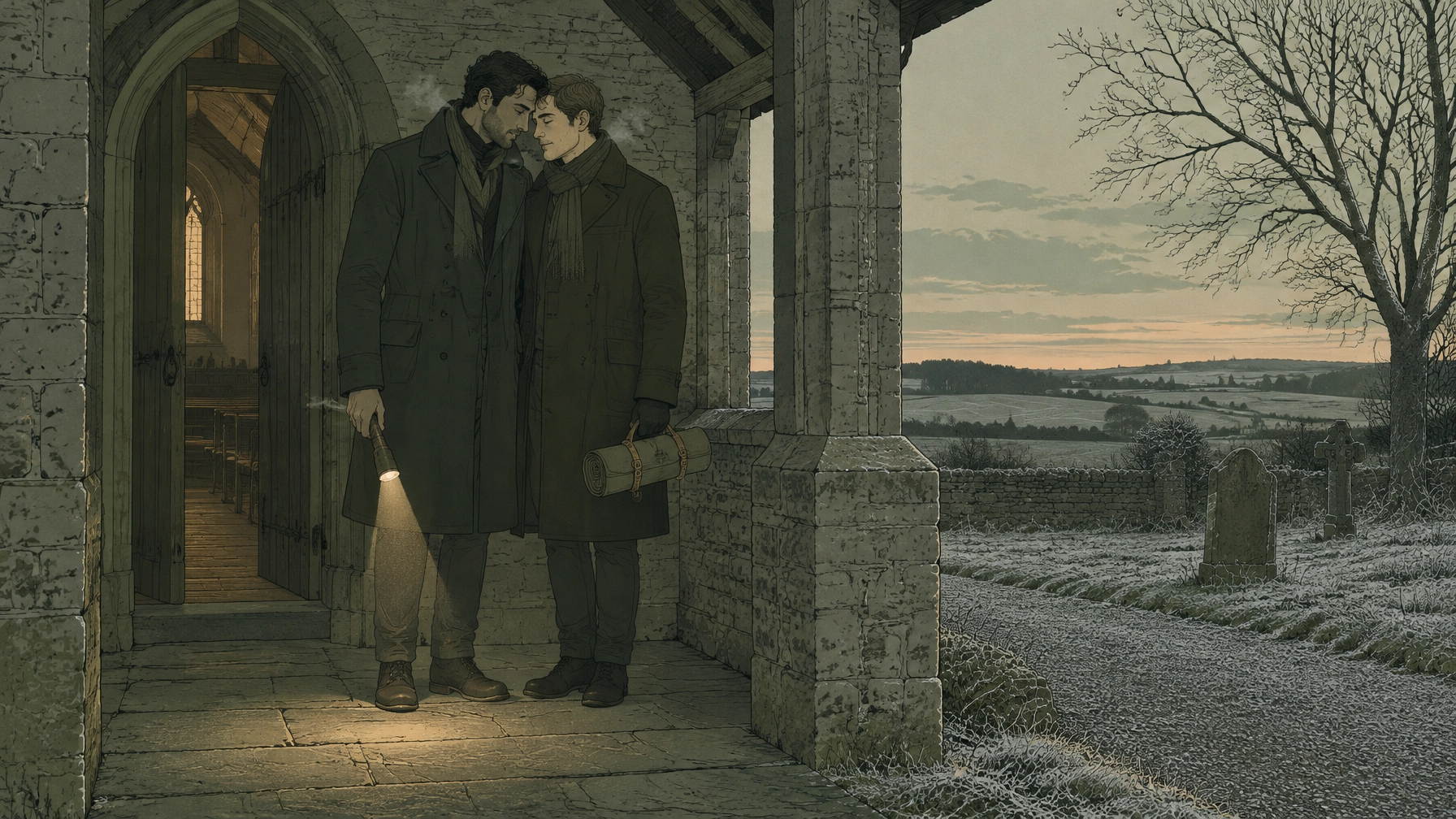
Outside, the gravel shone with frost. Alec switched off his torch and stood beside me in the dark.
“Could you hear me?” I asked.
He dabbed at his left eye with the knuckle of his right hand. “Cold,” he said.
“Of course.”
“Thursday. Six o’clock. I’ll have the heaters on and the kettle going, and you can put the fourth line right.”
I did not ask what he meant. The torch stayed dark between us, and the gravel shifted under my boot.
After the Last Verse
MM romance unexpected places can begin with two cups of tea, a coat left on its hook, and the silence after a hymn. For readers seeking a gay love story emotional journey, Dick Ferguson’s novels make room for tenderness beside fear, and for the difficult notes that bring two men closer. His character-driven queer fiction is written for emotionally invested MM readers who want feeling to linger after the last page.
For those drawn to emotional MM romance literary in its attention to inner lives and lyrical detail, explore Dick Ferguson’s books at Read with Pride, or visit Read with Pride to find more LGBTQ+ fiction and reading community.
Follow us on social media: Instagram · X · Facebook · Read with Pride
#MMRomance #GayLoveStory #QueerFiction #EmotionalMMRomance #ReadWithPride #CharacterDrivenFiction #SlowBurn #GayBooks #LGBTQBooks


Leave a Reply
You must be logged in to post a comment.