

Category: Unexpected Places | Morning Edition
The things by the door
Daniyar Sarsenov had a talent for describing rooms. He could tell you how a window held the afternoon light, where a floorboard complained, what kind of silence gathered behind a closed door. He could not tell you what he felt standing in one.
His grandmother’s flat in Almaty had been waiting for him since September. She had raised him there; now, nine days after coming back from Berlin and London, he was meant to empty it. The rooms were full of ordinary things that had outlasted their owner: a hand-wound clock, a row of tea tins, a stool with one uneven leg. Dani had come prepared with boxes and a plan. He had not come prepared for the things to look as if they were still expecting her.
He had also hired Serik Abenov for two drives up to Lake Kaindy in three days. Serik drove a battered UAZ up the mountain track, kept three horses in Saty and had spent twelve years transporting visitors to a lake he had never walked down to see. When Dani admitted he needed help with the flat more than another driver, Serik shrugged and took hold of a box.
Then he began saving things from the pile by the door.
The clock. The tea tins. The stool.
“You’re hoarding other people’s grief,” Dani said.
Serik set the stool down carefully. “You record everything so you never have to keep anything.”
Dani felt the sentence land where it had found him. He owned thousands of hours of sound: rooms, roads, weather, voices from places he might never visit again. He almost never listened to any of it. He recorded so that nothing could be entirely gone, then left the recordings untouched.
“At least I don’t spend my life driving strangers to a lake I’m afraid to look at,” he said.
Serik’s gold tooth showed when his mouth tightened. Neither man apologised properly. Between them, the clock kept ticking.
A road that does not hurry
On their first trip, the UAZ laboured along the rough track from Saty toward the national park post. Serik sang under his breath to the engine, a low tune that changed whenever the gears complained. Dani held his grey wind muff in his palm like a small animal. He was always cold, even in the cab.
From the post, the lake was still a walk away: roughly one and a half to two kilometres, mostly uphill, with horses available for the last stretch. A new road built in 2025–26 reached a car park below the lake, but no road could shorten the part that asked you to climb. Dani had forgotten most of his Kazakh and apologised for it at a stop along the way. Serik did not correct him. He only waited while Dani found the words.
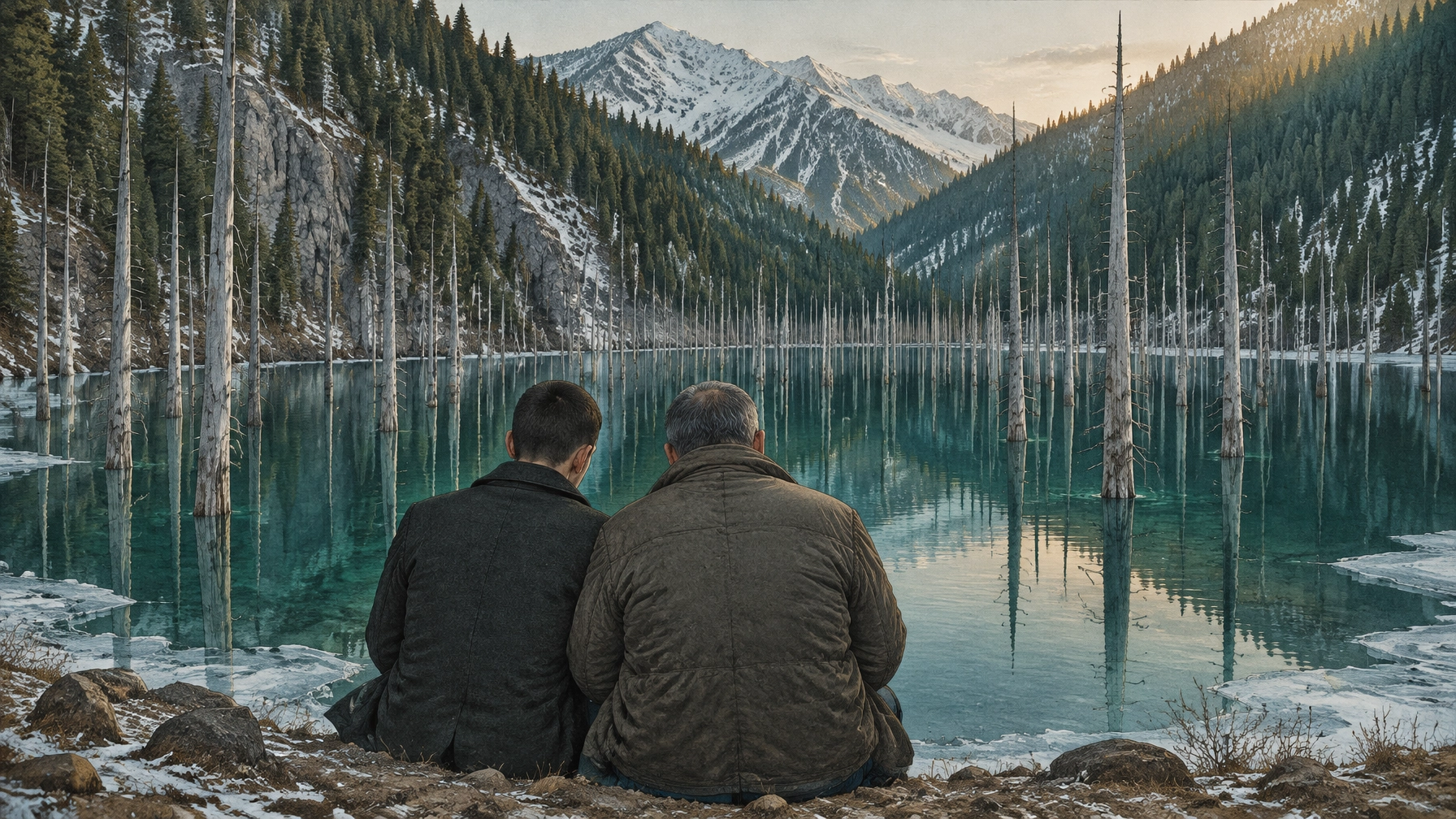
Lake Kaindy sits in the Chon-Urekty gorge, in Kolsay Lakes National Park, among the Tien Shan mountains of southern Kazakhstan. It is a small, young lake, about four hundred metres long and up to thirty metres deep, close to two thousand metres above sea level. Its drowned Schrenk’s spruce stand upright in the water like a forest interrupted in the middle of a sentence.
Above the surface, the bare trunks are bleached silver-grey. Below it, branches and fine twigs remain visible beneath algae, dark and startlingly intact. Limestone deposits give the water its blue-green colour, which shifts with the light; from one angle it seems green, from another almost deep blue. Even the landscape refused to hold still for Dani’s descriptions.
Locals call it the “dead lake,” a phrase visitors repeat. But birds swim and feed there, and algae grows on the branches. The trees do not grow upside down, whatever some people claim. The lake is not dead so much as changed beyond the easy language people bring to it. This is what MM romance unexpected places keeps coming back to: a real thing that already knows how to hold a loss, and does not need anyone to improve it. The emotionally invested MM readers who follow this series tend to trust such a place more than any invented one, and they are right to.
What the headphones heard
By the second run, late November had begun to draw a thin skin of ice along the shallows. The middle of the lake remained liquid. Dani knew the water stayed around four to six degrees Celsius throughout the year, cold enough to preserve the submerged wood. Swimming was not allowed under park rules, and diving required a certificate, personal equipment and a permit. He had no intention of entering the water.
Instead, at the edge, he lowered a hydrophone on a cable beneath the thin ice. Serik stood beside him, hands tucked into the pockets of the same padded jacket he wore in every season.
Dani put on his headphones.
At first, there was only his own breathing, close and uneven. The cable ticked against the ice. Then came a low wooden knock. A pause. Another knock.
Two submerged trunks had shifted and touched beneath the water.
Dani lifted one side of the headphones away from his ear. “It isn’t dead. It’s just never been warm enough to fall apart.”
He looked at Serik. The cold had kept every branch almost exactly where it had been for a hundred and fifteen years, he said. But none of it was growing.
Serik stared out across the water. He had driven people up here perhaps a thousand times. He had wrapped his horses’ legs himself, listened to the UAZ complain, waited in the cold while visitors walked to the shore. He had transported them to beauty without believing it was his to look at.
Then he started down the path.
Not quickly. Not as if he had discovered a new man inside himself. He simply put one boot ahead of the other, and the distance between the track and the water became his to cross.
This was the turn such a story turns on: not a declaration, but a man finally choosing to look. Their connection was still rough-edged, full of the things they had said to hurt each other. The walk did not resolve those things. It made room for them to stand together without pretending they had vanished, which is the difficult space readers of character-driven queer fiction keep coming back for.
What a person chooses to carry
At the shore, the thin ice creaked at the edge. The trunks rose pale above the water and disappeared into green-blue dark. Serik said nothing about the lake. Dani did not ask him to.
There are moments when the literary in emotional MM romance means trusting what is true over what is beautiful, and this was one of them. Dani and Serik did not find a perfect sentence for the dead, the living, or the years spent elsewhere. They stood in the cold, and the lake made its small wooden sounds beneath them.
Dani did not sell the flat in nine days. He kept the key and asked Serik to hold the second one, check the pipes over winter, and make sure the place did not freeze while he was away. For Serik, who had spent twelve years staying in the driver’s seat, it was a different kind of journey.
“Yes,” he said too quickly.
Then he pretended to think about it and said yes again.
Dani took three things from the flat: the clock, the tea tins and the stool. Not everything. Not nothing. Serik did not tell him that the choice was right. He carried the stool.
On the way down, Dani played the recording once in the cab. He did not say what it was. Serik listened to the low knocks and the faint scrape of cable against ice, to his own mountain making a sound he had never known it made. The UAZ rattled beneath them. Frost held at the edges of the windscreen.
Dani did not delete the file. For the first time, he began listening to the things he had recorded, not to prove that nothing was gone, but to hear what remained.
Not every gay love story emotional journey promises that grief will be tidied away, or that two men can undo the years behind them. Sometimes it begins with a key held through winter, a recording played without explanation, a walk made late. If that is the journey you read for, the novels are gathered in one place: Read with Pride.
The next morning, before the drive back to Almaty, they walked down to the water one last time. Thin ice creaked at the shore. Bare silver trunks went down into the green-blue dark. Neither man said what it had cost to stand there.
The trees were still dead. The flat was still full.
Nothing was fixed, and something had begun.
Factual note: Dani Sarsenov, Serik Abenov and the events in this story are fictional. Lake Kaindy is real. It formed when a landslide dammed the valley and mountain water drowned a stand of Schrenk’s spruce. The commonly cited cause is the January 1911 Kemin earthquake, and tree-ring research has supported that date, though some researchers argue for the 1889 Chilik earthquake instead.
Follow us on social media
Instagram | X | Facebook | Read with Pride
#MMRomance #QueerFiction #GayRomance #ReadWithPride #LGBTQBooks #BookLovers #LiteraryFiction #MorningEdition #LakeKaindy #Kazakhstan #SunkenForest #UnexpectedPlaces
The Mapparium in Boston — a walk-in stained-glass globe crossed by a glass bridge, where every voice comes back from the place it was spoken, and two men hear their own words returned.
One Square Inch of Silence in the Hoh Rain Forest, Washington — the quietest place in the United States, where overflights have worn the silence thin, and two men find out whether quiet is a place you can keep or only borrow.
The Singing Ringing Tree above Burnley — a wind sculpture of steel pipes on a Lancashire hill that plays a chord nobody conducts, and two men learning who is actually playing whom.
Images


Leave a Reply
You must be logged in to post a comment.