

The tree arrives early, according to one of them
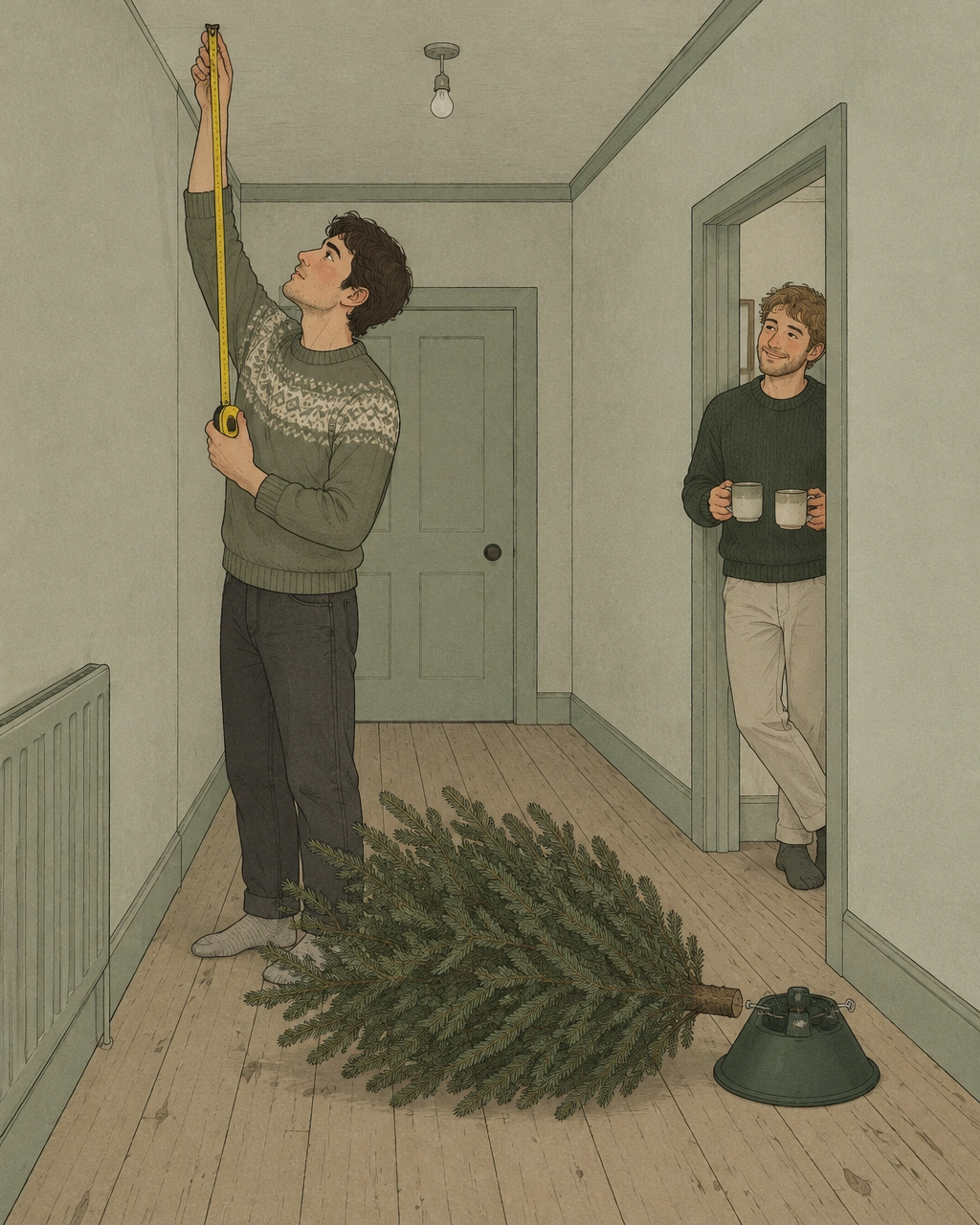
Julian brought the tree home on a Tuesday, laid across his arms like a rather prickly piece of evidence.
“It’s too early,” Elias said from the doorway.
“It’s the twenty-fifth of November,” Julian replied, with the calm of a man presenting a spreadsheet to a committee that had asked for one. “The corner shop sells out earlier every year. I checked.”
“You checked the tree situation?”
“I researched sell-out dates. I measured the ceiling twice. I bought one nine inches shorter than the available height, for the star and for optimism.”
The tree was on the floor in the hall, its netted branches reaching across Gerald, the creaky floorboard. Gerald made his opinion known with a long wooden groan as Julian tried to shift the trunk.
“The flat has opinions,” Elias said. “Most of them structural.”
Julian backed up, considered the narrow space and moved the tree a few inches. Gerald groaned again, apparently unconvinced.
The ugly duck mug sat on the kitchen shelf, its little blue knitted hat tilted over the handle. It held Elias’s spare key, as it always did. The key had been used often enough now that nobody had to comment on it. That, Elias thought, was how the ordinary things began to matter: they stopped asking to be noticed.
Julian found the tape measure in his coat pocket and checked the ceiling again.
“Still measured?” Elias asked.
“Everything’s a project if you’re thorough.”
“That must be exhausting.”
“It’s reassuring,” Julian said, and looked at him as if both things could be true.
Elias smiled despite himself. “All right. We have a tree. We have… several weeks to decide what it means.”
“We have a tree,” Julian agreed. “The meaning can be added later.”
The box with Theo’s handwriting
The decorations were on the top shelf of the wardrobe, in the box Elias had carried over from his old place in September and then left there, because he couldn’t decide what else to do with it. When Julian asked if he wanted it down, Elias said yes before he had time to make the answer more complicated.
The cardboard box was lighter than he expected. Theo’s handwriting crossed the lid in a familiar slant. Elias ran his thumb over the letters, then lifted the flaps.
Inside were the good bulbs, carefully wrapped, and a coil of lights that had spent years becoming one object with itself.
“The lights were never the problem,” Theo used to say. “The tangle was inherited.”
Elias laughed softly. The sound didn’t take him away from the room. It simply let Theo be in it for a moment: the laugh audible from another room, the chip-stealing defended as a moral position, the catastrophic films Theo insisted had suffered some kind of injustice.
Then Elias’s fingers stopped on the box edge.
“If we put this stuff up,” he said quietly, “it feels like turning him into a decoration. And if we leave it packed away, it feels like erasing him.”
Julian didn’t rush to answer. He sat down beside Elias on the floor, leaving the box open between them.
“I don’t think we have to decide what it means before we touch anything,” he said.
Elias looked at the ornaments. Julian wasn’t offering a tidy solution, and Elias was grateful for that. Some things didn’t become simple because somebody loved you carefully.
“Could we just look?” Julian asked.
“Just look,” Elias said.
So they did. Julian lifted each ornament with both hands, as though it deserved the courtesy. Elias named the ones he remembered. They let the lights remain tangled.
A ritual that isn’t a checklist
The woodland-finish coffee tasted faintly of bark. Julian had bought it because the packet promised notes of forest, which Elias felt was an ambitious description for something that mostly tasted like it had spent time near a tree.
They drank it anyway, with mince pies. Julian had a considered view about pastry.
“This one’s structurally weak,” he said, examining the crust.
“It’s a mince pie, not a bridge.”
“That’s no excuse for collapse.”
Elias leaned against the counter, watching Julian put the ornaments back into their box. The Luigi’s Corner menu waited in the kitchen drawer, with Julian’s deliberate fold down one side. The flat held on to objects with more patience than either man managed with feelings.
“New flat,” Elias said. “No rule for when the tree goes up.”
Julian nodded, already looking as if he might write a list of possible rules.
“Traditions aren’t a checklist.”
“A checklist is just a tradition that hasn’t been repeated yet.”
“That is exactly the sort of thing a person says before making a checklist.”
Julian looked down at the small notebook beside him. It held the cat’s sightings: dates, times, which direction Here had gone, and once, simply, “slept on Elias’s coat.” The wary grey-and-white stray had taken three visits before coming inside. Now Here came and went, often heading back out around eleven and returning the next evening.
“You can’t schedule Here,” Elias said.
“I’m not trying to,” Julian replied. “I’m documenting what cannot be scheduled.”
Maurice, on the bookshelf beside the framed photograph of Elias and Theo, had acquired a strand of tinsel. The dramatic one-leaf plant seemed to be thriving on household emotion like premium plant food.
“It’s insufferable already,” Elias said.
“Remarkable. It’s been decorated for four minutes.”
“It’s had a lot to work with.”
Julian passed him another mince pie. Elias took it, careful not to let the small kindness feel like a conclusion.
Two rituals, one room
They settled on a rule that was less a rule than a way to start.
Theo’s box would go up first. Then they would add whatever this year had brought.
The old decorations came out slowly. Elias set the good bulbs aside. Julian untangled one length of lights with an intensity usually reserved for an appliance manual. When the wire looped back on itself, he stopped and breathed out.
“Inherited,” Elias reminded him.
“I know. I’m respecting the provenance.”
They put up the old pieces together. Nobody declared the room transformed. The tree remained slightly lopsided, and Gerald continued to creak whenever either man crossed the hall. Maurice held on to its tinsel with the authority of a monarch who had been waiting years for formal recognition.
Then came the new decorations: a small wooden one Elias had picked up from the corner shop, and a second, round ornament that Julian held up for inspection.
“That is not a cat,” Elias said.
“I didn’t say it was.”
“You’re looking at it as if it’s a cat.”
“It’s representative.”
“Of what?”
“Possibility.”
Elias gave him a look. Julian placed it on a branch without further explanation.
There was no star. Julian had measured for one, and bought the tree shorter to allow for it, but he hadn’t actually bought a star. The oversight sat between them with the quiet weight of a plan that had stopped just short of happening.
“We could make one,” Elias said.
From the tree’s cardboard box, they cut a simple star. Julian trimmed the edges; Elias folded the points into something that held together. Before they fixed it on top, Elias took the pencil and wrote Theo’s name on the inside.
No one could read it from the room. It was still up there.
Julian didn’t ask whether Elias wanted to explain. He helped fit the star onto the top branch, and they let it sit a little crooked.
The first evening with the tree lit
When they switched on the lights, half the string blinked at once and the other half took a moment to catch up. Julian said he would inspect it tomorrow. Elias said tomorrow could have the job.
Here came in the next evening, pausing at the sitting-room threshold to assess the tree. The cat treated it as a piece of furniture that had been placed badly, walked around it, and ignored it.
For a while, Here kept to the familiar arrangement: Elias’s coat folded on the kitchen chair, a cautious stretch of the paws, one eye open to monitor the humans. Julian made a note in the sightings book. Elias pretended not to notice him doing it.
Later, Here settled underneath the tree.
Elias sat on the floor beside Julian, both of them with mugs in hand. Their shoulders touched. The room held the photograph on the shelf, the old ornaments, the new wooden one, the not-a-cat, the cardboard star. And, beneath the branches, a cat who had decided the whole arrangement was acceptable enough for a nap.
“Not too early?” Julian asked.
Elias watched the lights catch on the tinsel around Maurice’s one leaf.
“Maybe a little,” he said. “But not wrong.”
The flat hadn’t forgotten anything. It hadn’t been asked to. A new ritual didn’t replace an old one; it simply added a year to the room.
For the Emotionally Invested Reader
Character-driven queer fiction makes room for the small, awkward choices that carry more feeling than anyone says aloud: opening a box, keeping a name close, deciding what can be added without taking anything away. That’s the kind of emotional MM romance that trusts readers to notice what a shared mug, a familiar photograph, or a crooked cardboard star can hold. For emotionally invested MM readers, Elias and Julian’s gay love story emotional journey isn’t about leaving grief behind. It’s about making a life spacious enough for memory and change to sit together. Read with Pride is a home for queer fiction, MM books, MM romance books and LGBTQ+ ebooks.
Dick Ferguson collection on Read with Pride: Explore the collection
Follow us on social media: Instagram · X · Facebook · Read with Pride
#QueerExperiencesAndStories #MMRomance #QueerFiction #GayRomance #LGBTQFiction #CharacterDrivenRomance #ReadWithPride #EmotionalMMRomance
Possible next instalments
- Maurice Gets a Second Leaf, When Two Men Learned That Recovery Can Look Unimpressive and Still Count
- Julian's Own Photograph, When Two Men Learned That Being Asked About the Past Is Not the Same as Being Interrogated
- New Year's Eve in a Flat with One Working Radiator, When Two Men Learned That the End of a Year Is Not a Verdict on It


Leave a Reply
You must be logged in to post a comment.