

In the last instalment of our Queer Life and Identity series, we talked about the anchors we choose: chosen family, lifeline friendships, and the people who know us well enough to recognise when we are pretending everything is fine.
Those relationships matter enormously. They give us somewhere to land.
But what happens when the person beside us is not only an anchor, but a fellow traveller? What happens when love moves beyond the early rush and becomes something more complicated, more ordinary, and: if we are lucky: more enduring?
That is the long game of love.
For two men building a life together, staying is rarely about standing still. It is about learning how to change without losing one another.
Love after the first bright beginning
The early stages of a relationship often arrive with their own weather system. Everything feels heightened: the first messages, the first kiss, the first private jokes that make no sense to anyone else. There is discovery in every small detail.
You notice how he takes his coffee. You learn the expression he makes when he is trying not to laugh. You begin to understand which silences mean peace and which ones mean something needs to be said.
That early buzz is beautiful, but it cannot last forever: and it is not supposed to.
Long-term love asks different questions. Not, Do I still feel butterflies every time he walks into the room? but:
- Can we talk when we are tired?
- Can we make room for each other’s changing identities?
- Can we apologise without keeping score?
- Can we build a home where both of us are allowed to be fully real?
- Can we remain lovers while also becoming carers, friends, co-workers, problem-solvers, and occasionally the person who remembers to buy washing-up liquid?
There is romance in the grand gesture, certainly. But there is also romance in knowing when he needs quiet. In making the appointment he has been avoiding. In saving the last piece of cake because you know he had a difficult day.
A lasting gay love story is not less passionate because it includes routine. Sometimes routine is the proof that love has found somewhere to live.
Growing together without becoming the same
One of the great misconceptions about lasting relationships is that two people must grow in the same direction at the same speed.
Real life is rarely that tidy.
One man may become more confident about being visible as a gay man while the other is still negotiating old fears. One may want to move cities, change careers, or explore a different understanding of his bisexuality, gender, faith, or family history. One may be ready to speak openly about the future while the other needs time to imagine it.
Growing together does not mean becoming identical. It means remaining curious about the person your partner is becoming.
That curiosity can sound very simple:
What has changed for you?
What do you need from me now?
Is there a part of yourself you have been afraid to show me?
These questions are not signs that something is wrong. They are ways of keeping the relationship alive.
In the best MM relationships, identity is not treated as a finished document. It is more like a landscape: always shaped by memory, experience, culture, community, and choice. A partner does not have to understand every part of that landscape immediately. But he should be willing to keep walking through it with you.
The quiet courage of staying
Staying is often portrayed as passive, as though it simply means not leaving.
But staying well is active work.
It means choosing to speak instead of withdrawing. It means refusing to turn every disagreement into evidence that the relationship is doomed. It means recognising the difference between a difficult season and a harmful pattern.
There are times when leaving is necessary. Love should never be used to excuse cruelty, coercion, fear, or abuse. The long game is not about enduring everything at any cost.
But many relationships face ordinary forms of difficulty: financial pressure, illness, work stress, family conflict, grief, depression, distance, changing bodies, and the slow accumulation of misunderstandings. These moments can make even a strong bond feel fragile.
The quiet courage of staying may look like sitting at the kitchen table after an argument and saying, “I don’t want us to keep speaking to each other this way.”
It may mean asking for help before resentment becomes the main language of the relationship. It may mean learning how to fight the problem rather than each other.
For queer couples, there can also be pressures from outside the relationship. Discrimination, family rejection, social expectations, and the exhaustion of being misunderstood can all place strain on a partnership. That is why resilience should not be imagined as two men gritting their teeth alone.
Healthy love reaches outward. It accepts support from trusted friends, chosen family, queer community, and affirming professionals when needed.
A couple can be deeply committed to one another and still need a village.
The beautiful, unglamorous work of building a life
The long game is made from small negotiations.
Who takes the bins out? How do we divide the emotional labour? What happens when one of us earns more? How do we care for each other when our needs are unequal? Which traditions do we keep, and which ones do we invent?
These questions may not sound like the stuff of sweeping gay romance books, but they are where intimacy becomes visible.
A relationship becomes a life through repetition. The same hand reaching across the bed. The same voice calling from another room. The same two men making plans, revising plans, and occasionally abandoning plans because one of them has had a terrible week.
There is beauty in being witnessed over time.
Your partner sees the versions of you that nobody else meets: the ambitious version, the frightened version, the grieving version, the ridiculous version dancing badly while cooking dinner. He sees you change your mind. He sees you fail. He sees you try again.
And you see him too.
That kind of witnessing can be uncomfortable. It asks us to surrender the polished version of ourselves and accept that being loved does not mean being impressive every day.
Sometimes it means being honest about the fact that you are not fine. Sometimes it means letting him care for you. Sometimes it means caring for him without making his vulnerability feel like a debt.
When love changes shape
Long-term love is not a single feeling stretched across decades. It changes shape as life changes.
There may be seasons of intense closeness and seasons when practical demands leave little energy for romance. There may be periods of adventure, followed by years of rebuilding. There may be new homes, new jobs, new communities, new losses, and new versions of the future.
The relationship must have enough flexibility to hold those changes.
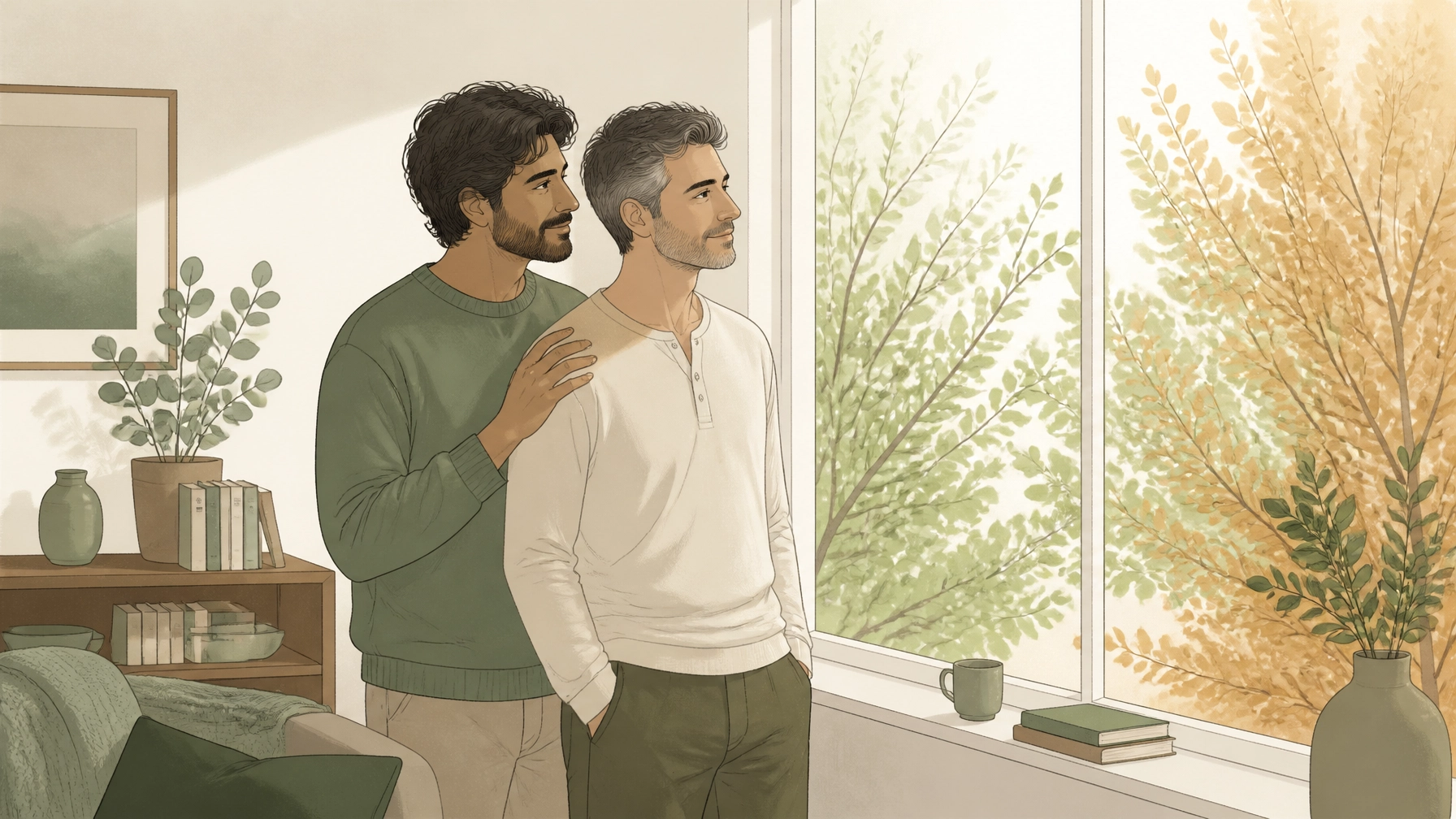
That does not mean abandoning desire or accepting emotional distance as inevitable. It means understanding that intimacy can be renewed in many forms: a walk after dinner, an honest conversation in the dark, a hand on the back while crossing a busy road, a shared plan made after a difficult year.
Sometimes love returns through grand passion. Sometimes it returns through one man saying, “I remembered what you told me,” and proving that he was listening.
Stories that honour the staying
For readers of emotionally immersive MM fiction, the most powerful love stories are not always about whether two men will fall in love.
Sometimes the deeper question is whether they can keep choosing one another after the fantasy has been tested by reality.
That is where character-driven MM romance becomes especially compelling. A couple can survive danger, betrayal, distance, or social pressure: but the emotional truth lies in what happens afterwards. Can they rebuild trust? Can they stop using old wounds as weapons? Can they imagine a future that is not simply a return to the past?
The most satisfying gay love stories understand that a lasting relationship is not a reward for becoming perfect. It is a place where two imperfect people practise honesty, patience, accountability, and hope.
They do not always get it right. They do, however, keep learning.
A love that lasts is still a love that grows
There is no single blueprint for a successful queer relationship. Some couples marry; some do not. Some share a home; others maintain separate spaces. Some build families through children, friends, community, or creative work. Others make a quieter life that belongs only to them.
What matters is not whether the relationship resembles anyone else’s idea of permanence.
What matters is whether both men can recognise themselves inside the life they are building.
After chosen family comes the question of how we sustain love within that wider circle: how we remain open, accountable, and brave enough to grow. The long game is not about holding someone in place. It is about making enough room for both people to become more fully themselves.
That is the quiet courage of staying: not clinging to who you were at the beginning, but meeting each other again and again as the seasons change.
For more emotionally rich MM romance, gay fiction, and LGBTQ+ ebooks, explore the stories available through Read with Pride.
Three ideas for the next Queer Life and Identity instalment
- The Homes We Make : Stories of Domestic Queerness, Belonging, and Turning a Place into a Sanctuary
- When We Change : Stories of Identity, Reinvention, and Loving Someone Through a New Chapter
- The Courage to Be Seen : Stories of Public Love, Private Fear, and Living Beyond the Closet
Follow us on social media
Follow Dick Ferguson for more gay books, MM novels, queer fiction, emotional MM books, and LGBTQ+ reading:
#QueerLifeAndIdentity #ReadWithPride #MMRomance #GayRomance #QueerFiction #GayFiction #LGBTQPlusFiction #MMNovels #GayLoveStories #EmotionalMMBooks #HeartfeltGayFiction #LGBTQReading #GayAuthors #QueerAuthors #ReadingWithPride


Leave a Reply
You must be logged in to post a comment.