

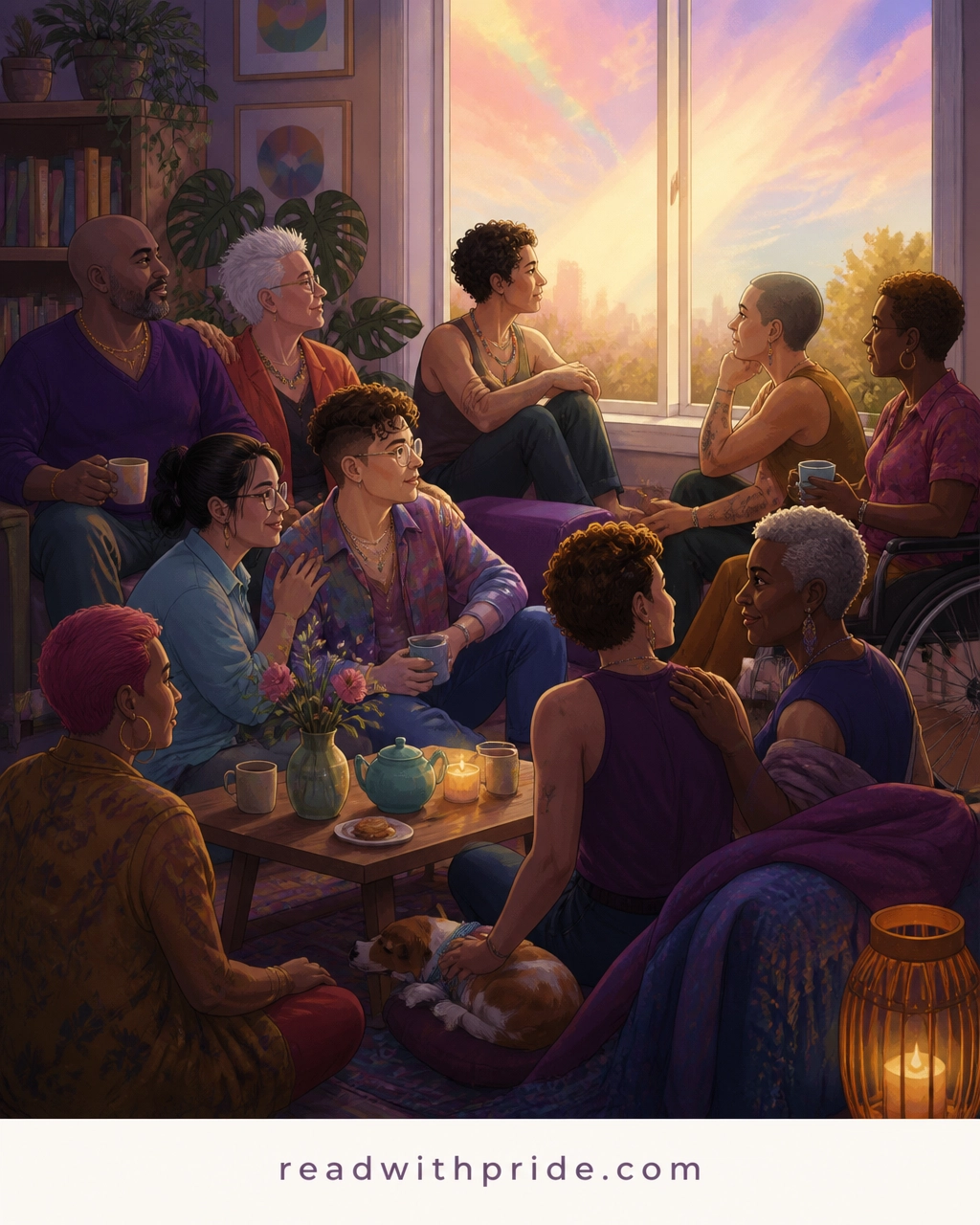
There is a particular kind of grief that many LGBTQ+ people know well. It might be grief for the family we hoped we would have, the years spent hiding, the relationships that could not survive someone else’s prejudice, or the version of ourselves we had to leave behind to become honest.
Sometimes it is personal. Sometimes it is collective. Sometimes it arrives while scrolling through the news, hearing another familiar story of discrimination, or realising that an older queer person in our community never got to experience the freedom we are still fighting for.
And sometimes grief simply appears on a completely ordinary Tuesday, because apparently emotions enjoy surprise entrances.
This is where queer healing begins: not by pretending the pain never happened, but by making room for the whole truth. We can acknowledge what was lost while still imagining what might be possible. We can honour the past without allowing it to write every chapter ahead.
That is the heart of future visions: creating hopeful, practical pictures of queer life beyond survival. Not perfect futures. Not shiny, unrealistic worlds where nobody ever struggles. Real futures filled with safety, chosen family, tenderness, laughter, accessible care, and the freedom to be wonderfully, inconveniently ourselves.
Grief is part of the story, but it is not the ending
Queer grief can be complicated because it does not always receive the recognition it deserves.
You may be grieving someone who rejected you but is still alive. You may be grieving a childhood that never felt safe. You may be grieving a relationship that had to remain hidden, a community lost to distance, or the future you were told was impossible.
There can also be grief connected to survival itself. When we spend years monitoring our safety, managing other people’s reactions, or translating our identity into language they might understand, authenticity can feel both liberating and exhausting.
None of this means you are broken. It means something mattered.
Healing does not require you to rush past grief in order to become inspirational. You do not have to turn every difficult experience into a lesson, a campaign, or a neatly packaged story of triumph. Sometimes healing looks like rest. Sometimes it looks like anger. Sometimes it looks like saying, “That hurt me,” without immediately adding, “But I’m stronger now.”
There is strength in honesty. There is strength in needing help. There is strength in refusing to perform resilience for people who are more comfortable admiring your survival than changing the conditions that made survival so difficult.
LGBTQ+ resilience is more than “bouncing back”
The word resilience gets used a lot around LGBTQ+ communities. It can be affirming, but it can also become a burden if it suggests we should always recover quickly, stay positive, or handle hardship without support.
True LGBTQ+ resilience is not about being indestructible. It is the ability to remain connected to our humanity after being told that our humanity was the problem.
It can look like:
- Asking for support before reaching crisis point.
- Setting a boundary without writing a three-page apology.
- Finding people who use your name and pronouns with care.
- Making space for joy even when the world is noisy.
- Letting trusted people witness your sadness.
- Building a life that does not follow a compulsory timeline.
- Choosing softness when hardness is no longer protecting you.
Resilience is also collective. It lives in the friend who brings dinner. The sibling who learns. The neighbour who checks in. The community organiser who keeps showing up. The queer elder who shares a story that reminds you your life is part of a much longer continuum.
It lives in the group chat, naturally. Never underestimate the healing power of one perfectly timed voice note and a meme that is far too specific.
Chosen family turns hope into something practical
Hope can sound abstract until it has a face, a phone number, or a spare key.
Chosen family is one of the ways queer communities turn hope into everyday care. It might include close friends, partners, ex-partners, neighbours, colleagues, mentors, or community members. It does not have to look like a traditional family to be real. It only needs to be built on mutual respect, trust, and the freedom to show up as your full self.
Chosen family can help us heal by offering:
- Witnessing: someone who remembers what you have survived.
- Affirmation: people who do not treat your identity as a debate.
- Practical support: lifts, meals, childcare, company at appointments, or a place to sleep.
- Joy: shared rituals, celebrations, dancing, reading, cooking, and doing absolutely nothing together.
- Continuity: relationships that help us imagine ourselves growing older, changing, and still belonging.
The future becomes less frightening when we are not expected to reach it alone.
If family, parenting, or intergenerational queer life is part of your future vision, Read with Pride’s Alternative Family collection offers stories that explore LGBTQ+ families, resilience, and unconditional love. These narratives matter because they show that queer futures are not only about political progress. They are also about school runs, birthday traditions, messy kitchens, bedtime stories, and someone remembering how you take your tea.

Future visions begin with a small question
When life has demanded constant vigilance, imagining the future can feel risky. What if we hope for something and lose it? What if the world changes again? What if we are not equipped for the life we want?
You do not need a ten-year plan to begin. Start with one gentle question:
What would make tomorrow feel a little more like home?
The answer could be enormous: legal safety, housing, healthcare, family acceptance, or freedom from violence.
It could also be wonderfully ordinary:
- A morning where you do not brace yourself before checking your phone.
- A partner who knows how to support you when you are overwhelmed.
- A room painted in a colour that makes you happy.
- Friends who come over without needing a special occasion.
- A neighbourhood where queer elders are visible and valued.
- A future where young people grow up knowing that their identity is not a problem to solve.
These small visions are not insignificant. They give our values somewhere to land.
Try writing a short “future postcard” to yourself. Describe one day in a life where you feel safe enough to relax. Who is around you? What can you hear? What are you doing with your time? What no longer occupies your thoughts?
Do not worry about making it poetic. “I have a kitchen where everyone is welcome and nobody comments on my mugs” is a perfectly valid vision. Honestly, it may be the most achievable form of utopia.
Healing can be personal and political
Queer healing is not only an individual project. We cannot meditate our way out of discrimination, unsafe housing, inaccessible healthcare, or the structural pressures that create minority stress.
Personal care matters, but so does collective action. Supporting queer organisations, sharing resources, checking on isolated people, learning about intersectionality, and making our communities safer are all forms of future-building.
This work must include the people most often pushed to the edges of LGBTQ+ conversations: trans people, disabled queer people, QTBIPOC communities, migrants, older LGBTQ+ people, people living with poverty, and anyone whose identity or circumstances do not fit a tidy public narrative.
A hopeful queer future cannot be built by asking the most vulnerable people to wait patiently for their turn. It has to make room from the beginning.
Stories can help us practise this kind of imagination. Reading queer memoir, queer fiction, LGBTQ+ romance, and stories of chosen family allows us to encounter lives beyond the narrow scripts we were handed. The Read with Pride LGBTQ+ blogs and articles explore identity, relationships, healing, community, and the many ways queer people create meaning.
For readers seeking something more directly supportive, Beyond Survival: A Practical Guide to LGBTQI+ Anxiety offers an LGBTQI+-affirming approach to anxiety, stress, and self-worth. It is not a replacement for professional care, but it may be a useful addition to your reading list if anxiety or hypervigilance has been taking up too much space.

Hope does not erase grief
It is possible to miss someone and still build a beautiful life.
It is possible to feel furious about injustice and still laugh with your friends. It is possible to carry complicated memories and still fall in love, make art, plan a holiday, start a family, change careers, or discover a new favourite book.
Hope is not a denial of reality. It is a decision not to let reality remain unchanged.
Our future visions can hold grief and possibility at the same time. We can remember the people who did not get enough time while making more room for those who are here. We can honour what queer communities have endured while insisting that endurance is not the highest thing we should expect from one another.
The future we deserve is not merely one where queer people are allowed to survive. It is one where we have time to be curious, rested, loved, creative, ridiculous, ambitious, ordinary, and free.
And we do not have to wait for that future to arrive fully formed. Every act of care helps build it. Every boundary makes space for honesty. Every queer story expands the map. Every chosen family dinner, community project, tender conversation, and joyful declaration says: we are still here, and we are making something new.

A gentle invitation for today
Take a moment today to name one thing you are grieving, one thing that is helping you heal, and one thing you hope to experience in the future.
You do not need to solve everything. You do not need to feel hopeful every minute. Just allow yourself to imagine that your life can contain more than what hurt you.
Explore more affirming LGBTQ+ ebooks and queer stories at Read with Pride, and follow along for thoughtful conversations about queer life, identity, relationships, and LGBTQ+ resilience on Facebook and Instagram.
Your future does not have to look like anyone else’s. It only has to feel more like yours.
#QueerHealing #FutureVisions #LGBTQResilience #ReadWithPride #QueerFiction #LGBTQBooks #ChosenFamily #QueerJoy #LGBTQHealing #QueerFutures

Leave a Reply
You must be logged in to post a comment.