

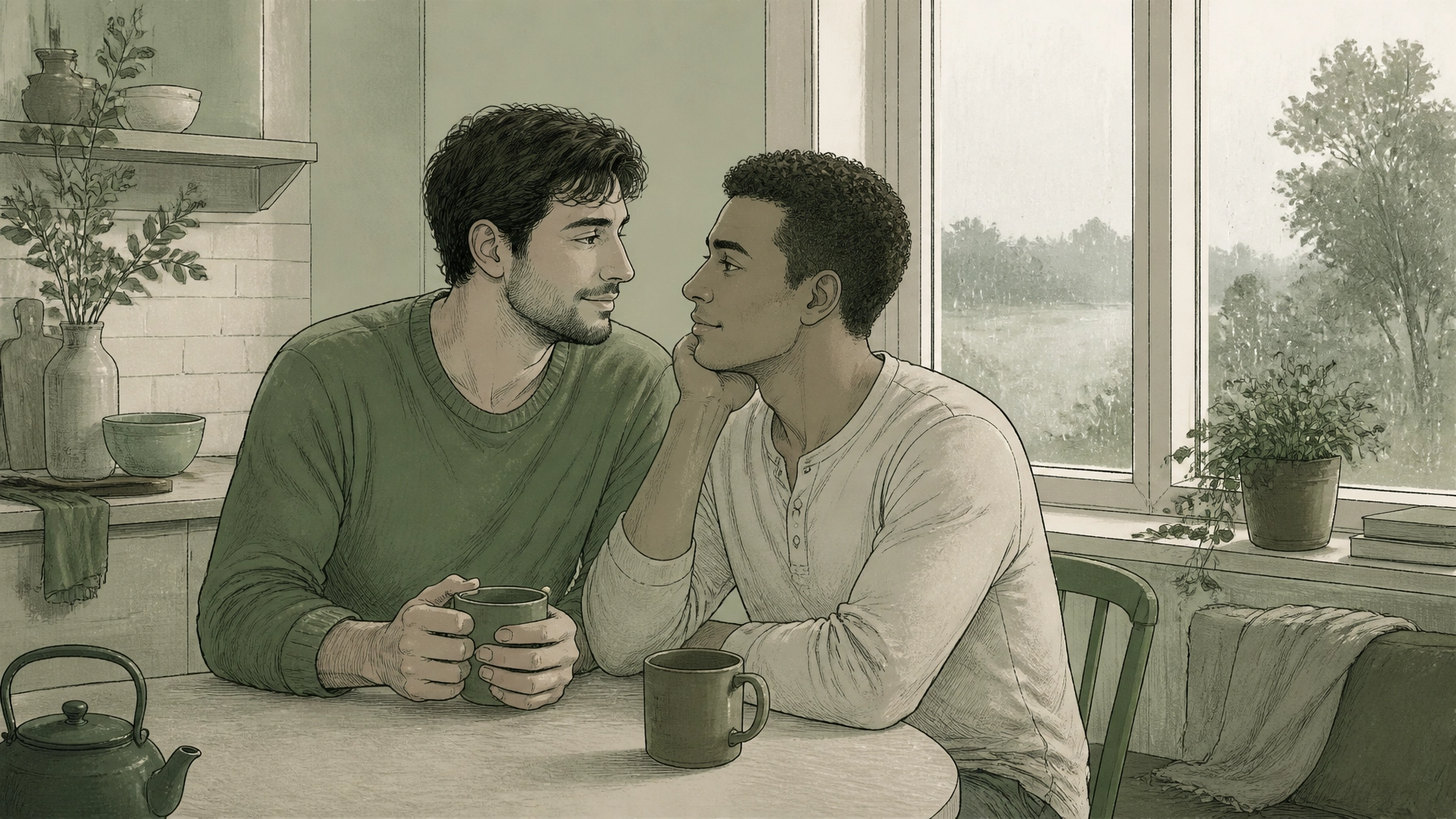
For a long time, Julian believed peace was another word for waiting.
Waiting for the next argument. Waiting for the next silence to become something sharper. Waiting for Elias to look at him and decide that loving him was too complicated, too exhausting, or simply too much trouble.
Elias, meanwhile, had learned to distrust anything that felt easy.
Easy meant temporary. Easy meant the calm before someone changed their mind. Easy meant that if he relaxed for even a moment, life would find the exact place where he was most vulnerable and press hard.
So when the storm finally passed, neither of them knew what to do with the quiet.
They had survived the difficult conversations. They had said the things they had spent months avoiding. They had admitted where fear had shaped their choices, where jealousy had disguised itself as certainty, and where love had been present long before either man was brave enough to name it.
The emotional breakthrough had been enormous.
The morning after was not.
There was no swelling music. No dramatic declaration in the rain. No perfectly timed gesture that made the past disappear.
There was only Elias standing in the kitchen in an old grey T-shirt, staring at the coffee machine as though it had personally betrayed him.
“You’re pressing the wrong button,” Julian said from the doorway.
“I’m creating a new method.”
“You’re creating coffee-flavoured water.”
Elias glanced over his shoulder. “That sounds like a judgement.”
“It’s an observation.”
“It’s a judgement wearing a nicer coat.”
Julian smiled before he could stop himself.
That smile mattered. Not because it solved anything, but because it arrived without effort. It belonged to the ordinary morning: the unwashed mugs, the crooked tea towel, the faint dampness still clinging to the window. It belonged to the life they were learning to build when nobody was watching.
The part of love that comes after the confession
In many romances, the confession is treated as the finish line. Two people finally speak the truth, the misunderstanding clears, and the story closes just as they begin to imagine a future together.
But for Julian and Elias, the confession was a doorway.
On the other side waited the less glamorous, more challenging work of becoming safe for one another.
Safety did not mean they never disagreed. It did not mean Elias stopped becoming withdrawn when he felt overwhelmed, or that Julian never reached for reassurance in ways that sounded more like accusation. It meant they started recognising those patterns before the patterns took over.
It meant Julian could say, “I’m frightened you’re pulling away,” instead of, “You don’t care.”
It meant Elias could answer, “I’m still here. I just need twenty minutes,” and trust that Julian would hear a boundary rather than a rejection.
These were small victories. So small, sometimes, that neither man mentioned them aloud.
But small victories have a way of becoming a life.
That is one of the reasons character-driven queer fiction can feel so intimate. The most meaningful changes often happen in the space between major events. A man pauses before repeating an old mistake. Another allows himself to be comforted. Two men learn how to share a room without treating silence as a threat.
This is the heart of a gay love story emotional journey: not simply finding love, but learning how to remain present inside it.
Stability is not the absence of passion
At first, Julian worried that their calmer life meant something had changed between them.
The urgency was different now. There were fewer midnight conversations that stretched until dawn, fewer moments when every glance seemed to carry the weight of a decision. The intensity had not vanished, but it had stopped demanding constant proof.
Elias still reached for him in crowded rooms. Julian still noticed the particular softness in Elias’s voice when he was tired. Desire still moved between them, warm and familiar, sometimes sudden and sometimes slow.
But passion no longer needed to arrive as chaos.
It could be Elias placing a hand on the back of Julian’s neck while passing behind him.
It could be Julian saving the last piece of cake because he knew Elias would pretend not to want it.
It could be the quiet confidence of falling asleep beside someone and waking to find him still there.
For emotionally invested MM readers, these details can carry as much weight as any dramatic turning point. They show love not as a spectacular event, but as a practice. A daily decision. A language made from gestures that become meaningful through repetition.
The coffee. The shared shopping list. The argument about which shelf belonged to whom. The familiar “text me when you get home.” The relief of knowing that an ordinary Tuesday could be enough.
None of it was boring.
It was evidence.
A home made from ordinary things
Their flat was not perfect.
The heating made a strange clicking noise. The bedroom window refused to close properly in cold weather. Elias kept leaving books on the stairs, despite Julian’s increasingly theatrical complaints about the hazards of living with a “literary obstacle course.”
Still, the space began to feel like theirs.
Not because they bought expensive furniture or chose matching colours. The sanctuary came from accumulation: two toothbrushes in one cup, photographs tucked into the edges of mirrors, Elias’s records beside Julian’s battered paperbacks, a spare key resting in the bowl by the door.
The first time Julian came home after a difficult day and found Elias cooking, he stopped in the hallway.
Elias was humming badly. The kitchen smelled of garlic and rosemary. One sock had vanished from his left foot, and he was wearing an apron Julian had bought as a joke.
“You’re staring,” Elias said.
“I’m taking in the scene.”
“Is it too much for you?”
“Deeply. I may need to sit down.”
Elias turned, wooden spoon in hand. “You could help.”
Julian crossed the room and wrapped his arms around him from behind.
For a moment, neither of them spoke.
The embrace was not a rescue. It was not an apology or a promise to fix what had been broken. It was simply contact: steady, mutual, and welcome.
Elias leaned back against him.
Julian rested his cheek against Elias’s shoulder.
Outside, traffic moved through the wet streets. Somewhere nearby, somebody laughed. A door slammed. The world continued with all its noise and uncertainty.
Inside, Elias turned off the hob.
“Dinner’s probably ruined,” he said.
“Then we’ll order something.”
“You hate ordering food.”
“I love you more than I hate ordering food.”
Elias went still for half a second, as though the words had caught him by surprise.
Then he covered Julian’s hands with his own.
“I love you too,” he said. “Even when you’re dramatic about takeaway.”
Especially then, Julian thought.
The courage to enjoy the good days
There is a particular kind of fear that can follow hardship: the fear of trusting happiness.
Julian carried it quietly. He found himself cataloguing good moments, as though he needed evidence that they had really happened. Elias noticed when Julian became too careful, too watchful, too ready to apologise for needing anything.
So they began making a habit of naming the good days.
Not in grand speeches. Just simple acknowledgements.
“This is nice,” Julian would say while they walked home with groceries.
“It is,” Elias would reply.
Or:
“I like waking up here.”
“Me too.”
The words did not make the happiness more fragile. They made it more visible.
That mattered because queer lives are not defined only by survival. They are also shaped by pleasure, belonging, laughter, routine, chosen family, and the profound relief of being known without having to perform.
A gay love story does not need to remain trapped in the moment of coming out, the fear of rejection, or the struggle to be understood. Those experiences may shape a person, but they are not the whole of his life.
Julian and Elias were discovering what came next.
They were discovering that love could be a place where a man did not have to stay impressive. He could be tired. Uncertain. Irritable. Quiet. He could need reassurance and still be worthy of it. He could offer comfort without losing himself.
That is where emotional MM romance literary storytelling can become especially powerful: in the honest tension between the wounds people carry and the tenderness they are still capable of giving.
The sanctuary they choose
Months after the storm, Julian woke before Elias.
The room was pale with early light. Elias slept on his side, one hand tucked beneath his cheek, his breathing slow and even. Julian watched him for a while, not because he was afraid Elias might disappear, but because he was grateful for the chance to witness an ordinary morning.
He got up quietly and went to the kitchen.
The coffee machine waited on the counter.
Julian pressed the button Elias had taught him to use.
A minute later, Elias appeared in the doorway, hair untidy, eyes half-closed.
“You’re making coffee,” he said.
“I’m evolving.”
“Should I be worried?”
“Only if you prefer coffee-flavoured water.”
Elias came closer and slipped his arms around Julian’s waist.
They stood there together while the machine hummed.
No crisis waited outside the door. No confession demanded to be made. No old fear needed to be defeated before they were allowed to begin the day.
There was only this: two men, a shared home, and the quiet certainty that love did not have to hurt to be real.
Stability was not a lack of passion.
It was passion with somewhere safe to rest.
And sanctuary was not something they had found by accident. It was something they had built: conversation by conversation, morning by morning, ordinary choice by ordinary choice.
For readers looking for MM romance unexpected places, a gay love story emotional journey, or deeply character-driven queer fiction, Julian and Elias’s story offers a gentler truth: sometimes the most courageous ending is not the one where love survives the storm.
It is the one where love learns how to live after it.
Discover more emotionally immersive stories through Read with Pride and explore Dick Ferguson’s MM romance and LGBTQ+ fiction collection.
Follow us on social media
#QueerExperiences #QueerStories #MMRomance #GayRomance #MMFiction #QueerFiction #GayLoveStory #CharacterDrivenFiction #EmotionalMMRomance #LGBTQBooks #ReadWithPride #GayAuthors #MMAuthors #EmotionallyInvestedReaders
Three possible next posts in the 6 PM Series
-
The Space Between Us: When Julian and Elias Learned to Ask for What They Needed
A tender exploration of communication, vulnerability, and the difference between being loved and being understood. -
A Room of Their Own: Julian and Elias Build a Home That Finally Feels Like Theirs
A domestic, emotionally rich story about chosen family, queer belonging, and claiming space without apology. -
The Fear That Returned: How Two Men Faced an Old Wound Without Letting It Define Their Future
A higher-angst continuation focused on trust, reassurance, and the quiet strength of repairing love together.


Leave a Reply
You must be logged in to post a comment.