There are two kinds of people in the morning: those who wake up refreshed and spiritually aligned with the sunrise, and the rest of us, negotiating with the alarm clock like it owes us money.
Welcome back to Read with Pride’s Queer Life & Hobbies series, where coffee is essential, emotional-support water bottles are encouraged, and finding your people is considered a perfectly valid life goal.
Today, we’re talking about the magic of shared interests. Not just as a way to pass the time, but as a way to build friendships, find chosen family, deepen relationships, and occasionally meet someone who makes you think, “Oh no. They’re attractive and they know how to use a lockpick.”
From queer archery and digital communities to queer parenting, professional niches, book clubs, and MM romance, shared interests are often the beginning of something beautiful.
Why shared interests make connection easier
Making friends as an adult can feel like applying for a job you’re wildly overqualified for but still nervous about. Add being queer, trans, non-binary, lesbian, bisexual, or questioning, and the process can involve an extra layer of wondering whether a space will actually feel welcoming.
A shared hobby removes some of that pressure.
You do not have to arrive with a perfect introduction or a fully developed social personality. You can simply show up because you like gardening, tabletop games, reading, baking, hiking, photography, or learning how complicated mechanisms work.
The activity gives you an easy opening:
- “Have you tried this class before?”
- “Do you know what this piece of equipment does?”
- “Which character build are you using?”
- “Is that a new book?”
- “Can someone please explain why my plant is being dramatic?”
That last one is especially useful in queer gardening circles.
Shared interests create natural opportunities for repeated contact, which is how casual introductions become familiar faces, then friendships, then the people you message when you need advice, snacks, or a furious voice note about a fictional couple refusing to communicate.
Explore more ideas in Queer Hobbies and Community Connection and Building Queer Connection One Hobby at a Time.
Queer archery: focus, fun, and excellent main-character energy
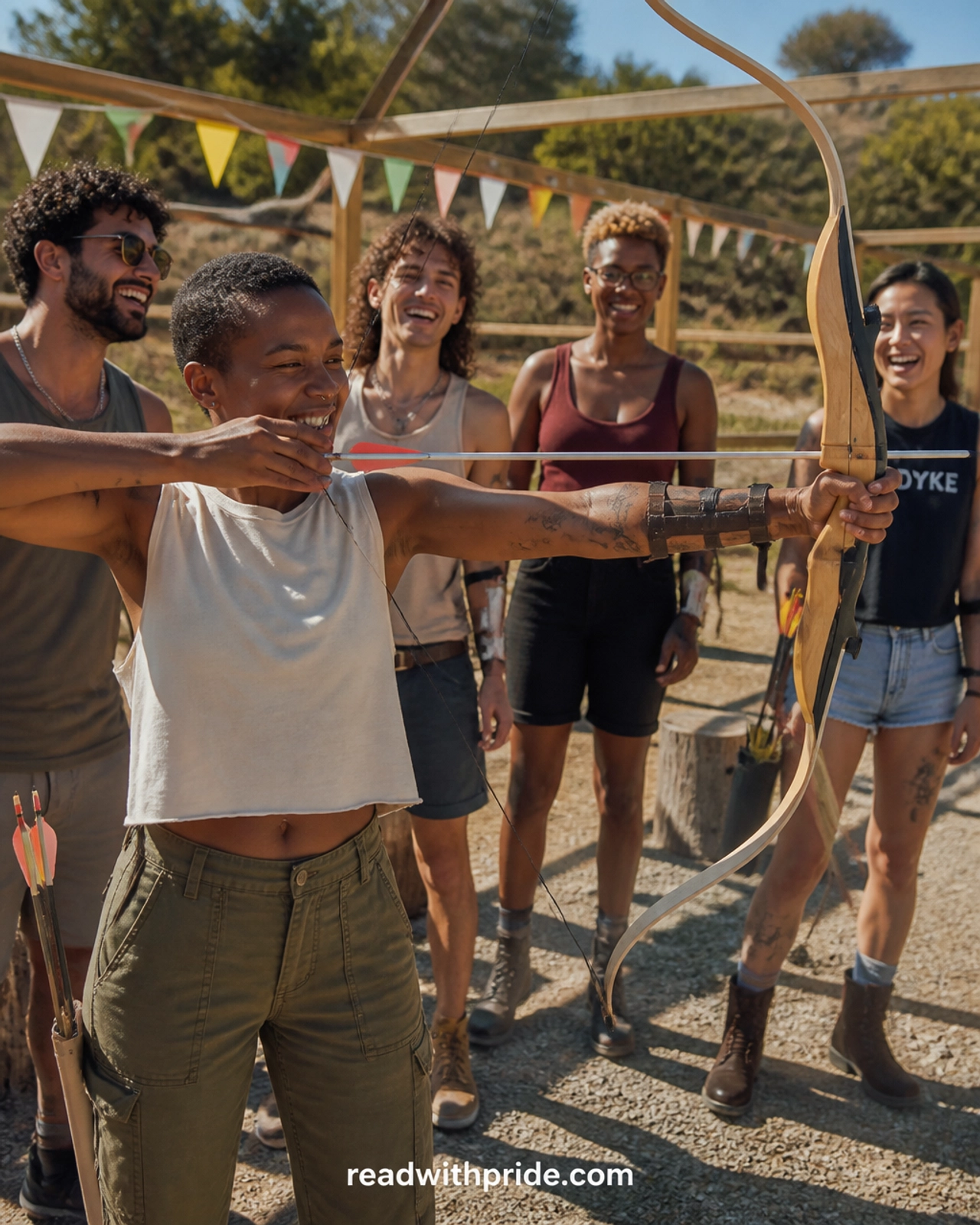
Archery has a certain cinematic quality. You stand in the sunlight, draw the bow, focus on the target, and briefly feel like the protagonist of a very specific gay historical romance.
In real life, there may be more safety instructions, equipment checks, and slightly less dramatic wind. Still, the appeal is obvious.
Queer archery groups can offer:
- A structured activity that makes conversation easier.
- A welcoming environment for beginners.
- A way to build confidence and body awareness.
- Opportunities to meet people outside traditional nightlife spaces.
- Plenty of stories to tell afterwards over coffee.
You do not have to be athletic or experienced to start. Many clubs offer beginner sessions, and the best groups understand that people arrive with different bodies, abilities, comfort levels, and reasons for being there.
Maybe you want to learn a new skill. Maybe you are looking for a queer community. Maybe you simply want to spend a Saturday doing something more memorable than scrolling through videos of strangers reorganising their refrigerators.
All excellent reasons.
Lockpicking and the joy of learning something unexpected
Lockpicking, or locksport, is another hobby that sounds like it belongs in a spy romance until you discover that it is primarily about patience, precision, and understanding how mechanisms work.
It is also a fantastic example of how niche interests can create community. Maker spaces, hacker groups, puzzle clubs, and technical communities often attract LGBTQ+ people who enjoy solving problems, taking systems apart, and putting them back together in a slightly more interesting configuration.
The important thing is to practise responsibly and legally, using your own practice locks or equipment designed for learning. No dramatic breaking-and-entering subplot required.
Locksport can also be a useful reminder that queer hobbies do not have to fit a particular stereotype. You can love romance novels and technical puzzles. You can be into makeup and coding. You can enjoy steamy MM romance, ethical hacking, birdwatching, drag history, and baking in the same week.
A full life is allowed to contain multitudes. It may also contain several half-finished projects.
Tabletop games: chosen family with dice
Tabletop role-playing games are practically built for queer connection.
A good campaign offers a shared world, a regular gathering, creative problem-solving, and the opportunity to become emotionally attached to a fictional character you invented five minutes ago. It is community, storytelling, and low-stakes chaos around one table.
Queer tabletop groups can be especially powerful because they allow people to imagine worlds where LGBTQ+ identities are ordinary, celebrated, and never treated as a surprise plot twist.
You can play:
- A heroic lesbian paladin with excellent boundaries.
- A gay rogue who definitely has a secret.
- A bisexual bard who has flirted with at least three members of the party.
- A non-binary wizard with a deeply impractical cape.
- A tired parent who just wants one evening without anyone asking for a snack.
The real-life benefits matter too. A regular game night provides continuity. You begin to learn people’s humour, communication styles, and boundaries. You celebrate victories together, recover from disasters together, and eventually develop the kind of shorthand usually found in the best MM romance books 2026 has to offer.
Found family, forced proximity, emotional tension, and someone saying, “I trust you with my life”? That is basically a campaign.

Queer parenting and hobbies that fit real life
Queer parenting is rewarding, exhausting, meaningful, and occasionally involves discovering stickers in places stickers should never be.
When you are raising children, co-parenting, fostering, supporting younger relatives, or helping build a chosen-family network, traditional hobby advice can feel unrealistic. “Simply dedicate three hours every evening to yourself” is not always useful when somebody has misplaced a shoe and the dog is eating a crayon.
The good news is that hobbies can be flexible.
A queer hobby might look like:
- Ten minutes of reading during nap time.
- A family gardening project.
- A virtual book club you join asynchronously.
- A weekend board-game afternoon.
- A shared playlist or storytelling ritual.
- A community group that welcomes children.
- A private creative project you return to whenever time allows.
Queer parenting also creates opportunities to meet other LGBTQ+ families. Community gardens, library activities, family craft sessions, Pride events, and inclusive game groups can become valuable spaces for both children and adults.
Representation matters here. Queer families deserve stories that include school runs, bedtime routines, messy kitchens, shared hobbies, and the everyday tenderness of making a life together. Browse Read with Pride’s Alternative Family collection for LGBTQ+ stories exploring family, love, and belonging.

Digital life is still real community
Not every queer person lives near a thriving LGBTQ+ centre, inclusive club, or welcoming hobby group. Some people are disabled, parenting, working unusual hours, managing anxiety, or simply more comfortable meeting others online first.
Digital queer life can be a lifeline.
Online gaming groups, moderated Discord communities, virtual writing workshops, social media book clubs, queer crafting circles, and video-call events can all create meaningful connection. They are especially useful when travelling across town feels like a major expedition or when your social battery has entered power-saving mode.
The best digital spaces have clear rules, active moderation, and respect for privacy. A rainbow logo is lovely. Consistent behaviour is better.
Shared-interest communities can also lead to romance. You might meet someone through a gaming group, a book discussion, a writing server, or a professional network. Before long, you are sharing playlists, sending memes, and planning a video date around two completely different work schedules.
Sometimes love looks like an airport reunion. Sometimes it looks like sending, “I saw this and thought of you,” while waiting for the kettle to boil.
Read more about digital queer life, professional niches, queer parenting, and MM romance.
Professional niches can become personal communities
Your interests do not have to stay separate from your working life.
LGBTQ+ people are building careers in areas such as:
- Inclusive publishing.
- Sensitivity reading.
- Digital illustration.
- Community moderation.
- Accessibility consulting.
- Game writing and narrative design.
- LGBTQ+ education.
- Podcast production.
- Event coordination.
- Queer marketing and social media.
- Independent writing and publishing.
A hobby can become a portfolio project, a side business, a new career direction, or simply a way to meet people who share your values.
Perhaps you write queer fiction after work. Maybe you design websites for LGBTQ+ organisations. Perhaps you are the person in your office who knows how to make a community event accessible, welcoming, and significantly better catered.
Read with Pride supports LGBTQ+ authors and stories across MM romance, lesbian romance, queer fiction, gay thrillers, fantasy, contemporary romance, memoir, and more. If you are a queer writer, explore the global LGBTQ+ publishing portal and discover a platform built with queer storytelling in mind.
Shared reading is its own kind of love story
Of course, we cannot talk about queer hobbies without mentioning books.
A queer book club is one of the easiest ways to combine a personal interest with community building. You can meet online or in person, choose a monthly theme, and make the discussion as structured or chaotic as you like.
Try exploring:
- Enemies-to-lovers MM romance.
- Forced proximity and only-one-bed stories.
- Slow-burn gay romance novels.
- Queer parenting and found family.
- Lesbian romance and sapphic fiction.
- Emotional LGBTQ+ ebooks.
- Gay historical romance.
- MM contemporary romance.
- Queer fantasy and adventure romance.
The story gives everyone something to discuss, but the connections often happen around it. Someone recommends a new title. Someone else shares why a particular character resonated. Another person arrives with snacks and an extremely strong opinion about the third-act misunderstanding.
That is how reading becomes belonging.

Start small and make it welcoming
If you cannot find the group you want, start one.
It does not need a polished website, expensive venue, or ten-year strategic plan. Begin with a clear name, a recurring time, and one activity.
Try:
- Name the group clearly: “Queer Archery Beginners” is more inviting than “Saturday Activity Club.”
- Keep it recurring: Monthly or fortnightly events give people a chance to miss one session without feeling excluded.
- Welcome beginners: Nobody should need specialist knowledge to join.
- Plan for access: Consider location, transport, cost, sensory needs, and online options.
- Set community guidelines: Safety and respect should be visible from the beginning.
- Let the group evolve: Maybe archery becomes dinner. Maybe dinner becomes a book club. Maybe the book club becomes chosen family.
There is no single correct way to build a queer life. You can be social or private, partnered or single, parenting or child-free, deeply online or happiest outdoors. You can love MM romance books, lesbian romance, board games, gardening, lockpicking, or all of the above.
The ultimate love story may not begin with a grand romantic gesture. It may begin with a shared interest, an invitation, and somebody saying, “Come along. You’ll like these people.”
Start your next reading adventure with Read with Pride’s LGBTQ+ ebooks, then follow the conversation on Facebook and Instagram.
Here’s to queer hobbies, chosen family, unexpected skills, loving relationships, and finding people who make the world feel a little more like home.
#ReadWithPride #QueerHobbies #LGBTQBooks #MMRomance #MMRomanceBooks #GayRomance #GayFiction #QueerFiction #QueerParenting #QueerJoy #ChosenFamily #LesbianRomance #LGBTQReading #GayBookClub #BestMMRomanceBooks2026

Leave a Reply
You must be logged in to post a comment.