

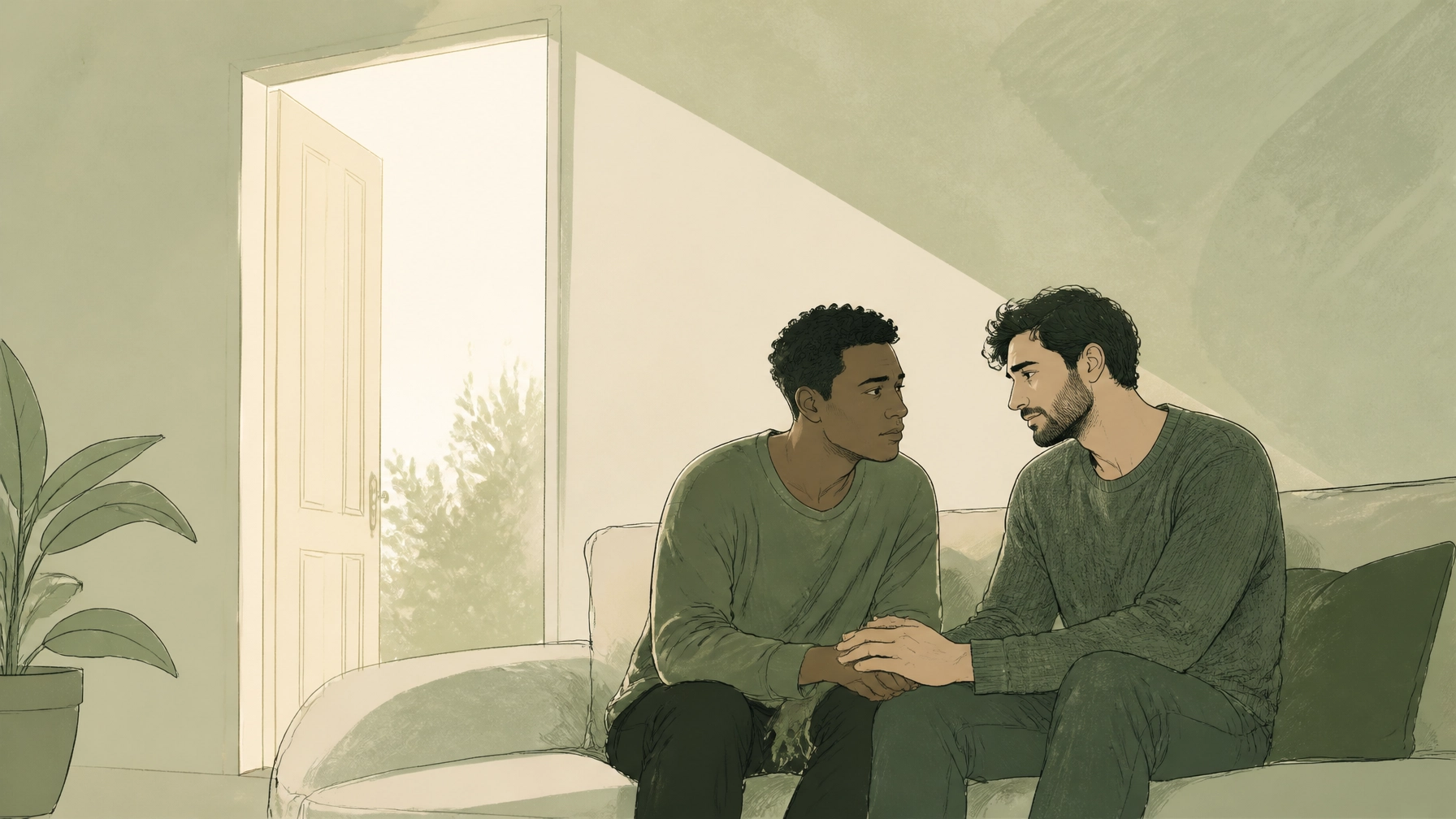
Coming out is often described as a moment of truth. We imagine the words leaving our mouths, the silence that follows, and then: perhaps: a rush of relief.
But what happens after?
Sometimes the fear does not disappear when the secret is spoken. It simply changes shape.
Before coming out, a queer man may be afraid of being discovered. Afterwards, he may become afraid of being seen differently. A family member might pause before answering a message. A friend might seem more careful around him. A lover might suddenly ask questions that feel loving, intrusive, or both. Even a familiar room can feel unfamiliar when the person sitting in it knows something important about you.
This is the emotional territory of today’s Queer Life and Identity series: the fear after the truth, and the way coming out can alter the meaning of every relationship we thought we understood.
The truth can feel like freedom: and exposure
There is courage in saying, “This is who I am.” There is also vulnerability.
For many queer men, coming out removes the exhausting work of hiding. There may be no more editing conversations, avoiding pronouns, inventing explanations, or pretending that a man is “just a friend” when the connection means far more. The truth can make ordinary life feel lighter.
Yet being honest can also make a person feel newly exposed.
When a truth has been private for a long time, sharing it can create the unsettling feeling that everyone else now has access to something deeply personal. A queer man may begin replaying conversations, searching for changes in tone or expression:
Did he already know?
Did I say too much?
Will they treat me differently now?
What if the person I trusted becomes the person I fear?
These questions do not mean coming out was a mistake. They mean the person has crossed an emotional threshold. The old secrecy has ended, but the new reality has not yet settled into place.
Jonah’s story: when every silence becomes an answer
Let’s imagine Jonah.
Jonah is thirty-two. He has known for years that he is attracted to men, but he has kept that truth carefully contained. He told himself that privacy was the same as control. If nobody knew, nobody could reject him.
Then he met Daniel.
Daniel did not rescue Jonah from himself. He did something more difficult: he made honesty feel possible. Their relationship grew through small acts of trust: late-night conversations, shared meals, the gentle familiarity of knowing how the other took his coffee. Jonah began to imagine a life in which love did not have to remain hidden.
Eventually, he told his family.
The conversation was not a disaster. Nobody shouted. Nobody told him to leave. There were questions, long silences, and a few awkward attempts at reassurance. One relative said they loved him but needed time. Another changed the subject too quickly.
Jonah went home relieved, then cried in the kitchen.
He had expected rejection. What he had not expected was uncertainty.
For the next few weeks, every message became a test. If a relative took too long to reply, Jonah assumed they were angry. If a friend did not ask about Daniel, he wondered whether they disapproved. When Daniel became quieter after a difficult conversation, Jonah feared that his own anxiety had made the relationship too heavy.
The truth had not destroyed Jonah’s relationships. But it had changed the way he looked at them.
He was no longer asking only, “Do they love me?” He was asking, “Do they love all of me?”
That is a much more frightening question.
Existing relationships may need to be renegotiated
Coming out can change the unspoken agreements within a relationship.
A friendship that once relied on shared assumptions may need new language. A family may have to reconsider expectations about the future. A romantic relationship may need to make room for conversations about identity, trust, public affection and emotional safety.
None of this means that queer identity is a problem that other people must solve. It means that truth changes the conditions of intimacy.
A friend who once assumed every story involved women may need to learn to listen differently. A relative may need to understand that a queer man’s partner is not a temporary phase or a detail to be politely ignored. A lover may need reassurance that coming out is not a rejection of the relationship, but an attempt to live more honestly within it.
Some people rise to that challenge immediately. Others need time. Some relationships grow stronger because honesty makes deeper closeness possible. Others become strained because the people involved cannot: or will not: accept the whole truth.
That uncertainty can be painful. It can also be clarifying.
The fear of being reduced to one truth
Another fear can emerge after coming out: the worry that sexuality will become the only thing people see.
A queer man may wonder whether every decision will now be interpreted through his identity. Will relatives treat him as fragile? Will friends ask inappropriate questions? Will colleagues make assumptions? Will a new partner see only the fact that he is gay or bisexual, rather than the complicated person behind that word?
Identity matters. It shapes our experiences, our communities and the stories we are able to tell. But it is never the whole story.
Jonah is not only a gay man. He is also impatient in the mornings, loyal to old friends, uncertain about his career and secretly sentimental about music from his teenage years. He is someone who wants to be loved without having to provide a simplified explanation of himself.
That is one reason character-driven queer fiction matters. The best gay novels and emotional MM books do not treat identity as a label placed on a flat character. They show how sexuality interacts with fear, family, ambition, jealousy, tenderness and hope.
A compelling gay love story emotional journey is not simply about whether two men get together. It is about what becomes possible when they stop dividing themselves into acceptable and unacceptable parts.
When friends and lovers respond with care
Fear is not the only thing that follows coming out.
Sometimes a friend says, “Thank you for trusting me,” and means it. Sometimes a partner listens without trying to make the moment about themselves. Sometimes a family member asks a clumsy question, apologises, and learns.
Acceptance does not always arrive as a grand speech. Often, it appears through ordinary behaviour:
- A friend remembers your partner’s name.
- A relative includes him in future plans.
- Someone stops treating your relationship as a secret.
- A lover gives you space to process without making you prove your commitment.
- People allow you to be happy without demanding that you explain your happiness.
These gestures can help rebuild trust after years of fear. They show that coming out has not made a relationship less real. It has given the relationship a chance to become more honest.
For emotionally invested MM readers, these small moments often carry as much weight as a dramatic declaration. Emotional MM romance literary storytelling understands that intimacy is built in pauses, choices and everyday acts of recognition.
When the response is complicated or painful
Not every reaction is affirming. Some queer men face rejection, hostility, manipulation or emotional withdrawal. Others encounter a more confusing mixture: affection alongside prejudice, support in private but silence in public, or acceptance that comes with conditions.
It is understandable to grieve these changes.
Coming out can involve losing the version of a relationship you hoped you had. It can reveal that someone’s love was dependent on an image of you that was never complete. That loss deserves to be acknowledged rather than minimised.
At the same time, safety comes first. Nobody owes a disclosure to a person who may respond with violence, homelessness, financial control or other forms of harm. Coming out is not a moral performance, and there is no single correct timeline. A queer man can choose when to speak, whom to tell and what boundaries he needs afterwards.
Sometimes courage looks like saying the truth aloud. Sometimes it looks like waiting until the conditions are safer. Sometimes it looks like stepping back from people who repeatedly make honesty feel dangerous.
Learning to see relationships clearly again
After coming out, Jonah eventually understood that he could not control every reaction. He could only decide what kind of relationships he wanted to build from that point forward.
Daniel remained beside him: not with perfect words, but with patience. When Jonah spiralled over a delayed message, Daniel did not dismiss the fear. He helped him name it. When Jonah worried that his family’s uncertainty meant he was unlovable, Daniel reminded him that uncertainty belonged to the family, not to Jonah’s worth.
Slowly, Jonah learned to stop treating every silence as a verdict.
That may be one of the hardest parts of living openly: learning that the truth does not guarantee acceptance, but it does make genuine acceptance possible. It gives the people who love us a chance to meet us honestly. It also gives us a chance to notice who is willing to make that journey.
For readers seeking queer fiction, gay romantic fiction and thoughtful LGBTQ+ romance, this emotional movement: from fear to discernment, from secrecy to self-trust: is where the deepest stories often live. It is also why MM romance can arrive from unexpected places: a difficult family conversation, a guarded friendship, a shared apartment, or one man finally allowing another man to see how frightened he really is.
You can explore Dick Ferguson’s LGBTQ+ ebooks, gay books and emotional MM romance on Read with Pride, including stories shaped by identity, vulnerability, complicated love and the courage to be known.
Next in the Queer Life and Identity series
In the next instalment, we’ll look at “The Morning After: Navigating the Vulnerability of New Intimacy”: what happens when the confession has been made, the first kiss has happened, and two men must face the tenderness and uncertainty that follow.
After that comes “Building a Life: From the First Kiss to Shared Keys and Quiet Sundays,” a reflection on the everyday work of creating a shared queer life: routines, domestic trust, chosen family and the quiet decisions that turn romance into home.
The truth may change how we see every relationship. With time, patience and the right people beside us, it can also teach us how to see ourselves more clearly.
#QueerLifeAndIdentity #MMRomance #GayRomance #QueerFiction #GayFiction #EmotionalMMRomance #LGBTQFiction #GayLoveStories #MMNovels #CharacterDrivenQueerFiction #EmotionallyInvestedReaders #ReadingWithPride
Follow us on social media
Follow Dick Ferguson and Read with Pride for more LGBTQ+ ebooks, gay book recommendations, queer fiction and emotionally rich MM romance:


Leave a Reply
You must be logged in to post a comment.