

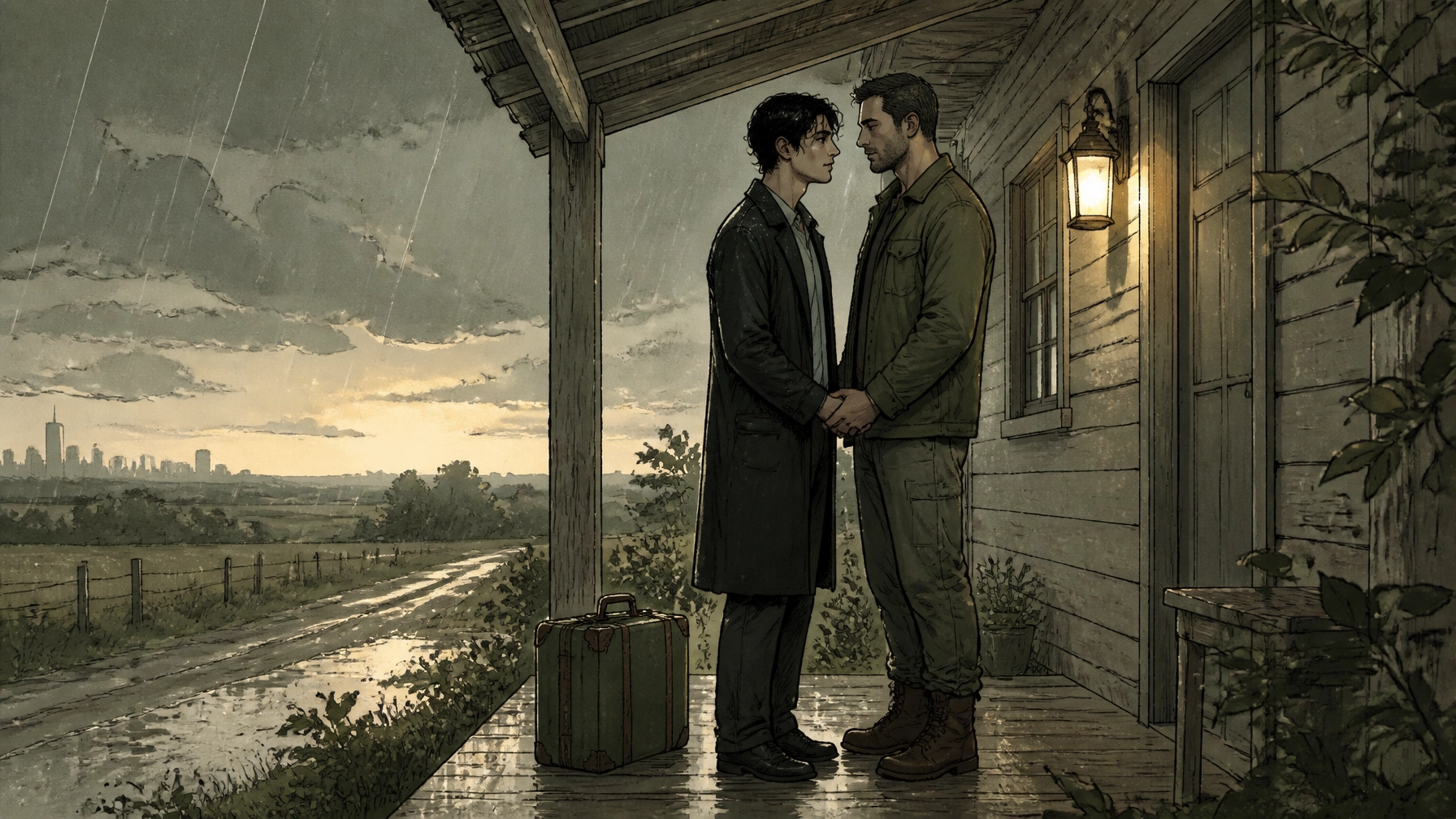
There are love stories that begin with certainty: a planned dinner, a carefully chosen outfit, a message sent at exactly the right moment.
And then there are the stories that begin because the rain comes down too hard to keep walking.
A car takes the wrong turning. A city man with a battered suitcase finds himself stranded at the edge of unfamiliar fields. A rural porch, old timber and warm light, offers shelter. The man who opens the door does not ask too many questions. He simply steps aside.
For a while, that is enough.
The storm presses against the roof. Water gathers in the ruts of the lane. The city traveller listens to the unfamiliar quiet, while the man who lives there moves through the house with the ease of someone who knows which floorboards complain and which window catches the wind.
They are different in almost every visible way. One has come from glass towers, crowded trains, and a life measured in appointments. The other belongs to a landscape of muddy boots, hedgerows, early mornings, and neighbours who notice when a light stays on too late.
Yet beneath the rain, something begins.
Not a grand declaration. Not an instant transformation. Just the first small permission to remain.
Why unexpected places make powerful love stories
The best MM romance unexpected places are rarely about the place alone. A porch, a railway platform, a late-night kitchen, or a remote cabin becomes meaningful because it removes the characters from the roles they have learned to perform.
The city man cannot hide behind his polished coat or his efficient answers when his clothes are soaked through. The country man cannot retreat into routine when a stranger looks at him as though there is more to him than the work of keeping a house standing.
Shelter creates a temporary world.
Inside that world, the usual rules loosen. There is no meeting to attend, no train to catch, no audience to impress. There is only the rain, the narrow space between two chairs, the steaming mug placed carefully within reach.
This is where character-driven queer fiction often finds its deepest force. The emotional turning point does not need to arrive in a ballroom or beneath fireworks. It can happen while one man dries the other’s coat. It can happen when a guarded question receives an honest answer.
“Why did you come here?”
“I don’t know.”
“Do you want to go back?”
“Not yet.”
Sometimes intimacy begins with the courage to admit that you have nowhere else you want to be.
Relationship milestones are often quiet
Readers are taught to look for certain landmarks in a romance: the first meeting, the first kiss, the declaration, the proposal, the happy ending.
These moments matter. But in an emotionally invested MM romance, the most important milestones often happen between them.
The first time one man falls asleep without keeping his phone in his hand.
The first time the other says, “You can stay,” and means more than one night.
The first disagreement that does not end in abandonment.
The first morning when neither of them pretends the connection is temporary.
A lifetime promise is rarely made all at once. It is assembled from smaller acts of trust. A dry towel. A shared meal. A hand held under the table. The decision to tell the truth before fear can tell it for you.
In a gay love story emotional journey, vulnerability is not simply a character trait. It is an action. It is something a man chooses, often while every instinct tells him to remain hidden.
For the city traveller, staying on the porch may be the first time he allows himself to be cared for. For the rural man, offering shelter may be the first time he risks wanting someone whose life seems to belong elsewhere.
Their relationship grows not because they become less complicated, but because they stop treating complication as proof that love is impossible.
The city and the countryside speak different emotional languages
Urban and rural settings can create more than visual contrast. They can reveal the private logic by which each character survives.
The city is movement. It is noise, light, speed, and constant negotiation. A man can disappear there even while surrounded by thousands of people. He can become excellent at being unavailable. His calendar can protect him from questions he does not want to answer.
The countryside is exposure of another kind. There are fewer places to hide, but also fewer distractions. The road is visible from the porch. The weather changes the shape of the day. A person’s absence is noticed.
Neither world is automatically kinder.
The city may offer freedom, anonymity, queer community, and the chance to build a life beyond other people’s expectations. It may also leave a man exhausted from always being in motion.
The countryside may offer space, stability, and a deeper connection to place. It may also carry old assumptions, family histories, and the pressure of being known too well.
That tension gives the romance emotional texture. The question is not whether one man must surrender his world for the other. The question is whether they can build a third space between them.
The porch becomes that space.
It faces the fields but looks towards the skyline. It belongs to the house, but welcomes someone travelling through. It is neither fully inside nor fully outside. In that sense, it mirrors the relationship itself: a threshold where two men can decide what comes next.
The storm changes, but the promise remains
Eventually, the rain weakens.
The drops become scattered taps along the gutter. The clouds lift enough for the evening light to reach the fields. The road remains flooded in places, shining beneath the last pale wash of the sky.
The storm was never the true obstacle. It was only the interruption that made honesty possible.
Now the city man has a choice. He can pick up his suitcase, thank the stranger, and return to the life he understood before the rain. Or he can admit that the most frightening part of the journey is not being stranded somewhere unfamiliar.
It is being offered a reason to stay.
For the man on the porch, the choice is just as difficult. Wanting someone is one thing. Making room for him is another. Love is not only the feeling that arrives during a storm. It is the practical, vulnerable work of asking what happens after.
Where will they live?
What will they tell people?
Which life will change?
What will they do when the weather is clear and there is no crisis to hold them together?
These questions are the heart of emotional MM romance literary storytelling. A powerful romance does not end when the characters recognise their feelings. It becomes more honest when they begin imagining the ordinary days that might follow: groceries, difficult conversations, shared keys, long silences, and the quiet comfort of knowing who will be there when the rain starts again.
Why this kind of story stays with us
A passing storm is easy to remember. The smell of wet wood. The cold weight of damp clothes. The first warmth of tea between both hands.
But what stays with us is the transformation of the place.
Before the storm, the porch is simply part of a house. Afterwards, it becomes the location of a decision. A threshold. A beginning. Proof that a life can change without announcing itself loudly.
This is why emotionally invested MM readers return to stories of unexpected connection. They are not only looking for a plot where two men fall in love. They are looking for the moment when love becomes believable because it is built from fear, choice, repair, and tenderness.
They want queer fiction that understands a promise is not made powerful by its size. It becomes powerful because someone could have walked away and chose to remain.
If you enjoy heartfelt gay fiction, character-driven gay novels, and MM romance books shaped by emotional vulnerability rather than formula, discover more LGBTQ+ ebooks and gay love stories through Read with Pride. You can also explore Dick Ferguson’s collection of emotional MM romance and gay literary fiction.
For more stories about unexpected places, chosen connection, and the lives we build after difficult seasons, read The Midnight Greenhouse, The Man Who Stayed, and The First Key on Read with Pride.
Three possible Evening Edition stories for tomorrow
- The Last Train Home: How a missed connection brought two men face to face with the life they had been avoiding.
- The Apartment Above the Bakery: When shared mornings turned an inconvenient arrangement into a chosen home.
- The Lighthouse in Winter: How two men learned that waiting for someone can be an act of courage, not weakness.
Follow us on social media
Follow Dick Ferguson for new releases, emotional MM romance, gay fiction, queer literature, and behind-the-scenes glimpses into the stories.
#ReadWithPride #MMRomance #GayRomance #QueerFiction #GayFiction #MMBooks #LGBTQBooks #EmotionalMMRomance #CharacterDrivenFiction #GayLoveStories #QueerLiterature #MMRomanceBooks #UnexpectedPlaces #RelationshipMilestones #ReadingWithPride


Leave a Reply
You must be logged in to post a comment.