

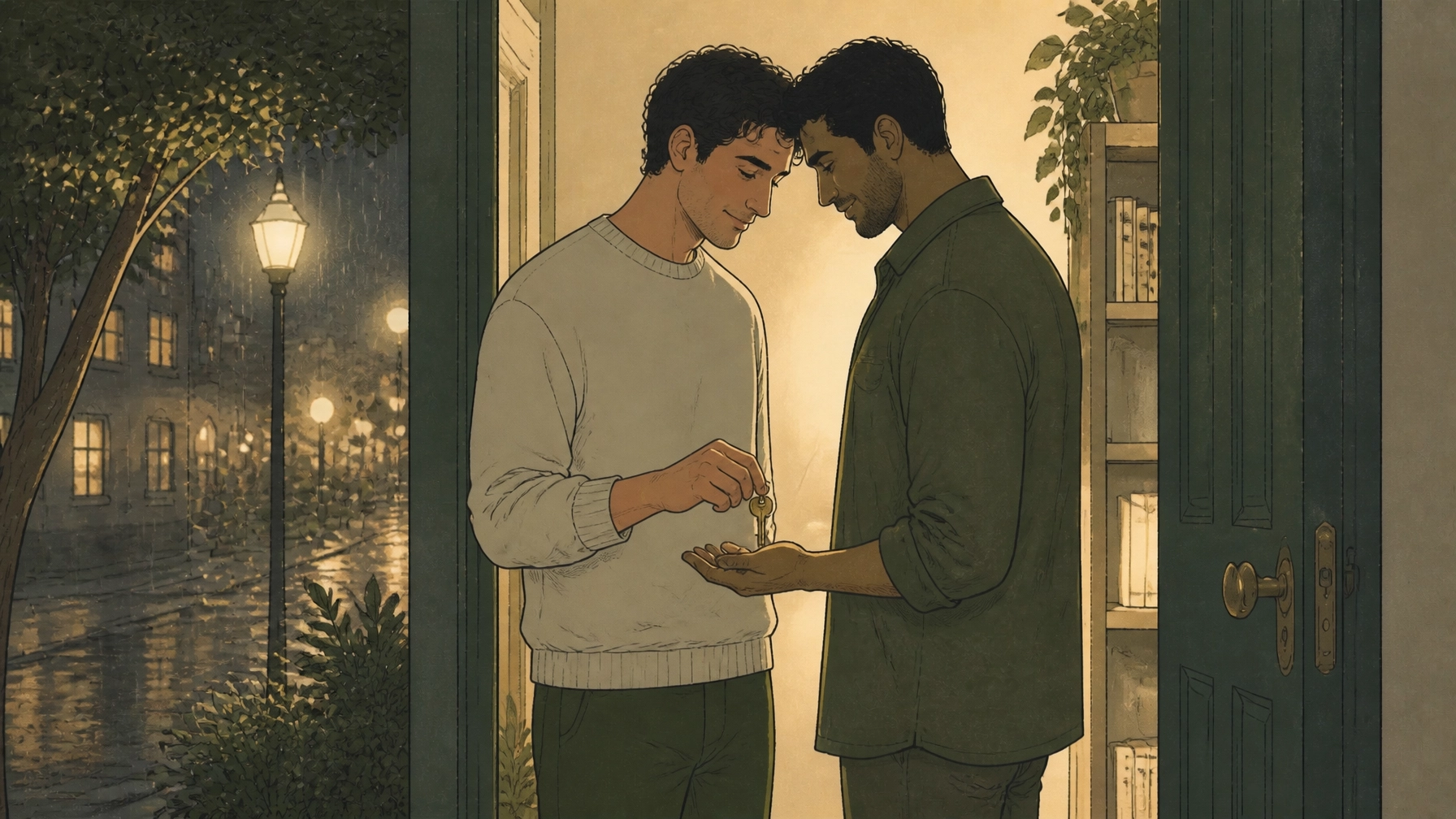
There are grander declarations of love than handing someone a key.
There are proposals beneath restaurant lights, letters written over several pages, flights taken across oceans, and public admissions made with a trembling voice. But the first house key is different. It is smaller. Colder. Easier to close your fingers around: and much harder to pretend it means nothing.
When one man gives another access to his home, he is not simply solving a practical problem. He is opening the door to his private life: the unwashed mug by the sink, the bad dreams, the unpaid bills, the silence after a difficult day. He is saying, in the plainest language he can manage: You may come in when I am not prepared for company.
For two men in love, that quiet promise can carry an extraordinary emotional weight.
A key is not just access: it is belonging
Early romance is often made of carefully chosen settings. A bar with flattering light. A cinema where neither man has to fill every silence. A restaurant table cleared of clutter. Even a first shared night can be shaped by the desire to offer the best version of oneself.
The house key changes that arrangement.
It moves a relationship from selected moments into ordinary life. The man who receives it no longer belongs only to the evenings arranged in advance. He can arrive after a difficult commute. He can let himself in with groceries. He can sit in the living room while his partner is still at work, surrounded by the objects and habits that existed before the relationship had a name.
That is why a key can feel more intimate than a kiss. A kiss belongs to a moment. A key belongs to the hours around it.
In emotionally deep MM romance, this milestone works because it exposes the difference between being desired and being trusted. Desire can be urgent, dazzling, even frightening. Trust is quieter. It asks whether someone will treat your home, your history, and your vulnerabilities with care.
The key answers that question without needing a speech.
The city key: privacy in a crowded world
In the city, a house key may be light and modern, cut for an apartment several floors above a noisy street. It may open three locks: the communal entrance, the building door, and the flat itself. Perhaps there is a buzzer, a security camera, a lift that shudders between floors.
Outside, the city is full of eyes and movement. Buses sigh at the kerb. Rain shines on the pavement. Someone is always rushing somewhere. Neighbours pass without learning one another’s names.
Inside, the key creates a different kind of geography.
For a gay man who has spent years measuring his gestures in public, home can be the first place where he stops editing himself. He can touch his boyfriend’s hand without checking who is watching. He can leave a photograph of the two of them on a shelf. He can say my partner without deciding first whether the room is safe.
When he gives that key to another man, he may be offering more than entry. He may be offering refuge from the constant calculation of public life.
Yet the city also makes the gesture complicated. An apartment is often temporary. The rent may rise. The neighbours may change. The job that keeps the lights on may demand too much. A key does not guarantee permanence. It simply says: For now, this is where I want you to be.
That “for now” can be both tender and terrifying.
A guarded character may hold the key but keep it in his pocket for weeks. He may sleep beside it on the bedside table, unable to decide whether accepting it makes him safe or exposed. His fear may not be that the relationship will fail. His fear may be that it will not: and that belonging will become something he can no longer imagine living without.
The rural key: history, land, and the fear of being seen
In the countryside, the key can feel heavier.
It may be old iron, darkened by years of use. It may open a painted door in a house that has belonged to one family for generations. The lock may stick in wet weather. The porch may smell of wood smoke, damp earth, and the faint sweetness of apples stored for winter.
There may be fewer doors, fewer cameras, fewer strangers passing beneath the window. But privacy is not the same as anonymity.
In a small village, people notice who arrives, who stays, and whose boots are left beside the back step. A relationship that can disappear into an urban crowd may become visible against a rural horizon.
That contrast gives the first key a different emotional charge. The man offering it may be inviting his partner not only into a house but into a history: the kitchen where his mother once kneaded bread, the shed where his father kept tools, the fields he ran through as a boy. Every room carries a memory. Every neighbour may carry an opinion.
For the man receiving the key, the question becomes more complicated than Do I love him?
It becomes: Can I belong to the life that made him?
Rural settings are often treated as peaceful backdrops in gay love stories, but they can hold enormous tension. The silence of the fields can be comforting. It can also make every unspoken worry seem louder. A city hides conflict beneath traffic and light. The countryside leaves it standing in the open.
A key in this setting can represent a choice to stay visible: not necessarily to the whole world, and not without fear, but to one another. It can mean accepting the muddy boots, the family expectations, the long drives, the people who have known him since childhood.
It can also mean building something new in a place that once seemed incapable of making room for them.
The first key is a test of internal struggle
The strongest relationship milestones do not arrive when characters are entirely ready. They arrive when readiness and fear occupy the same room.
One man may offer the key casually.
“Keep it,” he says, as though he is handing over a spare pen.
The other man hears everything beneath those two words. He hears the invitation. He hears the risk. He hears the possibility of being asked for the key back one day.
This is where character-driven MM novels find their deepest emotional material. The object remains small, but the history surrounding it is not.
Perhaps one man has been abandoned before. Perhaps he grew up believing that love was conditional, granted only when he behaved correctly. Perhaps he has never had a room that remained his after someone else became angry.
Perhaps the other man is more comfortable giving than receiving. He can unlock his door, offer food, make space in a wardrobe: but he cannot easily ask to be chosen. His generosity may be a form of protection. If he gives everything first, he never has to admit how badly he wants something in return.
The key exposes both men.
It asks the giver to trust that his home will not be invaded. It asks the receiver to trust that the invitation is real. It transforms a private fear into a physical object that can be lost, refused, returned, or held tightly in a closed fist.
Love is often made of ordinary permissions
A house key does not promise that two men will never hurt one another. It does not erase jealousy, grief, family pressure, old shame, or the difficult conversations waiting beyond the front door.
What it offers is more modest: and perhaps more meaningful.
It offers a place to begin again after an argument.
It offers the possibility of arriving without an explanation.
It offers a spare towel, a familiar mug, a side of the bed left unspoken but understood. It turns domestic routine into a language of devotion. Over time, the key may become scratched. Its edges may soften. It may share a ring with other keys, practical and unromantic.
That is precisely why it matters.
The first key is not a guarantee of a perfect future. It is evidence that two men are willing to make room for one another in the imperfect present.
Readers who love heartfelt gay fiction, emotional MM books, gay contemporary romance, and high-angst stories understand the power of that kind of promise. The most memorable gay love stories are rarely built from declarations alone. They are built from small acts that cost the characters something: showing up, telling the truth, staying after the fear arrives, and placing a key in someone else’s hand.
To discover more emotionally immersive gay novels and character-driven MM romance books, visit Dick Ferguson’s Read with Pride store. For readers looking for LGBTQ+ fiction with vivid settings, complicated men, and relationships shaped by trust, it is a place to read with feeling: and with pride.
Three possible next Evening Edition reads
-
The Coat Left on the Chair: Why leaving clothing in a partner’s home can feel more permanent than saying “I love you.”
-
The First Family Visit: What happens when two men move from private devotion to public belonging.
-
The Light Left On: How waiting up for someone becomes a quiet portrait of commitment in gay contemporary romance.
Follow us on social media
Follow us on social media for more gay book recommendations, LGBTQ+ reading, new gay releases, emotionally charged MM fiction, and reading with pride:
#MMRomance #GayRomance #GayLoveStories #LGBTQPlusFiction #QueerFiction #GayFiction #MMNovels #EmotionalMMBooks #CharacterDrivenMM #GayContemporaryRomance #GayLiterature #LGBTQReading #ReadWithPride #ReadingWithPride



Leave a Reply
You must be logged in to post a comment.