

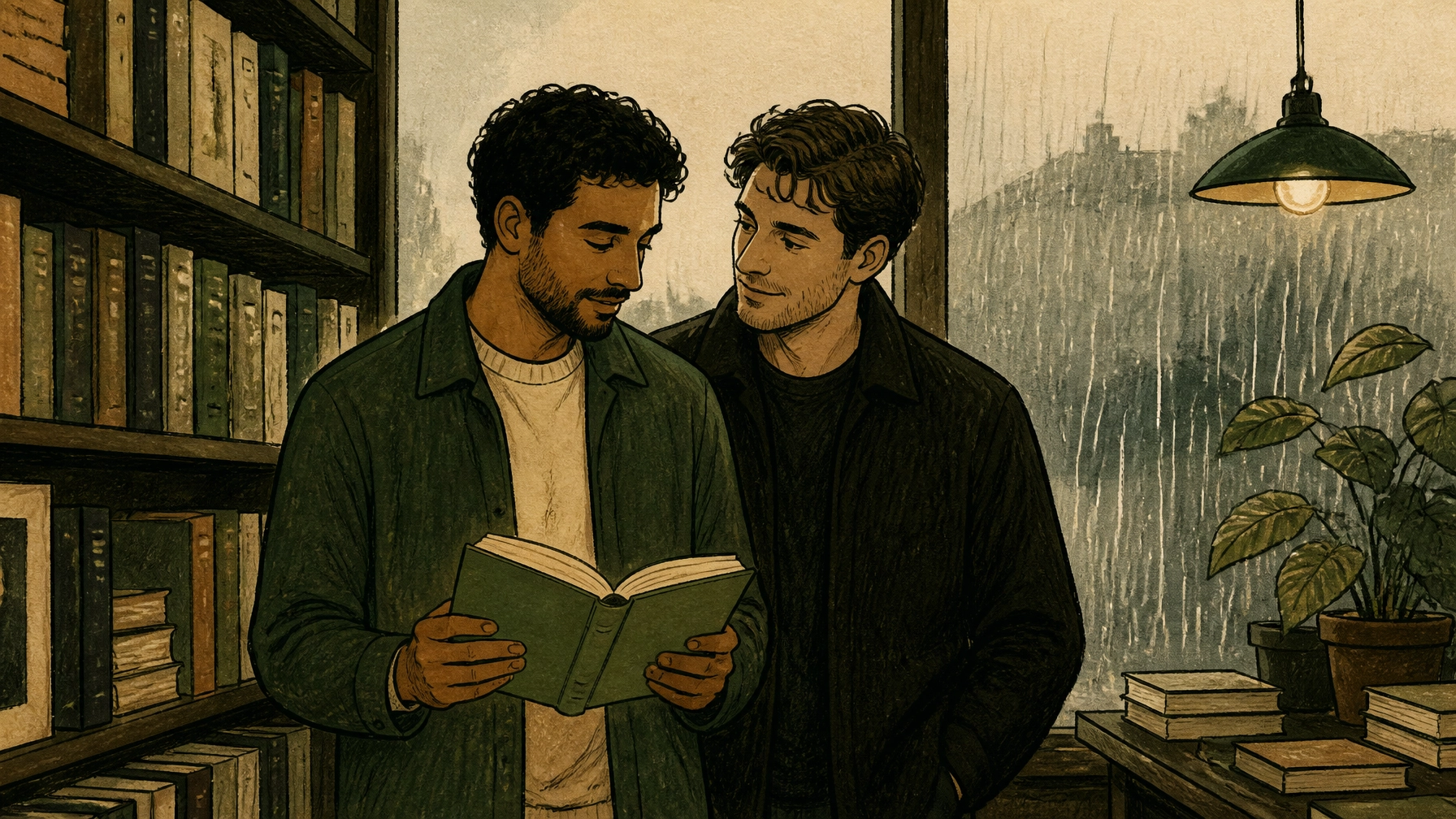
There are places we enter to escape the weather and leave having encountered something far more disruptive: another person.
A rain-soaked bookstore is one of those places.
Outside, the streets shine beneath a grey morning sky. Water runs along the kerb, gathers in the hollows of the pavement, and turns every passing headlight into a trembling reflection. Inside, the world becomes quieter. The rain taps against the windows. The floorboards complain softly beneath damp shoes. Somewhere near the counter, an old radiator clicks and sighs.
The shelves offer their own kind of shelter.
Two strangers can walk into such a place carrying entirely different lives. One may be running late, trying to outpace a difficult conversation or the memory of someone he has lost. The other may have nowhere urgent to be, yet still feel as though he is constantly trying to escape himself.
Then they reach for the same book.
It is a familiar romantic premise, but in an emotionally rich MM romance, the moment is not simply a charming meet-cute. It is the first crack in the walls both men have built around their hearts.
Why unexpected places make powerful love stories
The best unexpected-place romances work because they interrupt routine.
A man may believe he knows what his day will contain: coffee, work, obligations, perhaps the careful avoidance of anything that might make him feel too much. Then the rain drives him into a bookshop, and suddenly he is standing beside a stranger whose presence unsettles him.
Not because the stranger is immediately perfect.
Because he is observant. Because he notices the book being held too tightly. Because he sees the hesitation before a smile. Because he asks a simple question and waits for the answer.
For readers who seek character-driven MM fiction, this kind of encounter offers more than instant attraction. It creates a meeting between two interior worlds. The romance begins not with certainty, but with recognition.
Each man sees a little of himself in the other: the guardedness, the loneliness, the private hope that has not quite died.
The bookstore as a place of truth
A bookstore is more than a setting. It is a place where people reveal themselves without meaning to.
The books they choose can speak of grief, longing, anger, identity, or a desire for a life they have not yet dared to pursue. A man browsing the poetry shelves may be searching for language to describe feelings he has spent years avoiding. Another may stand among the biographies and memoirs, looking for proof that someone else has survived the same confusion.
In an LGBTQ+ bookstore or a queer-friendly bookshop, that revelation can carry particular weight.
The shelves may contain stories of coming out, bisexuality, chosen family, desire, heartbreak, and resilience. They offer reflections of lives that have too often been simplified or pushed into the margins. For a man who has struggled to understand himself, finding those books can be both comforting and frightening.
What happens when another man notices what he is reading?
The answer depends on trust.
Perhaps one character assumes he will be judged. Perhaps he has learned to keep his desires private, even from himself. Perhaps he has loved before, but only in ways that required silence. The other man may appear more confident, yet carry his own fear of being misunderstood.
Their shared interest in a book becomes a quiet test.
Will this stranger laugh? Will he ask an intrusive question? Will he look away?
Or will he simply say, “That’s one of my favourites”?
Sometimes intimacy begins with the relief of not having to explain everything.
Rain, silence, and the language of vulnerability
The rain creates a natural pause in the story.
Neither man can leave immediately. The storm has closed the door behind them, at least for a while. This gives them time to remain in the same space without having to invent a reason.
At first, their conversation may stay safely near the surface.
They discuss authors. They disagree about endings. One recommends a novel; the other admits he has already read it but never understood why everyone loves it. Their exchanges carry the tentative rhythm of strangers learning one another’s boundaries.
Then the conversation shifts.
A question about a book becomes a question about home. A joke about bad weather becomes an admission that one of them has been avoiding going back to his flat. A comment about a character’s fear becomes a confession about his own.
The movement should feel gradual because emotional trust is not built through grand declarations alone. It is created through small acts of attention.
One man remembers the other’s coffee order. He notices when the room becomes too crowded. He does not press when a subject becomes painful. He offers companionship without treating it as a debt.
For emotionally invested readers, these details matter. They transform attraction into connection.
When desire meets self-protection
A compelling gay love story is rarely only about whether two men are attracted to each other. It is also about whether they can accept what that attraction asks of them.
Love may require one man to admit that he is lonely. It may require the other to acknowledge that his independence has become a form of isolation. One may fear abandonment; the other may fear being known too completely.
These fears can create tension without turning either character into a villain.
Perhaps one man has recently left a relationship in which his needs were treated as unreasonable. Perhaps the other has spent years presenting himself as composed while quietly believing he is impossible to love. Their meeting in the bookstore gives them a glimpse of safety, but safety can be frightening when a person is accustomed to disappointment.
This is where high-angst MM romance becomes most powerful.
The conflict is not manufactured simply to delay happiness. It grows from the characters’ histories and the coping strategies that once helped them survive. A guarded man may retreat when intimacy deepens. A possessive man may mistake fear for certainty. Someone who has been rejected may push away the very person he most wants to keep.
The emotional journey lies in recognising these patterns: and choosing differently.
Books as mirrors, bridges, and promises
The book they reach for together can become a recurring symbol throughout the romance.
Perhaps one man buys it and later leaves it on the other’s doorstep. Perhaps its margins contain a note, an underlined sentence, or a question neither of them is ready to answer. Perhaps they return to the same shelf months later and realise how much has changed since that first rainy morning.
Stories can become a language between them.
A recommendation can mean, “I want you to understand me.” Lending a favourite novel can mean, “I trust you with something precious.” Reading side by side can offer a kind of closeness that does not demand constant conversation.
The bookstore becomes the place where they first meet, but it does not need to remain the only place where their relationship exists. They may carry its atmosphere with them: the patience, the softened voices, the willingness to look more carefully.
In time, the question is no longer whether they found love by chance.
It is whether they are brave enough to choose it on purpose.
The quiet courage of being seen
Some love stories arrive with certainty. Others begin with two people standing in the wrong place at the right time, damp coats dripping onto an old wooden floor.
The second kind can be especially moving because it reflects the uncertainty of real life. We do not always meet love when we are prepared for it. We may be grieving, confused, defensive, or convinced that our best days are behind us.
Then someone sees us.
Not the polished version. Not the version carefully designed to avoid rejection. The real person beneath the performance: frightened, hopeful, complicated, and deserving of tenderness.
That is the heart of an emotionally immersive MM romance. The relationship is not an escape from struggle. It is a space where struggle can be spoken aloud, met with empathy, and gradually transformed.
For readers drawn to lyrical prose, queer fiction, heartfelt gay novels, and emotional MM books, the rain-soaked bookstore offers an ideal beginning. It is intimate without being closed off, romantic without losing its connection to reality, and full of the quiet tension that makes a love story linger.
Sometimes the most important chapter of a person’s life begins when he steps inside simply to get out of the rain.
Explore more LGBTQ+ ebooks, gay literature, MM romance books, and queer fiction through Read with Pride. You can also find Dick Ferguson’s emotionally charged stories in the Dick Ferguson e-book store.
Three possible next blog posts
- The Slow Burn of Being Known: Why Emotional Intimacy Matters in MM Romance
- When Love Finds You at Work: The Hidden Tension of an Unexpected Workplace Romance Between Two Men
- After the Last Train: How Two Strangers Find Hope on a Journey Home
Follow us on social media
Follow Dick Ferguson and Read with Pride for new releases, LGBTQ+ reading recommendations, gay book recommendations, and emotionally immersive MM fiction:
#ReadWithPride #Readwithpride #MMRomance #GayRomance #MMBooks #QueerFiction #GayFiction #GayNovels #GayLoveStories #MMNovels #LGBTQPlusFiction #GayLiterature #MMFiction #GayRomanceBooks #MMRomanceBooks #LGBTQRomance #EmotionalMMBooks #HeartfeltGayFiction #GayAuthors #QueerAuthors #MMAuthors #GayBookRecommendations #LGBTQReading #ReadingWithPride


Leave a Reply
You must be logged in to post a comment.