

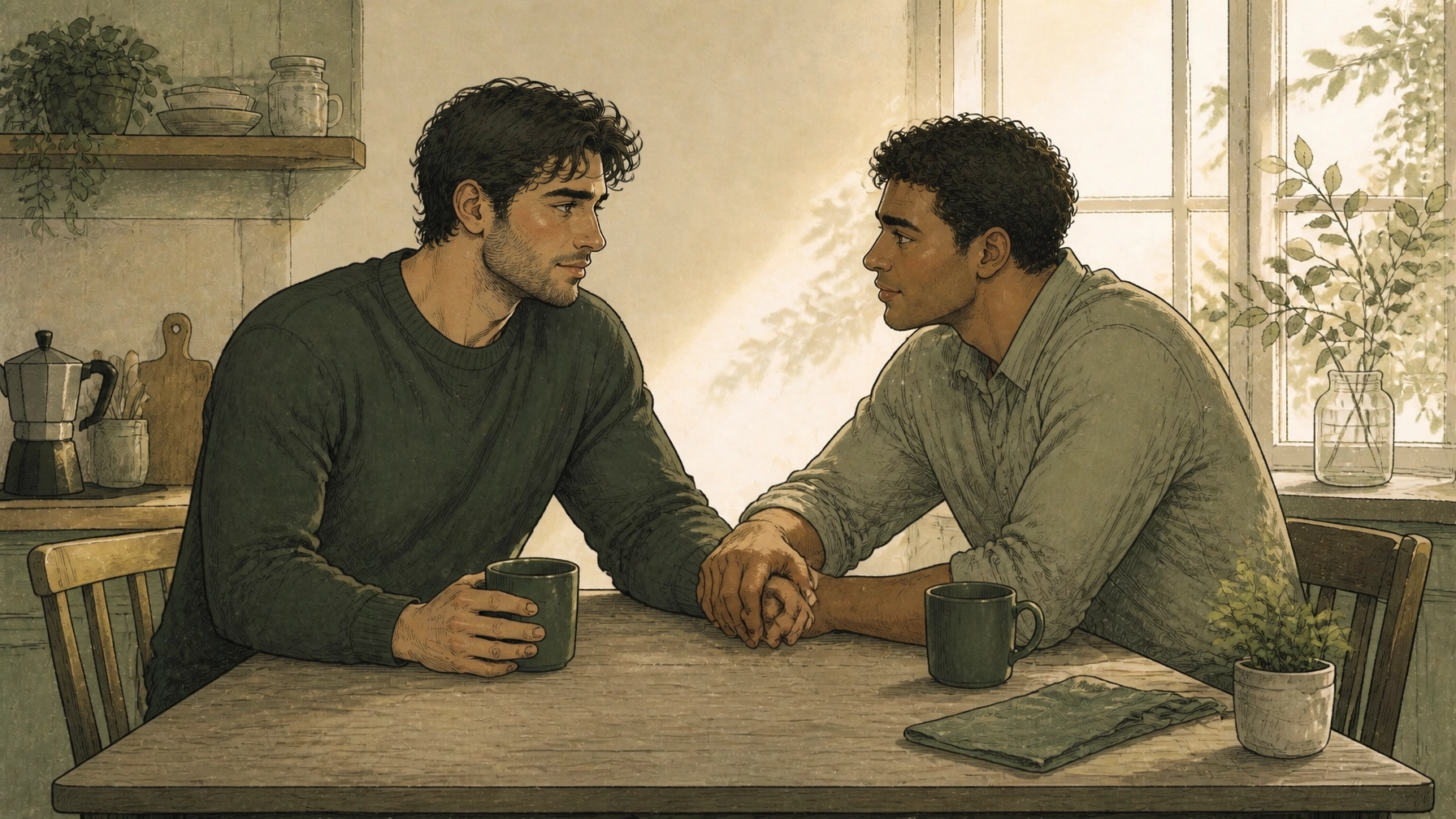
This is the next entry in the ongoing Queer Experiences and Stories 6 PM series, following “The Evening Elias Learned to Say It Out Loud.”
There are some truths that feel possible only after dark.
At night, the world seems smaller. A bedroom becomes a private country. A kitchen table becomes a place where two people can say what they have spent years avoiding. Shadows soften the room, traffic fades beyond the windows, and the silence between sentences feels almost protective.
But morning arrives eventually.
Daylight finds everything: the abandoned coat over the chair, the untouched cup of coffee, the tired face of the man who has finally said what he means. It asks a difficult question.
Was the truth still true in the morning?
For Elias and Julian, the answer begins with a quiet decision. Julian stays.
Not because Elias has made a perfect confession. Not because their fears have vanished. Julian stays because love, when it is real, does not always arrive as a dramatic promise. Sometimes it looks like making coffee, sitting across the table, and refusing to pretend that last night did not happen.
Morning makes honesty feel real
Elias wakes before Julian.
For a few seconds, he does not remember where he is. Then the previous evening returns in fragments: Julian’s voice, the long silence afterwards, the words Elias had struggled to say.
He remembers admitting that he was afraid.
Not vaguely afraid. Not “a little overwhelmed.” Afraid in the deep, physical way that makes the body prepare for escape before the mind understands what is happening.
He remembers telling Julian that being known had never felt entirely safe. That every honest admission seemed to carry a hidden cost. That he had spent years editing himself into someone easier to love.
In the darkness, saying it had felt like relief.
In the daylight, it feels like evidence.
Elias sits at the kitchen table and studies the room. Nothing has changed, but everything feels exposed. There is no emotional shelter in the pale morning light. No music playing. No rain against the windows. Just the ordinary world continuing as if he has not rearranged his entire life with a few trembling sentences.
Then Julian enters.
He does not ask whether Elias has changed his mind.
He does not pretend the conversation was unimportant. He simply takes the chair opposite him and waits.
That is the first thing Elias notices.
Julian stays without demanding reassurance that staying has been accepted correctly.
The fear after coming out
Many queer experiences and stories focus on the moment someone says the truth out loud. It is a powerful moment, but it is not always the end of the struggle.
Sometimes the fear comes afterwards.
A gay man may spend years imagining what will happen when people know. He may prepare for rejection, anger, silence or pity. He may picture the worst response so often that even acceptance feels suspicious. What if the other person is only being kind for now? What if they change their mind? What if the truth becomes something they use later?
For Elias, coming out is not just about naming his feelings. It is about allowing Julian to see the parts of him he has kept carefully hidden.
He expects Julian to look at him differently.
Perhaps with confusion. Perhaps with concern. Perhaps with the quiet disappointment Elias has been bracing for since before he had the language to explain himself.
Instead, Julian asks, “Did you sleep?”
It is such an ordinary question that Elias nearly laughs.
Then his eyes sting.
Because sometimes ordinary care is more frightening than dramatic rejection. It creates the possibility that someone might actually stay.
Julian does not try to wash the truth away
Julian knows he could make the morning easier by acting as if nothing has changed.
He could tease Elias about the cold coffee. He could suggest breakfast and talk about errands. He could place the previous night in a sealed box marked too emotional to revisit.
But Julian understands that avoidance would only make Elias feel more alone.
So he says, “I meant what I said last night.”
Elias looks up. “Which part?”
“All of it.”
The answer is not polished. It does not solve every uncertainty between them. But it gives Elias somewhere to stand.
Julian continues carefully.
“I’m not staying because I feel sorry for you. I’m not staying because I think I can fix what happened before we met. I’m staying because I want to be here.”
Elias looks down at his hands.
He wants to believe him. That is the problem.
Wanting to believe someone can feel like another form of vulnerability. If Elias trusts Julian and is hurt, he will not be able to tell himself that he expected it. He will have to admit that he hoped.
Hope is dangerous when you have built your life around self-protection.
Love is not proof that fear was foolish
A weaker romance might suggest that Julian’s presence makes Elias’s fear irrational. A more honest gay love story understands that fear can remain reasonable even when love is genuine.
Elias has history.
He has learned to read pauses, changes in tone and delayed messages. He has learned that people can say they care and still leave when the relationship becomes inconvenient. He has learned to offer the least complicated version of himself in exchange for temporary safety.
Julian cannot erase those lessons by being kind for one morning.
What he can do is stop treating Elias’s fear as an insult.
“I know you don’t trust this yet,” Julian says.
Elias’s throat tightens. “I do trust it. I just don’t know how long it will last.”
Julian nods.
That answer matters. He does not insist that Elias promise complete confidence. He does not turn the conversation into a test Elias must pass before breakfast.
“Then we’ll start with today,” Julian says.
It is a small promise, but small promises can be the most believable ones.
Today, Julian will stay.
Tomorrow, they will speak again.
Trust will be built through repetition rather than demanded as proof of love.
The truth belongs in ordinary places
There is something deeply moving about queer stories that allow honesty to exist in everyday spaces.
Not only in dramatic confrontations. Not only beneath rainbow flags or during carefully staged declarations. Truth also belongs in kitchens, on buses, in supermarket queues and beside the bed where someone has left a book open.
For Elias and Julian, this morning is important because nothing about it looks extraordinary.
Julian pours coffee.
Elias admits he is still frightened.
Julian asks whether he can sit closer.
Elias says yes.
They do not kiss immediately. They do not make grand plans. They sit together while the city wakes around them, learning what it feels like to remain present when the emotional intensity of the previous evening has faded.
That is the real test.
Anyone can promise forever in the heat of a powerful moment. The deeper question is whether two people can continue choosing honesty when the room is bright, the coffee has gone cold and there is no dramatic music telling them what to feel.
Staying is a choice, not a sentence
Julian’s decision to stay does not mean Elias now owes him certainty.
This is important.
Care should never become a contract in which one person’s support requires the other person to heal on schedule. Julian can choose to remain without demanding that Elias become fearless. Elias can accept love without pretending that he no longer needs reassurance.
They are not rescuing each other.
They are learning how to stand beside each other.
Elias tells Julian that he may need time. He may go quiet sometimes. He may ask the same question more than once because old fears do not always respond to new evidence.
Julian tells him that he may not always know what to say. Sometimes he will get it wrong. Sometimes he will need space to understand his own feelings before he can explain them.
Neither man offers perfection.
They offer honesty about their limits.
That is what makes the connection feel possible.
What daylight reveals
By late morning, Elias has stopped watching the door.
He notices this only when he realises he has been looking at Julian instead.
Julian is standing by the window, sleeves pushed up, reading a message on his phone. Sunlight catches the side of his face. He looks ordinary, familiar and completely real.
The truth has not disappeared.
It has changed shape.
Last night, honesty felt like a cliff edge. This morning, it feels more like a doorway. Elias is still afraid to walk through it, but he no longer believes he has to do so alone.
Julian turns from the window.
“Are you all right?”
Elias considers the question.
The old answer is ready: I’m fine.
He almost says it.
Then he chooses something more accurate.
“I’m still scared,” he replies. “But I’m glad you stayed.”
Julian crosses the room and takes his hand.
“I’m glad you told me.”
Their fingers tighten together.
Outside, the day continues. Cars pass. People hurry to work. Somewhere, a door opens and closes. The world does not stop to honour their honesty.
That is all right.
The truth does not need the world to pause before it becomes real.
Read with Pride
If you enjoy emotionally immersive MM romance, heartfelt gay fiction, high-angst relationships and character-driven queer fiction, discover more of Dick Ferguson’s work through the Dick Ferguson e-book store on Read with Pride.
Explore Read with Pride for LGBTQ+ ebooks, gay books, queer fiction, gay novels, MM novels, LGBTQ+ fiction, gay literature and emotional MM books created for readers who want more than a simple love story.
For emotionally invested readers, Julian and Elias’s story reflects one of the most powerful truths in queer fiction: coming out may change the conversation, but love is built in everything that follows.
In the quiet mornings.
In the difficult questions.
In the decision to stay present.
Three possible next 6 PM stories
-
Queer Experiences and Stories: The Afternoon Elias Asked Julian What Staying Meant : When Two Men Learned That Love Needs Language
-
Queer Experiences and Stories: The Evening Julian Introduced Elias Without Hesitation : When Two Men Discovered That Being Seen Could Feel Ordinary
-
Queer Experiences and Stories: The Night Elias Believed Him : When Two Men Learned That Trust Sometimes Begins Before Certainty
Follow us on social media
Follow Dick Ferguson for more emotional MM romance, gay love stories, queer fiction, gay book recommendations and reading with pride:
#QueerExperiencesAndStories #MMRomance #GayRomance #GayLoveStories #EmotionalMMRomance #CharacterDrivenFiction #QueerFiction #GayFiction #GayNovels #MMNovels #LGBTQFiction #HeartfeltGayFiction #EmotionalMMBooks #GayRomanceBooks #ReadingWithPride #ReadWithPride


Leave a Reply
You must be logged in to post a comment.