

readwithpride.com
There is a kind of grief that does not always arrive with a clear goodbye.
Sometimes it follows the death of a partner, friend, relative, mentor, or chosen-family member. Sometimes it comes from a relationship that could not survive prejudice, years spent hiding, a childhood that never felt safe, or the younger self who had to become careful before they ever had the chance to become carefree.
For LGBTQ+ people, grief can be personal, social, and historical all at once. We may mourn people we have lost, futures we were told we could not have, or parts of ourselves we had to leave behind to survive.
And yet, queer communities have always carried something remarkable alongside grief: the ability to imagine beyond it.
That is where queer healing begins, not with pretending everything is fine, and certainly not with forcing ourselves to “bounce back”. It begins with honesty, care, and the understanding that healing rarely moves in a straight line. Sometimes we move forward. Sometimes we pause. Sometimes we circle back to an old hurt with new language, better support, and a little more patience for ourselves.
Queer healing is not about becoming unbreakable
Resilience is often described as strength, toughness, or the ability to keep going no matter what. That definition can feel strangely uncomfortable for queer people. We have already been praised for surviving things we should never have had to endure.
LGBTQ+ resilience is not a demand to remain cheerful while facing rejection, discrimination, violence, illness, financial stress, or loss. It is not a gold star for coping alone. It is not proof that pain has failed to affect us.
Real resilience can be very soft.
It can look like telling a friend, “I am not doing well today.” It can mean leaving a space that makes you feel unsafe instead of trying to prove that you belong there. It can be resting without earning it first, turning off the news, accepting help, or allowing someone else to cook dinner while you sit quietly and breathe.
Research and community work on queer resilience repeatedly point towards connection as a vital source of wellbeing. Chosen family, LGBTQ+ community spaces, mutual aid, affirming healthcare, creative expression, and honest storytelling can all help us feel less alone in experiences that are often made heavier by isolation.
As research on queer survival and future possibilities suggests, survival is not only about enduring the present. It is also about nurturing possibilities for what comes next.
Grief deserves room at the table
There is no correct way to grieve a queer loss.
You might feel sadness, anger, relief, guilt, numbness, gratitude, or all of these before lunchtime. You might miss someone deeply while also acknowledging that they did not always understand or accept every part of you. You might grieve a relationship that ended years ago because it represented safety, possibility, or a version of your life that never had the chance to unfold.
This complexity does not make your grief less valid. It makes it human.
Queer healing asks us to name what has been lost without allowing loss to become the only story available to us. That might mean writing down the person you miss and what they taught you. It might mean creating a small ritual, returning to a meaningful place, talking with someone who understands, or giving yourself permission to remember imperfectly.
It can also mean grieving the larger things: safety, acceptance, time, community, bodily autonomy, or the freedom to imagine a future without first calculating the risks.
The goal is not to tidy grief into a neat conclusion. Grief may remain part of your life. But with support, it can become something you carry rather than something that carries you.
If this topic feels close to a current bereavement or crisis, please reach out to someone you trust or an LGBTQ+-affirming professional or support service in your area. You do not have to manage a heavy day by yourself.

The healing power of being witnessed
One of the most generous things a person can offer is attention without trying to rush the other person towards a solution.
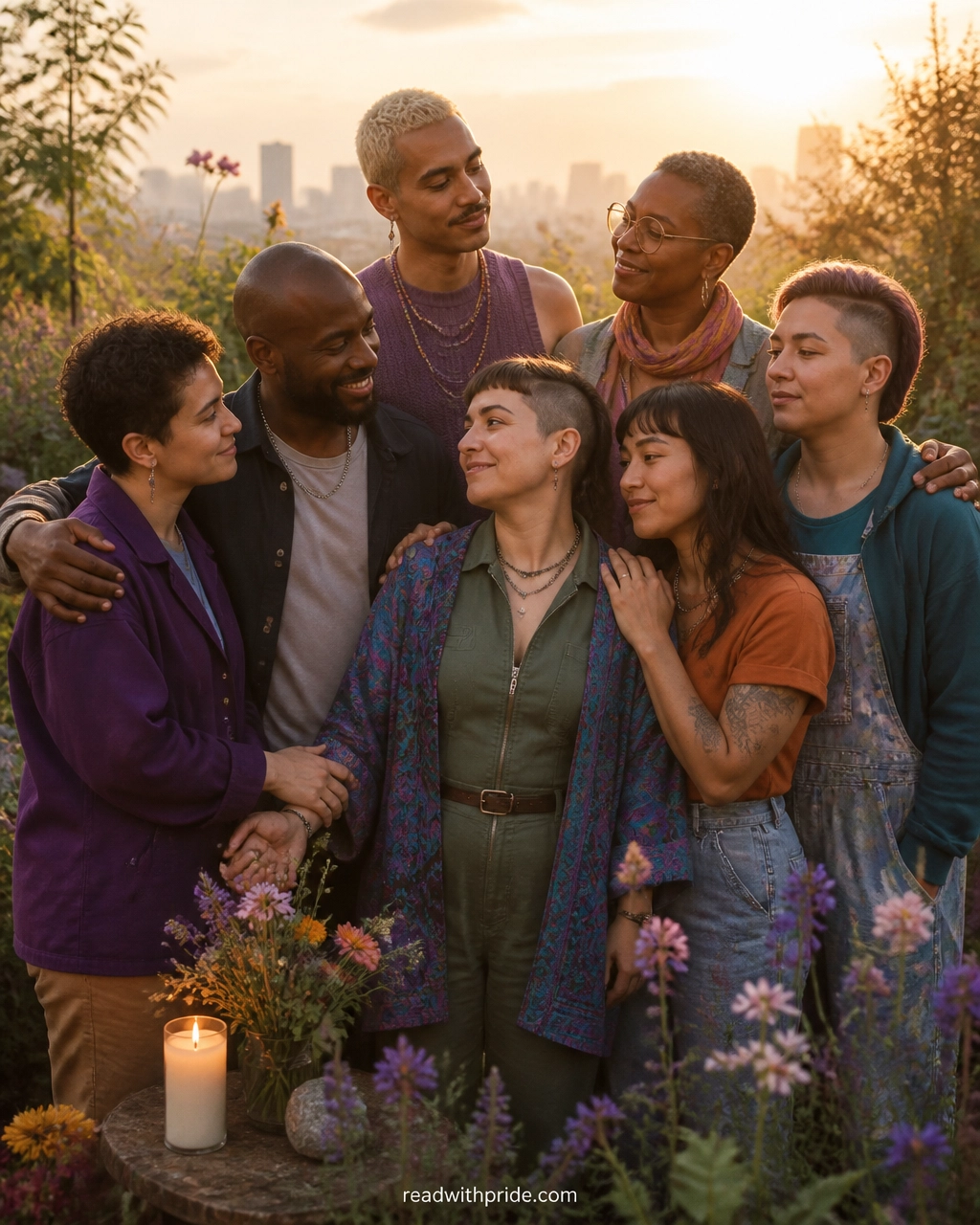
Queer communities understand this instinctively. We know that being witnessed can be a form of relief. There is a difference between being asked to explain your identity and being welcomed without explanation. There is a difference between being tolerated in a room and being able to exhale there.
Healing often grows in those small moments of recognition:
- Someone remembers your pronouns without making a performance of it.
- A friend asks what kind of support you want instead of assuming.
- Your partner listens when you say that a family gathering was difficult.
- A community member checks in after a difficult anniversary.
- You find a story that reflects an experience you thought nobody else could understand.
This is one reason queer fiction matters. Gay romance books, lesbian romance, queer fiction, and LGBTQ+ ebooks can offer emotional mirrors, windows, and doors. A story may help us name a feeling, imagine a relationship built on mutual respect, or remember that queer people deserve tenderness, adventure, desire, humour, and happily-ever-afters too.
At Read with Pride, our collection celebrates LGBTQ+ stories across different moods and experiences: from heartfelt gay fiction and emotional MM books to lesbian romance, steamy MM romance, and narratives about identity, belonging, and chosen family.
Future visions are a healing practice
Hope is not the same as optimism.
Optimism says everything will probably work out. Hope is more practical, more stubborn, and sometimes more tired. Hope says: “This is difficult, but it is not the only possible future.”
Queer future visions allow us to imagine lives shaped by safety, freedom, pleasure, care, and community. They do not need to look perfect. In fact, the most meaningful futures are often ordinary in the best possible way.
Imagine:
- A young queer person growing up with language for who they are and adults who believe them.
- A trans elder surrounded by people who know their stories and celebrate their wisdom.
- LGBTQ+ people accessing healthcare without having to educate every professional in the room.
- Queer families living in homes designed around accessibility, affordability, and belonging.
- Lesbian, gay, bisexual, trans, non-binary, and questioning people finding love without believing they must shrink themselves to keep it.
- Community libraries and bookshops where queer stories are not treated as controversial, but as part of the everyday literary landscape.
These visions may sound simple. That is part of their power. A future does not have to be shiny or spectacular to be revolutionary. Sometimes the boldest dream is a safe home, a reliable friend, a body treated with dignity, or the chance to grow old surrounded by people who know exactly who you are.

Building tomorrow together
No one person can imagine or build a better future alone.
Collective care can be wonderfully unglamorous. It is sharing a spare room. Sending money when someone is short. Offering a lift. Making a group chat for practical support. Bringing food to a grieving friend. Creating a queer book club where people can talk about stories, relationships, history, and life without translating themselves for the room.
It is also making space for difference within LGBTQ+ communities. Queer resilience is not one-size-fits-all. A disabled queer person may need a different kind of access and support than an able-bodied person. A queer person of colour may carry histories and pressures that white queer people do not. A bisexual person may face erasure in both straight and queer spaces. A trans person may need safety planning that others have never considered.
An inclusive future vision has room for all of this. It does not ask the most marginalised people in a community to do all the surviving, educating, and organising. It treats interdependence as wisdom rather than weakness.
Small acts count. Every time we make a space more welcoming, share a resource, listen carefully, challenge an assumption, or choose a queer story, we are practising the future we want to inhabit.
Let your timeline be your own
Many people are taught to measure life through a narrow sequence: come out, find a partner, build a home, get married, have children, succeed professionally, and remain permanently well-adjusted.
Queer lives have always been more expansive than that.
You may come out at 16 or sixty. You may fall in love once, many times, or not at all. You may build a family through friendship, adoption, community, partnership, creativity, or a beautiful combination of all five. You may change your name, pronouns, relationship structure, career, city, or understanding of yourself.
Healing does not have a deadline. Neither does self-discovery.
Your future is not behind schedule because it does not resemble someone else’s. There is no single queer timeline, only the life you are gradually making more honest and more yours.

A gentle question for the days ahead
When the future feels too enormous to imagine, make the question smaller:
What would make tomorrow feel a little more like home?
Perhaps the answer is one honest conversation. A doctor who listens. A boundary. A nap. A new book. A message to someone who makes you laugh. A visit to a queer community space. A promise to stop treating your needs as an inconvenience.
You do not have to solve everything today. You do not have to transform grief into inspiration before you are ready. You are allowed to heal slowly, imperfectly, and in company.
The future is not something we wait for passively. We create it through the care we offer, the stories we protect, the people we believe, and the joy we refuse to surrender.
That is queer resilience: not simply surviving what came before, but making room for a tomorrow where more of us can breathe, love, rest, read, and belong.
Explore the LGBTQ+ ebooks at Read with Pride and find stories that hold complexity, desire, tenderness, and hope. You can also read more from our LGBTQ+ blogs and articles, including “Queer Healing and Future Visions: Holding Grief, Carrying Hope” and “Queer Healing and Future Visions: Carrying Each Other Forward”.
Follow Read with Pride on Instagram and Facebook, share this post with someone who needs a little hope, and keep imagining boldly.
#ReadWithPride #QueerHealing #LGBTQResilience #FutureVisions #QueerHope #LGBTQBooks #QueerFiction #LGBTQReading #ChosenFamily #QueerJoy

Leave a Reply
You must be logged in to post a comment.