

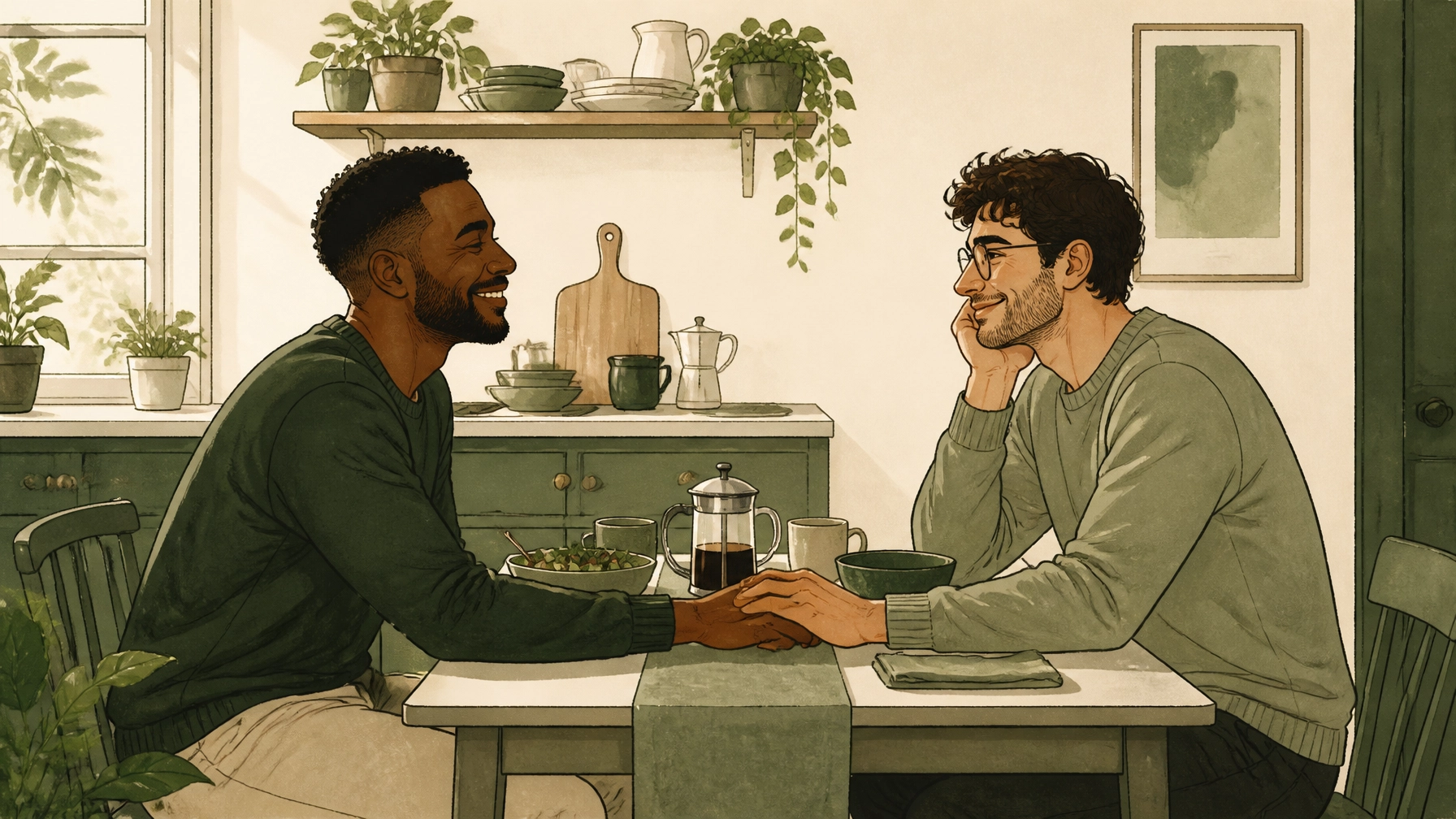
There is a particular kind of happiness that rarely makes headlines.
It is the happiness of deciding what to cook together. Of arguing gently about where the sofa should go. Of laughing so hard with friends that someone snorts into their drink. Of reaching for someone’s hand in public and not immediately checking who might be watching.
For queer people, these moments can carry a meaning that goes far beyond the moment itself. They are ordinary, yes, but ordinary does not mean insignificant. A shared meal, a chosen home, a familiar joke, or a peaceful Sunday morning can represent safety, belonging, and the freedom to exist without explanation.
That is why everyday queer happiness matters.
In the Queer Life and Identity 2 PM series, we have explored the complexity of identity, love, belonging, and self-discovery. This next story theme turns towards something gentler: the quiet joy of building a life that feels like your own.
Queer happiness is not only found in major milestones
Queer stories are often expected to focus on the most dramatic parts of identity: coming out, rejection, discrimination, heartbreak, or the struggle to be accepted. These stories matter. They can offer recognition, comfort, and language for experiences that are difficult to name.
But queer life is not made only of difficult conversations.
It is also made of breakfasts, bus rides, birthdays, house keys, inside jokes, shared playlists, and someone remembering exactly how you take your tea.
For gay men, happiness might be the first time a relationship feels natural in the presence of friends. It might be cooking with a boyfriend in a kitchen that belongs to both of them, or introducing a husband without bracing for an awkward response.
For lesbians, it might be choosing a home together, decorating a bedroom, or laughing with the particular ease that comes from being understood without having to translate every part of yourself.
For bisexual people, ordinary happiness can include being loved and believed without having their identity questioned or reduced to the gender of their current partner. It can mean being able to say who they are without having to provide a defence, a history lesson, or proof.
None of these moments are small to the people living them.
The emotional power of sharing a meal
Food is one of the simplest ways people create a life together.
A meal can be romantic, but it does not need to be grand. It might be two men making pasta after work, one chopping vegetables while the other tells a story about something ridiculous that happened on the train. It might be a lesbian couple sharing takeaway on the floor because they have not unpacked the dining table yet. It might be a bisexual person bringing their partner home to meet friends who already understand that love does not need to fit one narrow shape.
Meals create rhythm. They turn affection into something practical.
Someone asks whether you have eaten. Someone saves you the last piece. Someone knows you will want extra chilli, or no coriander, or coffee before conversation. These gestures say: I notice you. I remember you. Your comfort matters to me.
That is the emotional heart of many great queer love stories. Not only the first kiss or the dramatic declaration, but the accumulation of small acts that make love believable.
A compelling gay love story emotional journey often becomes most powerful when characters move from wanting to be chosen to understanding what it means to choose one another every day.
Choosing a home, and choosing a future
A home is more than a physical space. It is the place where many people hope to stop performing.
For queer people, creating a home can be a deeply affirming act. It might mean hanging photographs of the people you love, choosing colours that make you feel calm, or leaving a pair of shoes beside your partner’s without worrying about what the arrangement suggests.
Home can also be chosen family.
Some people are warmly supported by their relatives. Others build their closest circles through friendships, community, shared experience, and mutual care. A group of friends who celebrate your relationship, respect your identity, and make space for your changing understanding of yourself can become as important as any traditional family structure.
This is particularly meaningful for bisexual people, who may sometimes find themselves misunderstood both inside and outside LGBTQ+ spaces. A genuinely welcoming home, whether shared with a partner, friends, or relatives, does not ask someone to become simpler in order to belong.
It allows complexity to remain part of the picture.
In character-driven queer fiction, the choice of a home can reveal more about a person than a speech ever could. Does a character keep the curtains closed? Do they leave room for another toothbrush? Do they imagine staying? These details show whether they are still surviving, or beginning to believe they deserve a future.
Laughter is a form of belonging
There is freedom in laughing with people who know you well.
Queer friendship is often portrayed as a support system during crisis, and it can certainly be that. But friendship is also play. It is gossip, bad dancing, shared references, long voice notes, birthday traditions, and the confidence to be completely ridiculous.
Laughter can be a sign that someone feels safe enough to lower their guard.
For a gay man who has spent years monitoring how he speaks or moves, laughing openly with friends can become a quiet release. For a lesbian who has had to explain or defend her relationship, being surrounded by people who simply understand can make joy feel effortless. For a bisexual person, finding friends who do not treat their identity as a phase or a puzzle can create space for a more relaxed, whole self.
These moments do not erase the hardships queer people may face. They do something else: they prove that hardship is not the complete story.
Queer people are not only resilient because they endure. They are resilient because they continue to create connection, humour, tenderness, and possibility.
Holding hands without fear
Holding hands is a simple gesture, but context changes everything.
For some couples, it is automatic. For others, it involves a quick calculation: Where are we? Who is nearby? Is this safe? Will someone stare, comment, or follow us?
That is why a moment of public affection can feel so meaningful. Two men walking through a neighbourhood with their hands linked are not necessarily trying to make a statement. They may simply be walking home. A lesbian couple leaning into each other on a train may be tired after work. A bisexual person kissing their partner goodbye may be doing nothing more dramatic than saying goodbye.
Yet the ability to be ordinary in public is precious.
Safety creates room for spontaneity. When people do not have to constantly assess the risks of being seen, they can pay attention to the person beside them. They can notice the weather, the music from an open window, or the way their partner’s thumb brushes across their knuckles.
That is the kind of emotional detail that gives an MM romance unexpected places its depth. The romance does not have to take place somewhere glamorous. It can unfold in a supermarket aisle, outside a corner shop, or on a familiar walk home. The setting becomes meaningful because the characters are finally able to inhabit it honestly.
Being fully yourself is an everyday achievement
Authenticity is sometimes presented as one bold decision: coming out, changing your name, leaving a relationship, or stepping into a new community.
In reality, being yourself is often a series of smaller choices.
You tell a new colleague about your partner. You wear the clothes that make you feel most at ease. You correct someone who makes an assumption about your sexuality. You let trusted friends see the parts of you that you once considered too complicated, too emotional, or too difficult to love.
You also give yourself permission not to perform queerness in a particular way.
There is no single correct version of gay identity, lesbian identity, or bisexual identity. Some people are visibly expressive; others are private. Some are certain about labels; others find that their language changes over time. Some build traditional domestic lives; others create unconventional families and relationships.
Ordinary queer happiness makes room for all of this.
It says that a queer life does not need to be dramatic to be meaningful. It does not need to be constantly educational, politically impressive, or narratively tidy. Sometimes it is enough to feel peaceful in your own body, loved in your own home, and recognised by the people who matter.
Why readers need stories about ordinary queer joy
Readers deserve queer stories that acknowledge pain without making pain the only source of depth.
They deserve characters who are allowed to want a quiet life, even when their pasts are complicated. They deserve romances where tenderness is not treated as a reward for suffering, but as part of the relationship itself. They deserve stories about men loving men, women loving women, and bisexual people navigating love and identity with honesty and dignity.
This is especially important for emotionally invested MM readers. They are not looking only for a plot that moves from conflict to resolution. They want to feel the texture of a relationship: the silences, habits, misunderstandings, jokes, fears, and small acts of trust.
That is where emotional MM romance literary storytelling can leave a lasting impression. A character placing a hand on someone’s back in a crowded room may reveal years of longing. A shared meal may show that two people have stopped imagining an escape route. A laugh between friends may suggest that a life once shaped by fear is becoming spacious again.
These are not filler moments.
They are the story.
If you are drawn to emotionally rich, character-driven queer fiction, you can explore more gay novels, MM fiction, LGBTQ+ romance, and heartfelt gay fiction through Read with Pride.
Let ordinary happiness count
Queer joy does not have to be loud to be real.
It can be the relief of saying “my partner” and being met with a smile. It can be a key turning in the lock of a home you chose together. It can be friends who know when to offer advice and when to order dessert. It can be walking hand in hand. It can be waking up beside someone and feeling, for once, no need to become anyone else.
Everyday happiness matters because it gives queer people more than a moment of pleasure. It gives them evidence of belonging.
And when these moments appear in fiction, they offer readers something equally valuable: the chance to imagine a future built not only around survival, but around comfort, laughter, love, and the beautiful ordinariness of being fully known.
Follow us on social media for more reflections on queer life, identity, gay love stories, MM romance, and LGBTQ+ reading.
#QueerLife #QueerJoy #LGBTQFiction #GayLiterature #MMRomance #GayRomance #QueerFiction #BisexualRepresentation #LesbianStories #GayLoveStories #CharacterDrivenFiction #EmotionallyInvestedReaders #ReadWithPride #ReadingWithPride


Leave a Reply
You must be logged in to post a comment.