

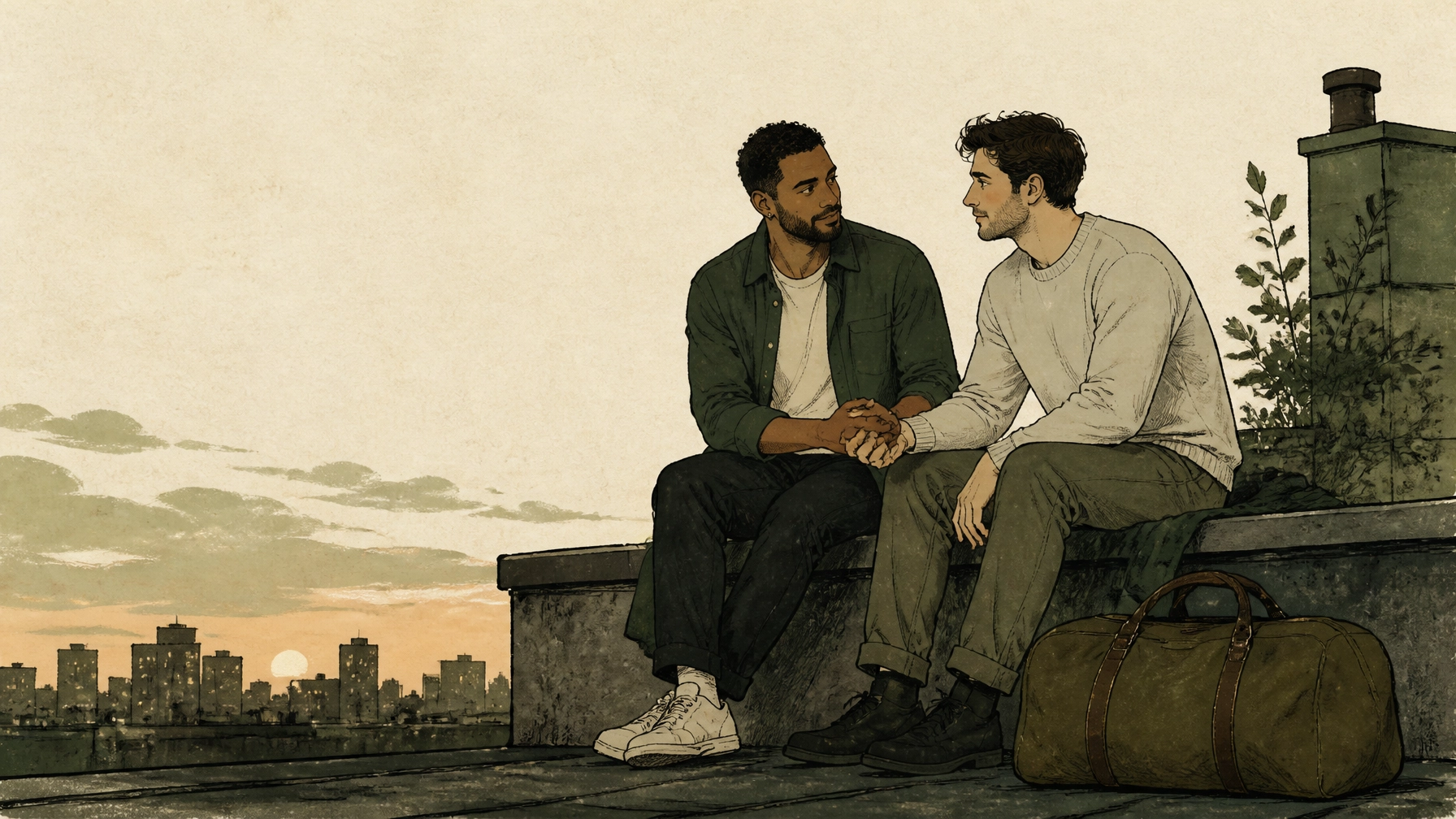
There is a particular kind of exhaustion that comes from always appearing capable.
You answer, “I’m fine,” because it is quicker. You solve the problem before anyone notices it exists. You become the dependable friend, the calm partner, the one who can leave a difficult family conversation and still make everyone else feel better.
For many queer people, especially queer men, independence can begin as protection. You learn to rely on yourself because relying on others has not always been safe. Perhaps you grew up without language for your identity. Perhaps you had to become skilled at reading a room before deciding whether it was safe to tell the truth. Perhaps you learned that needing too much could make you vulnerable to rejection.
But independence and isolation are not the same thing.
In this next instalment of the Queer Life and Identity 2 PM daily series, we are looking at the courage to ask for help: what it means for identity, trust, belonging, and love when we finally admit that carrying everything alone is not the only way to survive.
Why asking for help can feel like an identity risk
Asking for help sounds simple until you consider what the request might reveal.
“I’m struggling.”
“I don’t know what to do.”
“I’m scared.”
“I need you.”
These statements can feel especially exposing when you have spent years managing how other people see you. Queer identity is not a single experience, and there is no universal way queer people relate to vulnerability. Still, many queer men understand the pressure to prove that they are self-sufficient, emotionally controlled, or unaffected by the things that hurt them.
Sometimes that pressure comes from traditional ideas about masculinity. Sometimes it comes from queer spaces where people are also trying to protect themselves. Sometimes it comes from the painful belief that being accepted means being easy to love.
If you have had to defend your identity, explain your relationships, or make other people comfortable with your existence, it can become tempting to minimise your needs. You may think:
- Other people have problems that are more serious.
- I should be able to handle this myself.
- If I ask for help, I will become a burden.
- If I show how frightened I am, people may change their minds about me.
- If I depend on someone, I will eventually be disappointed.
These thoughts are not proof that you are incapable of connection. They may be evidence that you have learned to treat connection as something that must be carefully earned.
The first request does not have to be enormous
You do not have to begin with a dramatic confession. In fact, a small, clear request can be a powerful place to start.
Try saying:
- “Could you stay on the phone with me for a few minutes?”
- “I’m having a difficult day, and I don’t want to pretend otherwise.”
- “Can I talk something through without you trying to fix it?”
- “I need practical help with this.”
- “I’m not ready to explain everything, but I would like some company.”
Specific requests can make vulnerability feel less like falling and more like placing one foot on solid ground.
They also give the other person a way to respond. Someone who cares about you may not know what you need until you tell them. They may assume you want advice when you really want reassurance, or offer space when what you are hoping for is closeness.
Asking for help is not demanding that someone read your mind. It is giving them the chance to meet you honestly.
That chance matters in a gay love story emotional journey, where intimacy is not built only through desire or shared plans. It is built when two men begin to understand each other’s private fears and respond with care rather than judgement.
Chosen family begins with being allowed to need
Chosen family is often described as a group of people who offer the love, recognition, and safety that biological family may not have been able to provide. That description is true, but chosen family is not created through a single grand gesture.
It is built through repeated moments of trust.
Someone remembers what you told them. Someone checks in after a difficult appointment. Someone makes room for your uncertainty without turning it into gossip. Someone lets you change your mind without treating that change as betrayal.
For queer men, chosen family can include close friends, partners, housemates, colleagues, neighbours, community members, or other people who understand what it means to move through the world with an identity that has not always been welcomed.
The important thing is not the label. It is the quality of the relationship.
Emotional safety may look like:
- Being able to say what you feel without being mocked.
- Having your boundaries respected, including your need for time.
- Being listened to without every conversation becoming a competition.
- Knowing that conflict will not automatically lead to abandonment.
- Being accepted as a whole person rather than as a role you perform.
- Feeling free to admit that you are confused, tired, jealous, lonely, or afraid.
A chosen family does not remove every difficulty. It gives you somewhere to bring the difficulty.
Emotional safety in male/male relationships
Male/male relationships can create beautiful opportunities to rethink the rules many men were taught about strength.
There does not have to be one strong man and one fragile man. There does not have to be a permanent caretaker and a permanent recipient of care. A healthy relationship can make room for both men to be capable, uncertain, independent, needy, brave, and afraid at different times.
That balance is part of what makes emotional MM romance literary so compelling. The emotional stakes are not limited to whether two men will become a couple. The deeper question is whether they can build a relationship where neither person has to disappear in order to be loved.
A man who asks for help is not handing over his identity. He is sharing information about his inner life.
A man who accepts help is not surrendering his independence. He is allowing trust to become mutual.
In a secure relationship, care should move in more than one direction. One man may offer comfort today; tomorrow, he may be the one who needs reassurance. One may be better at making decisions, while the other is more willing to name difficult emotions. Neither position needs to become permanent.
Love is not a test of who can endure the most.
Independence, isolation, and the middle ground
Independence can be deeply meaningful. It can represent survival, self-respect, financial security, creative freedom, or the right to make choices without permission.
The goal is not to abandon independence for total reliance. The goal is interdependence: remaining yourself while allowing other people to matter.
Interdependence sounds like:
“I can make my own decisions, and I still want your perspective.”
“I could manage this alone, but I would rather let you stand beside me.”
“I need space, but I do not want to disappear.”
“I trust you enough to tell you when I am struggling.”
Isolation often disguises itself as strength. It says, “Nobody can disappoint you if you never ask anything of them.” It promises control, but it can quietly shrink your life.
A useful question is not simply, “Can I do this alone?” You probably can. Queer people have survived and achieved remarkable things under difficult conditions.
The more revealing question may be: “Do I want to do this alone?”
That question brings desire back into the picture. It recognises that support is not only about weakness or crisis. Sometimes help is about sharing the weight of ordinary life before it becomes unbearable.
What emotionally invested readers recognise in these stories
Readers drawn to character-driven queer fiction often understand that the most dramatic turning points are internal.
A character does not have to announce his identity in public for his life to change. He may change when he sends one honest message. When he lets his partner see the panic behind his anger. When he admits that independence has become a wall. When he accepts that chosen family is not something he has to earn by being endlessly useful.
This is why emotionally complex male/male relationships can stay with us long after the final page. The central conflict is not only whether love will survive external pressure. It is whether the characters can believe they deserve care without first proving that they are easy, strong, or undemanding.
For emotionally invested MM readers, that inner movement can matter as much as the romance itself. The most powerful love stories often take place in unexpected emotional spaces: after an argument, during a difficult conversation, beside a hospital corridor, in a message typed and deleted three times, or in the quiet after someone finally says, “I need you.”
That is where MM romance unexpected places can become so affecting. The romance does not merely happen in a beautiful setting. It transforms the meaning of the setting by making honesty possible there.
A small invitation to begin
If asking for help feels impossible, begin with one person and one sentence.
You do not need to explain your entire history. You do not need to make your pain sound reasonable. You can simply say:
“I have been carrying more than I want to carry alone.”
Then notice what happens.
The right person may not respond perfectly. No one does. But emotional safety is often revealed by what follows: whether they listen, whether they respect your pace, whether they stay curious rather than judgemental, and whether they treat your need as information instead of inconvenience.
You are allowed to build relationships where care is mutual.
You are allowed to be a queer man who is strong and still asks for help.
You are allowed to love another man without turning either of you into a fortress.
And you are allowed to discover that belonging is not a reward for carrying everything alone. Sometimes belonging begins when you finally let someone help you set the weight down.
Explore emotionally rich gay fiction, MM novels, LGBTQ+ fiction, and heartfelt gay love stories at Read with Pride, including Dick Ferguson’s available eBooks.
Follow us on social media
Follow Dick Ferguson and Read with Pride for more reflections on queer identity, emotional MM romance, gay literature, and character-driven stories:
#QueerLifeAndIdentity #MMRomance #GayRomance #QueerFiction #GayFiction #MMFiction #LGBTQBooks #GayLiterature #GayLoveStories #CharacterDrivenFiction #EmotionalMMRomance #ChosenFamily #QueerMen #ReadingWithPride #ReadWithPride #GayAuthors #MMAuthors #LGBTQReading


Leave a Reply
You must be logged in to post a comment.