

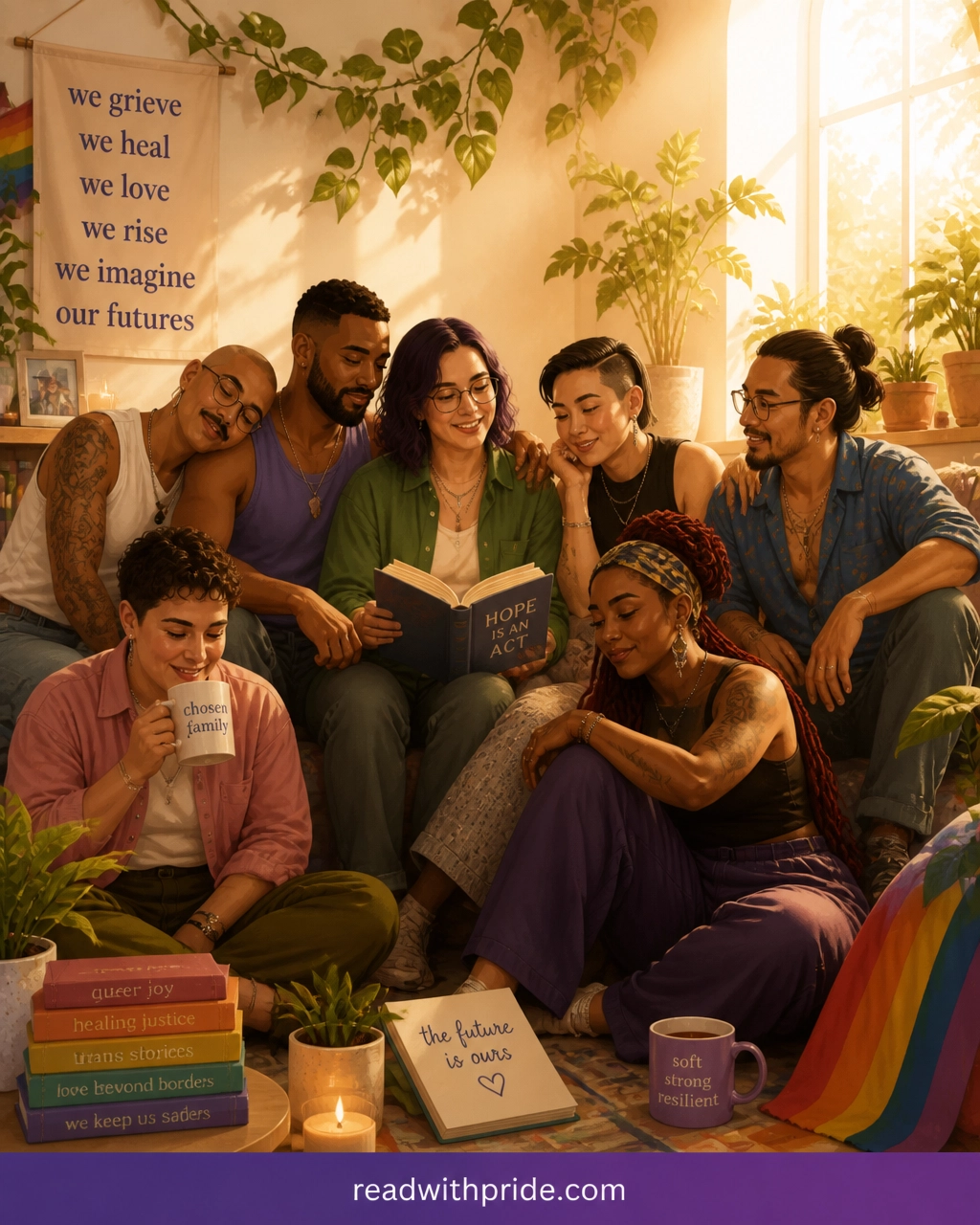
There is a kind of grief that does not always arrive with a clear beginning or an obvious goodbye.
Sometimes it follows the loss of a partner, friend, relative, mentor, or chosen-family member. Sometimes it is grief for the years spent hiding, a relationship that could not survive prejudice, or the younger version of yourself who deserved more safety and tenderness.
Sometimes it is collective. It arrives while scrolling through the news, hearing another story of discrimination, or remembering queer people from earlier generations who never got to experience the freedom they helped make possible.
And sometimes grief turns up on an entirely ordinary Tuesday, because emotions apparently enjoy dramatic entrances.
This is where queer healing can begin: not by pretending the pain did not happen, but by making room for the whole truth. We can honour what was lost while still imagining what might be possible. We can remember the past without allowing it to write every chapter ahead.
That is the heart of future visions: creating hopeful, practical pictures of queer life beyond survival. Not perfect futures. Not glossy worlds where nobody struggles and every group chat is emotionally mature. Real futures filled with safety, chosen family, accessible care, tenderness, laughter, creativity, and the freedom to be wonderfully, inconveniently ourselves.
Grief deserves recognition, not a deadline
Queer grief can be complicated because not every loss fits the traditional script.
You may be grieving a relationship with someone who is still alive. You may be grieving family acceptance that never came, a public life you were not allowed to have, a community lost to distance, or the years you spent monitoring your voice, clothes, body, or relationships.
You may also be grieving a future you once imagined.
Perhaps you expected to grow old with someone who is no longer beside you. Perhaps you thought coming out would bring freedom but instead brought rejection. Perhaps you are mourning the person you might have become in a kinder world.
These losses count.
You do not need official paperwork to prove that someone was family. You do not need to make your grief more convenient for people who have never had to question whether their love would be recognised. You are allowed to miss someone who was never welcomed into the family room. You are allowed to be angry about time you cannot recover.
Grief is evidence that something mattered. It is not proof that you are stuck or failing.
Healing does not require you to rush past pain in order to become inspirational. You do not have to turn every difficult experience into a lesson, a campaign, or a neatly packaged story of triumph. Sometimes healing looks like rest. Sometimes it looks like anger. Sometimes it looks like saying, “That hurt me,” without immediately adding, “But I’m stronger now.”
There is strength in honesty. There is strength in needing help. There is strength in refusing to perform resilience for people who are more comfortable admiring your survival than changing the conditions that made survival so difficult.

Queer healing is not about going backwards
Many ideas about healing suggest that we should return to who we were before the loss, trauma, rejection, or heartbreak.
But queer healing may not work that way.
You may not be able to return to an earlier version of yourself. You may not even want to. The person you were before had the tools available at the time. The person you are becoming can gather new ones.
Healing can look like:
- Setting boundaries with people who repeatedly minimise your identity.
- Finding an LGBTQ+-affirming therapist, support group, or community space.
- Allowing trusted friends to help instead of insisting you can manage everything alone.
- Learning to notice when your body needs food, sleep, movement, quiet, or company.
- Journalling honestly without tidying your feelings into a neat little package.
- Reconnecting with art, music, reading, ritual, or nature.
- Celebrating small moments of peace instead of waiting for one dramatic breakthrough.
- Choosing a safer space instead of proving you can endure an unsafe one.
There is no universal formula. What helps one queer person may not help another. What feels comforting one month may feel like too much the next.
Healing is allowed to be non-linear, inconsistent, and occasionally powered by tea, snacks, and an aggressively comforting blanket.
You are not a problem to solve. You are a person worthy of care.
LGBTQ+ resilience is not the same as being indestructible
The word resilience gets used frequently when we talk about LGBTQ+ communities. It can be affirming, but it can also become another expectation: be strong, stay positive, recover quickly, and make your pain useful.
That is a lot to put on one community.
True LGBTQ+ resilience does not mean being indestructible. It does not mean queer people should have to endure endless harm. It does not require us to transform every wound into a motivational speech with excellent lighting.
Resilience can be much quieter.
It can be the friend who sends a message saying, “I’m outside with snacks.” It can be choosing a name that feels right, asking for reassurance, trying dating again after heartbreak, or making your home welcoming to the younger queer person you once were.
It can be laughing at the kitchen table with people who understand the joke without a lengthy explanation.
Queer communities have always practised this everyday kind of care. We share resources. We recommend therapists, books, playlists, and friendly cafés. We make meals. We celebrate one another’s milestones. We create spaces where someone can arrive uncertain and leave feeling a little less alone.
That is resilience rooted in relationship. It is not individual toughness. It is the power of being carried for a while: and learning, when you have the strength, to carry someone else.
Chosen family makes hope practical
Hope can sound abstract until it has a face, a phone number, or a spare key.
Chosen family is one of the ways queer communities turn hope into everyday care. It may include close friends, partners, former partners, neighbours, colleagues, mentors, queer elders, online community members, or the person who brings food before you have even worked out what you need.
It does not have to resemble a traditional family to be real. It needs trust, mutual respect, communication, and room for everyone to show up as their full self.
During grief, chosen family can offer:
- Witnessing: someone who remembers what happened and understands why it mattered.
- Affirmation: people who treat your identity and relationships as real, not debatable.
- Practical support: meals, lifts, childcare, company at appointments, or somewhere safe to sleep.
- Emotional safety: room to cry, vent, be quiet, or change the subject completely.
- Continuity: reminders that your life is still connected to a wider community.
- Joy: shared rituals, birthdays, reading, cooking, dancing, and doing absolutely nothing together.
If you are supporting a grieving LGBTQ+ person, do not assume biological relatives are their closest support network. Ask who should be included. Use the words they use for their relationships. Do not erase a partner, ex-partner, friend, or chosen-family member because their connection does not resemble your own.
Sometimes the most healing sentence is wonderfully simple:
“I know this relationship was real, and I am here to remember it with you.”
For readers thinking about family, parenting, or intergenerational queer life, Read with Pride’s Alternative Family collection explores LGBTQ+ families, unconditional love, and the many forms belonging can take.

Future visions can start very small
When life has demanded constant vigilance, imagining the future can feel risky.
What if we hope for something and lose it? What if the world changes again? What if we are not equipped for the life we want?
You do not need a ten-year plan or a colour-coded vision board. Start with one gentle question:
What would make tomorrow feel a little more like home?
The answer might be enormous: safe housing, affirming healthcare, legal protection, family acceptance, or freedom from violence.
It might also be wonderfully ordinary:
- Waking up without bracing yourself before checking your phone.
- Sharing a home with people who understand your boundaries.
- Having a partner who knows how to support you when you are overwhelmed.
- Seeing queer elders treated with dignity and care.
- Building a friendship circle that feels steady rather than conditional.
- Reading openly in a public place without worrying who is watching.
- Growing up knowing your identity is not a problem to solve.
- Having a bookshelf filled with gay books, lesbian romance, and queer fiction that makes you feel seen.
Small visions are not insignificant. They give our values somewhere to land.
Try writing a “future postcard” to yourself. Describe one ordinary day in a life where you feel safe enough to relax. Who is nearby? What can you hear? What are you doing with your time? What no longer occupies your thoughts?
It does not need to be poetic. “I have a kitchen where everyone is welcome and nobody comments on my mugs” is a perfectly valid utopia.
Stories can help us practise possibility
Reading is not a replacement for professional care, community support, or meaningful social change. But stories can accompany all three.
A heartfelt piece of queer fiction can give shape to feelings that have been difficult to name. A gay love story can remind us that queer relationships contain tenderness, humour, desire, awkwardness, domesticity, and second chances: not only tragedy.
A lesbian romance can offer the comfort of seeing women love each other with complexity, joy, and agency. An emotionally rich MM romance can let readers spend time with characters who are learning how to trust, communicate, desire, forgive, and build a life together.
A slow burn can remind us that closeness does not have to happen instantly. A found-family story can help us recognise the people already showing up for us. A fantasy romance can open the door to a world where queerness is not an obstacle to adventure, but part of the magic.
This is one reason LGBTQ+ ebooks matter. They give readers access to gay books, lesbian romance, MM fiction, and wider LGBTQ+ fiction wherever they are. They can be private companions during difficult seasons and joyful invitations when you are ready for something lighter.
At Read with Pride, our collection is curated for readers looking for emotional depth, authentic representation, romantic joy, desire, laughter, mess, and hope.
Hope does not erase grief
It is possible to miss someone and still build a beautiful life.
It is possible to feel furious about injustice and still laugh with your friends. It is possible to carry complicated memories and still fall in love, make art, plan a holiday, start a family, change careers, or discover a new favourite book.
Hope is not a denial of reality. It is a decision not to let reality remain unchanged.
Our future visions can hold grief and possibility at the same time. We can remember the people who did not get enough time while making more room for those who are here. We can honour what queer communities have endured while insisting that endurance is not the highest thing we should expect from one another.
The future we deserve is not merely one where LGBTQ+ people are allowed to survive. It is one where we have time to be curious, rested, loved, creative, ridiculous, ambitious, ordinary, and free.

A gentle invitation for today
Take a moment to name:
- One thing you are grieving.
- One thing that is helping you heal.
- One future possibility you would like to make room for.
You do not have to solve everything today. You do not have to feel hopeful every minute. Just allow yourself to imagine that your life can contain more than what hurt you.
If grief feels overwhelming, unsafe, or impossible to carry alone, consider reaching out to an LGBTQ+-affirming mental health professional, support group, or crisis service in your region. You deserve care that respects your identity, your relationships, and the full shape of your loss.
When you are ready for your next story, explore Read with Pride’s collection of LGBTQ+ ebooks, queer fiction, MM romance, gay romance, and lesbian romance. For more thoughtful conversations about queer life, reading, relationships, and community, follow Read with Pride on Instagram and Facebook.
Your future does not have to look like anyone else’s. It only has to feel more like yours.
#QueerHealing #FutureVisions #LGBTQResilience #ReadWithPride #QueerFiction #LGBTQBooks #LGBTQEbooks #ChosenFamily #QueerJoy #LGBTQHealing #QueerFutures #MMRomance #LesbianRomance #GayLoveStories #LGBTQReading

Leave a Reply
You must be logged in to post a comment.