

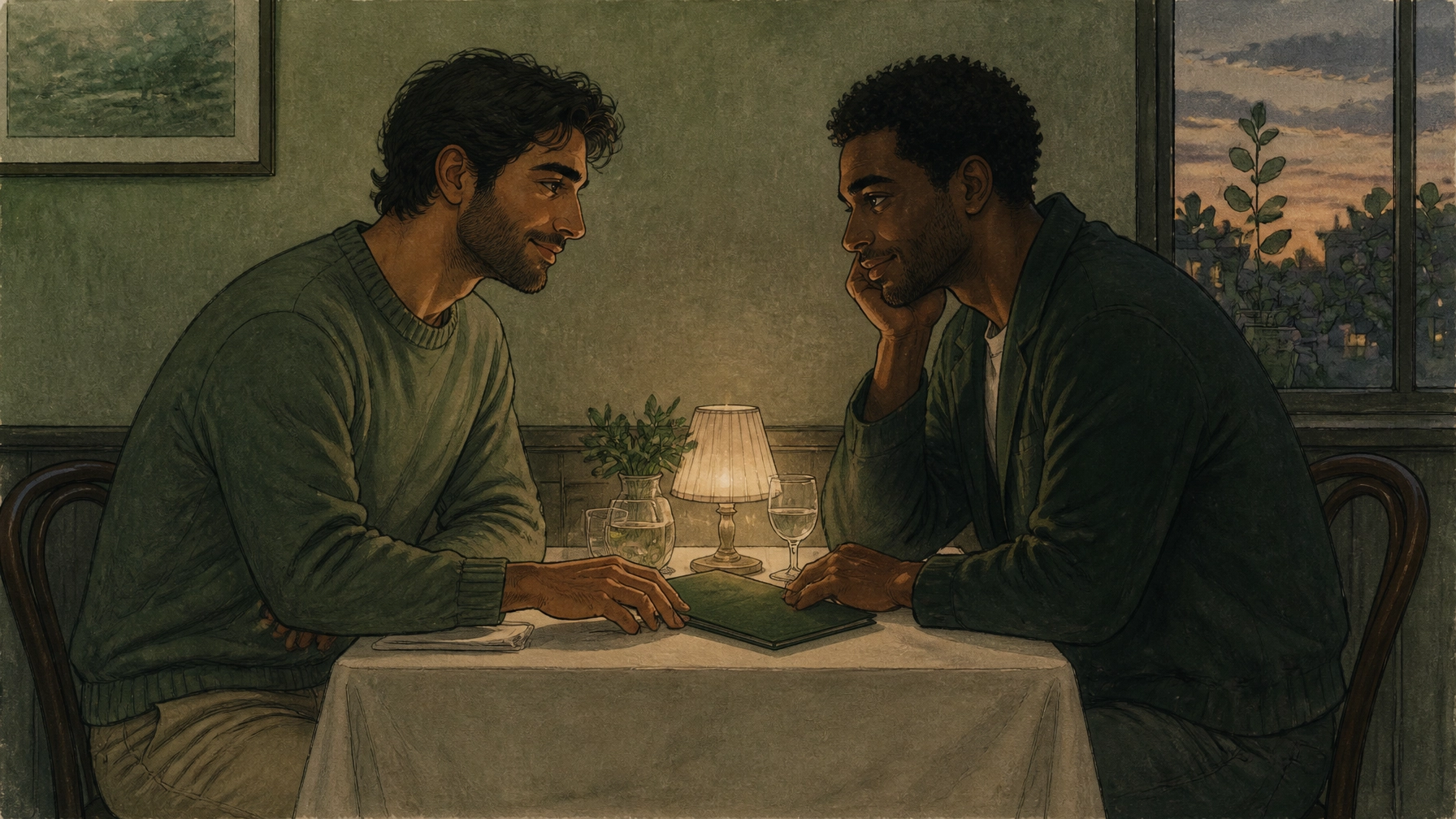
Elias had chosen a mug.
It had been matte green, slightly heavier than the others, with a handle that sat comfortably beneath his fingers. Julian had called it “quietly beautiful,” which Elias had pretended not to hear because compliments still made him feel as though he had been placed beneath a bright light.
But he had chosen it.
That was the important part.
He had said, “I like this one,” and he had not followed the sentence with but anything is fine.
Now, three days later, Julian stood in the centre of his sitting room with his phone in one hand and two jackets draped over the other arm.
“Your turn,” he said.
Elias looked up from the book he had not been reading. “My turn for what?”
“To decide where we eat.”
The room seemed to alter around him.
Not visibly. The walls remained the same muted cream. The evening light still rested across the floor in long, pale rectangles. Julian was still Julian: warm, handsome, impossible to ignore even when he was doing nothing more dramatic than looking for his keys.
But something inside Elias tightened.
“Anywhere,” he said.
Julian glanced at him.
Elias knew that glance. It was not irritation. It was attention, which sometimes felt worse.
“Anywhere where?”
“Anywhere you want.”
“That’s not deciding.”
“It can be.”
“It really can’t.”
Elias tried to smile. It came out thin. “You’re very strict about restaurants.”
“I’m strict about you getting to have an opinion.”
The words landed too close to the truth.
Elias lowered his eyes. “I have opinions.”
“I know.”
“Do you?”
Julian put the jackets over the back of a chair. “Yes.”
“Because I don’t always say them.”
“No,” Julian said softly. “You don’t.”
The silence that followed was not large, but Elias felt himself falling through it.
He had become skilled at making himself easy. Easy to love, perhaps. Easy to accommodate. Easy to take places, feed, understand. He had learned to accept the first suggestion before anyone could discover that he wanted something else.
Wanting something else had once seemed dangerous.
It could make a room difficult. It could make a person difficult. It could make someone ask questions he did not know how to answer.
Julian sat beside him, leaving enough space between them to make the choice of closing it belong to Elias.
“What are you in the mood for?” Julian asked.
Elias stared at the cover of his book.
“Food.”
Julian breathed out through his nose. “That narrows it down beautifully.”
“I’m serious.”
“So am I.”
“I don’t know.”
“That’s allowed.”
“It isn’t helpful.”
“I’m not trying to be helpful. I’m trying to know you.”
Elias looked at him then.
Julian’s expression held no accusation. That was the problem. Elias could have defended himself against anger. He understood anger. Anger had edges, and edges could be avoided.
Kindness was harder. Kindness waited.
“I don’t want to choose the wrong place,” Elias admitted.
Julian’s mouth softened. “There’s a wrong place?”
“If you want Italian and I choose Thai, then, ”
“Then we eat Thai.”
“And if you hate it?”
“Then I tell you I hate it.”
Elias gave him a startled look.
Julian smiled. “I might phrase it more gently.”
“You might?”
“I’d say, ‘This green curry has personally betrayed me.’”
Despite himself, Elias laughed. The sound loosened something in his chest, though not enough.
Julian leaned back. “What are you actually worried about?”
The honest answer rose quickly.
That if I choose something you dislike, you’ll remember it.
That you’ll decide I’m selfish.
That you’ll see how much work I’m doing to appear uncomplicated.
Instead, Elias said, “Nothing.”
Julian waited.
Elias felt the old instinct move through him: fill the quiet, smooth the surface, give Julian the answer that would let them both continue.
“I’m fine,” he added.
Julian’s face changed.
Not dramatically. He did not sigh or stand or turn away. He simply looked at Elias with the tired tenderness of someone who had heard the same locked door close too many times.
“You know,” he said, “you don’t have to say that every time something feels difficult.”
“I know.”
“You just said it.”
“I know.”
“Elias.”
The use of his name made him look down.
The matte green mug sat on the coffee table between them. Elias had brought it from the kitchen earlier without thinking. Its surface was smooth beneath the lamplight, its colour deepening towards the rim.
Julian touched the mug with one finger.
“You chose this,” he said.
“Yes.”
“Why?”
Elias frowned. “Because I liked it.”
“And that was enough?”
“It should be.”
“It was.”
The simplicity of Julian’s answer hurt more than criticism would have done.
Elias picked up the mug, though it was empty. “I don’t know how to do this.”
“Choose a restaurant?”
“Choose anything.”
Julian said nothing.
Elias turned the mug slowly in his hands. “When I was younger, having a preference felt like making a demand. If I wanted the window open, someone else wanted it shut. If I didn’t like something, I was ungrateful. If I changed my mind, I was difficult. So I stopped saying what I wanted.”
Julian’s hand moved across the sofa, palm up.
Elias noticed it. He did not take it yet.
“I got very good at saying the right thing,” he continued. “The harmless thing. The thing that meant nobody had to adjust their plans for me.”
“That sounds exhausting.”
“It was efficient.”
“It sounds exhausting and efficient.”
Elias smiled faintly. “You’re allowed to disagree with me.”
“I know.”
“You don’t always.”
“I disagree with you constantly.”
“You hide it.”
“I’m choosing my moments.”
That earned another small laugh, but this one trembled.
Julian’s hand remained open between them.
“What if I choose somewhere and you don’t like it?” Elias asked.
“Then I don’t like it.”
“And then?”
“Then we talk about it.”
“And if I choose badly?”
“Then you chose badly. That’s not a moral failure.”
Elias looked at him.
Julian’s eyes were steady. “You’re allowed to be wrong about dinner.”
The sentence entered Elias slowly.
He had spent years believing that every wrong choice revealed something permanent about him. Carelessness. Selfishness. Neediness. A lack of gratitude. A lack of love.
But perhaps a wrong restaurant was only a wrong restaurant.
Perhaps the evening could survive it.
Perhaps Julian could survive it too.
Elias placed the mug back on the table. Then he took Julian’s hand.
The contact was familiar. It was still frightening.
“There’s a small place near the river,” Elias said.
Julian’s thumb moved over his knuckles. “Tell me about it.”
“It has an awful sign.”
“How awful?”
“An enormous painted lemon. It looks vaguely threatening.”
“I’m listening.”
“They make pasta from scratch. The tables are too close together, and the chairs are uncomfortable, but the food is good.”
Julian smiled. “You’ve thought about this place.”
“I’ve walked past it.”
“That wasn’t my question.”
Elias felt heat rise into his face. “I’ve considered going.”
“Why haven’t you?”
“I didn’t know if you’d like it.”
“Do you like it?”
“I think I might.”
Julian tilted his head. “That sounds dangerously close to an opinion.”
“Don’t make a fuss.”
“I’m making a very small fuss.”
“You’re making a face.”
“It’s my proud face.”
“You look smug.”
“I am smug. My boyfriend has a restaurant preference.”
The word boyfriend still carried a strange weight, though it no longer frightened Elias in the same way. Julian said it easily, as though love could be spoken without ceremony and still remain enormous.
Elias squeezed his hand. “I’m not promising the pasta will be good.”
“I’m not asking you to.”
“And the chairs really are uncomfortable.”
“Excellent.”
“The lemon is worse in person.”
“I can’t wait.”
They walked to the river beneath a darkening sky. Elias kept expecting to feel regret. It did not arrive. Anxiety did, in waves, but anxiety was not the same as a warning. He was beginning to understand that.
At the restaurant, the painted lemon watched them from above the door with an expression of theatrical menace.
Julian stopped beneath it.
“Oh,” he said. “You undersold this.”
“I told you.”
“You said threatening. This lemon has enemies.”
Elias laughed, properly this time.
Inside, the restaurant was warm and narrow. Their shoulders brushed as they were shown to a small table near the window. Elias glanced at the menu. The words blurred for a moment.
Julian noticed.
“Still your choice,” he said.
Elias looked across the table. “You can choose what you want.”
“I can.”
“But you don’t have to pretend to like it.”
“I won’t.”
“And if you want something else, ”
“I’ll tell you.”
Elias nodded. “Right.”
The server arrived. Julian looked at Elias, but he did not rescue him. He did not translate the pause or make the decision for both of them.
Elias took a breath.
“I’d like the mushroom pasta,” he said. “And sparkling water.”
The words were small.
His heart reacted as if he had made a public declaration.
Julian ordered after him. When the server left, he reached across the table.
“That was brave,” he said.
“It was pasta.”
“It was pasta you wanted.”
Elias looked down at their joined hands. “Those things aren’t always separate.”
“No,” Julian said. “They aren’t.”
For a while, they sat without trying to turn the moment into something larger. The river moved beyond the glass, catching pieces of city light. Their table was too small. Their chairs were, exactly as Elias had promised, terrible.
The pasta was excellent.
Julian’s was not.
He took one bite, considered it, and said, “The lemon has arranged this.”
Elias laughed so hard he had to put down his fork.
Later, walking home, Julian asked, “Would you come here again?”
Elias thought about it.
The old answer waited at the back of his throat. Anything is fine. It was ready, polished and familiar.
He let it pass.
“Yes,” he said. “But next time I want to try somewhere else.”
Julian stopped beneath a streetlamp.
“Somewhere else?”
“Yes.”
“Do you have somewhere in mind?”
“Not yet.”
“That’s okay.”
“I might.”
Julian smiled. “That’s even better.”
Elias looked at him, at the man who never seemed to understand how much courage could be hidden inside an ordinary sentence.
“I’m not always fine,” Elias said.
Julian’s expression gentled.
“I know.”
“I mean it.”
“I know.”
“And sometimes I don’t know what I want until I say what I don’t want.”
“Then we can start there.”
Elias stepped closer. “You make it sound simple.”
“It isn’t simple.”
“No.”
“But it can be shared.”
That was the part Elias was still learning.
Love did not mean guessing correctly every time. It did not mean becoming so agreeable that nobody ever had to make room. It meant allowing another person to see the uneven edges of a choice and trusting them not to turn those edges into weapons.
Elias rested his forehead against Julian’s.
“I liked the restaurant,” he whispered.
“I know.”
“I liked choosing it.”
“I know.”
“I was terrified.”
“I know that too.”
Julian kissed him gently, not as an answer but as a kind of welcome.
The city carried on around them. Cars passed. Windows glowed. Somewhere behind them, the enormous painted lemon continued its silent campaign against happiness.
Elias smiled against Julian’s mouth.
For an emotionally invested reader, this is where the real romance lives: not only in grand declarations, but in the trembling decision to say, I want this one. A character-driven queer fiction story can find its deepest conflict in an ordinary evening, because ordinary life is where old fear and new trust meet.
That is the heart of this gay love story emotional journey. It is also what makes emotional MM romance literary: the external action may be as simple as choosing a table, a mug or a meal, while the internal stakes reach much further.
For more queer fiction, gay novels, heartfelt gay love stories and emotionally immersive MM romance, explore Read with Pride’s collection of LGBTQ+ ebooks. You can also discover Dick Ferguson’s gay romance and character-driven MM fiction when you are ready for another story about men choosing honesty, connection and the difficult beauty of being known.
Three possible next entries in the Julian and Elias series
-
The Morning Julian Asked Elias to Stay for Breakfast : Elias discovers that accepting care can feel just as exposing as asking for it, especially when Julian gives him the freedom to leave.
-
The Afternoon Elias Changed His Mind : After choosing a day trip, Elias realises he no longer wants to go and struggles to believe that changing his mind will not damage the relationship.
-
The Evening Julian Heard the Unsaid Answer : A harmless question about the future brings Elias face-to-face with the fear that wanting a shared life might make him too dependent on the man he loves.
Follow us on social media
Follow us for more queer experiences and stories, new gay releases, LGBTQ+ reading recommendations and emotionally driven MM romance:
#QueerFiction #MMRomance #GayRomance #GayLoveStories #CharacterDrivenFiction #EmotionalMMRomance #LGBTQBooks #GayBooks #MMNovels #QueerLiterature #ReadingWithPride #ReadWithPride #EmotionallyInvestedReaders

Leave a Reply
You must be logged in to post a comment.