

The Story
By the time Theo reached the shoreline, the night had become almost completely dark.
Not empty-dark. Not the clean darkness of a room with its lights switched off, but a living darkness: warm, salt-heavy, threaded with the rasp of insects and the distant hush of water moving against stone. The path behind him had disappeared beneath the mangroves. Ahead, the bay lay silent and black, its narrow mouth opening toward a sea he could no longer see.
He adjusted the camera strap across his shoulder and wondered, not for the first time, whether he had travelled all this way to find something or to avoid being found.
For three months, every assignment had felt like a performance. He photographed other people’s disasters, other people’s joy, other people’s hands reaching for one another in places where the world had become difficult. He knew how to stand at the edge of a moment and make himself useful.
He had never learned how to remain inside one.
The relationship had ended quietly. There had been no betrayal dramatic enough to blame, no slammed doors or messages sent at midnight. Only the slow collapse of something he had never fully inhabited. He had brought half of himself to the man he loved, then resented him for not knowing the other half was there.
That was the cruelty of hiding: eventually, you began to call the loneliness someone else’s fault.
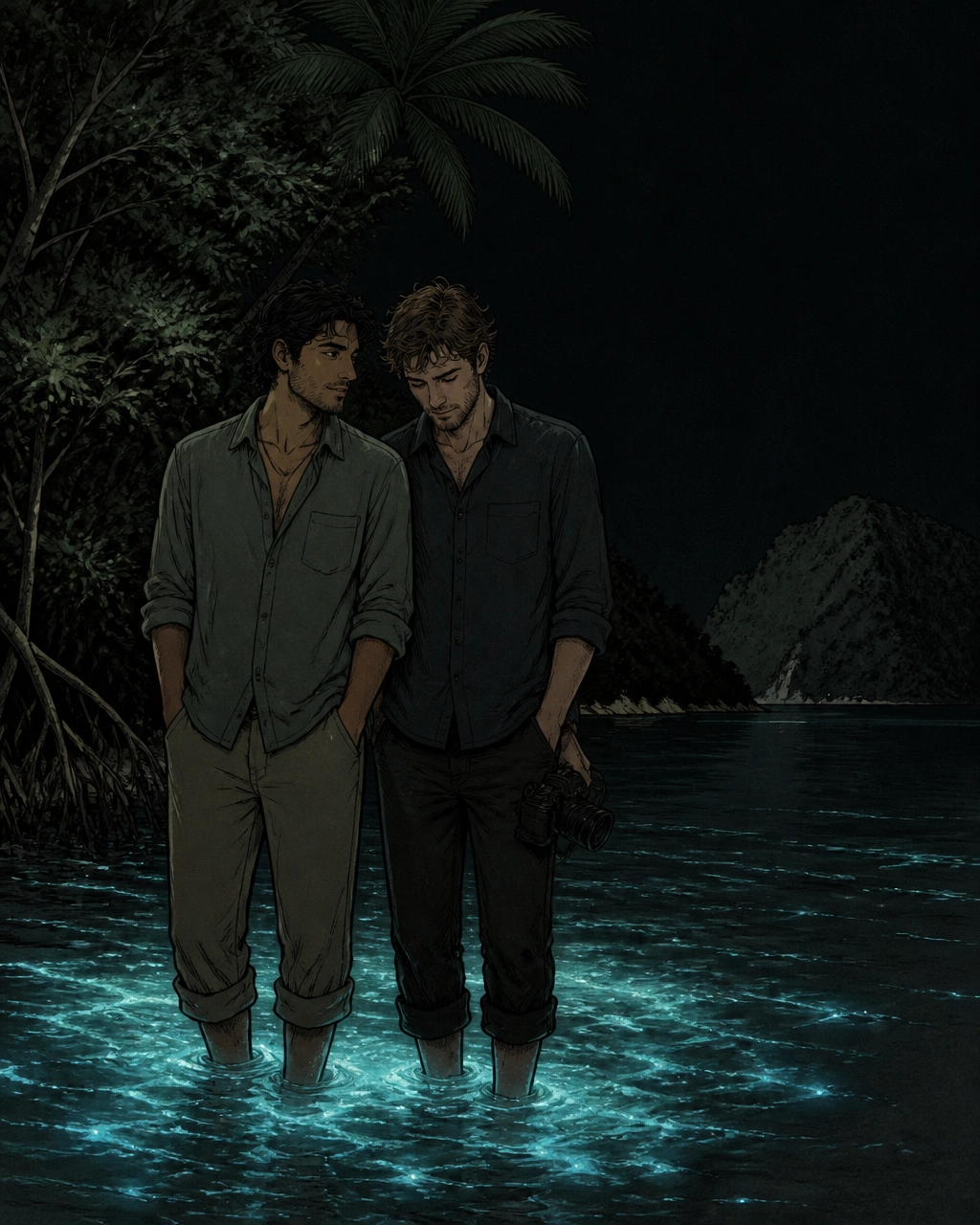
A figure stood farther along the shore, beside a low wooden platform. He wore a faded green shirt with the sleeves rolled to his elbows. In one hand he held a small sampling container; in the other, a torch pointed toward the ground.
“You’re early,” the man said.
Theo looked at his watch. “You’re late.”
“I’m always late when the tide changes.”
The man’s voice was calm, carrying easily across the dark. He had a face that seemed made for concentration: strong brows, an attentive mouth, eyes that caught what little light remained. A marine biologist, Theo guessed from the equipment and the patient way he watched the water.
“Rafael,” the man said.
“Theo.”
They shook hands. Rafael’s palm was warm and faintly damp from the night air.
“You’re the photographer,” Rafael said.
“Photojournalist.”
“Is there a difference?”
“Usually in how much people expect you to work for free.”
Rafael smiled, but only briefly. He turned back toward the bay.
Theo had expected a spectacle. He had imagined the water igniting beneath him, the whole lagoon transformed into a bowl of stars. Instead, there was only darkness, thick and watchful.
“Tonight may not be the night,” Rafael said.
“Your sign said it was.”
“The sign was printed six years ago.”
“That seems optimistic.”
“It’s a scientific field station. Optimism is not our strongest discipline.”
They stood together without speaking. Somewhere in the mangroves, a bird made a low, uncertain call. Theo could smell wet leaves, salt, and the mineral tang of the exposed shore. Sweat gathered beneath his collar.
Rafael stepped into the shallows.
“Don’t move too quickly,” he said. “The organisms respond to agitation. They need movement, but not too much.”
“That sounds like advice about people.”
Rafael glanced at him. “Does it?”
Theo followed him into the water.
The bay was warm around his ankles. Sand shifted beneath his feet. For several seconds, nothing happened. Then Rafael moved his hand through the water.
A faint blue-green spark appeared around his fingers.
Theo stopped breathing.
Rafael drew his hand back, and the light vanished. He tried again, slower this time. The glow returned, gathering around his wrist in small, scattered flashes. When Theo stepped forward, the water opened beneath him in a trembling line of cold colour.
It was not bright. That was what made it beautiful. The glow did not conquer the darkness; it answered it.
Every movement became a secret.
Theo lifted one foot. Light gathered around his toes. He turned his hand beneath the surface, and a blue-green constellation slipped between his fingers. Behind them, the bay remained black. Above them, the sky held no moon.
“Dinoflagellates,” Rafael said quietly. “Single-celled organisms. They flash when disturbed.”
“Defensive response?”
“Probably. A burglar alarm for predators.” He watched the luminous water. “Or a warning that says, I am here. Do not swallow me.”
Theo looked at him. “You make them sound lonely.”
“I make them sound alive.”
For the next hour, they moved through the bay with the careful concentration of children afraid to break a spell. Rafael explained the narrow mouth of the lagoon, the mangrove roots, the warm, stable water and the delicate balance that allowed the organisms to remain in such high concentrations. The bay did not glow like this every night. Storms, rainfall, salinity, moonlight and changes in the water could alter the brightness. Some years offered only a handful of nights when the light was strong enough to look like magic.
Rafael had spent years studying those conditions.
Theo took photographs until the darkness swallowed the edges of his work. The images would be difficult. Long exposure, a steady hand, almost no light. But for once, he did not care whether he captured it correctly.
“What brought you here?” Rafael asked.
Theo lowered the camera.
“Burnout,” he said.
“That’s an honest answer.”
“It’s not the whole answer.”
“No,” Rafael said. “It usually isn’t.”
Theo looked toward the opposite shore, where mangroves rose in a jagged black line. “I was with someone. We ended things. I thought leaving would make the ending feel more deliberate.”
“Did it?”
“No.”
Rafael nodded as if Theo had confirmed something he already knew.
“And you?” Theo asked. “What brought you here?”
“I work here.”
“That’s not the whole answer.”
This time, Rafael laughed. It was a low, surprised sound, quickly hidden.
He walked out of the water and sat on the edge of the platform. Theo followed. Their clothes clung to their skin. Salt dried on Theo’s forearms in a fine, invisible crust.
Rafael removed his glasses and rubbed them with the corner of his shirt.
“I’ve spent most of my life being careful,” he said.
Theo waited.
“Careful with what I say. Careful who I correct. Careful what people assume.” Rafael looked at the dark water. “At work, they know everything about the bay. They know the nutrient levels, the tidal cycles, what happens after a storm. They know how much I care about this place.”
“But not you?”
“Not the parts that complicate the story.”
The words seemed to settle between them.
Rafael told Theo he was bisexual. He said it plainly, without apology, but not without fear. He had told a handful of people over the years. None of them had reacted badly. That was almost worse, he said. Their acceptance had been polite and distant, as though he had announced a dietary preference.
His family had learned to love the version of him who was easiest to explain. His colleagues had learned to respect the version who never asked to be understood.
“I kept waiting for the right moment,” Rafael said. “A moment when I would be certain. Certain about what I wanted. Certain about who I was allowed to disappoint.”
Theo rested his hands on his knees. “Did it come?”
“No.” Rafael looked at him. “I think the right moment is mostly a story we tell ourselves so we can keep waiting.”
The bay shifted below them. A fish passed through the shallows, leaving a brief trail of blue-green fire.
Theo felt something inside him move: not attraction, not yet. Something more cautious. Recognition, perhaps. The ache of seeing another person standing beside the same locked door.
“I loved him,” Theo said.
Rafael did not ask who.
“I loved him, and I still couldn’t give him all of me. I thought if I kept certain things private, I was protecting us. But privacy became absence. He was living with a man who was always almost there.”
Rafael’s expression did not soften with pity. Theo was grateful for that. Pity made a person feel like a wound.
“Do you want him back?” Rafael asked.
Theo watched the water. “I want to stop turning him into a lesson.”
The honesty left him exposed. He expected the old instinct to rise: the urge to make a joke, pick up the camera, turn the moment into an image he could manage.
Instead, he stayed still.
Rafael placed his hand on the platform between them, palm upward. He did not reach for Theo. He only left the possibility there.
Theo looked at that hand for a long time.
Then he placed his own beside it.
Their fingers touched.
The contact was small. Almost nothing. But the water beneath the platform stirred, and a soft blue-green glow appeared in the blackness below them, tracing the shape of their joined hands.
Neither man moved away.
“I don’t know how to do this,” Theo said.
“Neither do I.”
“That’s not reassuring.”
“It’s honest.”
Theo turned his hand, slowly, until their palms met. Rafael’s fingers closed around his. There was no promise in the gesture. No sudden cure for fear, no neat ending to the histories they carried.
Only warmth.
Only the decision not to leave the moment before it became real.
They remained that way while the bay flickered below them. Rafael spoke about the organisms and the fragile ecosystem that sheltered them. Theo listened. Then Theo spoke about photographs he had never taken because he was afraid they would reveal too much. Rafael listened without trying to repair him.
Near dawn, the glow began to fade.
The water returned to darkness one ripple at a time. The shoreline emerged in shades of green and grey. Birds called from the mangroves. The air cooled against their damp clothes.
Rafael stood first and offered Theo his hand.
This time, Theo took it without hesitation.
They walked along the shore, not touching now, but close enough that their shoulders brushed whenever the path narrowed. Ahead lay the field station, the road, the ordinary world that would demand explanations from them.
Neither man pretended the fear was gone.
Rafael would still have to decide what truth looked like at work and at home. Theo would still have to learn how to grieve without disguising grief as movement. Their pasts had not dissolved in the glowing water.
But the night had given them something quieter than certainty.
It had shown them that darkness was not always the place where a person disappeared. Sometimes it was the only place where a hidden light could be seen.
And sometimes, if you stayed still long enough, someone else stayed with you.
Why Rare Experiences Make Powerful MM Romance Settings
A rare setting can do more than provide atmosphere. In the best MM romance unexpected places, the landscape becomes part of the emotional architecture. A bioluminescent bay gives two men a world where light appears only when something moves: an evocative parallel for a gay love story emotional journey shaped by honesty, fear and the courage to be witnessed.
For emotionally invested MM readers, the appeal is not simply the unusual location. It is the way an unfamiliar place creates room for familiar questions: Who are we when nobody is watching? What does coming out ask of us? How long can we perform a safer version of ourselves before the performance becomes a prison?
That is where character-driven queer fiction finds its power. The glow in the water is beautiful, but Rafael and Theo’s real transformation comes through conversation, restraint and emotional risk. Their connection is not instant love. It is the slower, more affecting experience of being known in increments.
Readers looking for emotional MM romance literary fiction often want precisely that combination: vivid sensory detail, complex inner lives and a relationship that feels earned. Whether you call it MM romance, queer fiction, gay fiction, LGBTQ+ romance or gay literature, the strongest stories make emotional truth impossible to separate from the setting.
Discover more LGBTQ+ ebooks, gay romance books, MM novels, gay love stories and emotional MM books through Read with Pride. You can also explore Dick Ferguson’s work in the Read with Pride e-book store, where readers can find heartfelt stories about identity, vulnerability, longing and connection.
Three Possible Next Morning Edition Stories
1. The Underground Salt Cathedral
Two men meet beneath an abandoned salt mine during a rare guided descent. One is a geologist who has spent years refusing to speak about his bisexuality; the other is a conservator mourning the end of a relationship that left him afraid of permanence. As the mine’s walls begin to glitter under their lamps, they must decide whether the truths they have buried can survive the light.
2. The Desert Radio Observatory
At a remote observatory, a sound engineer arrives to record the silence between radio transmissions. He encounters the astronomer maintaining the station alone after a personal loss. Across one night of static, dust and distant signals, the two men discover that loneliness can be measured: but not always explained.
3. The Tidal Cave of Bells
A coastal cartographer and a withdrawn rescue diver enter a sea cave where the rising tide makes the stone chambers sing. Trapped until the water recedes, they confront the different ways they have turned survival into a life: one through constant motion, the other through never leaving anyone close enough to hurt him.
Follow Us on Social Media
Follow Dick Ferguson and Read with Pride for more literary MM romance, LGBTQ+ reading recommendations, gay novels, queer authors and emotionally immersive gay love stories:
#ReadWithPride #ReadingWithPride #MMRomance #GayRomance #MMNovels #QueerFiction #GayFiction #LGBTQPlusFiction #GayLiterature #EmotionalMMBooks #CharacterDrivenMM #LGBTQRomance #GayLoveStories #BisexualRepresentation #ComingOutStories #LiteraryRomance
Images


Leave a Reply
You must be logged in to post a comment.