

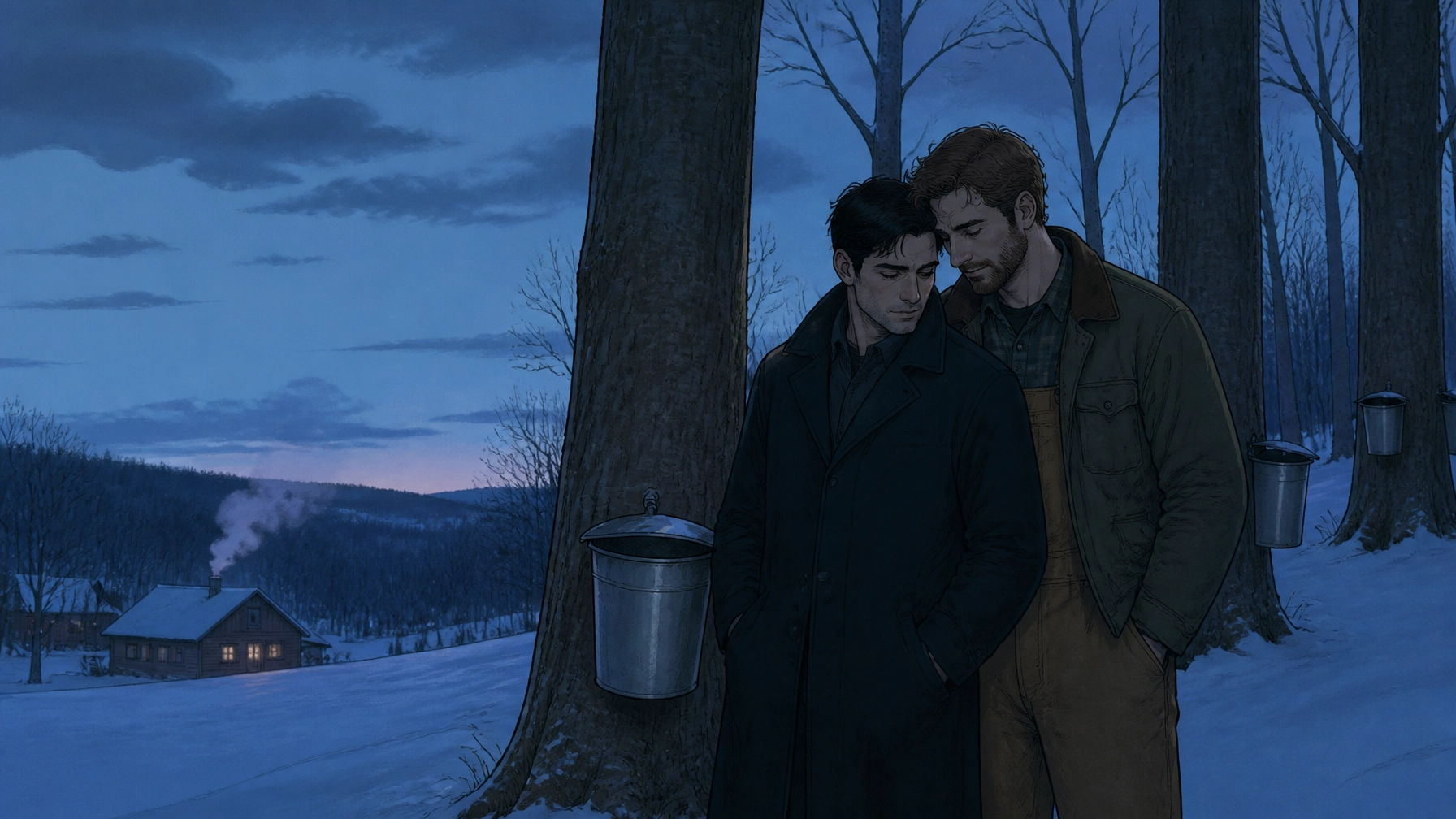
There are places where a person can pretend not to remember.
Jonah had become very good at finding them.
He had lived in cities with enough traffic to swallow a name, enough lit windows to make loneliness look like privacy, enough strangers passing shoulder to shoulder that no one needed to ask where he had come from or why he never stayed. He had moved apartments before the neighbours learned his habits. He had ended relationships while they were still tender enough to mourn. He had made a life out of leaving before anyone could leave him.
Then his grandmother died, and the small rural property came back to him like a question.
The house stood at the edge of a maple wood, its roof shouldering late-winter snow. Beyond the back fence, the land rose gently into a sugar bush: a stand of old maples tapped each spring by the neighbour, Ezra.
Jonah had expected the property to feel empty.
Instead, it seemed to be waiting.
A Return to the Place Where People Stayed
He arrived in the afternoon with two suitcases, a folder of legal documents, and the brittle confidence of a man who believed grief could be managed through lists.
There were boxes to sort. Furniture to value. Utilities to cancel. A solicitor to call in town. He would stay three days, perhaps four. Long enough to settle the estate, clear the house, and return to the city before the rural quiet had time to learn his shape.
Ezra appeared at the fence just before dusk.
He wore a canvas jacket dusted with snow and carried a metal pail in one gloved hand. A line of taps ran along the maples near the property boundary, each one fitted with a small spile and a bucket. From somewhere among the trees came the delicate, irregular sound of sap falling against metal.
Tick.
Pause.
Tick.
“Your grandmother said you might come back,” Ezra said.
Jonah looked at him. He had expected the neighbour to be older, perhaps distant in the way of people who had known his family longer than they had known him. Instead, Ezra had a steady face, dark hair touched by cold, and an expression that did not demand anything.
“She said a lot of things,” Jonah replied.
Ezra glanced toward the house. “She did.”
It was not an accusation. That made it worse.
The Slow Work of Sugaring
Maple sap does not arrive dramatically. It gathers.
It moves according to the weather: freezing nights, warming days, the pressure of thaw beginning beneath the bark. The trees give a little, then stop. They do not perform generosity on command.
Ezra showed Jonah how to walk the rows without disturbing the snow around the roots. They emptied the buckets into a larger gathering pail, their boots making a soft, compressed sound over the white ground. The metal taps chimed faintly whenever a branch shifted overhead.
Jonah had spent years mistaking speed for survival. In the city, everything seemed to reward urgency. Messages arrived and demanded answers. Work expanded to fill every hour. Desire could be made immediate, and endings could be made clean.
Here, a bucket might contain only a few inches of clear sap after an entire night.
“That’s all?” Jonah asked the first time he lifted one.
Ezra smiled. “That’s what the tree had.”
They carried the sap to the sugarhouse, a low wooden building set behind the house. Inside, a wood fire roared beneath the evaporator pan. Steam rolled toward the rafters. The air smelled of wet timber, smoke, metal, and something faintly sweet beneath it all.
Jonah stood near the door, still wearing his city coat.
“You can come closer,” Ezra said.
“I’m fine here.”
“I didn’t say you weren’t.”
That was Ezra’s gift, Jonah began to understand. He could offer an invitation without turning it into a test.
What Jonah Refused to Say
At night, Jonah sorted his grandmother’s things.
Her reading glasses rested beside a chair. A wool cardigan hung behind the kitchen door. In a drawer, he found envelopes addressed in her looping handwriting, some unopened, some never sent. The house held evidence of a life that had not been waiting for him to approve of it.
He had loved her. He had also kept her at a careful distance.
When he first told her he was bisexual, he had been twenty-three and living in a different city. He had prepared himself for disappointment, for questions that would reduce him to a phase or a confession. She had simply asked whether he was frightened.
He had said no.
She had looked at him for a long moment and answered, “You don’t have to be brave every minute.”
He had changed the subject.
It was easier, sometimes, to be seen in fragments. A man could tell the truth about himself and still keep the doors locked around it. Jonah had loved men. He had loved women. He had spent years resisting the idea that either truth needed to be offered as proof of anything.
What frightened him was not his bisexuality. It was the possibility of being known in full and still being asked to remain.
Ezra never asked Jonah to explain himself.
That silence became its own kind of tenderness.
Steam, Firelight, and the Shape of Trust
The boiling-down nights developed a rhythm.
Ezra split wood. Jonah fed the fire. They checked the level in the pan and carried fresh sap from the storage tank. The work was repetitive enough to quiet the mind but demanding enough to keep sorrow from becoming theatrical.
Outside, the blue hour stretched over the snow. The trees turned almost black against the fading sky. The buckets caught the last light, each one holding a dim reflection of the world.
Inside, steam blurred the windows.
Sometimes they talked.
Ezra told Jonah about the first year he had tapped the maples alone. He had drilled too deeply into one tree and lost the tap. He had boiled an entire day’s sap too fast and scorched the batch. He had learned, slowly, that the forest punished impatience without taking it personally.
Jonah told Ezra about the city, though rarely about himself. He described trains, late-night diners, rooftop gardens, the restless brightness of streets that never seemed to forgive darkness.
“Do you like it there?” Ezra asked.
Jonah watched a bubble rise in the pan.
“I’m good at being there.”
“That’s not what I asked.”
“No,” Jonah said. “I suppose it isn’t.”
Ezra did not press him.
Later, when the fire settled into red coals, Jonah found himself sitting beside him on the wooden bench. Their knees touched. Neither moved away.
The contact was so slight that it should not have mattered.
It mattered because Jonah noticed how badly he wanted it to continue.
The Sweetness That Takes Time
Maple syrup begins as something nearly weightless. Sap is mostly water, and it takes an enormous amount of it to make a small quantity of syrup. The transformation depends on heat, patience, and attention.
Ezra watched the pan carefully as the liquid darkened.
“People think the fire does all the work,” he said.
“What does?”
“Knowing when not to rush it.”
Jonah looked at him then.
The sugarhouse was warm enough to loosen the cold from his hands. Firelight moved across Ezra’s face. Beyond him, snow pressed against the windows, silent and absolute.
“I’m leaving next week,” Jonah said.
Ezra’s expression changed, but only slightly. “Are you?”
“I have a place in the city.”
“That doesn’t mean you have to stay there.”
Jonah laughed once, without humour. “You make it sound simple.”
“No. I make it sound possible.”
There it was: the thing Jonah had spent his life avoiding. Not a declaration. Not a promise. Possibility.
He had believed belonging was something a place granted you after years of proving your usefulness. He had believed love was safer when it remained temporary. He had believed that if he left first, he could call the wound an exit.
But Ezra had not tried to possess him. He had not asked Jonah to become rural, or certain, or less complicated. He had only made room beside the fire.
Jonah reached for his hand.
Ezra let him.
Allowed to Stay
The estate took longer than expected.
There were repairs to arrange and papers that required signatures. The house needed clearing, but not all at once. Jonah began sleeping in his grandmother’s spare room and waking before dawn to the sound of wind moving through the maples.
He and Ezra continued working the sugar bush.
On the final night of the season, they stood outside the sugarhouse while the last sap dripped into the buckets. The snow had begun to soften. Water moved beneath it, quiet and purposeful.
Jonah could smell woodsmoke in his coat. His hands were sticky with syrup. Ezra’s shoulder rested against his.
“I thought I’d hate this place,” Jonah said.
“You still might.”
“I might.”
Ezra turned toward him.
Jonah had no polished speech prepared. No brave, perfect explanation. He had only the truth, warm and frightening in his chest.
“I don’t want to leave yet.”
Ezra’s eyes held his. “All right.”
The words were simple. They did not make the decision for him. They did not bind him to the land or to the house or even to Ezra.
They made staying his choice.
Jonah leaned in, and Ezra met him halfway. Their kiss was quiet, tasting faintly of smoke and maple, surrounded by the patient dark of the trees.
Somewhere nearby, sap struck metal.
Tick.
Pause.
Tick.
The sweetest things, Jonah understood, refused to be hurried. They asked for time. They asked for fire. They asked you to remain close enough to notice the moment water became something more.
For readers drawn to MM romance unexpected places, this is the heart of the journey: love arriving not through spectacle, but through shared labour and the gradual lowering of defences. It is a gay love story emotional journey shaped by grief, bisexual identity, fear, and the courage to be witnessed.
It is also what makes character-driven queer fiction so powerful. The romance does not erase Jonah’s history or simplify his guardedness. It gives him a place where those truths can exist without punishment.
For emotionally invested MM readers seeking emotional MM romance literary in tone, Jonah and Ezra’s story offers a reminder that healing is rarely a grand transformation. Sometimes it is a hand held beside a boiling pan. Sometimes it is returning the next morning. Sometimes it is discovering that staying does not mean surrendering your freedom.
It means you have finally found somewhere your freedom can rest.
Discover more LGBTQ+ ebooks, gay fiction, queer fiction, MM novels, and heartfelt gay love stories through Read with Pride. To explore Dick Ferguson’s emotionally rich e-books, visit the Dick Ferguson store on Read with Pride.
Three Possible Next Evening Edition Stories
-
The Lighthouse Keeper’s Second Key : A guarded man inherits a storm-battered lighthouse and finds himself drawn to the male caretaker who knows every dangerous current by heart.
-
The Last Train to Bellwether : Two men stranded overnight in a rural station confront the lives they abandoned and the possibility of taking the same train forward.
-
The Orchard After Rain : A city archivist returns to restore an old orchard and discovers that the man tending it has been preserving more than trees.
Follow us on social media
Follow us on social media for more literary LGBTQ+ reading, gay book recommendations, MM romance, queer authors, new gay releases, and Reading with Pride:
#MMRomance #GayRomance #QueerFiction #GayFiction #MMNovels #LGBTQFiction #GayLoveStories #EmotionalMMBooks #CharacterDrivenMM #LiteraryMMRomance #HeartfeltGayFiction #QueerAuthors #LGBTQReading #EveningEdition #ReadWithPride


Leave a Reply
You must be logged in to post a comment.