

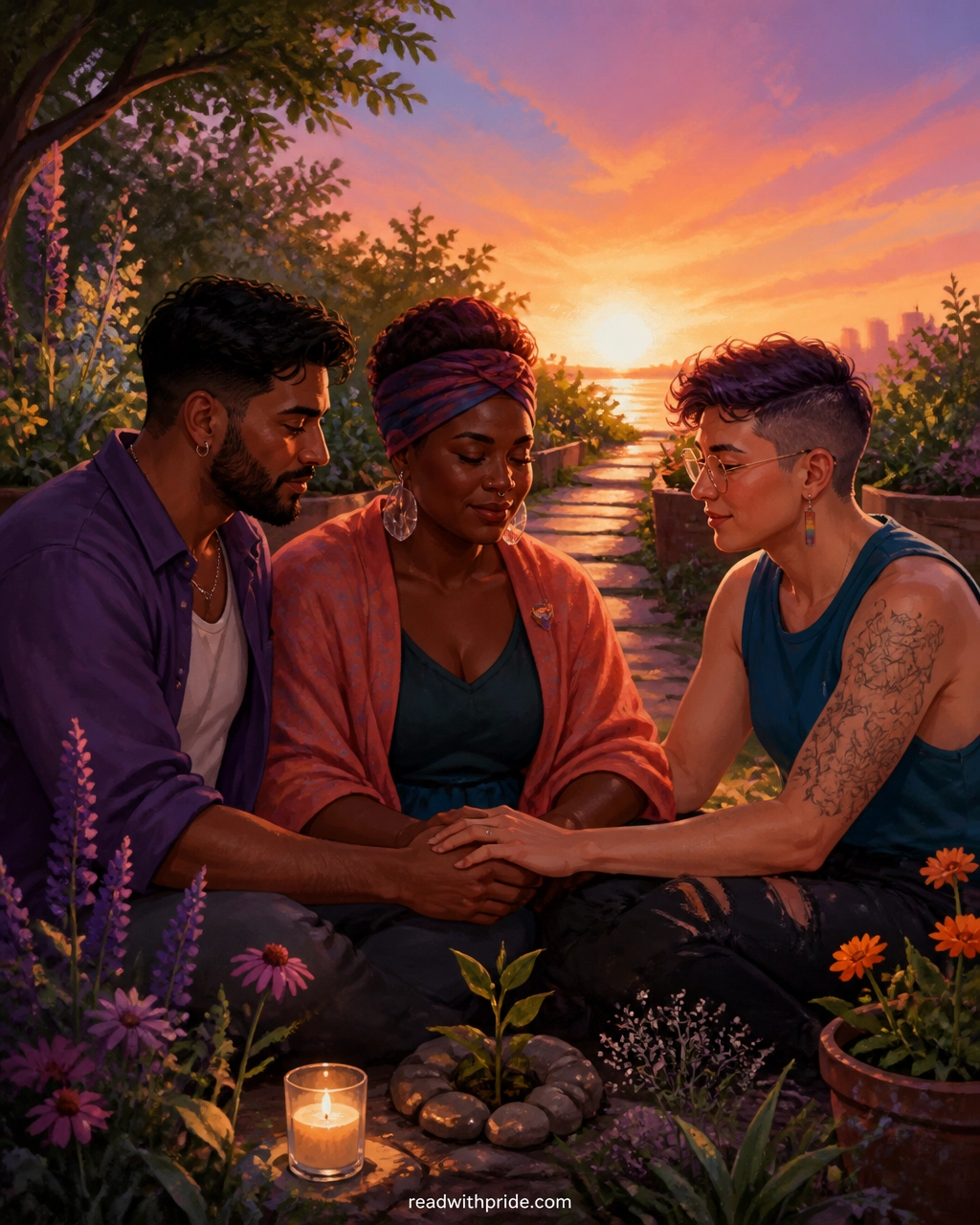
Queer Healing and Future Visions · 16:00 edition
Grief does not always arrive with a clear beginning, a tidy middle, and a satisfying conclusion. Sometimes it appears as a song you cannot listen to yet. Sometimes it is the message you still expect from someone’s old number. Sometimes it is the sudden realisation that you are mourning not only a person, but a home, a relationship, a version of yourself, or a future you once thought was guaranteed.
For LGBTQ+ people, grief can carry extra layers. We may be mourning lost community, family rejection, interrupted coming out stories, discrimination, illness, violence, or relationships that were never recognised as fully real by the people around us. We may be grieving queer spaces that have closed, friendships that changed, or years spent surviving instead of imagining what life could become.
That is why queer healing is not about “getting over it.” It is about learning how to carry what happened while making room for what might still be possible.
Queer grief is rarely just one thing
There is no single way to experience loss, and there is certainly no universal LGBTQ+ grief timetable. One person may need to talk constantly. Another may need silence, routine, or a few days of watching comfort television while ignoring every notification known to humankind.
Both are valid.
Queer grief can include the obvious losses: a partner, friend, family member, home, job, or community. It can also include less visible losses:
- The family relationship that became conditional after coming out.
- The childhood you might have had if you had felt safe sooner.
- The relationship that could not be acknowledged publicly.
- The community space that once made you feel visible and welcome.
- The imagined future that no longer fits.
- The energy spent explaining your identity to people committed to misunderstanding it.
These losses deserve care, even when other people do not know what to call them. Your grief does not need a courtroom, a panel of experts, or a signed permission slip to be real.
Sometimes healing begins with naming the loss honestly. Not dramatically. Not perfectly. Just honestly.
“I miss them.”
“That ended, and it hurt.”
“I am grieving the years I lost.”
“I thought my future would look different.”
There can be enormous relief in telling the truth without immediately trying to make it inspirational.

LGBTQ+ resilience is not the same as being unbreakable
Queer communities are often praised for resilience, and there is truth in that praise. We have created families, movements, art, language, celebrations, and entire worlds in circumstances that asked us to disappear.
But resilience should not become another demand placed on us.
You do not have to be endlessly strong to be resilient. You do not have to turn every painful experience into a lesson. You do not have to smile brightly enough to reassure everyone else that you are coping.
LGBTQ+ resilience can be quiet. It can look like asking a friend to come with you to an appointment. It can be setting a boundary with someone who keeps minimising your identity. It can be changing your name, starting therapy, taking your medication, eating something with actual nutritional value, or replying to one message instead of pretending you are fine to the entire internet.
It can also look like rest.
Rest is not laziness, and needing help is not failure. In fact, asking for help can be one of the most courageous ways to remain connected to yourself and your community.
For some people, healing may involve an LGBTQ+-affirming therapist or grief counsellor. For others, it may involve a support group, spiritual practice, art, journaling, music, movement, or simply sitting beside someone who does not need you to explain every detail.
There is no prize for suffering privately.
Chosen family can help us carry what feels too heavy
Chosen family is often discussed as though it is a replacement for biological family. Sometimes it is. Sometimes it is something more expansive: a network of people who recognise you, remember your history, respect your boundaries, and show up without requiring you to perform gratitude.
Chosen family may bring dinner. They may help with paperwork. They may sit quietly on the floor while you cry. They may remember the anniversary you did not mention. They may say, “Of course that mattered,” when someone else has decided it did not.
This kind of care is not small. It is infrastructure.
A queer book club can become part of that infrastructure too. Shared reading creates a gentle reason to gather, especially when direct conversation feels intimidating. You can discuss a character’s choices for forty minutes and accidentally talk about your own life for five. Honestly, that is often how emotional breakthroughs sneak in: wearing a fictional trench coat and pretending to be a discussion about chapter twelve.
A welcoming queer book club should make room for different levels of participation. Some readers may want to speak. Others may prefer to listen. Some may be out in every part of their life; others may need privacy. Content notes, flexible attendance, and respect for names and pronouns can help create a space where people feel safe enough to be present.
Stories matter here. Gay fiction, lesbian romance, LGBTQ+ novels, and queer love stories can give language to experiences we have struggled to describe. They can remind us that our lives are not only made up of crisis and survival. They contain tenderness, humour, desire, awkward first dates, second chances, complicated families, and the deeply radical experience of being loved without having to audition for it.
Books can offer a handrail, not an escape from reality
Reading cannot fix every loss. It should not have to.
But a story can offer companionship. It can give us a place to put feelings that are too tangled for ordinary conversation. It can show us a character choosing themselves, rebuilding trust, finding a new family, or falling in love after believing that chapter was over.
That is part of the power of MM romance books and gay romance novels. A satisfying romance does not erase pain, but it can insist that pain is not the only possible ending. The same is true of lesbian romance, bisexual stories, trans narratives, and wider LGBTQ+ fiction.
Some readers look for gentle comfort. Others want emotionally intense plots, messy relationships, or characters who make spectacularly questionable decisions before finally communicating like adults. There is room for all of it.
At Read with Pride, readers can browse a curated collection of LGBTQ+ ebooks, including fiction and romance titles across different moods, identities, and genres. Whether you are looking for heartfelt gay fiction, steamy MM romance, lesbian love stories, or a story about starting again, representation can be a form of recognition.
And recognition can be healing.

Future visions do not need to be enormous
When we are grieving, “the future” can sound like an unreasonable assignment. Five-year plans? Big dreams? Reinventing yourself? Please. Some days, getting through lunch is a perfectly respectable achievement.
Future visions do not need to be grand. They can begin with one small possibility:
- A home where your name is spoken with affection.
- A friendship that feels mutual and safe.
- A relationship where you do not have to shrink.
- A body you learn to inhabit with more gentleness.
- A community where older queer people are visible and valued.
- A creative project you are allowed to make badly at first.
- A morning that feels ordinary in the best possible way.
Hope is not denial. It does not require us to pretend that injustice has disappeared or that loss was somehow worthwhile. Hope can sit beside anger. It can share a room with sadness. It can be as simple as believing that your current pain is not the complete biography of your life.
Even a search term as mysterious as C Section 2026 can lead somewhere human: to a story, a question, a book, or a reader looking for proof that queer futures are worth imagining. Sometimes the path begins in a place we did not expect.
The future becomes more believable when we picture it together. We imagine queer elders resting in safe homes. We imagine young people growing up with affirming language from the beginning. We imagine families that do not treat love as a negotiation. We imagine community care as ordinary rather than emergency-only. We imagine joy that does not need to apologise for taking up space.
That is the work of future visions: not predicting exactly what will happen, but practising the belief that something kinder can exist.

Carrying grief without carrying it alone
Healing may loop back. A good day may be followed by a difficult one. You may feel ready to move forward and then find yourself missing someone intensely while buying toothpaste. This does not mean you are back at the beginning. It means grief is not a straight line, and neither are we.
Try asking yourself:
- What am I carrying today?
- What part of this loss needs to be acknowledged?
- Who helps me feel more like myself?
- What would make the next hour gentler?
- What future possibility can I allow myself to imagine?
You do not need to answer every question. You do not need to transform your grief into productivity. You only need to notice what is true and offer yourself the kind of care you would offer someone you love.
If grief feels overwhelming, unsafe, or impossible to manage alone, please reach out to someone you trust or seek support from an LGBTQ+-affirming mental health professional. Resources such as The Center’s guidance on community and loss and LGBTQ+ grief support resources from Eluna Network may also offer useful starting points. If you are in immediate danger, contact emergency services or a crisis service in your country.
You are not failing by needing support. You are still here, still becoming, still connected to futures that have not yet arrived.
For more reflections on queer healing, explore Read with Pride’s LGBTQ+ blog, including “Healing Isn’t Linear and Neither Are We” and “Turning Our Scars Into Seeds”.
When you are ready, explore LGBTQ+ fiction 2026 on Read with Pride. Find MM romance books, gay romance novels, coming out stories, lesbian romance, and queer love stories that honour where we have been while helping us imagine where we might go next.
#ReadWithPride #QueerHealing #FutureVisions #LGBTQResilience #MMRomanceBooks #GayRomanceNovels #LGBTQFiction2026 #QueerBookClub #QueerLoveStories #LGBTQBooks

Leave a Reply
You must be logged in to post a comment.