

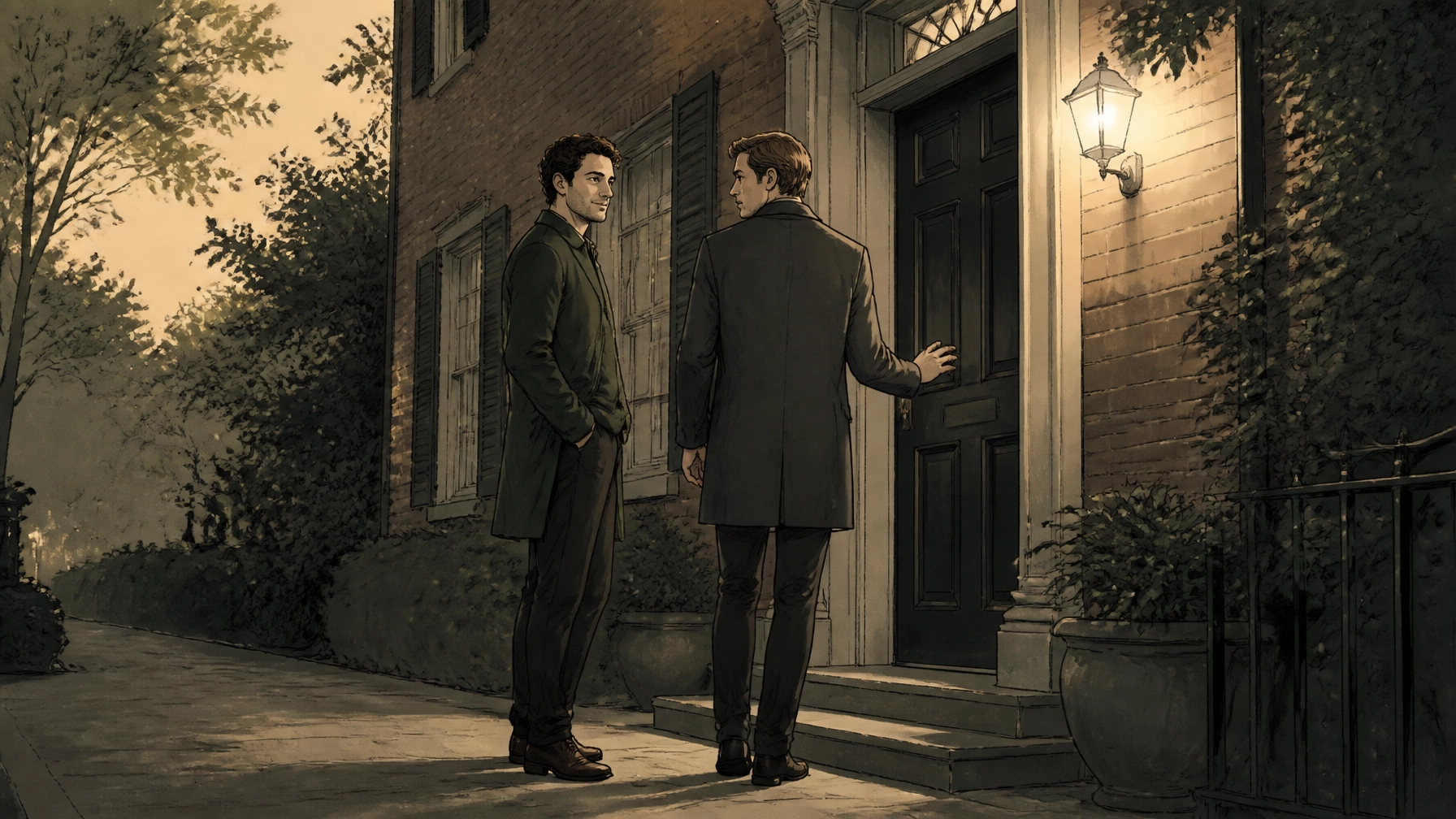
Elias chose the house because it still had the same blue door.
The paint had blistered around the letterbox. One of the brass numbers hung slightly crooked. The front window was full of the yellow-orange glow of a lamp, and behind the glass, the curtains moved whenever someone crossed the room.
It was strange how a place could remain so recognisable after everything else had changed.
Julian parked beneath a sycamore tree and turned off the engine.
For a while, neither of them moved.
The silence between them was not uncomfortable. They had grown good at quiet. Julian knew when Elias needed a question and when he needed the soft, unspoken company of someone who would not demand an explanation.
Still, Julian’s hand rested on the centre console, palm open.
Elias looked at it.
“You can say it,” Julian said.
“I haven’t said anything.”
“You’ve been staring at that door for seven minutes.”
“Have you been timing me?”
“I have been trying not to.”
That earned him the smallest smile. It appeared and disappeared quickly, but Julian felt it like a match struck in the dark.
The house belonged to Elias’s older brother, Adrian, now. Their father had died three years earlier, and the property had passed to the only person who had stayed. Adrian had never forgiven Elias for leaving. Or, more accurately, he had never forgiven him for leaving without explaining himself.
There were versions of the story that made Elias selfish.
There were versions that made him cruel.
There were versions in which he had simply been twenty-three, frightened, and determined not to disappear entirely.
None of those versions were easy to say aloud.
“I don’t want you to come in,” Elias said.
Julian’s fingers curled slightly against his knee.
The first instinct arrived before the second. It always did.
The first instinct was to ask who was going to be there, what Adrian had said, whether Elias wanted Julian to come inside and make sure the conversation stayed civil. The first instinct was a bright, sharp thing with its sleeves rolled up. It wanted facts. It wanted a plan. It wanted to stand between Elias and anything that might hurt him.
The second instinct was quieter.
Listen.
Julian looked at him. “Okay.”
Elias turned towards the window. “I mean it.”
“I know.”
“If I ask you to come in, that’ll be different. But I don’t want you deciding that I’ve changed my mind because it gets difficult.”
“I won’t.”
“And if you hear shouting: ”
“I’ll stay outside.”
Julian said it carefully, because he could feel the weight of the promise.
Elias looked at him then. His eyes were guarded, but not closed. “Even if you think I need you?”
“I’ll be here.”
“That’s not what I asked.”
Julian took a breath.
“Even if I think you need me,” he said. “I’ll wait until you ask.”
Something shifted in Elias’s face. Not relief exactly. Relief was too simple a word for it. This was closer to recognition: the startled understanding that someone had heard the whole request, including the part Elias usually swallowed.
Julian had once believed love meant noticing danger before the other person did.
He had thought care was measured by speed: how quickly he could intervene, how efficiently he could solve, how completely he could remove the threat.
Elias had taught him that sometimes a person needed to walk towards the difficult thing with their own feet.
Not because they wanted to be alone.
Because they wanted to know they could still move.
“I’ll text you when I’m done,” Elias said.
“You don’t have to.”
“I want to.”
“Then text me.”
“And don’t send twelve question marks if I take too long.”
“I have never sent twelve question marks.”
“You sent four.”
“That was an emergency.”
“It was forty minutes.”
“You were in the supermarket.”
“You didn’t know that.”
“I suspected.”
This time, Elias’s smile stayed.
He reached for the door handle, then stopped. His shoulders lifted with a slow, restrained breath.
Julian wanted to touch him. He wanted to take Elias’s hand and press his mouth to the knuckles. He wanted to say that Adrian did not deserve the version of Elias who had spent years making himself small enough to be tolerated.
But the moment did not belong to Julian’s anger.
It belonged to Elias.
So Julian only said, “You know where I am.”
Elias nodded and opened the door.
The evening air entered the car, cool and damp. Somewhere beyond the houses, traffic moved along the main road. A dog barked once and then fell silent.
Elias stepped onto the pavement.
He looked back through the open door. “You’ll stay here?”
“Right here.”
“Not around the corner?”
“Right here.”
“Not in the doorway?”
Julian lifted both hands. “I understand the assignment.”
Elias studied him for another second. Then he crossed the narrow path to the blue door.
Julian watched him climb the steps.
He watched Elias raise his hand.
He watched him knock.
The door opened almost immediately.
Adrian stood there in a grey jumper, older than Julian remembered from photographs and somehow exactly as Elias had described him: broad across the shoulders, tired around the eyes, with a way of looking at people that made them feel as if they had arrived carrying an accusation.
Adrian said something Julian could not hear.
Elias answered.
Then the door opened wider, and Elias went inside.
It closed behind him.
Julian stayed in the car.
For the first ten minutes, he managed.
He looked at the dashboard clock. He checked his phone. He read the same message from work three times without understanding it. He watched a cyclist pass under the sycamore tree with a red light blinking beneath the seat.
At twelve minutes, he imagined Elias standing in the hallway while Adrian spoke over him.
At fifteen, he imagined the opposite: Elias saying nothing at all, his silence mistaken for surrender.
At twenty, Julian was outside the car.
He had not decided to leave it. His body had simply carried him to the pavement before his mind caught up.
The blue door was fifteen steps away.
Fifteen steps was nothing.
Fifteen steps was enough to change the meaning of the entire evening.
Julian stopped beside the car.
He could go up there. He could knock once. He could tell Adrian that Elias had not come to be cross-examined. He could make the conversation about himself, about the man Elias loved, about the life they had built together.
He could rescue Elias from the possibility of being misunderstood.
He could also take away the chance for Elias to speak without being protected by Julian’s voice.
Julian put his hands in his coat pockets.
The old impulse paced inside him, restless and furious. It told him that waiting was passive. It told him that love should be louder. It told him that if he remained outside, he was failing.
Then he remembered Elias in the car, asking, Even if you think I need you?
Julian sat down on the low wall beneath the front window.
He sent one message.
I’m here. No rush.
He did not add a question.
He did not write Are you okay?
He did not write Do you want me to come in?
He put his phone away.
The minutes passed differently after that.
A light came on in the upstairs window. Then it went off. A car pulled into the neighbouring drive. Rain began as a fine mist, barely enough to darken the pavement.
Julian moved beneath the small porch awning. He found two paper cups in the car and walked to the corner shop, returning with tea he knew Elias might not drink. He held one cup between his hands and watched the blue door.
He thought about how many kinds of waiting existed.
There was waiting that meant abandonment.
There was waiting that meant punishment.
There was waiting that meant uncertainty, the suspended ache of not knowing whether someone would return.
And then there was this.
A promise with a location.
A body kept faithfully in one place.
At half past eight, his phone buzzed.
Coming out.
Julian stood before he could think better of it.
The door opened.
Elias stepped onto the porch, his face pale beneath the yellow light. He looked exhausted. His hair had fallen forward, and one sleeve was pushed up his forearm as if he had needed to move freely while speaking.
Adrian remained inside.
For a moment, he and Julian saw each other through the open doorway.
Adrian’s expression changed: not softened, exactly, but settled into something less certain. Then he looked at Elias.
“Next week?” he asked.
Elias glanced over his shoulder.
“Maybe,” he said.
The door closed.
Elias came down the steps.
Julian did not move towards him until Elias crossed the last stretch of pavement. Even then, he waited.
Elias stopped in front of him.
“You stayed,” he said.
“I said I would.”
“I thought you might decide the promise was less important than your worry.”
Julian looked at the tea in his hand. “I worried very impressively.”
“Did you?”
“Quietly.”
“That must have been difficult.”
“It was terrible.”
Elias gave a tired laugh. Then the laugh broke apart, and his face folded in on itself.
Julian set the tea on the wall.
Elias stepped forward.
The embrace was not dramatic. There was no desperate collision, no sweeping relief. Elias simply leaned into him, forehead against Julian’s shoulder, and Julian wrapped both arms around him.
He held Elias without asking what had happened.
For now, that was the thing Elias needed.
After a while, Elias said, “I told him I left because I couldn’t keep pretending I was fine.”
Julian rested his cheek against Elias’s hair.
“I told him I was in love with a man,” Elias continued. “Not you specifically. I wasn’t ready to give him your name. But I told him there was someone. Someone who knew me.”
Julian closed his eyes.
“And?” he asked.
“And he said he should have known.”
The words were quiet.
“He said he thought I was angry with him. I told him I was. I was angry with everyone. But mostly I was scared that if I stayed, I’d become someone I didn’t recognise.”
Julian’s hand moved slowly over Elias’s back.
“Did you tell him that?”
“Some of it.”
“That sounds like a lot.”
“It felt like breaking a bone and then having to explain the shape of it.”
Julian pulled back just enough to look at him.
Elias’s eyes were wet, but he was smiling now. Not happily. Honestly.
“I didn’t need you in there,” he said.
“I know.”
“I needed you outside.”
Julian nodded. “I know that now.”
Elias lifted one hand and touched the front of Julian’s coat. “You being there changed everything.”
“I didn’t do anything.”
“You waited.”
The rain gathered in the dark strands of Elias’s hair. Julian brushed one away from his forehead.
“I can do that,” he said.
“I know.”
Elias leaned forward until their foreheads touched.
Behind them, the blue door remained closed. The past was still inside the house, complicated and unfinished. Nothing had been neatly repaired. Adrian had not transformed into a different man. Elias had not become fearless.
But he had gone in alone.
And Julian had stayed exactly where he had been asked to stay.
Sometimes love was the hand that reached for you.
Sometimes it was the hand that remained open, close enough to find, but never closing around you without permission.
Elias took Julian’s hand as they walked back to the car.
This time, Julian did not lead.
He walked beside him.
Read with Pride: Stories About Love That Make Room for the Whole Self
The most affecting MM romance is not always found in grand gestures. Sometimes it lives in a parked car, a difficult doorway, or the quiet decision to respect what a partner has asked for.
This gay love story emotional journey between Julian and Elias is about more than a difficult family conversation. It is about trust, identity, boundaries, and the kind of intimacy that allows two men to remain fully themselves while still choosing one another. Their relationship belongs to the tender, thoughtful tradition of character-driven queer fiction, where emotional change matters as much as plot.
For emotionally invested MM readers, stories like this offer something beyond a simple romantic resolution. They explore how love is built through attention: remembering what someone has said, resisting the urge to take control, and learning that support can mean staying close without stepping in.
If you enjoy emotional MM romance literary fiction, heartfelt gay fiction, and gay love stories shaped by authentic internal struggles, you can discover more reading with Read with Pride. Explore Dick Ferguson’s MM romance and LGBTQ+ ebooks for emotionally immersive stories about men navigating love, vulnerability, resilience, and the complicated roads that lead them home.
Three Possible Next 6 PM Stories
-
The Morning Julian Found Elias’s Name Still Written on the Old Apartment Wall
Elias returns to the neighbourhood where he first learned to disappear, but Julian notices that leaving a mark can be an act of survival. -
The Night Elias Asked Julian Not to Make the Bed
After an argument leaves them sleeping in separate rooms, Elias struggles to explain why disorder feels safer than pretending everything is fine. -
The Afternoon Julian Met the Man Elias Used to Be Friends With
A chance encounter forces Elias to decide whether he wants an apology, an explanation, or simply the freedom to walk away without either.
Follow Us on Social Media
Follow us for more queer experiences and stories, emotionally driven MM romance, gay fiction, LGBTQ+ reading recommendations, and new instalments in the Julian and Elias arc:
#QueerExperiencesAndStories #MMRomance #GayRomance #QueerFiction #GayFiction #MMNovels #LGBTQFiction #GayLoveStories #EmotionalMMBooks #HeartfeltGayFiction #CharacterDrivenRomance #GayRomanceBooks #MMRomanceBooks #ReadingWithPride #ReadWithPride


Leave a Reply
You must be logged in to post a comment.